Heart Redwood vs Sap Redwood: Durability Differences
Heart Redwood is the durable choice for exposed outdoor work; Sap Redwood is far less decay-resistant and should be used only where it stays dry. Use the wrong grade, and rot starts sooner at cut ends, fasteners, and any spot that traps moisture. This guide shows where heartwood earns its price, when sapwood is acceptable, and how mixed boards fail in fences, decking, siding, and raised beds.
| Decision factor | Heart Redwood | Sap Redwood | Winner |
|---|---|---|---|
| Decay and insect resistance | Contains the extractives that give redwood its built-in outdoor resistance. | Lacks that built-in resistance. | Heart Redwood |
| Soil contact | Better fit for on-or-near-soil use when the grade is intended for it. | Not recommended on or near the soil. | Heart Redwood |
| Above-ground appearance work | Available in clear architectural grades and garden grades, depending on the job. | Best for above-ground applications where dry service is expected. | Tie |
| Fastener-zone and cut-end tolerance | More forgiving where holes, cuts, and splash exposure happen. | More vulnerable at cut ends and around hardware. | Heart Redwood |
| Purchase efficiency for dry exterior work | Worth paying for when exposure is high. | Usually the cheaper fit when boards stay elevated and dry. | Sap Redwood |
Why heartwood holds up better outdoors
Heart Redwood comes from the inner wood of the tree and is the reddish-brown portion that contains decay- and insect-resistant extractives. Sap Redwood is the cream-colored outer growth layer and lacks that built-in resistance, so it belongs in drier, above-ground service. The color difference helps, but it is only a clue.
Why the color difference matters outdoors
Color tracks more than appearance here. Heartwood usually holds up better because its chemistry resists decay and insect attack, while sapwood depends far more on dry conditions and careful detailing. A board with a broad band of pale outer wood becomes a weaker choice once rain, splash, and trapped moisture enter the picture.
What the natural resistance difference means
For outdoor work, exposure matters more than species name alone. Heart Redwood is the safer choice where lumber may sit near soil, catch splashback, or see repeated wetting at end grain. Sap Redwood can still work when it stays elevated and protected, but it does not provide the same margin for abuse.
Why durability depends on placement
Durability changes with location. A board under a roof overhang faces a very different service condition than a fence picket a few inches above damp soil. The same redwood can last acceptably in one place and fail early in another.
Soil contact and splash zones
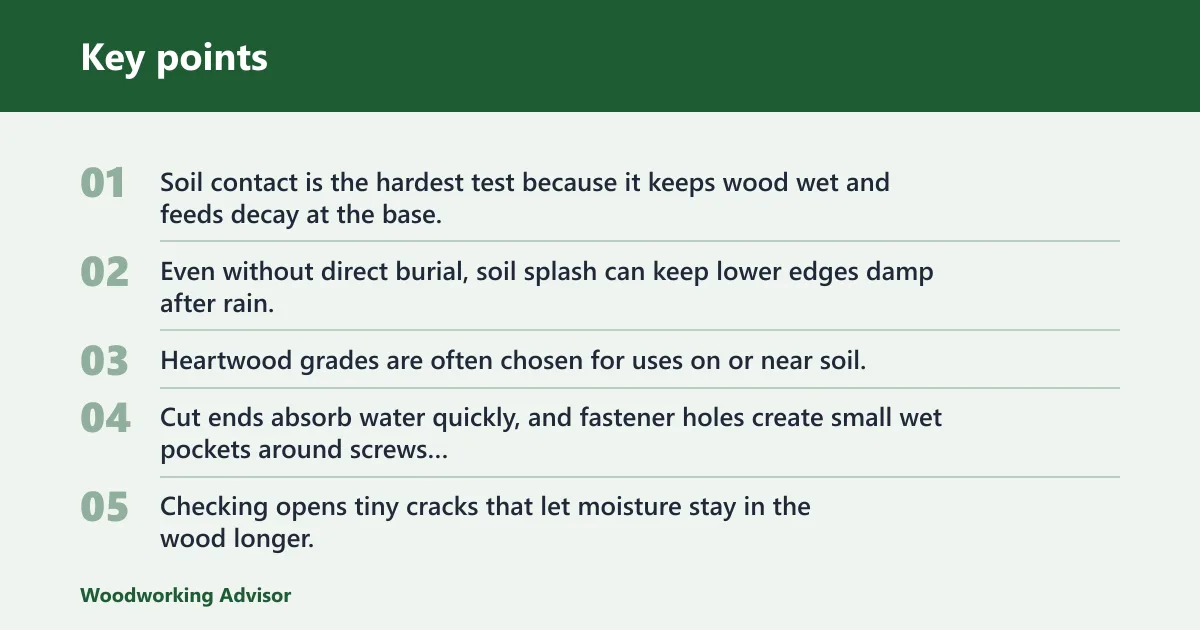
Soil contact is the hardest test because it keeps wood wet and feeds decay at the base. Even without direct burial, soil splash can keep lower edges damp after rain, so the bottom of a fence, post, or raised bed usually fails sooner than the face. Heartwood grades are often chosen for uses on or near soil; sapwood grades are not recommended there.
Fastener holes, cut ends, and checking
Cut ends absorb water quickly, and fastener holes create small wet pockets around screws and nails. Checking opens tiny cracks that let moisture stay in the wood longer, especially on boards that dry fast after rain. Those spots are often where mixed boards fail first, even when the face still looks sound.
Where sapwood can still work
Sap Redwood can be a practical choice for trim, siding, fence components above grade, and other parts that stay dry and get regular airflow. Seal cut ends, keep the piece off the soil, and detail it so water sheds away fast. Do not treat that as a ground-contact fix.
Which redwood grades should you buy?
Pick the grade by exposure first, then by appearance. Redwood grading uses criteria from the Redwood Inspection Service, and the grade reflects both durability and appearance, so the same species can be sold for very different jobs. That is why one board may fit a fence post while another belongs on siding.
Construction Heart for fences, posts, and decks
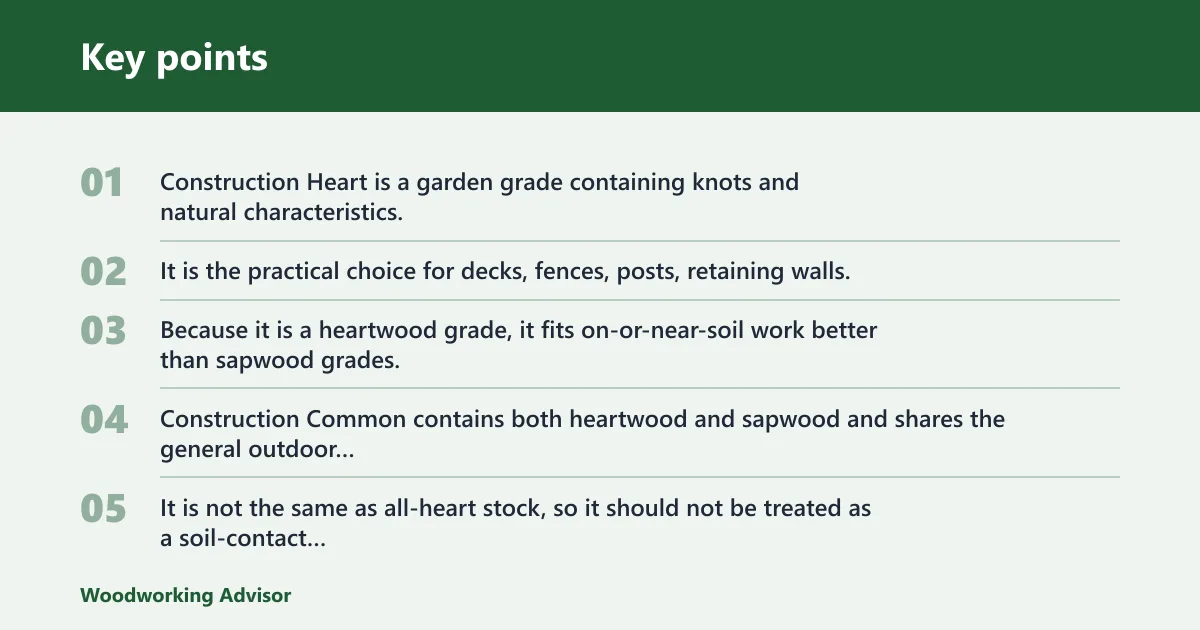
Construction Heart is a garden grade containing knots and natural characteristics. It is the practical choice for decks, fences, posts, retaining walls, and garden structures where outdoor durability matters more than a flawless face. Because it is a heartwood grade, it fits on-or-near-soil work better than sapwood grades.
Construction Common for above-ground boards
Construction Common contains both heartwood and sapwood and shares the general outdoor character of Construction Heart, but it is better suited to above-ground deck and fence boards. It is not the same as all-heart stock, so it should not be treated as a soil-contact grade. Use it where the lumber stays dry enough to justify the mix.
Heart Clear and Clear for finish work
Heart Clear is the finest architectural heartwood grade commercially available. It is the right call for siding, trim, cabinetry, and millwork when you want a cleaner face and the performance of heartwood. Clear redwood is the finest architectural sapwood grade; it contains sapwood, so it suits above-ground applications rather than soil exposure.
Deck Heart for structural deck lumber
Deck Heart is an all-heartwood grade and is graded for strength. It comes in 2×4 and 2×6 only, which makes it a structural deck and exterior framing option rather than a finish-grade substitute. If a deck needs long service and stronger material selection, this is the grade to look for, along with a check of local code and grade stamp requirements before use.
Redwood grades and uses
| Grade | Wood type | Typical use | Best exposure | Do not use |
|---|---|---|---|---|
| Construction Heart | Heartwood | Decks, fences, posts, retaining walls, garden structures | On or near soil | Do not choose it as a finish-grade substitute when you need a clear, defect-free face. |
| Construction Common | Mixed heartwood and sapwood | Above-ground deck and fence boards | Above ground | Do not use it where soil contact or persistent splashback is expected. |
| Heart Clear | Heartwood | Siding, trim, cabinetry, millwork | Above ground, visible finish work | Do not buy it as a cheaper structural alternative when knots are acceptable. |
| Clear | Sapwood | Above-ground applications | Dry exterior or interior use | Do not use it where the base will sit on soil or stay damp. |
| Deck Heart | All heartwood | Deck framing, fences, posts | Structural outdoor use | Do not expect sizes outside 2×4 and 2×6. |
How to spot sapwood in the yard
Start with color, but do not stop there. Fresh Heart Redwood usually shows a deeper reddish-brown tone, while Sap Redwood is lighter and cream-colored. The more useful test is how uniform the face and edge look.
Color cues on fresh boards
Look for a board that stays mostly reddish-brown across the face and edges if you want an all-heart option. A board with a broad pale margin, a pale corner, or a mostly light face contains more sapwood. If the seller is sorting stacks by grade, ask which side is heartwood-heavy before you load up.
Mixed faces and edge grain
Mixed boards often show a heartwood face with sapwood on one edge, or the reverse. That matters because the pale portion can take up moisture faster and may crack or stain sooner around fasteners. A quick edge inspection catches problems that a front-on glance can miss.
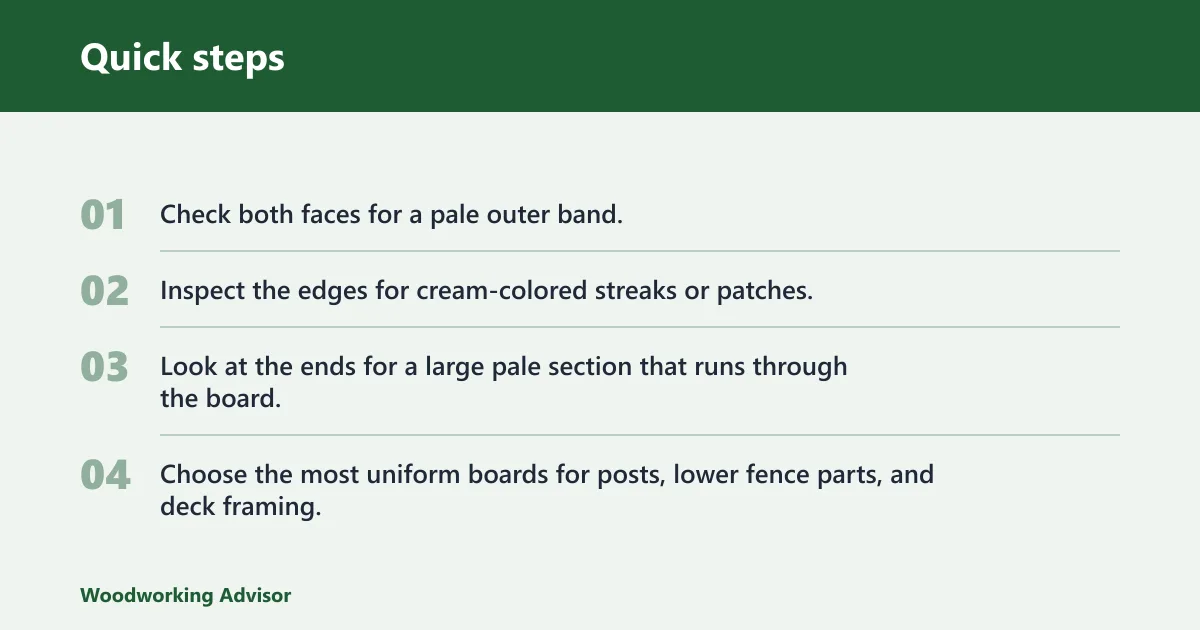
- Check both faces for a pale outer band.
- Inspect the edges for cream-colored streaks or patches.
- Look at the ends for a large pale section that runs through the board.
- Choose the most uniform boards for posts, lower fence parts, and deck framing.
What to check before you buy
Ask the yard to separate boards by grade and look for cut ends that already show a high sapwood share. A common first-timer mistake is buying by face color alone, then discovering pale edges after the boards are trimmed to length. That is where the mixed-board risk usually becomes obvious.
Say your 2×6 deck boards look mostly red on the face, but one edge is pale on half the stack. Those boards can still work above ground, but the pale edge should not be the part you expect to tolerate wet hardware or repeated splash. Pick the more uniform boards for the most exposed locations.
When mixed boards fail first
Mixed boards do not usually fail everywhere at once. They tend to fail at the weakest exposure point: cut ends, fasteners, and damp lower edges. The heartwood side may still look fine while the sapwood side starts to check or darken.
Cut ends and field cuts
Every new cut opens end grain, and end grain tends to absorb water readily. On a mixed board, the sapwood portion at the end can soften first, then decay starts at the newly exposed surface. That is why field cuts on fencing and decking deserve immediate sealing and why end-grain trim needs close inspection.
Wet hardware zones
Screws, nails, and brackets trap moisture around their holes, especially where the board moves through wet-dry cycles. Sapwood around a fastener zone is more likely to stain, check, and decay first, while heartwood offers more tolerance. This matters most on lower fence rails, stair stringers, and deck framing near splash.
Ground-contact mistakes
If a mixed board is placed where the bottom edge sits on damp soil or a planter base, the sapwood side becomes the weak link. The failure often starts at the bottom few inches, then spreads upward as checking and moisture cycling continue. That is why grade choice should match placement, not just the species name.
Suppose a raised bed uses 1×6 redwood boards with one pale edge facing down into the gravel base. The board may look fine for a while, then the lower edge softens first where water collects after irrigation. A heartwood grade would be the safer buy there.
Should you pay more for all-heart redwood?
Pay for all-heart redwood when the project will see wetting, splashback, or hard-to-replace failure. The extra cost makes the most sense on posts, lower fence runs, deck framing, and any part that sits close to soil. Where the piece is high, dry, and easy to replace, sapwood can be the smarter buy.
Best buys for long service life
For long service life, choose Construction Heart or Deck Heart where structure matters and moisture is hard to avoid. Choose Heart Clear when the piece must look clean and still needs heartwood performance. Those are the options that fit exposure first.
Where appearance can drive the choice
If the lumber will stay above ground and the main goal is a cleaner face, Clear can be a good value. It gives the fine-appearance route without paying for heartwood where the job does not need it. That is useful for trim, siding, and other visible work that stays dry.
When sapwood is an acceptable tradeoff
Sap Redwood is acceptable when the board will remain above ground, shed water, and dry quickly between storms. It can also work when the project is enclosed or protected and the cut ends are detailed carefully. It is not a substitute for heartwood where repeated wetting is part of the job.
Choose Heart Redwood if…
Choose Heart Redwood if the board will touch soil, sit near the ground, or face repeated wetting around fasteners and cut ends. It is the safer pick for fence posts, lower fence parts, decks, retaining walls, and other outdoor details where durability matters more than a lower purchase price.
Choose Sap Redwood if the piece stays above ground, gets good airflow, and can be kept dry with proper detailing. It works best for trim, siding, and fence or deck boards that do not belong in damp soil or splash zones. For visible finish work, sapwood can be acceptable when exposure is low.

Frequently asked questions
What is the difference between heart redwood and sap redwood?
Heartwood is the inner reddish-brown wood that often contains decay- and insect-resistant extractives. Sap Redwood is the lighter outer growth layer and lacks that built-in resistance. For outdoor use, that difference matters most where the wood gets wet, touches soil, or sits near fasteners and cut ends.
Is heart redwood more durable than sap redwood?
Yes. Heart Redwood is more durable because it has natural resistance that Sap Redwood does not have. That advantage matters most in places with splashback, soil contact, or repeated wetting. Sapwood can still be used outdoors, but only where the service conditions stay dry enough to protect it.
Can sap redwood be used for outdoor projects?
Yes, but only for above-ground use where it can dry well. Sap Redwood is a better fit for trim, siding, and fence or deck boards that stay away from soil. It is not recommended on or near the soil, and it should not be treated as a ground-contact solution.
Which redwood grade should I buy for fencing or decking?
For fences and decks, Construction Heart is the practical all-purpose choice when durability matters. Deck Heart is the structural all-heart option and comes in 2×4 and 2×6 only. Construction Common can work for above-ground boards, but it is not the same as a heartwood grade for soil-adjacent parts.
Does redwood heartwood need to be on or near the soil to last longer?
No. Heartwood does not need soil contact to last longer; it lasts better because of its natural resistance. The point is that heartwood is the better option when soil contact or near-soil exposure exists. Above ground, it still outperforms sapwood, but the placement advantage remains the same.
How can I tell if redwood lumber contains sapwood?
Look for cream-colored outer bands, pale edges, or mixed faces on the board. A board that shows both reddish-brown and pale wood usually contains sapwood. Check the cut ends too, because they often reveal more than the face does, especially on mixed-grade lumber.
What redwood grades are rated for ground contact?
Heartwood grades are intended for uses on or near soil. That includes grades such as Construction Heart and Deck Heart when the application calls for it. Sapwood grades are not recommended on or near the soil, so they should stay in above-ground service instead.
Why does some redwood last longer than other redwood?
Some redwood lasts longer because grade, wood type, and placement all change how much moisture the board sees. Heartwood has more natural resistance than sapwood, and grades with more heartwood are better suited to hard outdoor exposure. Cut ends, fasteners, and damp lower edges usually decide which board fails first.
Sponsored / affiliate links. As an Amazon Associate I earn from qualifying purchases. I may earn additional commission from eligible campaigns.