Best Metal Fence Brackets for Wood Posts (2026): Research Shows
The best metal fence brackets for wood posts are heavy-gauge, exterior-rated brackets that match your rail size, with at least two corrosion-resistant fasteners per connection and stainless or hot-dip galvanized hardware in wet or coastal areas. Wrong brackets loosen rails, invite rust, and can warp or split posts. This guide shows how to choose by connection type, corrosion exposure, and post-and-rail compatibility.
This guide is part of our Woodworking fasteners and project basics series.
Quick comparison
| Product | Badge | Best for | Price | ||
|---|---|---|---|---|---|
 |
UFAGFDA Heavy Duty 304 Stainless Steel Post Base BracketUFAGFDA | Our pick | 304 stainless · post base · wood/metal | $223.76
Price as of 15 Oct 2026
|
View |
 |
Toscoco 50 Pcs Heavy Duty ADC-12 Aluminum Deck Railingtoscoco | Also great | ADC-12 aluminum · 2×4 rail · 50 pcs | $85.48
Price as of 15 Oct 2026
|
View |
 |
SupConn 2-3/8"Steel to Wood Fence Brackets,12Pcs MetalSupConn | Also great | Hot-dip galvanized · 2-3/8" · 12 pcs | $39.99
Price as of 15 Oct 2026
|
View |
 |
50PCS 2×4 Fence Brackets – Black Powder Coated 18 Gauge 2×4Fadachai | Budget pick | 2×4 steel · black coated · 50 pcs | $42.99
Price as of 15 Oct 2026
|
View |
The main trade-off is straightforward: hot-dip galvanized steel fits most backyard fence work, stainless steel is the safer pick where moisture stays high, and powder-coated steel suits tighter budgets when long-term corrosion resistance matters less. Fit still matters more than finish, because a bracket that matches the post and rail can still fail if its shape or fasteners are wrong.
For comparison shopping, start with connection type, coating, and actual lumber size, then check the brand. A bracket that looks heavy-duty can still miss a 2×4 rail or a 4×4 nominal post if the hole pattern, offset, or inside width does not match the build.
How we chose
We compared brackets by four checks: corrosion resistance in the intended environment, fit with common post and rail sizes, bracket shape for the connection type, and fastener compatibility with pressure-treated lumber. We also looked for whether the design can tolerate racking, wind load, and gate-adjacent stress without relying on light-gauge metal or undersized screws.
Total installed cost matters too. A cheaper bracket can become the expensive option once you add exterior screws, washers, drill bits, replacement brackets, and the labor of fixing loosened holes or rusted hardware.
UFAGFDA heavy duty 304 stainless steel post base bracket: best for wet, high-maintenance sites
This is the safest style for posts that stay exposed to moisture, splashback, or coastal air, especially when the connection supports the post base rather than a light fence tie-in. Based on the published specs, the 304 stainless steel construction and adjustable range make it the most corrosion-tolerant choice in this set.
The flange-style geometry helps keep a post aligned under load, which matters when movement risk is higher near a gate or a low section that takes more side force. The drawback is cost. Stainless usually costs more up front, and a base-style bracket is not the right answer for every rail-to-post connection, so you still need to confirm the geometry before buying.
Toscoco 50 pcs heavy duty ADC-12 aluminum deck railing brackets: best for 2×4 rail runs
This set suits repeated 2×4 rail-to-post connections where you want a large quantity of matching brackets and included screws. The published details point to a rail-specific connector with an easy-install layout, which helps on long fence runs that share the same size and angle.
Its main strength is consistency across many connections, not heavy structural duty. The drawback is that rail connectors like this are less flexible than a more adjustable steel angle or offset bracket, and aluminum hardware may not be the first choice where the connection sees high gate-adjacent load or frequent impact.
SupConn 2-3/8 steel to wood fence brackets: best for angled steel-to-wood connections
This is the most purpose-built option for attaching wood fence members to a 2-3/8-inch steel post, especially where you need the bracket to work at 90 degrees, 45 degrees, or another angle. The hot-dip galvanized finish is the key value here, because steel-to-wood interfaces are often exposed to more movement and more corrosion risk than wood-to-wood joints.
The drawback is specificity. It is a strong fit for its intended post size and connection type, but that also means you need to verify post diameter and alignment before ordering. In a high-moisture area, you should still pair it with compatible exterior fasteners and treated-lumber-safe screws.
Fadachai 50 pcs 2×4 black powder coated brackets: best for dry-budget builds
This is a practical pick for standard 2×4 rail connections where you want a low per-bracket cost and a pre-drilled layout. The 18-gauge steel and powder-coated finish give it a cleaner appearance and weather resistance suitable for many dry or mildly exposed installations.
The drawback is finish damage. Powder coating can chip during installation or from impact, and once the coating is broken, touch-up becomes part of maintenance. In wet soil splash zones, snow-melt areas, or coastal salt air, it is usually a weaker long-term option than hot-dip galvanized or stainless hardware.
Galvanized steel brackets: best for most fences
Hot-dip galvanized steel brackets are the best all-around choice for typical backyard fencing because they balance cost, corrosion resistance, and availability. Electro-galvanized brackets can be fine in drier settings, but hot-dip galvanized coating is thicker and usually holds up better when treated lumber, rain, and seasonal wetting are part of the job.
Hot-dip versus electro-galvanized
Hot-dip galvanized steel is the safer pick for treated lumber contact, wet soil splashback, snow, and freeze-thaw cycles. Electro-galvanized coatings are thinner and more vulnerable once the surface is scratched or the bracket sits in a persistently damp area. If the fence line stays dry and shaded only part of the year, electro-galvanized may still work, but it has less margin for error.
Where galvanized steel falls short
Galvanized brackets are not immune to corrosion, and cut edges, scratched holes, and contact with wet treated lumber can become trouble spots over time. They are also less attractive than coated decorative hardware, and light-gauge versions can twist when a span racks under wind or when a gate opening pulls the frame out of square.
Best fasteners for galvanized brackets
Use exterior-rated structural screws or exterior deck screws that match the bracket coating and are approved for treated lumber. A common starting point is #9 or #10 screws, long enough to bite solid wood without punching through thin members; many fence joints use about 1 1/2-inch to 2 1/2-inch screws, depending on bracket thickness and wood size. Add washers when the hole pattern or slotted holes call for more bearing area.
Stainless steel brackets: best for wet or coastal sites
Stainless steel brackets are the best choice when rust resistance matters more than initial price. They are worth the premium in coastal salt air, persistent humidity, wet soil zones, and places where a fence connection is hard to inspect or replace after installation.
Choose stainless when the bracket will stay exposed to salt, standing moisture, or repeated wetting from irrigation, runoff, or snow melt. Stainless is also smart around pressure-treated lumber because it reduces the maintenance risk of stained fasteners, rust streaks, and early coating failure.
Fastener matching for stainless hardware
Match stainless brackets with stainless fasteners when possible. Mixing stainless with lower-grade screws can leave the screws as the weak point, especially where water sits in the hole pattern or around washers. Use exterior-rated screws, and keep pilot holes clean so the threads do not bind and strip under torque.
Limits in high-load fence sections
Stainless solves corrosion, not poor sizing. A thin stainless bracket can still twist if it is placed in a windy span or near a gate where racking forces are higher. If the section is structurally demanding, choose heavier gauge stainless or move to a bracket shape that resists rotation, such as a well-braced flange or offset design.
Powder-coated steel brackets: best for dry budgets
Powder-coated steel brackets make sense when you want a lower upfront cost and the fence is not living in a harsh corrosion zone. The coating improves appearance and slows weathering, but the steel underneath still needs protection, so the finish matters most when it stays intact.
Finish durability and chip risk
Powder coating resists ordinary weather, but chips from tool slips, clamp jaws, or overdriven screws can expose bare steel. That damage is often local at first, then spreads if moisture reaches the edge. Handle the parts carefully during installation and touch up any exposed metal promptly.
UV and weather exposure
UV exposure can dull the coating over time, while freeze-thaw and trapped moisture can stress fastener holes. Powder-coated brackets are best when the fence gets normal rain and sun, not constant splash, road salt, or heavy soil contact.
Touch-up and maintenance needs
Plan on occasional inspection. If the coating chips, clean the area and cover exposed steel with a compatible metal touch-up product. That maintenance is less demanding than replacing rusted hardware, but it is still part of the total cost of choosing powder-coated steel.
Fence bracket decision matrix
Use this table to match bracket material, shape, and fasteners to the actual job. A yes recommendation means the combination is a safe first choice when the listed conditions are true; no means it is a poor fit or too risky for that scenario.
| Post type | Rail size | Environment | Load condition | Safest bracket material | Best shape | Fastener choice | Yes / no |
|---|---|---|---|---|---|---|---|
| 4×4 nominal wood post | 2×4 rail | Dry suburban yard | Standard fence span | Hot-dip galvanized steel | L-bracket or angle bracket | Exterior #9 or #10 screws, 1 1/2–2 1/2 inches, washer if slotted | Yes |
| 4×4 nominal wood post | 2×4 rail | Wet soil splash zone | Standard fence span | Stainless steel | Angle or offset bracket | Stainless exterior screws, predrilled, with washers | Yes |
| Round steel post | 2×4 rail | Coastal salt air | High wind exposure | Stainless steel | Steel-to-wood wrap or offset bracket | Stainless screws and bolts sized to the bracket hole pattern | Yes |
| 4×4 nominal wood post | 2×4 rail | Snow and ice exposure | Gate-adjacent stress | Hot-dip galvanized or stainless | Heavy angle or offset bracket | Exterior structural screws, extra pilot care, washers where needed | Yes |
| Softwood post, wet zone | 2×4 rail | Freeze-thaw and frequent wetting | High racking load | Stainless steel | Reinforced offset bracket | Stainless screws with adequate thread engagement | Yes |
| Undersized or split post | 2×4 rail | Any outdoor exposure | Windy or gate-adjacent | None until post is repaired | None | Repair post first | No |
| 4×4 nominal wood post | 2×4 rail | Dry yard | Light decorative infill only | Powder-coated steel | Flat strap or light angle bracket | Exterior screws with pilot holes | Yes |
| 4×4 nominal wood post | 2×6 rail | Wet or coastal | Gate-adjacent stress | Stainless steel | Heavy offset bracket | Stainless structural screws or bolts | Yes |
What bracket fits your fence?
The right bracket depends on the actual post and rail dimensions, not the nominal lumber label alone. For 4×4 posts, the finished size is usually about 3 1/2 by 3 1/2 inches, and a 2×4 rail is usually about 1 1/2 by 3 1/2 inches. Those actual dimensions determine whether the bracket sits flush or binds against the wood.
4×4 posts and 2×4 rails
For a standard 4×4 post with a 2×4 rail, choose a bracket with an opening or offset that fits the rail’s actual 1 1/2-inch thickness and reaches the post face without forcing the rail out of plane. If the bracket is too shallow, the screw heads crowd the edge; if it is too deep, the rail can shift or twist.
Round versus square posts
Square wood posts accept flat strap, L-bracket, and angle styles more easily. Round steel posts usually need a bracket that wraps, clamps, or offsets around the curve. If the hardware was made for a 2-3/8-inch steel post, do not assume it will fit a larger or smaller pipe without checking the stated diameter range.
Actual dimensions to measure before you buy
Measure the post face, rail thickness, and the clearance for screw heads before ordering. Also check whether the rail is pressure-treated and whether the bracket leaves enough room for washers, because treated lumber can swell slightly and tighter brackets can pinch the wood during seasonal movement.
Say your garden enclosure uses cedar posts and horizontal pickets along a sloped driveway. A light powder-coated bracket may hold at first, but the repeated lateral load can start to rack the connection, loosen the screws, and oval the holes. A heavier hot-dip galvanized or stainless angle bracket gives more margin.
How should you install them?
Start with a drill/driver, the correct bit size for pilot holes, a level, clamps, and exterior-rated screws or bolts that match the bracket holes. Good installation matters as much as bracket choice, because even a strong bracket can fail if the holes split, the screws strip, or the rail is set out of square.
Drill, bit, and pilot hole basics
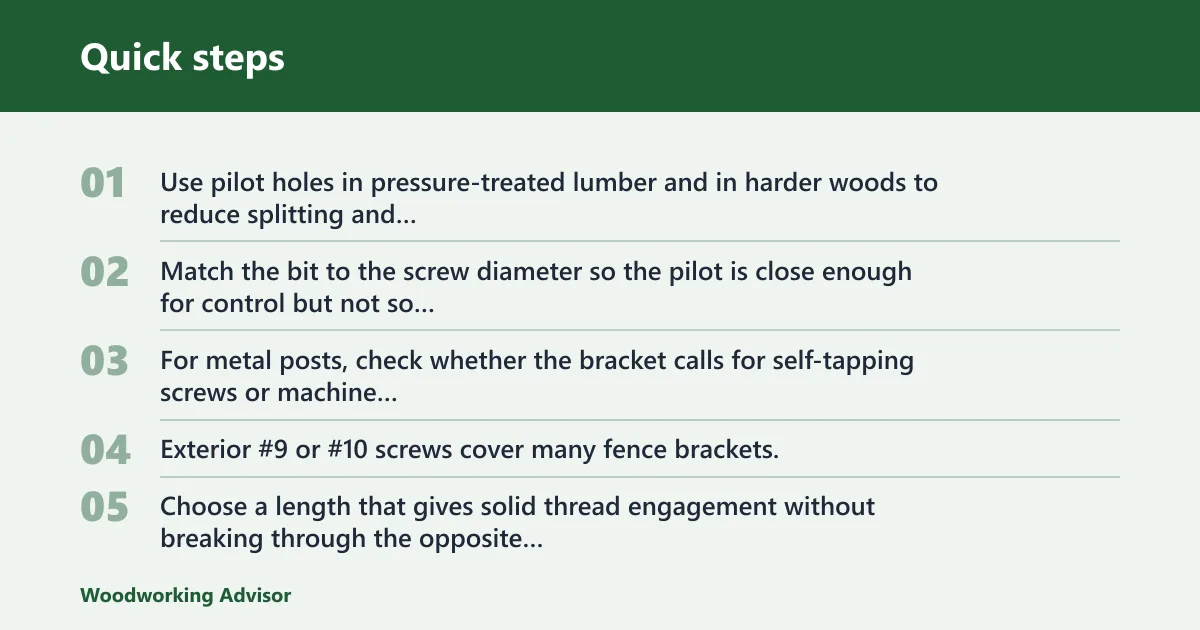
Use pilot holes in pressure-treated lumber and in harder woods to reduce splitting and keep the screw threads from binding. Match the bit to the screw diameter so the pilot is close enough for control but not so tight that the screw shears or the head cams out. For metal posts, check whether the bracket calls for self-tapping screws or machine fasteners.
Screw length, diameter, and washer use
Exterior #9 or #10 screws cover many fence brackets, but heavier brackets may need larger structural screws or bolts. Choose a length that gives solid thread engagement without breaking through the opposite side of the post. Use washers on slotted holes or where the bracket flange needs more bearing area to avoid pull-through.
Leveling, clamping, and alignment checks
Clamp the rail before driving the final screws, then verify level and plumb from more than one direction. That check matters because small errors stack up along a fence line. A bracket that starts crooked can force the next rail to twist, which creates racking stress and uneven gaps.
A common first-timer mistake is driving the screws before the rail is clamped. The bracket shifts a few millimeters, then the next fastener locks in the error. That is how a level line becomes a stair step.
Which one should you buy?
For standard backyard fencing, hot-dip galvanized steel is the best balance of cost, availability, and corrosion resistance. For wet, snowy, or coastal exposure, stainless steel is the safer long-term choice. For gate-adjacent stress, choose a heavy-gauge bracket with an offset or reinforced angle, not a light decorative connector. If budget is tight and the site is dry, powder-coated steel is acceptable, but expect more finish maintenance.
If the job is wood-to-steel, buy a bracket built for that exact interface instead of trying to adapt a wood-to-wood connector. If the job is wood-to-wood with repeated 2×4 rails, a consistent rail bracket package can save time and keep spacing uniform. In every case, total installed cost should include screws, washers, pilot bits, and the chance you may need replacement hardware later.
Choose galvanized if…
Choose galvanized if the fence is in a typical yard, the posts are 4×4 nominal wood, and the rails are standard 2x4s. It is the safest budget-friendly default when the environment is not persistently wet and the bracket is heavy enough for the span.
Choose stainless if…
Choose stainless if the fence sits near salt air, wet soil, snowmelt, or irrigation spray. It is also the better pick if you want the least maintenance and the longest corrosion margin around pressure-treated lumber.
Choose powder-coated if…
Choose powder-coated if the site is relatively dry, the load is modest, and you are willing to inspect for chips or scratches. It works best where appearance and low upfront cost matter more than maximum corrosion resistance.
Frequently asked questions
What are the best metal fence brackets for wood posts?
The best metal fence brackets for wood posts are heavy-gauge exterior-rated brackets that match the rail size and the post type, with corrosion-resistant fasteners sized for the connection. Hot-dip galvanized is the usual default; stainless is better in wet or coastal locations. Fit and load capacity matter more than brand name.
How do I attach a wood fence panel to a metal post?
Use a bracket made for wood-to-steel or metal-to-wood connection, and verify the post diameter, hole pattern, and rail size before drilling. Pre-drill where required, use exterior-rated screws or bolts, and keep the panel clamped level so the bracket does not twist under load.
Are steel to wood fence brackets better than wood-to-metal brackets?
Neither is automatically better. Steel-to-wood brackets are usually designed around a steel post shape and often handle angle changes well, while wood-to-metal brackets may be simpler on square lumber. Choose the bracket that matches the actual post material, corrosion exposure, and the direction of load.
What size bracket do I need for 4×4 wood posts?
For a 4×4 nominal wood post, you usually need a bracket that fits the actual 3 1/2-inch face and gives enough room for the rail thickness and screw heads. Pair it with a bracket sized for a 1 1/2-inch-thick 2×4 rail unless your lumber dimensions are different.
Can I use metal fence brackets outdoors without rusting?
Yes, if the bracket material and coating fit the environment. Hot-dip galvanized and stainless hardware are the safer outdoor choices, while powder-coated steel works best in drier locations. Outdoor use still requires good fasteners, clean pilot holes, and attention to scratched edges or cut surfaces.
What is the difference between fence post brackets and post base brackets?
Fence post brackets connect rails or panels to a post. Post base brackets support or anchor the post itself to a surface or footing. They are not interchangeable, and using the wrong one can leave the fence loose, out of plumb, or poorly protected from corrosion and movement.
Sponsored / affiliate links. As an Amazon Associate I earn from qualifying purchases. I may earn additional commission from eligible campaigns.