Heating a Shed in Winter: Safe Options That Work
Heat a shed in winter with a thermostatically controlled electric heater if the shed is insulated and you have enough amperage. Use propane only in unpowered sheds with good ventilation and an indoor-rated heater. Pick the wrong setup and you risk fire, carbon monoxide, tripped breakers, frozen tools, and higher bills. This guide compares heat options by insulation, power supply, climate, and shed use so you can choose the safest low-cost setup.
What changes in a shed in winter?
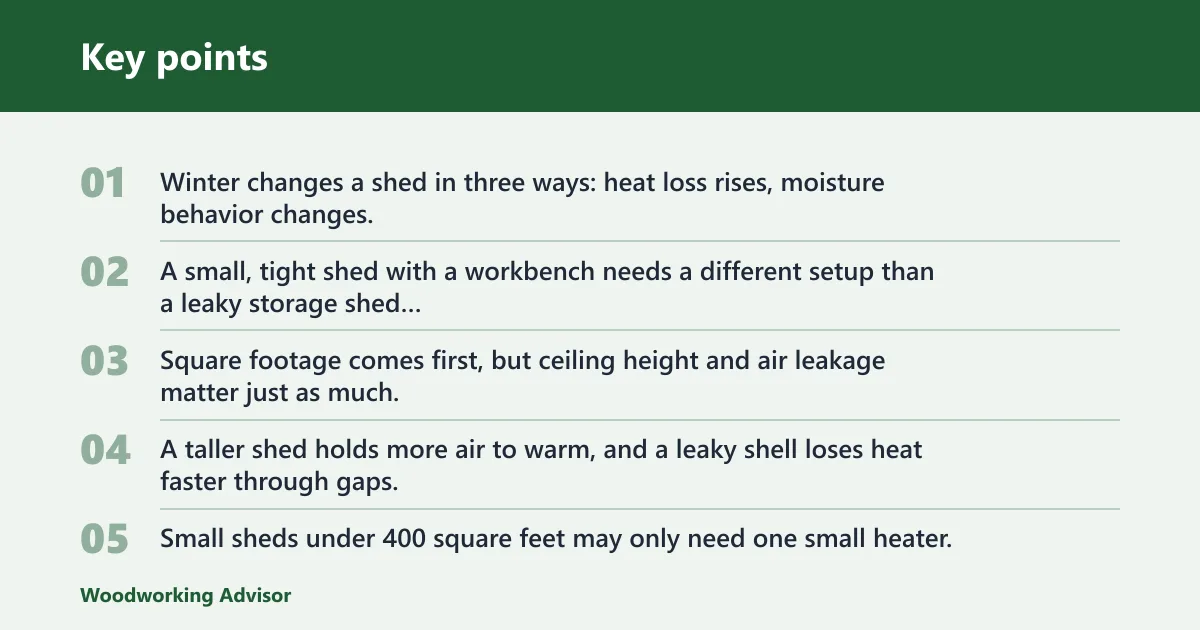
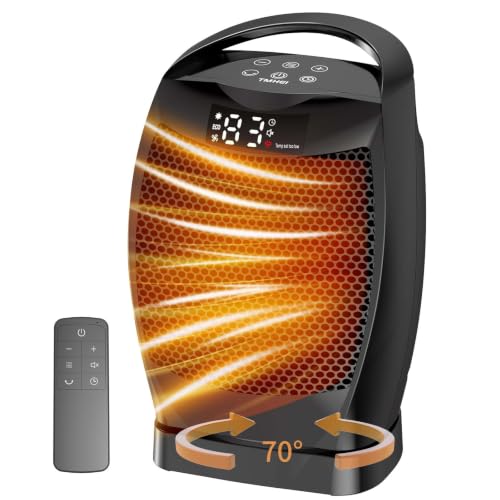


Winter changes a shed in three ways: heat loss rises, moisture behavior changes, and the heater has to match the space you actually use. A small, tight shed with a workbench needs a different setup than a leaky storage shed full of seasonal tools.
Why shed size and ceiling height matter
Square footage comes first, but ceiling height and air leakage matter just as much. A taller shed holds more air to warm, and a leaky shell loses heat faster through gaps, doors, and thin panels. Small sheds under 400 square feet may only need one small heater, while medium and large sheds beyond 400 square feet may need larger heaters.
If the shed is used for bench work, finishing, or battery charging, you need steadier warmth than a storage-only shed. Storage can often tolerate wider temperature swings. Occupied workspaces need more even heat and better condensation control.
How wind, leaks, and outdoor temperature change heat loss
Outside temperature sets the floor for heater demand. Wind exposure and air leaks can push a shed below the outdoor still-air expectation, which is why winter conditions may require heaters that work below freezing. A shed on an exposed lot loses heat faster than one blocked by fencing, trees, or another building.
Suppose a 10-by-12 shed has thin walls, a leaky door, and no ceiling insulation. A small electric heater may keep hands comfortable for light work on a mild day, then fall behind when the temperature drops and wind picks up. The same heater can be enough in a tighter shed with insulated walls and ceiling.
Occupied shed vs storage shed needs
A storage shed can focus on freeze protection. An occupied shed needs comfort, safer humidity control, and stable temperatures around tools, finishes, and chargers. Some items must stay above freezing and need reliable heat plus insulation.
Insulation and condensation basics
Insulation helps, but it is not always required before heating a shed. It can reduce energy bills and retain heat longer, yet it does not create or hold a fixed temperature by itself. Air sealing and ventilation still matter because heat loss and moisture behavior do not stop at the insulation layer.
Wall, ceiling, and floor insulation
Wall insulation slows heat loss through the largest surface area in many sheds. Ceiling insulation matters even more in heated sheds because warm air rises. Floor insulation helps if the shed sits over cold air or a damp slab, especially when you spend time standing in the space.
For a storage shed, partial insulation may be enough to protect sensitive items from freeze damage. For a workshop, full insulation of walls and ceiling gives the heater a better chance to keep temperature stable and cost less to run. Floor insulation is helpful, but the ceiling usually gives the biggest return first.
Air sealing, ventilation, and makeup air
Air sealing cuts drafts, but it should not trap combustion exhaust or moisture. A heated shed needs air sealing and ventilation too. Fuel-burning heaters need fresh air and makeup air for safe combustion, and some ventilation is also needed to handle humidity from people, wet lumber, snow-covered boots, and warming tools.
How heating affects humidity, dew point, and cooldown
When you warm cold air, its relative humidity drops, then climbs again as the space cools. That warm-up and cooldown cycle can drive condensation on metal tools, fasteners, and cold walls if the shed is leaky or poorly insulated. A humid shed that is heated only for short periods can cycle through dew-point conditions over and over.
A common first-timer mistake is heating an uninsulated shed for an hour, then shutting the heater off and closing the door tightly. The air warms fast, then cools fast, and moisture can condense on the coldest surfaces. Better insulation and a controlled cooldown reduce that cycle.
Which heater type fits your shed?
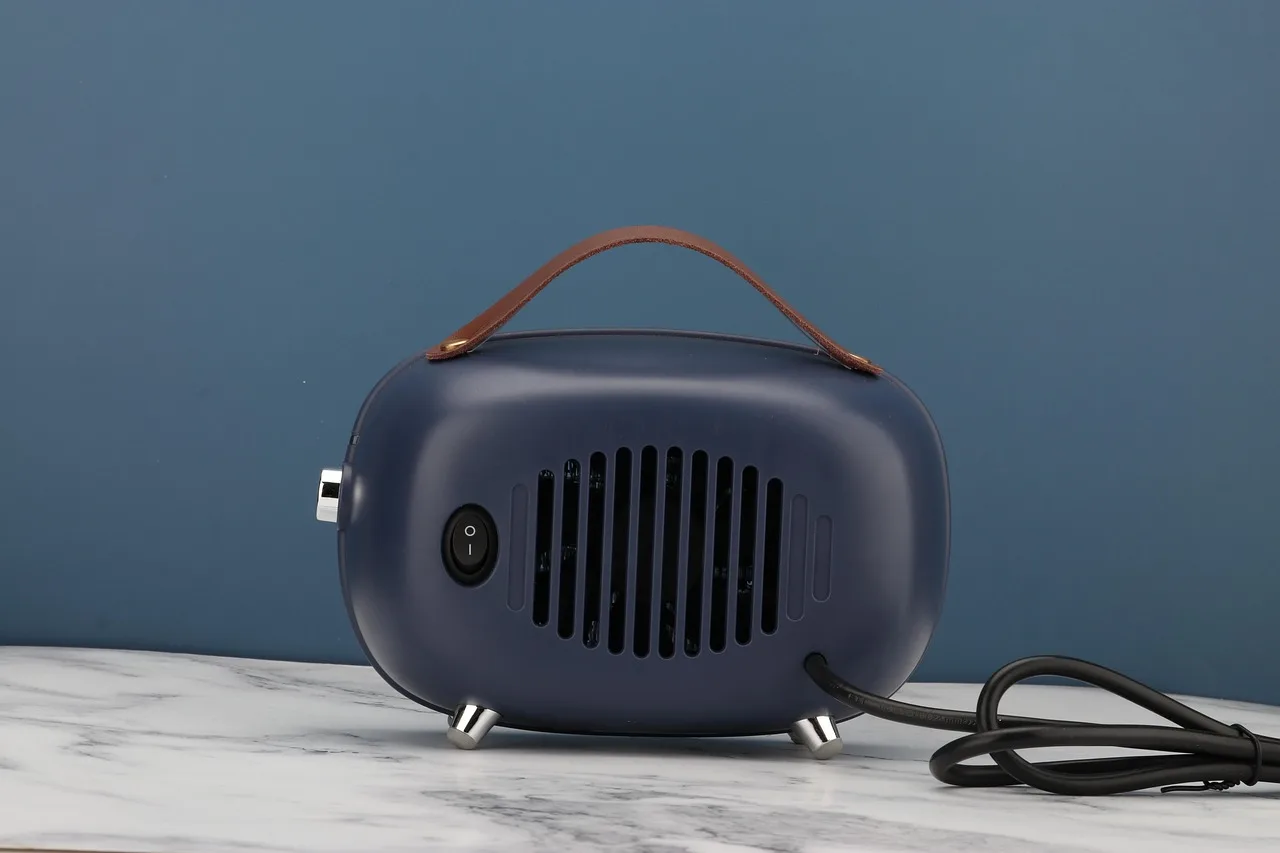
The best heater depends on whether you have electricity, gas, or neither, plus the insulation level and how often you use the shed. Electric heat is usually the safest default for insulated sheds with enough circuit capacity. Propane, kerosene, wood, and heat pumps each fit narrower cases.
Electric heaters: plug-in, wall-mounted, ceiling-mounted, and hardwired
Electric heat works well for small to medium sheds with adequate service. A plug-in space heater is the simplest option for occasional use. Wall-mounted and ceiling-mounted units free floor space and are better for regular use. Hardwired units make more sense when you want fixed heat and a dedicated circuit.
For a small insulated shed, electric heat is often enough if the circuit can handle the load. For a shed used as a workshop, a wall-mounted thermostat-controlled unit is usually safer and easier to manage than a portable heater sitting on the floor.
Propane heaters: indoor-rated only and when to avoid them
Propane can work in an unpowered shed, but only if the heater is indoor-rated, the space is ventilated, and the installation follows the manufacturer instructions and local code. Many unvented fuel-burning heaters are unsafe or prohibited in tightly enclosed small sheds. That risk is higher in leaky or tiny spaces where combustion can be poor and oxygen can fall.
Indoor-rated propane heaters should have an oxygen depletion sensor, proper clearance to combustibles, and a fuel cylinder sized for the heater and run time you need. Do not assume a propane heater is safe simply because the shed is small. Safety depends on the model, ventilation, clearance, and local code.
Wood heat, kerosene, and heat pumps compared
Wood heat brings spark and ember risk, along with chimney and ash handling. It can fit a remote shed, but only with proper venting, a non-combustible base, and clearances that match the stove manual. Kerosene and other combustion heaters raise the same ventilation and carbon monoxide concerns as propane.
Heat pumps can be efficient in a well-insulated shed with enough electrical service, and some models work better in cold weather than others. They are usually more of a permanent installation than a temporary fix. Check the manufacturer listing for low-temperature performance and electrical requirements before you plan around one.
Electrical load and circuit limits
Electric heat only works if the circuit can support it. A common check is whether you have 120V/15A or 120V/20A service available at the shed and what else is already on that circuit. If the heater load is too high, a dedicated circuit or hardwired unit may be needed.
Checking amperage, voltage, and breaker size
Match the heater to the circuit, not the other way around. Review the breaker size, the outlet rating, and the heater nameplate before you buy. If the shed already powers lights or tools, adding heat to the same circuit can trip breakers or overload wiring.
Extension cords are a bad default for shed heat. They add voltage drop, heat at connections, and another failure point. If you must use one temporarily, follow the heater manual exactly and treat that as a short-term exception, not a setup plan.
When a dedicated circuit or hardwired unit makes sense
A dedicated circuit makes sense when the shed is used often, when you want a thermostat-controlled fixed heater, or when a portable unit would crowd the workspace. Hardwired heat is also the better choice when the heater’s electrical demand would leave no safe margin for other loads.
Shed heating decision matrix
This matrix compares six common setups by shed size, insulation, power, climate, cost, and safety needs. Use it as a first pass, then confirm the heater manual, local code, and your electrical limits before you buy.
| Setup | Best shed size | Insulation level | Power availability | Winter temperature | Upfront cost | Operating cost | Safety needs | Best for | Avoid if |
|---|---|---|---|---|---|---|---|---|---|
| Portable electric space heater | Small shed under 400 square feet | Light to moderate insulation | 120V outlet with spare capacity | Mild to moderate cold | Low | Moderate | Tip-over shutoff, thermostat, clearances | Short work sessions and quick warm-up | Very leaky sheds or shared circuits |
| Wall-mounted electric heater | Small to medium shed | Moderate to full insulation | Dedicated circuit preferred | Cold to below freezing | Moderate | Moderate | Thermostat, correct mounting, breaker match | Regular workshop use | Uninsulated sheds with weak wiring |
| Ceiling-mounted electric heater | Medium shed | Moderate to full insulation | Hardwired or dedicated circuit | Cold to below freezing | Moderate to high | Moderate | Clear ceiling clearance, proper mounting | Floor-space-sensitive shops | Low ceilings or poor wiring |
| Indoor-rated propane heater | Small shed, case by case | Light to moderate insulation | None or limited electricity | Below freezing if ventilated | Low to moderate | Varies by fuel use | ODS, CO alarm, ventilation, combustibles clearance | Unpowered spaces with short use periods | Tightly enclosed sheds or prohibited setups |
| Kerosene heater | Small to medium shed | Moderate insulation, good ventilation | None or limited electricity | Cold to below freezing | Low to moderate | Varies by fuel use | CO alarm, ventilation, fuel handling, clearance | Remote sheds with proper ventilation | Confined storage spaces or poor airflow |
| Wood stove or heat pump | Medium to large shed | Full insulation preferred | Wood: none; heat pump: substantial electric service | Below freezing with proper design | High | Low to moderate, model dependent | Chimney or venting, non-combustible base, ash handling, or electrical review | Permanent workshop or long-term heated shed | Temporary use or tight construction without code support |
How do you heat a shed safely?
Safe shed heating starts with the heater manual, enough clearance, and the right fuel strategy for the space. For fuel-burning units, you need ventilation, combustion exhaust handling, and carbon monoxide protection. For electric units, you need correct circuit capacity and no overloaded cords or outlets.
Clearances to combustibles and non-combustible bases
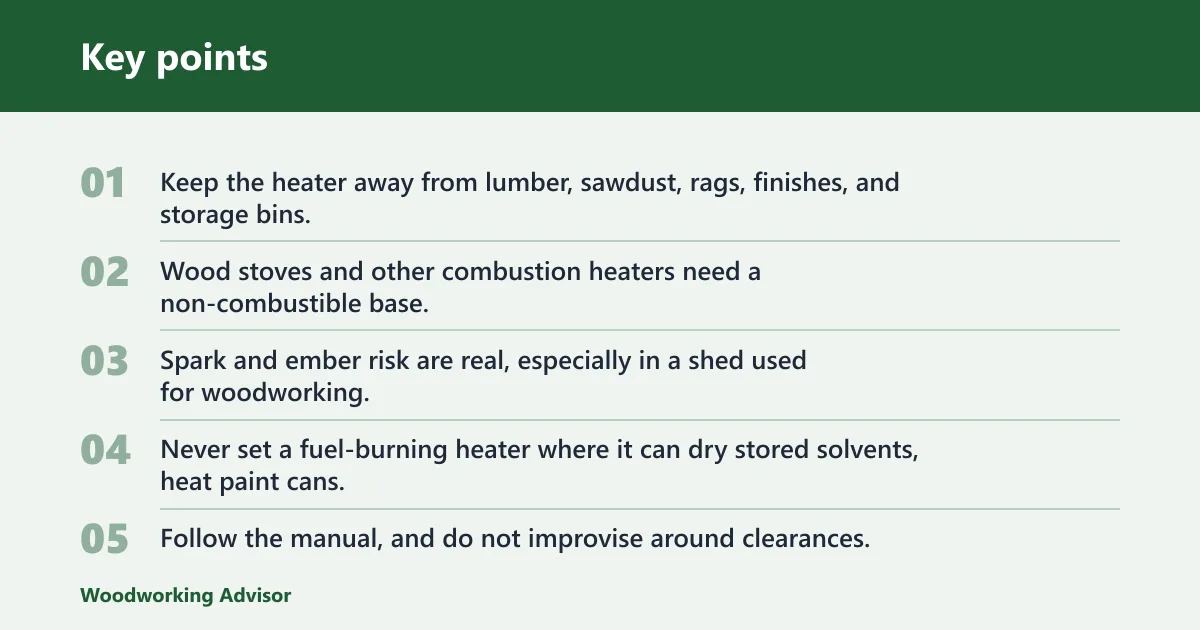
Keep the heater away from lumber, sawdust, rags, finishes, and storage bins. Wood stoves and other combustion heaters need a non-combustible base, chimney or venting that matches the unit, and clearance that matches the manufacturer listing. Spark and ember risk are real, especially in a shed used for woodworking.
Never set a fuel-burning heater where it can dry stored solvents, heat paint cans, or sit under shelving full of combustibles. Follow the manual, and do not improvise around clearances. If the manual and the shed layout do not fit together cleanly, choose a different heater.
Carbon monoxide alarms, battery backup, and test frequency
A carbon monoxide alarm is commonly recommended whenever fuel is burned indoors, as a basic safety measure. Follow the alarm manufacturer’s placement instructions and local code rather than guessing at a “nearby” spot. Use a unit with battery backup, and test it regularly according to the manual.
Do not rely on smell or visible flame color to judge safety. Combustion can go wrong before you notice it, especially in a cold, leaky shed. If the shed is used as a work area, keep the alarm where it will be heard from that occupied zone.
Ventilation and fuel-burning safety checks
Fuel-burning heaters need fresh air exchange and a path for combustion exhaust. Ventilation also helps with moisture control, but too much uncontrolled leakage can make the heater work harder and create uneven warm-up. The goal is enough makeup air for the heater and enough drying power to avoid damp surfaces.
If the shed is tightly enclosed, if it cannot support the heater’s venting plan, or if local code forbids the setup, do not force it. A safer electric option is often cheaper than a fuel system that is hard to make compliant.
What size heater do you need?
Start with shed size, then adjust for insulation, air leakage, and winter severity. A heater that is too small will run constantly and still leave the space cold. A heater that is too large can overshoot the thermostat, waste energy, and worsen condensation by creating fast warm-up and cooldown cycles.
A simple sizing method
Begin with the shed’s square footage and ceiling height. Then decide whether it is lightly insulated, fully insulated, or uninsulated. For a small, insulated shed, a single small heater may be enough. For sheds above about 400 square feet, or for leaky spaces in freezing weather, a larger heater or a better shell may be needed first.
Use the heater only for the job you need. A storage shed that must stay above freezing can often run on less heat than a workshop used for finishing or battery charging. If the shed must stay warm for longer periods, insulation becomes part of the heat plan, not an optional add-on.
When to start with insulation instead of more heat
Start with insulation if the heater runs constantly, the floor and walls stay cold, or the bills climb without comfort gains. Insulation can reduce energy bills and retain heat longer, while air sealing helps stop draft-driven loss. For a shed that must protect certain items from freezing, insulation plus reliable heat is the safer path.
How much heat a shed needs in freezing weather depends on leakage, insulation, and wind exposure more than on square footage alone. A small shed with poor insulation can demand more heat than a larger but well-sealed one. That is why the heater choice should follow the shed shell first.
Frequently asked questions
How do I heat a shed in winter without risking a fire?
Use a heater that matches the shed’s power supply and install it with the clearances in the manual. Keep combustibles away from the heater, use a non-combustible base where required, and avoid extension cords as a normal setup. Fuel-burning heaters need ventilation, a carbon monoxide alarm, and code compliance.
Do I need to insulate a shed before heating it?
No, but insulation makes heating easier, cheaper, and steadier. A heated shed can work without full insulation if the use is light and the climate is mild. For longer work sessions, freeze protection, or exposed winter conditions, insulation in the walls and ceiling helps the heater hold warmth longer.
What size heater do I need for my shed?
Start with square footage, ceiling height, leakiness, and winter temperature, then choose a heater that can maintain the target temperature without running flat out all day. Small sheds under 400 square feet may need only one small heater, but larger or leakier sheds need more output. Check the manufacturer listing for the exact model.
Can I use a propane heater in a shed?
Yes, but only if the heater is indoor-rated, the shed has proper ventilation, and local code allows the setup. Many unvented fuel-burning heaters are unsafe or prohibited in tightly enclosed small sheds. Use an oxygen depletion sensor, keep clearances to combustibles, and install a carbon monoxide alarm with battery backup.
Is an electric heater enough for a small shed?
Often yes, especially if the shed is insulated and the circuit can handle the load. Electric heat is the simplest option for many small workshops because it avoids fuel storage and combustion exhaust. It will not be enough if the shed is very leaky, the climate is severe, or the breaker and wiring cannot support the heater safely.
Do I need a carbon monoxide alarm in a heated shed?
Yes, when you burn fuel indoors. Put the alarm where the manufacturer and local code say to place it, not just somewhere nearby, and choose one with battery backup. Test it regularly. Even a small propane or kerosene heater can create CO if combustion is poor or ventilation is not enough.
What heater works best for an uninsulated shed?
An uninsulated shed is usually the wrong place for casual fuel-burning heat. If there is no electricity, an indoor-rated propane heater may work only with proper ventilation, clearances, and CO protection, and only if local code allows it. For anything used often, insulation plus electric heat is usually the safer long-term fix.
Sponsored / affiliate links. As an Amazon Associate I earn from qualifying purchases. I may earn additional commission from eligible campaigns.