How Hot Should Wood Stove Pipe Get?
Wood stove pipe surface temperature is often considered acceptable around 250°F to 450°F, while probe thermometer readings of flue gas inside the flue are commonly higher, often around 300°F to 700°F depending on stove design. Single-wall pipe is generally hotter on the surface than double-wall pipe. Excess heat can warp the pipe, scorch nearby materials, and raise the chance of a chimney fire. This guide separates pipe-surface readings from flue-gas readings and explains what to do next for single-wall and double-wall pipe.
The safe answer changes with stove model, pipe type, fuel quality, draft, and where the thermometer sits. A reading near the stove outlet is not the same as a reading farther up the connector, and a magnetic strip is not the same as a probe.
Safe operating temperatures for stove pipe


Single-wall stovepipe temperatures
Single-wall stovepipe usually runs hotter on the outside than double-wall pipe because the metal is directly exposed to room air. It is commonly used as connector pipe between the stove and the chimney connection, where its job is to move smoke, not to stay cool.
Typical surface temperature behavior
A single-wall pipe surface often falls in the 250°F to 450°F range during normal operation, but the exact number depends on the stove and the burn stage. Higher surface temperatures near the stove outlet are common during startup, then the pipe usually settles as the fire reaches cruising output.
Clearance to combustibles matters because single-wall pipe gives off more heat to the room. Many installations require 18 inches of clearance, but the actual requirement comes from the manufacturer manual and local code. Do not assume one clearance fits every pipe layout.
Where it is usually used
Single-wall stovepipe is usually the connector section inside the room. It is not the same as a factory-built chimney system or chimney liner, and the rules for one do not automatically carry over to the other. Match the part you are measuring to the part the manual names.
Double-wall stovepipe temperatures
Double-wall stovepipe usually has a cooler outer wall than single-wall pipe, even while the inner flue stays hot enough to move smoke and reduce condensation. Some versions are air-cooled and some use insulated construction, so do not treat every double-wall pipe as the same product.
Outer-wall temperature behavior
The outer wall of double-wall pipe generally reads lower than a single-wall pipe at the same fire level. That lower surface heat is why many double-wall systems allow reduced clearances compared with single-wall pipe, but the exact clearance still depends on the model and its listing.
Inner flue temperature behavior
The inner passage of double-wall pipe can remain much hotter than the outer wall. That means a cool-looking outer surface does not prove the flue gas is too cool, and a warm outer surface does not tell you the fire is overfiring. Measure the right surface and read the right scale.
How hot is too hot?
Too hot means the fire is no longer running in the band the manufacturer expects. For many stoves, a pipe-surface reading above roughly 500°F to 600°F is a warning zone, but the manufacturer’s limits can differ a lot by model and by thermometer location.
Warning signs of overfire
- Pipe temperature climbs quickly and keeps rising after air is reduced.
- The stove fire looks bright, violent, or hard to calm.
- Metal parts glow, warp, or sound unusually loud.
- A hot, sharp smell appears near the stove or connector.
- Draft seems stronger than normal and the stove keeps racing.
When this happens, reduce the air supply in the way your manual allows. Close the air control step by step, not all at once unless the manual says to do so, and keep the stove door shut. If the stove still climbs toward the overfire range, follow the manual’s shutdown steps and call for inspection if any part of the system shows damage.
What to do when the reading keeps rising
Suppose a single-wall pipe is reading about 550°F on a magnetic thermometer and the stove is still accelerating after the air is cut to low. That is not a normal cruising burn. Keep the door closed, reduce air as directed by the manual, and prepare for an immediate shutdown plan if the temperature continues to rise or if you hear abnormal roaring.
How cool is too cool?
Too cool means the flue gas is spending too much time in the condensation range, where creosote can form on the pipe and chimney walls. Low stack temperatures raise that risk, especially during shoulder-season burns, slow overnight burns, or any run with weak draft and damp wood.
Creosote risk and chimney fire risk
Creosote forms when smoke cools enough that its vapors condense on cooler metal or masonry. The risk rises when the flue stays too cool for too long, and the buildup can fuel a chimney fire later. Regular cleaning and inspection matter because a pipe that looks fine outside can still hold deposits inside.
Picture a small stove loaded with wet oak and turned down for a long burn on a mild day. The pipe may feel warm, yet the flue gas may never stay hot enough to stay clean. That is the kind of setup that often leaves more soot and glaze behind than a properly dried load.
Common causes of low stack temperature
- Wet or poorly seasoned wood.
- Overly closed air control.
- Oversized stove for the room load.
- Weak draft in mild weather or a short chimney.
- Restricted chimney, cap, or connector from buildup.
Pipe temperature decision table
This table separates pipe type, reading method, and temperature band so you can match the number to a likely condition and the next step. Use it with your stove manual and the pipe listing, not instead of them.
| Pipe type or burn stage | Reading method | Temperature band | Likely condition | Likely cause | Next action |
|---|---|---|---|---|---|
| Single-wall pipe | Magnetic pipe thermometer on the connector surface | 250°F to 450°F | Normal operating band for many stoves | Steady burn with adequate draft and dry fuel | Keep operating within the manual’s range and watch for steady, not racing, changes |
| Double-wall pipe | Magnetic thermometer on the outer wall, if approved for that pipe | Lower than single-wall at the same burn | Outer wall stays cooler while inner flue stays active | Air gap or insulated design reduces surface heat loss | Use the model’s listed thermometer method and do not compare its outer-wall reading to a single-wall target |
| Startup | Magnetic thermometer or probe, matched to the model | Climbing toward the normal band | Warm-up phase | Cold metal and fresh fuel are still heating the flue | Open air enough to establish draft, then reduce gradually once the fire is established |
| Cruising burn | Probe thermometer in the flue or approved surface gauge | About 300°F to 700°F flue gas, depending on stove design | Stable, efficient burn | Dry fuel, proper loading, and steady draft | Hold the setting that keeps the fire stable and the pipe within the manual’s range |
| Low-draft smoldering | Any thermometer type, but read with caution | Low surface reading and low flue gas reading | Creosote risk rises | Wet wood, too little air, weak draft, or an oversized stove | Increase air modestly, confirm fuel dryness, and inspect for buildup if this happens often |
| Overfire warning | Magnetic surface gauge or probe reading that climbs fast | Often 500°F to 600°F+ on the pipe surface, or a rapid rise above the manual’s limit | Unsafe heat level | Too much air, too much fuel, strong draft, or restricted control response | Reduce air immediately in the way the manual allows, keep the door shut, and follow the shutdown plan if it does not settle |
How to read the thermometer correctly
A thermometer only helps if you read the right place with the right tool. A magnetic pipe thermometer reads surface heat, a probe thermometer reads gas temperature inside the flue, and an IR thermometer can be thrown off by shiny metal, angle, and emissivity.
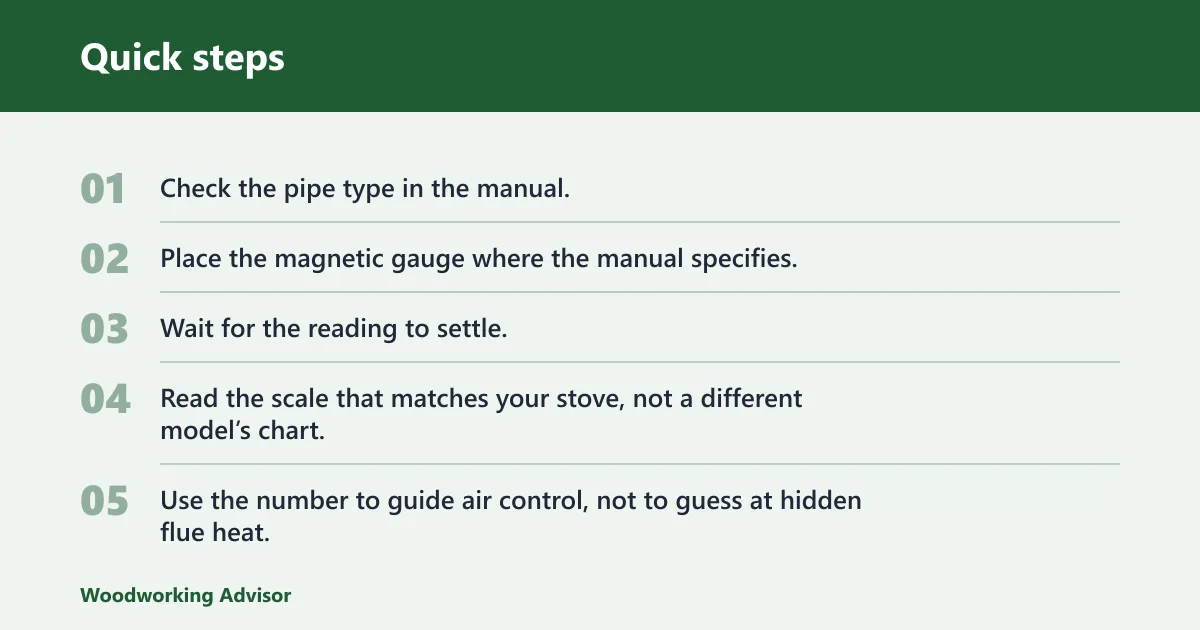
Magnetic pipe thermometer placement
Place a magnetic gauge on the section the manufacturer recommends, usually on the connector pipe away from seams, elbows, or draft caps unless the manual says otherwise. If the pipe is double-wall, confirm that the thermometer is approved for that outer surface, because some gauges are meant only for single-wall metal.
- Check the pipe type in the manual.
- Place the magnetic gauge where the manual specifies.
- Wait for the reading to settle.
- Read the scale that matches your stove, not a different model’s chart.
- Use the number to guide air control, not to guess at hidden flue heat.
Probe thermometer limits
A probe thermometer is useful for flue gas because it reads hotter gas inside the stream, but it must be installed where the listing allows. Its number cannot be compared one-for-one with a pipe-surface thermometer, since the two tools measure different things in different places.
IR thermometer limits
An IR thermometer can help spot hot spots, but reflective pipe, soot patterns, and angle can distort the reading. It is best used as a cross-check, not as the only number guiding your burn. Confirm the method with the stove and thermometer manuals before trusting the result.
Frequently asked questions
How hot should wood stove pipe get?
For many stoves, a pipe-surface reading around 250°F to 450°F is a common operating band. If you are using a probe thermometer, the flue-gas number will usually be higher. Check the manual for the listed limit and the approved gauge location.
How hot does wood stove pipe get?
It can range from warm to very hot, depending on startup, cruising, or overfire conditions. The number on the thermometer changes with fuel quality, draft, stove size, and where the gauge sits on the pipe.
How hot can wood stove pipe get?
That depends on the listing and the burn condition. A pipe surface that climbs above about 500°F to 600°F is often a warning sign, and some manuals set lower limits. If the temperature rises fast or keeps climbing after air is reduced, treat it as an overfire situation.
How hot does a wood stove flue pipe get?
Flue gas is often hotter than the outside of the pipe and is commonly reported around 300°F to 700°F by a probe thermometer inside the flue for many stoves. Do not compare a probe number directly with a magnetic surface reading, since they measure different heat.
How hot does double wall wood stove pipe get?
Double-wall pipe usually runs cooler on the outside than single-wall pipe, but the inner flue can still stay hot. The outer reading depends on whether the product is air-cooled or another listed design. Use the manufacturer’s chart, because the outer wall temperature is not the same as flue gas.
How hot does single wall wood stove pipe get?
Single-wall pipe usually runs hotter on the surface than double-wall pipe at the same fire setting. A normal surface band for many systems is about 250°F to 450°F, but the listed safe range can differ. Keep the clearances and the thermometer placement exactly where the manual calls for them.
Sponsored / affiliate links. As an Amazon Associate I earn from qualifying purchases. I may earn additional commission from eligible campaigns.