How Much Does Wood Weigh Per Square Foot?
Wood weighs between 0.5 and 7+ pounds per square foot — a 3/4-inch red oak board runs about 2.75 lbs/sq ft, while the same thickness in western red cedar comes in at just 1.44 lbs/sq ft. Without knowing both species density and board thickness, any weight figure is meaningless. This guide covers a species-by-thickness weight chart for 10 common woods at four thicknesses, the calculation formula with a worked example, hardwood flooring data, and how moisture content can push green-cut lumber 40-80% heavier than kiln-dried.
Quick Answer
Wood weighs 1.44 to 7.83 lbs per square foot at thicknesses from 3/4 to 2 inches, depending on species. At 3/4 inch — the standard for flooring and furniture — hardwoods like white oak weigh 2.94 lbs/sq ft, mid-range species like walnut weigh 2.38 lbs/sq ft, and lightweight softwoods like western red cedar weigh 1.44 lbs/sq ft. Use the species-by-thickness chart below for your specific combination.
Wood Weight Per Square Foot by Species and Thickness
Best Wood Moisture Meter Pick
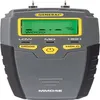
General Tools MMD4E Digital Moisture Meter
Trusted pin-type meter that reads 0-99% MC on wood and building materials. Know your actual moisture level before applying the species weight multiplier from the charts above.
- Best for: Shop and jobsite lumber checks before cutting or joining
- Why we picked it: Calibrated for 30+ wood species, widely trusted by flooring installers and home inspectors for consistent readings
- Main drawback: Pin holes are visible on finished surfaces — use a pinless meter on installed flooring
Compare more moisture meter options
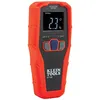 Option 1 Klein Tools ET140 Pinless Moisture Meter
|
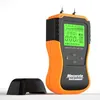 Option 2 Mecurate Digital Pin Type Moisture Meter
|
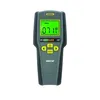 Option 3 General Tools MMD7NP Dual-Mode Moisture Meter
|
As an Amazon Associate we earn from qualifying purchases.
The table below gives weight in pounds per square foot for 10 common species at four standard thicknesses. All values are for kiln-dried lumber at approximately 12% moisture content, calculated using USDA Forest Products Laboratory average dry density data.
Formula: weight (lbs/sq ft) = species density (lb/ft3) x thickness (inches) / 12
| Species | Density (lb/ft3) | 3/4 in (lbs/sq ft) | 1 in (lbs/sq ft) | 1.5 in (lbs/sq ft) | 2 in (lbs/sq ft) |
|---|---|---|---|---|---|
| White Oak | 47 | 2.94 | 3.92 | 5.88 | 7.83 |
| Red Oak | 44 | 2.75 | 3.67 | 5.50 | 7.33 |
| Hard Maple | 44 | 2.75 | 3.67 | 5.50 | 7.33 |
| Birch | 43 | 2.69 | 3.58 | 5.38 | 7.17 |
| Black Walnut | 38 | 2.38 | 3.17 | 4.75 | 6.33 |
| Cherry | 35 | 2.19 | 2.92 | 4.38 | 5.83 |
| Douglas Fir | 32 | 2.00 | 2.67 | 4.00 | 5.33 |
| Yellow Poplar | 28 | 1.75 | 2.33 | 3.50 | 4.67 |
| White Pine | 26 | 1.63 | 2.17 | 3.25 | 4.33 |
| W. Red Cedar | 23 | 1.44 | 1.92 | 2.88 | 3.83 |
Weights in lbs per square foot. Based on USDA Forest Products Laboratory average dry weight data. Actual weights vary approximately plus or minus 5% due to grain pattern and growth conditions.
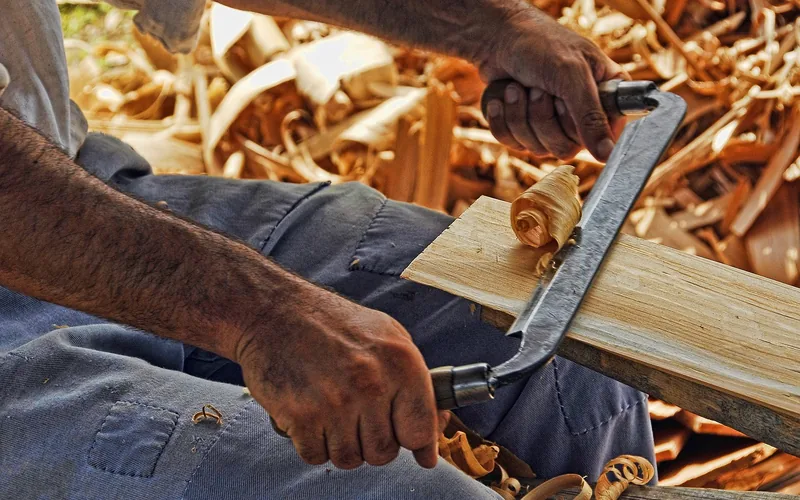
How to Calculate Wood Weight Per Square Foot
To find the exact weight for any board, you need two values: species density in lb/ft3 (from the table above or the USDA Forest Products Laboratory species database) and board thickness in inches. The math is straightforward once you have both.
Weight (lbs/sq ft) = Density (lb/ft3) x Thickness (inches) / 12
Worked example — 10-square-foot red oak tabletop at 1-inch thickness:
- Find the species density: Red oak averages 44 lb/ft3 (USDA Forest Products Laboratory)
- Convert thickness to feet: 1 inch divided by 12 = 0.0833 ft
- Calculate weight per square foot: 44 x 0.0833 = 3.67 lbs/sq ft
- Multiply by your area: 3.67 x 10 sq ft = 36.7 lbs total
That 36.7-lb result matters in practice: I use this exact calculation when speccing drawer slides for heavy slab-top desks and deciding whether a large cabinet base needs casters. Rough-estimating “about 30 lbs” has cost me on under-rated hardware more than once. For irregular-shaped pieces, break the area into rectangles, calculate each section separately, and add them up.
For quick field estimates, our wood weight calculator handles the math instantly — enter species, thickness, width, and length. For structural framing, the lumber calculator for framing factors in dead load requirements alongside member size.
Types of Wood and Their Weights: Hardwood vs. Softwood
Hardwood and softwood refer to tree classification (deciduous vs. coniferous), not actual hardness — though denser species do tend to be harder. The classification broadly predicts weight range.
Hardwoods (oak, maple, walnut, birch, cherry) generally run 35-50 lb/ft3 and weigh 2.19-3.92 lbs/sq ft at 3/4 to 1 inch thickness. Their density comes from tighter cell structure and slower growth rings. Softwoods (pine, cedar, Douglas fir, spruce) run 23-32 lb/ft3 and weigh 1.44-2.67 lbs/sq ft at the same thicknesses — lighter, easier to handle, but less resistant to denting and compression.
The practical weight difference shows up in construction and furniture making: a 100-square-foot white oak floor installation at 3/4 inch adds 294 lbs of dead load to your subfloor system; the same area in Douglas fir adds 200 lbs — a 94-lb difference that matters when your joists are 30+ years old. Learn more about ash wood weight per board foot if you’re working with that specific species for tool handles or sports equipment.
Hardwood Flooring Weight Per Square Foot
Hardwood flooring is typically sold at 3/4-inch thickness (solid) or 1/2-inch thickness (engineered). IRC requires residential floors to handle 40 psf live load — flooring weight contributes to the dead load side of that calculation, so knowing the species weight matters when replacing heavy tile with hardwood or vice versa.
| Flooring Species | 3/4 in Solid (lbs/sq ft) | 1/2 in Engineered (lbs/sq ft) |
|---|---|---|
| White Oak | 2.94 | 1.96 |
| Red Oak | 2.75 | 1.83 |
| Hard Maple | 2.75 | 1.83 |
| Black Walnut | 2.38 | 1.58 |
| Cherry | 2.19 | 1.46 |
| White Pine | 1.63 | 1.08 |
For load calculations on older homes, use our wood load capacity calculator to check whether your joist span and spacing can handle your chosen flooring species before installation begins.
Plywood Weight Per Square Foot by Thickness
Plywood weight depends on panel type and thickness. Standard softwood construction plywood averages 34 lb/ft3; hardwood plywood runs about 40 lb/ft3. OSB is typically 1-2 lbs/sq ft lighter than softwood plywood at the same thickness.
| Thickness | Softwood Plywood (lbs/sq ft) | Hardwood Plywood (lbs/sq ft) |
|---|---|---|
| 1/4 in | 0.71 | 0.83 |
| 3/8 in | 1.06 | 1.25 |
| 1/2 in | 1.42 | 1.67 |
| 5/8 in | 1.77 | 2.08 |
| 3/4 in | 2.13 | 2.50 |
A 4×8 sheet of 3/4-inch softwood plywood (32 sq ft) weighs approximately 68 lbs — a useful real-world reference for estimating how many sheets load safely in one truck run, or whether a cabinet carcass needs a furniture dolly to move. For structural applications, see our guide on how much weight 3/4-inch plywood can hold before sizing your cabinet shelves or workshop benchtop.
How Moisture Content Affects Wood Weight Per Square Foot
Moisture content (MC) is the single largest variable in wood weight after species and thickness. Every value in the charts above assumes kiln-dried lumber at 8-12% MC — the condition lumber yards deliver dimensional lumber. Fresh-cut green lumber can hold 50-200% of its oven-dry weight in water, which means a board that weighs 2.75 lbs/sq ft after drying might weigh 4.5 to 5.5 lbs/sq ft fresh off the log.
| Moisture Condition | Typical MC Range | Weight vs. Kiln-Dried | When You Encounter This |
|---|---|---|---|
| Oven-dry | 0% | Baseline (lightest) | Lab testing only |
| Kiln-dried (KD) | 8-12% | +5-10% vs. oven-dry | Lumber yard, flooring store |
| Air-dried | 15-19% | +15-25% vs. KD | Outdoor storage, rough lumber |
| Green (freshly cut) | 50-200%+ | +40-100% vs. KD | Fresh-milled lumber, logs |
To know where your lumber actually sits on this scale before you build, measure it with a pin-type moisture meter. Most kiln-dried lumber sold at home centers reads 10-15% MC on a meter — acceptable for structural work, but potentially too wet for tight-fitting joinery. For fine furniture and cabinet work, target 6-8% MC; for exterior or structural framing, 12-15% is typical and acceptable.
Common Mistakes When Estimating Wood Weight
Most estimation errors come from skipping the thickness variable or using the wrong moisture state. Here are the four mistakes I see most often in the shop and on job sites:
- Using a weight figure without specifying thickness. “Oak weighs 4 lbs per square foot” is incomplete. At what thickness? 3/4 inch? 2 inches? Always pair species weight with the actual board thickness — one without the other is useless for planning.
- Assuming kiln-dried weight for green lumber. If you’re working with freshly milled slabs or rough-sawn lumber from a local sawyer, expect the actual weight to be 40-100% higher than the kiln-dried values in any chart. Weigh a representative sample and compare to the chart to estimate actual MC.
- Ignoring engineered wood differences. Plywood and LVL (laminated veneer lumber) have their own density profiles that don’t match solid wood of the same species. A 3/4-inch oak plywood panel weighs about 2.50 lbs/sq ft, not 2.94 (the figure for solid white oak) — the adhesive layers and ply orientation change the density.
- Conflating board feet with square feet. A board foot is one square foot at one inch thick. When lumber is thicker than 1 inch, board feet and square feet are not the same. For multi-inch slabs and beams, use the cubic feet formula — not a square foot chart — to get accurate total weight.
Frequently Asked Questions
How much does wood weigh per square foot for flooring?
Solid 3/4-inch hardwood flooring weighs 1.63 to 2.94 lbs per square foot, depending on species. Red oak — the most common flooring species in North America — runs 2.75 lbs/sq ft. Cherry and white pine are lighter at 2.19 and 1.63 lbs/sq ft respectively. Engineered flooring at 1/2-inch thickness weighs roughly 30% less than solid at the same species. For a 200-square-foot room, that difference is 90-115 lbs in total dead load.
How do I calculate wood weight per square foot?
Use the formula: weight (lbs/sq ft) = species density (lb/ft3) x thickness (inches) / 12. Find your species density in the USDA Forest Products Laboratory data or the chart above. For example, Douglas fir at 32 lb/ft3 and 1.5 inches thick gives 32 x 1.5 / 12 = 4.00 lbs/sq ft. Multiply that by your total area in square feet to get total weight. Use a wood weight calculator for fast field estimates.
What is the lightest wood per square foot?
Among commercially available species, western red cedar is one of the lightest at 23 lb/ft3 — giving 1.44 lbs/sq ft at 3/4-inch thickness. Balsa, technically a hardwood, is lighter at around 9 lb/ft3 but is not used structurally. For structural softwood applications, white pine at 26 lb/ft3 (1.63 lbs/sq ft at 3/4 inch) is the lightest practical choice. For decking and outdoor applications, cedar is the go-to lightweight species.
How much does 3/4-inch plywood weigh per square foot?
Standard softwood construction plywood at 3/4 inch weighs approximately 2.13 lbs per square foot. Hardwood plywood at the same thickness weighs about 2.50 lbs/sq ft. A full 4×8 sheet (32 sq ft) of 3/4-inch softwood plywood weighs approximately 68 lbs. These figures assume typical construction-grade panels at 8-12% moisture content — marine-grade and specialty panels with denser cores may weigh 5-10% more.
Does moisture content significantly change wood weight per square foot?
Yes — moisture content is the biggest variable after species and thickness. Freshly cut (green) lumber can weigh 40-100% more per square foot than the same piece kiln-dried. For example, green-cut red oak at 3/4 inch might weigh 4.5-5.5 lbs/sq ft versus 2.75 lbs/sq ft kiln-dried. Air-dried lumber (15-19% MC) is 15-25% heavier than kiln-dried. Always confirm moisture content with a meter before using chart values for load calculations.
Conclusion
Wood weight per square foot is always a two-variable answer: species density and board thickness. Use the species-by-thickness chart above as your baseline, apply the formula for any combination not in the table, and always check actual moisture content with a meter before relying on kiln-dried values for structural or shipping calculations. For tools-and-calculators shortcuts, visit our woodworking calculators guide for the complete set of estimation tools.
Sponsored / affiliate links. As an Amazon Associate I earn from qualifying purchases. I may earn additional commission from eligible campaigns.