Firewood Cord Calculator: How Much Wood You Have?
A firewood cord calculator turns a stack’s length, height, and depth into cubic feet, then divides by 128; 128 cubic feet equals one full cord, and a 4×8 stack of 16-inch splits is usually one-third cord. Bad estimates can cost you money or shortchange the seller. This guide shows how to size stacked wood, loose deliveries, and mixed piles into a defensible cord estimate.
How is this calculated?
Press Calculate to see the math with your numbers.
What a cord measures
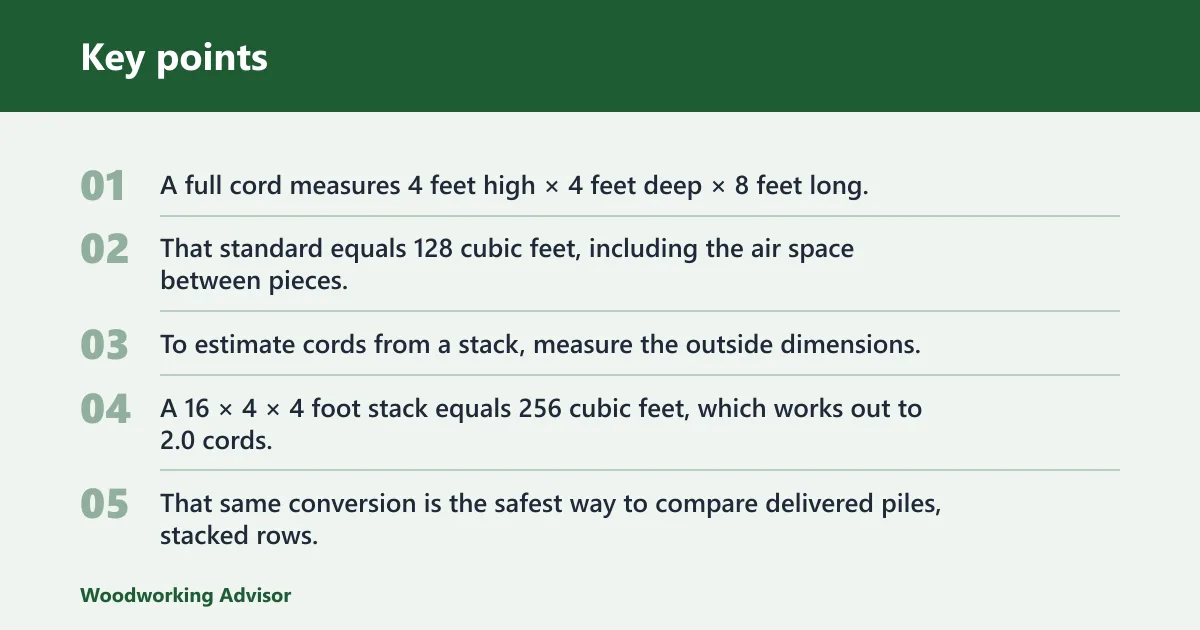


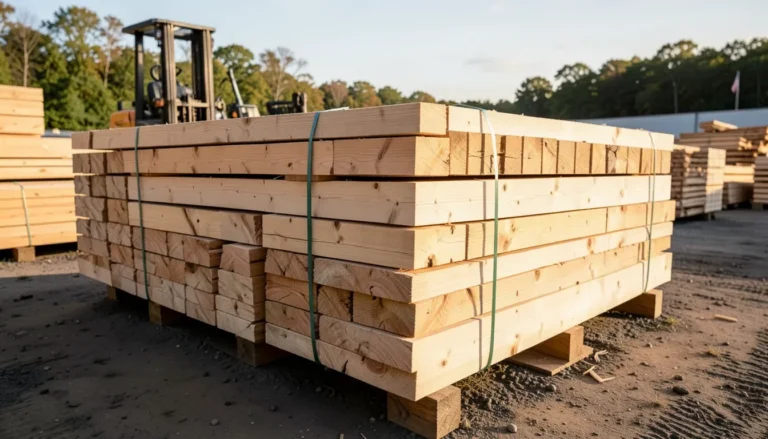
A full cord measures 4 feet high × 4 feet deep × 8 feet long. That standard equals 128 cubic feet, including the air space between pieces. To estimate cords from a stack, measure the outside dimensions, multiply them for cubic feet, then divide by 128.
How cubic feet convert to cords
Cubic feet ÷ 128 = cords. A 16 × 4 × 4 foot stack equals 256 cubic feet, which works out to 2.0 cords. That same conversion is the safest way to compare delivered piles, stacked rows, and seller quotes in the same unit.
Keep the measuring line honest. Use the stack’s outside length, depth, and height, not the gaps between split ends. If the pile bows outward or leans, measure the largest practical rectangle it occupies and note the irregular shape before you convert.
How much is a face cord?
A face cord is commonly shown as 4 feet × 8 feet × 16 inches, about 1/3 cord. In one common example, that works out to approximately 42.7 cubic feet. The catch is depth: in some regions, “face cord” changes with log length, so the term is not a universal size claim.
Face cord versus full cord
A full cord has a fixed volume standard. A face cord usually fixes only the front face at 4 × 8 feet, while the depth follows the cut length of the wood. If the seller uses 12-inch, 16-inch, or 24-inch splits, the quoted “face cord” can mean different actual volumes.
For that reason, treat face cord quotes as a measurement request, not a final answer. Ask for the stated height, length, and actual log length, then convert the result yourself. If the seller cannot state depth in inches or feet, the quote is too vague to compare fairly.
How do you calculate a stack?
Measure the stack’s length, width or depth, and height. Multiply those three numbers to get cubic feet, then divide by 128 to estimate cords. If the pile is neatly stacked, that method is direct. If the pile is uneven or loose, you still start there, then correct for air gaps.
Step-by-step stack math
- Measure the full outside length of the pile.
- Measure height from the ground to the top of the stack.
- Measure depth, or use the cut length if the stack is single-row and squared off.
- Multiply length × height × depth to get cubic feet.
- Divide cubic feet by 128 to estimate cords.
- Adjust for looseness, mixed lengths, or obvious voids before paying.
Say your pile measures 8 feet long, 4 feet high, and 16 inches deep. That is 8 × 4 × 1.33 feet, or about 42.7 cubic feet, which is about 1/3 cord. If the same pile is packed loosely instead of stacked tightly, the usable wood is less than the outside dimensions suggest.
Cord correction table
The table below turns common pile types into cord ranges. It starts with the measured outside stack size, then applies a correction for packing density or the stated log length. This protects you from counting empty space as solid wood.
| Pile type | Measurement steps used | Assumption | Estimated cords |
|---|---|---|---|
| Neatly stacked 16-inch splits | Measure length × height × depth in feet; use 16 inches as 1.33 feet; divide by 128 | Single-row stack with tight faces and limited voids | Use the raw cubic-foot result ÷ 128; example 4 × 8 × 16 inches = about 1/3 cord |
| Loose tossed splits | Measure the pile’s outside box, then apply a packing estimate to the raw volume before dividing by 128 | Loose stacking is often estimated at 70–75% density | Raw box volume × 0.70 to 0.75, then ÷ 128 |
| Mixed-length piles | Measure the full footprint and average height; separate areas by length if possible, then total the sections | Different log lengths create different voids and end gaps | Section-by-section volume, then apply a tightness correction if the pile is uneven |
| Face-cord quotes | Confirm face width, length, and actual log length in inches; convert depth to feet before dividing by 128 | Face cord is often 4 × 8 feet with 16-inch depth, but depth can vary by region | About 1/3 full cord for 16-inch wood; recalculate if depth differs |
How do you estimate loose firewood?

Loose or tossed firewood needs a correction because the outside box includes more air than a tight stack does. One calculator estimates loose stacking at 70–75% density, average stacking at 80–85%, and tight stacking at 90–95%. Use those as packing estimates, not as solid-wood facts.
Using a stacking factor
Start with the measured outside dimensions of the load. Then multiply the raw cubic-foot volume by a stacking factor that fits the pile’s tightness. A loose trailer load with random throws should sit near the low end; a careful row of split wood should sit near the high end.
Suppose a dumped load measures 12 feet long, 4 feet wide, and 2 feet high on the trailer. That box is 96 cubic feet. At 70% density, the corrected estimate is 67.2 cubic feet of stacked equivalent, or about 0.53 cord. At 75%, it is 72 cubic feet, or about 0.56 cord.
Handling uneven or mixed piles
Break the pile into smaller rectangles when the height changes or the log lengths shift. Measure each section separately, convert each section to cubic feet, then add the results. That approach is better than averaging a lopsided pile into one number, which can hide a large shortage or surplus.
Mixed-length piles need extra care because the short pieces pack differently from 24-inch or 18-inch pieces. The ends may look full while the center has gaps. When the pile is mixed, a seller’s “looks like a cord” claim is not enough; the cut length and measured depth must both be known.
Value, weight, and burn quality

To estimate value, multiply cords by the local price per cord. If a seller quotes by face cord, convert that fraction to full cords first, then price it. The same pile can look cheap or expensive depending on whether the quote is full cord, face cord, or a loose-load estimate.
Estimating price per cord
If a full cord costs a quoted amount, divide that price by 128 cubic feet if you need a cubic-foot comparison, or multiply by the estimated cord fraction if you only have a stack size. This lets you compare two sellers even when one quotes a face cord and the other quotes a full cord.
Weight is less exact than volume. A cord of wood can weigh anywhere from 2,000 to 5,000 pounds, depending on species, moisture content, and piece size. Dense hardwoods, green wood, and larger splits weigh more than dry softwood with smaller splits, so weight alone does not prove how much usable wood is present.
Moisture content and BTU per cord
Moisture content matters because seasoned, green, and kiln-dried wood burn differently. A moisture meter is the practical check for seasoned stock. Higher moisture usually means harder lighting, more smoke, and less usable heat for the same volume, so volume alone is not the whole buying decision.
BTU per cord also varies by species. High-BTU species deliver more heat per cord than low-BTU species, so two cords are not always equal in heating value. Use species, moisture content, and the measured cord estimate together if you are comparing prices across different wood types.
How to verify a seller’s claim
The safest buyer check is measurement first, payment second. Confirm the stated length, width or depth, and height of the stack or load. Then ask whether the quote is for a full cord, face cord, rick, or loose load, and convert it yourself before you pay.
| Buyer check | What to verify | Why it matters |
|---|---|---|
| Unit named on the quote | Full cord, face cord, rick, or loose load | Different unit names can describe different volumes |
| Measured dimensions | Length, height, and depth of the actual pile | Those numbers drive the cord calculation |
| Log length | 16 inches, 18 inches, 24 inches, or another cut length | Depth and packing change with cut length |
| Packing condition | Tight stack, average stack, or loose toss | Air gaps change the usable volume |
| Moisture state | Seasoned, green, or kiln-dried | Burn quality and heating value change with moisture |
| Species mix | Hardwood, softwood, or mixed species | BTU per cord varies by species |
Picture a seller quoting “two face cords” of 16-inch splits. That may sound like a full cord to a buyer who has not checked the regional meaning. Before paying, confirm the pile’s actual depth in inches, then convert the result to full cords so the price comparison is honest.
Another common first-timer mistake is accepting a loose trailer load as if the trailer box were solid wood. The outside dimensions are only the starting point. Without a stacking correction, the estimate can be too high by a wide margin.
Frequently asked questions
How do I calculate a firewood cord from a stack’s length, width, and height?
Measure the stack’s outside length, width or depth, and height in feet. Multiply those three numbers to get cubic feet, then divide by 128. If the pile is loose, uneven, or mixed length, apply a packing correction before you treat the result as a fair cord estimate.
How much is 2 cords of firewood in cubic feet?
Two cords equal 256 cubic feet because one cord is 128 cubic feet. If someone quotes two cords in another unit, convert that quote back to cubic feet first so you can compare it with a stacked pile, a trailer load, or a seller’s face-cord price.
How much firewood is a face cord?
A face cord is commonly 4 feet × 8 feet × 16 inches, which is about 1/3 of a full cord. In one common example, that equals approximately 42.7 cubic feet. The exact depth can vary by region and log length, so always confirm the cut length.
What is the difference between a full cord and a face cord?
A full cord has a fixed standard of 4 feet high × 4 feet deep × 8 feet long, or 128 cubic feet. A face cord keeps the 4 × 8 face but changes depth with the log length. That is why face cords need extra checking before you compare prices.
How much does a cord of firewood weigh?
A cord of wood can weigh anywhere from 2,000 to 5,000 pounds. Species, moisture content, and piece size drive the difference. That range is useful for transport planning, but it is not a substitute for measuring the pile, because weight does not tell you the cord count by itself.
How do I estimate the value of stacked firewood?
Estimate the number of cords first, then multiply by the price per cord. If the seller uses face cords or loose-load quotes, convert those to full cords before comparing prices. Seasoned wood, higher-BTU species, and tighter stacking usually affect value more than a rough visual estimate does.
Sponsored / affiliate links. As an Amazon Associate I earn from qualifying purchases. I may earn additional commission from eligible campaigns.