How Much Snow Can a Deck Hold?
Ignoring that load can crack members, pull fasteners, or trigger a sudden collapse. This guide gives a snow-type depth chart, warning signs, and when to clear a deck.
Understanding live and dead loads



A properly built deck can hold significant snow, but the safe limit depends on the framing, spans, ledger connection, posts, and current condition, not the decking surface alone. A common prescriptive basis is 40 to 50 pounds per square foot of live load, and that live load also includes people, furniture, grills, and planters.
Think in weight, not inches. Snow load changes with moisture content, compaction, and ice, so the same depth can be light one day and risky the next. A deck that was fine in dry weather may be much closer to its limit after a wet storm, drifting, or freeze-thaw cycles.
Deck load basics
Live load is the temporary load a deck is expected to support during use. Dead load is the permanent weight of the deck itself, including framing, decking, railing, and any built-in features. The common 40 to 50 pounds per square foot figure is a design basis, not a promise of unlimited snow capacity.
Framing and supports control capacity more than the walking surface. Joist size, spacing, beam spans, post size, footings, ledger fastening, and hardware condition matter far more than whether the top boards are wood or composite. Two decks with the same surface material can have very different strength.
For a simple reference point, a 5 by 10 deck is a 50-square-foot example. At 40 to 50 pounds per square foot, that example should hold 2000 to 2500 pounds of live load under the cited guidance. That is a load basis, not a reason to leave deep snow in place.
What common 40 to 50 psf guidance means
Competitor guidance often quotes 40 to 50 pounds per square foot as the expected live-load range for a well-built deck. Use that range as a ceiling for judgment, not as a target to reach. Snow, people, and stored items add together quickly.
If you already have several adults, patio furniture, or planters on the deck, your remaining safety margin drops. That matters most on older decks, decks with rot or corrosion, and decks with prior structural issues.
How much weight can a deck hold per square foot?
For many residential decks, the common design basis is 40 to 50 pounds per square foot of live load. That figure covers temporary loads such as snow, people, and movable items. The real safe amount depends on the deck’s framing, connections, supports, and current condition, so it should not be treated as a universal guarantee.
Snow load is not a fixed number per inch. It varies by density and moisture content, which is why depth alone is a poor predictor. Fluffy powder can be relatively light, while wet snow and refrozen layers can load a deck much faster than the same depth of dry snow.
Why framing and supports control capacity
The deck surface does not carry the load by itself. Loads move from the boards into joists, then beams, then posts, then footings and the ledger. Weak links in that path reduce capacity even if the decking boards still look sound.
Watch especially for loose fasteners, split members, rusted connectors, wood rot near posts or the ledger, and sagging beams. Those problems can reduce capacity long before the deck reaches a nominal code load.
How much snow weight can a deck hold?
Snow weight depends on density. A common reference range is 10 to 20 pounds per cubic foot, with wet snow toward the heavier end and fluffy snow toward the lighter end. Ice and refrozen layers can add weight quickly, so a thin crust over deeper snow can still be a problem.
That is why a deck can handle one depth in one storm and a very different depth in another. Convert snow depth into approximate weight before you judge risk.
Fluffy snow
Fluffy snow is the lightest common type and often starts near the lower end of the weight range. It can still compact, melt, and refreeze into a denser load. A foot of fluffy snow may look harmless at first, then become heavier after a warm spell or foot traffic.
Wet snow
Wet snow is heavier than fluffy snow and can max out a deck sooner than depth suggests. It often arrives during storms near freezing, and it sticks to rails, furniture, and the deck surface. Even a moderate depth can become a high-risk load if the deck is already carrying people or stored items.
Ice and refrozen layers
Ice is the biggest wild card. Refrozen slush, crusts, and meltwater that turns to ice can add concentrated weight and can also block drainage. Ice can create local overload spots near edges, stairs, and drifted areas, so it deserves removal sooner than dry powder of the same depth.
Deck snow risk calculator
The table below turns snow type into rough decision points. It is a practical guide, not a structural calculation. Use it with deck condition, current use, and any visible movement in the structure.
| Snow type | Approximate weight per cubic foot | Estimated inches per 10 psf | Estimated inches per 40 psf | Action threshold notes for wood, composite, and older decks |
|---|---|---|---|---|
| Fluffy snow | 10 lb/cu ft | About 12 inches | About 48 inches | Wood: monitor if depth keeps rising, especially near stairs or rails. Composite: the surface sheds moisture better, but the framing still controls capacity. Older decks: inspect sooner if there is sagging, rot, or loose connections. |
| Average mixed snow | 15 lb/cu ft | About 8 inches | About 32 inches | Wood: begin removal planning well before this level if the deck is in regular use. Composite: do not assume extra structural capacity from the surface material. Older decks: treat this as a caution range if defects are already present. |
| Wet snow | 20 lb/cu ft | About 6 inches | About 24 inches | Wood: high risk sooner than depth suggests, especially on soft woods such as cedar or redwood. Composite: moisture resistance helps the surface, not the load rating. Older decks: full unloading and inspection become more appropriate near this range. |
| Ice or refrozen crust | Varies; often heavier than fresh snow | Not reliable | Not reliable | Wood: remove carefully; ice can damage boards and railings. Composite: surface can be slippery even when structure is sound. Older decks: treat ice buildup as a prompt to check the framing, supports, and connection points. |
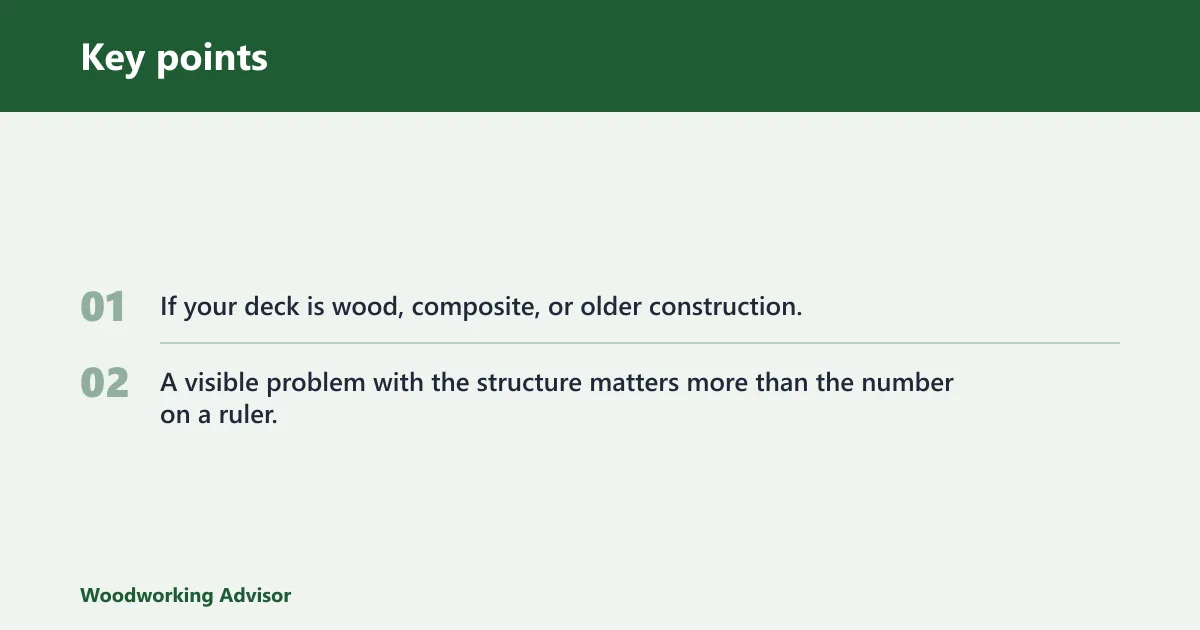
Use the table as a decision tool. If your deck is wood, composite, or older construction, do not wait for a precise inch count when the snow is wet, drifted, or crusted. A visible problem with the structure matters more than the number on a ruler.
When is snow too heavy?
Snow is too heavy when the deck shows warning signs, when the estimated load approaches the deck’s design basis, or when the deck is carrying more than just snow. If you see sagging, cracking, fastener movement, or unusual bounce, stop using the deck and remove load if you can do so safely.
If the deck is old, damaged, or has corrosion, rot, or prior structural issues, treat the threshold as lower. A deck that looks stable from above may still have hidden connection problems at the ledger, posts, or beam supports.
Visible warning signs of overload
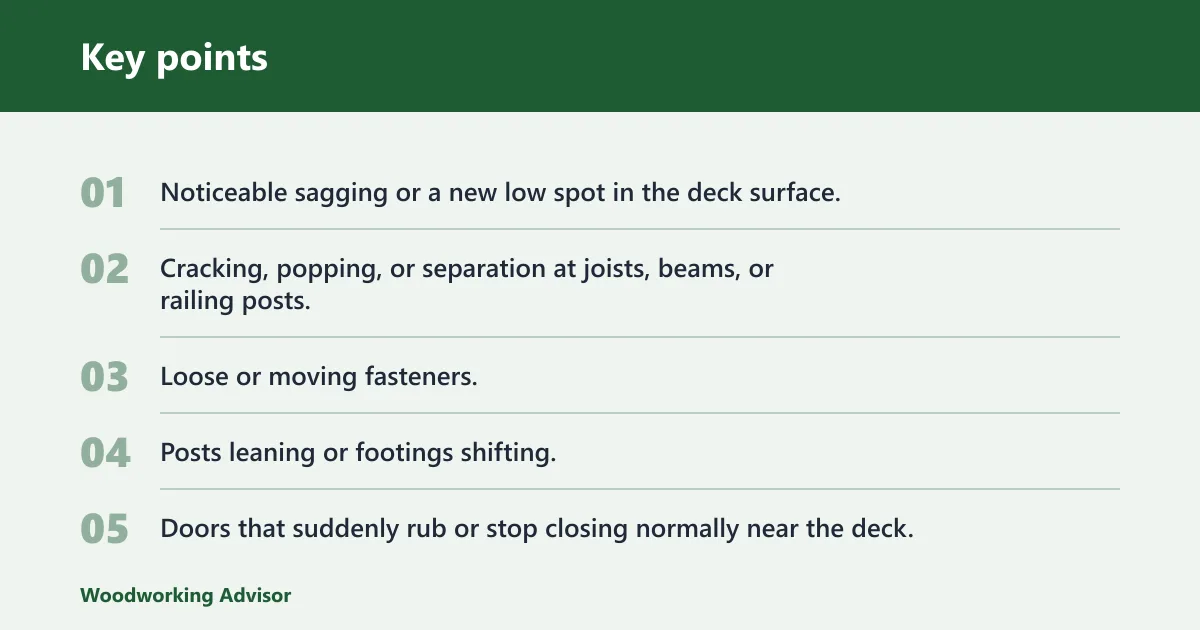
- Noticeable sagging or a new low spot in the deck surface.
- Cracking, popping, or separation at joists, beams, or railing posts.
- Loose or moving fasteners.
- Posts leaning or footings shifting.
- Doors that suddenly rub or stop closing normally near the deck.
When to unload the deck fully
Full unloading is the safer choice when snow is wet, drifted, or mixed with ice, and when the deck already has visible deflection or damage. Do not wait for a walking path only if the estimate is already near the design limit. The real question is whether the structure can safely carry any more load at all.
Say your 12 by 16 deck has a pile of wet snow along one side, patio furniture still in place, and a railing that flexes more than usual. That is not a “clear a path” situation. Remove the load if it can be done without risk, and arrange a qualified structural inspection if movement or cracking is present.
When to stop using the deck and get an inspection
Stop using the deck immediately if active failure signs appear: sudden sagging, a split beam, failing connections, or visible separation at the ledger or posts. If there is any doubt about the structure, arrange a structural engineer or a qualified deck contractor to evaluate it. If failure seems imminent, keep people off the deck and use emergency services as needed.
How should you remove snow safely?
Use a plastic or rubber shovel, not a metal blade. Metal can gouge wood, scratch composite surfaces, and damage railings. Remove snow gently in thin passes so you do not pry at boards or overload one area while working another.
A common first-timer mistake is pushing the shovel hard against the deck and trying to scrape it clean to bare boards. That can scar the surface and force water into damage points. Leave a thin residue if needed, especially on wood decks, rather than grinding into the boards.
Safe removal steps
- Clear furniture, planters, and movable items first if it is safe to do so.
- Start at the edge and work in thin layers.
- Push snow in the direction that creates the least load shift on the deck.
- Avoid piling snow against rails or along one edge.
- Stop if the deck flexes more than usual or new noises appear.
Which ice melt products to avoid?
Avoid chloride salts on wood decks when possible. They can damage the wood, fasteners, and nearby metal parts. If de-icing is necessary, choose deck-safe products and use them sparingly according to the product label. The goal is traction without accelerating corrosion or surface damage.
Wood vs composite decks in winter
Composite decking is usually more moisture-resistant than wood, so it handles winter surface exposure better. That does not mean it has much higher structural capacity if the framing, spans, and supports are the same. The structure carries the load.
Wood decks need more caution during snow removal because blades can gouge the surface and because soft woods such as cedar and redwood are more vulnerable to surface damage. Older wood decks also deserve extra scrutiny because rot, checking, and loose connectors can reduce capacity before snow becomes visibly deep.
What matters more than the decking surface
Deck capacity depends on joists, beams, posts, footings, ledger attachment, and fasteners. If those parts are undersized, damaged, or poorly connected, composite boards will not solve the problem. If those parts are sound, a wood deck can be very capable under winter load.
Suppose two decks are both 10 by 12 feet. One is newer with tight connections and sound framing; the other has a corroded ledger and sagging beam. The second deck is the one that needs attention first, even if both have the same surface material.
Should you worry about rail height?
Rail height is only a rough visual cue, not a capacity rule. One competitor uses 36 inches as a reference point, but railing height varies, and snow depth alone does not tell you whether the framing is safe. A rail can disappear under snow before the deck is near its limit, or remain visible while hidden structural damage exists.
Use rail height only as a reminder that accumulation is growing. Do not use it as the main decision point for safety.
Frequently asked questions
How much snow can a deck hold?
A properly built deck can hold significant snow, but the safe amount depends on framing, supports, connections, and condition. A common live-load basis is 40 to 50 pounds per square foot. Convert snow depth to weight by snow type, and clear the deck sooner if the snow is wet, drifted, or icy.
How much snow can a composite deck hold?
Composite decking is usually more moisture-resistant than wood, but the framing still governs snow capacity. A composite surface does not automatically mean higher structural strength. Judge the deck by its joists, beams, posts, ledger, and condition, then remove snow based on the estimated weight, not just the surface material.
How much snow can a wooden deck hold?
A wood deck can hold substantial snow if the structure is sound, but soft woods such as cedar and redwood need extra caution during removal. Use a plastic or rubber shovel, avoid gouging the boards, and watch for rot, corrosion, and loose connections that lower capacity before snow depth looks extreme.
How many inches of snow can a deck hold?
There is no single safe inch count because snow density changes the load. Dry powder is lighter than wet snow, and ice changes the risk again.
How much snow can a balcony hold?
A balcony follows the same structural principles as a deck, but capacity can be lower because balconies are often smaller and may have different support details. Do not assume balcony strength from snow depth alone. Treat wet snow, ice, and any visible movement as reasons to clear load and inspect the structure.
Sponsored / affiliate links. As an Amazon Associate I earn from qualifying purchases. I may earn additional commission from eligible campaigns.
 Wood Interlocking Deck Tiles, 12"X12" 36 PCS Patio Wooden Deck Flooring Waterproof for Balcony, Backyard, Garden & Poolside, All Weather Use, Natural Wood
 VICASKY 2PCS Small Wood Maintenance Beeswax Polish for Furniture Floors Natural Yellow Seasoning Wax for Crack Repair Surface Protection Food Safe Organic Formula Easy Application for