How to Attach Metal Legs to a Wood Table: Screw Length Chart
To attach metal legs to a wood table, screw each leg’s mounting plate to the underside of the top, using screws shorter than the top is thick so the tips never poke through the surface. Solid wood tops also swell and shrink across the grain, so hardware that ties wide boards down rigidly can crack them. This guide covers the three hardware styles, a screw-length chart by top thickness, and a wood-movement allowance.
Which Metal Leg Hardware Fits Your Table?
Best Hairpin Legs With Leveling Feet
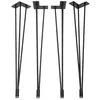 |
Rockler I-Semble 28 in. 3-Rod Hairpin Table Legs with Adjustable Feet (4-Pack), $69.99 Direct-mount plate legs like these are the simplest way to follow the steps in this guide, and the listing itself warns that the included screws are 1 in. long, which the screw-length chart below shows is too long for a thin top.
|
As an Amazon Associate we earn from qualifying purchases.
Metal legs reach the top in three common ways, and the hardware you buy decides how you attach them. Most of the legs people search for, hairpin legs and flat-plate steel legs, are the first type: the plate is part of the leg and the set ships with its own screws.
| Hardware style | What is on the leg | What goes into the top | Limits and notes |
|---|---|---|---|
| Direct-mount plate legs (hairpin, square tube) | Flat plate welded to the leg | Wood screws through the plate holes, supplied with the set | Check the supplied screw length against your top. Rockler’s standard 3-rod set ships 3/4 in. screws, its adjustable-foot set ships 1 in. screws. |
| Mounting plate plus hanger bolt | Hanger bolt driven partway into the leg | Screws through a separate plate (Rockler’s heavy-duty plate for 5/16-18 bolts has 5 holes) | Table Legs says this style is not for heavy loads, frequently moved furniture, or legs over 2.25 in. in diameter. |
| Threaded insert | Leg with a 3/8 in. insert bolt | Insert driven into the underside of the top | Table Legs lists it for wood bases only. |
The figures in the last column come from the Rockler adjustable-foot listing, the Rockler standard 3-rod listing and the Table Legs guide to attachment methods. None of those pages gives a load rating in pounds that we can verify, so this guide does not quote one. If your table has no apron to screw into, our guide to attaching legs to a table without an apron walks through plate, insert, block and cleat methods in more depth. For metal-to-wood fastening in general, see how to attach metal to wood.
How Long Should the Screws Be? A Chart by Top Thickness
The screw must be shorter than the top is thick, and the plate itself eats part of the screw length. Wood penetration equals the screw length minus the plate thickness. Our rule of thumb, which is our own arithmetic and not a published standard, is to leave at least 1/4 in. of uncut wood below the screw tip. Rockler’s adjustable-foot listing makes the same point in plainer terms:
“we suggest using shorter mounting screws to avoid any breakthrough”
The chart below assumes a plate 1/8 in. thick. Measure your own plate with calipers or a ruler and adjust: a 3/16 in. plate lets you use a screw 1/16 in. longer, a 1/16 in. plate needs one 1/16 in. shorter. Measure the top too. Actual thickness is what counts, not the nominal size on the lumber tag.
| Top thickness | Max wood penetration (thickness minus 1/4 in.) | Longest screw with a 1/8 in. plate | Rockler 3/4 in. screw | Rockler 1 in. screw |
|---|---|---|---|---|
| 5/8 in. | 3/8 in. | 1/2 in. | Breaks through | Breaks through |
| 3/4 in. | 1/2 in. | 5/8 in. | Leaves 1/8 in., tight | Breaks through |
| 1 in. | 3/4 in. | 7/8 in. | OK, leaves 3/8 in. | Leaves 1/8 in., tight |
| 1-1/2 in. | 1-1/4 in. | 1-3/8 in. | OK | OK |
| 2 in. | 1-3/4 in. | 1-7/8 in. | OK | OK |
Round down to the next screw length you can actually buy. The practical lesson is that the 1 in. screws in a typical hairpin set are only comfortable on tops at least about 1-1/4 in. thick under our rule, so a 3/4 in. plywood or butcher-block panel needs a shorter screw, usually 1/2 in. or 5/8 in. If the top is MDF, which is weaker in the face than solid wood, see our guide to joining MDF for pilot-hole and thread-type advice before you commit to screws.
Will Metal Legs Crack a Solid Wood Top? The Wood Movement Allowance
Solid wood changes width with humidity, and the change is across the grain, not along it. Fine Woodworking’s guide to attaching tabletops states that most of the expansion and contraction takes place across the grain, and that quartersawn wood moves a little less than half as much as flatsawn. Woodcraft’s tabletop fastener guide gives a working estimate of 3/16 in. of seasonal movement per foot of board width.
📊 Seasonal movement estimate: about 3/16 in. per foot of width across the grain. Source: Woodcraft, Tabletop Fasteners.
Applying that estimate gives the table below. These are our own arithmetic on Woodcraft’s per-foot figure, and real movement depends on species, cut and how far your room’s humidity swings, so treat them as order-of-magnitude numbers.
| Top width across the grain | Estimated seasonal movement | Slot length to add (our suggestion) |
|---|---|---|
| 12 in. | about 3/16 in. | 1/4 in. |
| 18 in. | about 9/32 in. | 3/8 in. |
| 24 in. | about 3/8 in. | 1/2 in. |
| 30 in. | about 15/32 in. | 5/8 in. |
| 36 in. | about 9/16 in. | 3/4 in. |
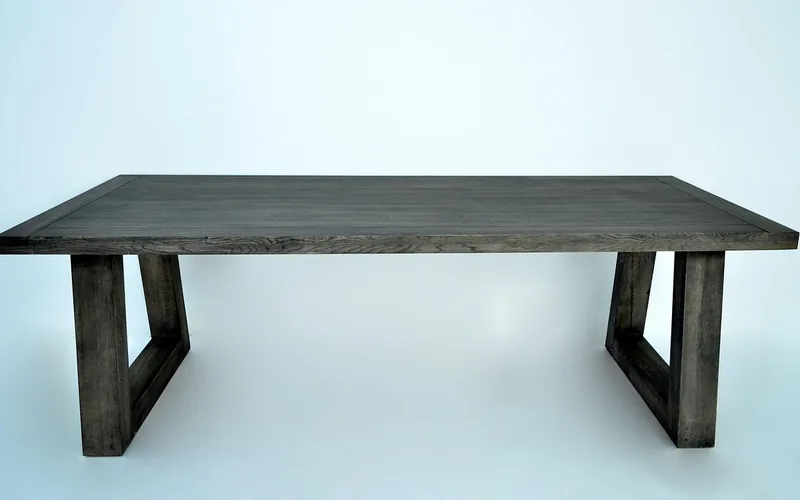
Here is the part most guides skip, and it is our own reasoning rather than a sourced rule. Four independent hairpin legs each grip only the footprint of their own plate, a few inches of wood, so the movement across a single plate is tiny and the top can still shift between legs. The real risk starts when something ties the legs together across the grain: an apron, a stretcher, a steel sled base, or a rail. A rigid frame fixed to a wide solid top at both edges leaves the wood nowhere to go. If you build a frame like that, our strong wooden box frame guide covers the corner joints, and the frame should attach to the top the way furniture makers attach any rail: with slotted holes, wooden buttons, or figure-8 or Z-clip fasteners, all methods Fine Woodworking and Woodcraft describe.
- Slot the screw holes in the frame or bracket in the cross-grain direction, using the slot lengths above as a starting point.
- Use a pan-head screw with a washer and drive it snug, not tight, so the washer can slide in the slot.
- Fix the top rigidly only along its centerline, where the board does not move relative to the base.
- For a calculation specific to your board, our wood movement calculator works out joint clearance.
How to Attach Metal Legs to a Wood Table, Step by Step
You need a drill, a bit for the pilot holes, a screwdriver or driver bit that fits the screw head, a tape measure and a pencil. A scrap of the same thickness as the top is worth having for a test hole.
- Protect the top: lay it finished side down on a blanket or cardboard.
- Mark the leg positions: decide the inset from the edges (see the stance section below), set each plate square to the edge and mark its holes with a pencil.
- Pick the screw length: use the chart above and wrap a piece of tape around the drill bit at the penetration depth so you stop in time.
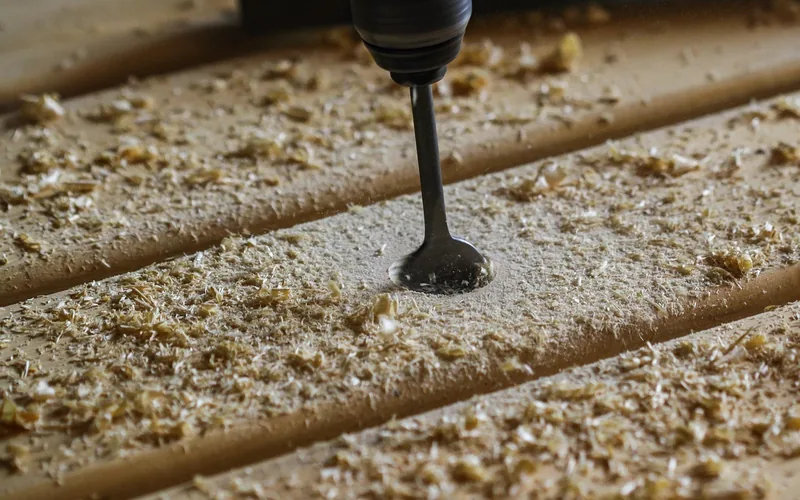
- Drill pilot holes: match the pilot to the screw size on the screw package and test it in the scrap first, because dense hardwood can split without a pilot.
- Drive the screws: run them in until the plate sits flat and snug. Stop at snug, since over-tightening can strip the threads in softer wood.
- Thread hanger-bolt legs in: if your legs use a hanger bolt, screw the bolt partway into the leg first, then turn the leg into the plate until it seats.
- Stand it up and test: set the table on a flat floor, press on each corner and adjust the feet or glides if it rocks.
Where to Put the Legs: Stance, Stability and Leveling
Wider stance means a more stable table, which is simple geometry. Measure from the outer edge of one leg to the outer edge of the opposite leg and keep that span as wide as the plate and the look allow. On a 30 in. by 60 in. top with each leg inset 3 in. from every edge, our example gives a stance of 24 in. by 54 in. The same legs inset 8 in. would stand on 14 in. by 44 in., a much easier table to tip. The plate must still sit fully on the top with wood around its holes, so check the plate footprint before you mark.
Match the leg to the table. Rockler lists its 28 in. 3-rod hairpin legs for dining tables, desks, buffets, entry tables and sofa tables, and its 16 in. size for coffee tables, end tables and media consoles, and says the third support stem makes the legs rigid enough for heavier tops. If the floor is not dead flat, a leg with an adjustable glide fixes it: Rockler notes that the nylon glides let you level the table and protect floors from scratching. If your set has no glides, separate feet are sold for hairpin legs.
Safety note: a table that rocks or tips can hurt, especially around small children who climb or lean on it. This guide gives no load rating because none of the sources we read lists one that we can verify, so test the finished table by pressing hard on each corner and the center before it is used. Treat that as a minimum, not as certification.
Common Mistakes When Attaching Metal Legs
- Using the supplied screws on any top: Rockler’s own sets ship 3/4 in. and 1 in. screws, so the right length depends on your top, not the box.
- Ignoring movement with a rigid frame: tying legs together with a stretcher bolted to a wide solid top, with no slots.
- Skipping pilot holes in hardwood: splits start at the screw, often on the underside where you will not see them.
- Setting the legs too close to the middle: the narrower the stance, the easier the table tips.
- Picking hanger-bolt plates for a heavy table that moves often: Table Legs advises against that use.
- Measuring nominal thickness: a top labeled 3/4 in. may measure less, which changes the safe screw length.
Frequently Asked Questions About Attaching Metal Legs
How long should the screws be for metal table legs?
Shorter than the top is thick, with at least about 1/4 in. of uncut wood below the tip under our rule of thumb. Subtract the plate thickness from the screw length to get the wood penetration. A 3/4 in. top, for example, takes a screw around 5/8 in. long with a 1/8 in. plate, not the 1 in. screws some hairpin sets include.
Do I need pilot holes for metal table legs?
Yes, in most wood. A pilot hole stops the screw from splitting the wood, especially near edges and in hardwood. Match the pilot size to the screw using the screw package, test it on scrap of the same thickness, and stop the drill before it reaches the top face.
Can hairpin legs crack a solid wood top?
Independent hairpin legs mostly let the top move because each plate covers only a few inches. The risk comes from tying the legs together with an apron or stretcher fixed rigidly to a wide solid top. Use slotted holes, buttons, or figure-8 or Z-clip fasteners across the grain in that case.
Do I need an apron if I use metal legs?
Not for direct-mount plate legs such as hairpins, which screw straight to the underside. Wide or heavy tops and tops that flex benefit from extra support. Our guide to attaching legs without an apron compares the plate, insert, block and cleat methods.
How do I stop a table with metal legs from wobbling?
First check that all plates sit flat and every screw is snug. Then use legs with adjustable glides, or add feet, to level the table on an uneven floor. A wider stance also reduces rocking and tipping.
Match the screw to the thickness of the top, give solid wood room to move whenever the legs are tied together, and set the legs as wide apart as the design allows. Those three choices matter more than the brand of leg. Our guide to building simple wooden table legs is the alternative if you would rather make the legs than buy them.
Sponsored / affiliate links. As an Amazon Associate I earn from qualifying purchases. I may earn additional commission from eligible campaigns.