How to Calculate the Load Capacity of Wood (With a Safety Factor)
To calculate the load capacity of a piece of wood, you need three things: the species’ allowable bending stress (Fb), the wood’s section modulus (based on its width and thickness), and a safety factor — typically 4:1 to 6:1 for general lumber use. Multiply Fb by the section modulus to get the ultimate load, then divide by your safety factor to get the safe working load. The exact numbers change with species, grade, moisture content, and whether the wood is loaded by bending (a shelf or plank) or by compression (a post or column) — those are two different calculations, not one formula.
If you’re specifically sizing a structural beam or joist across a span, see our wood beam load capacity guide for the full bending-stress formula and a size-by-size span chart. This guide covers the more general case: shelves, small pieces, and column/post loading.
Step-by-Step: Calculating Load Capacity for a Piece of Wood
Check This Before You Trust the Numbers
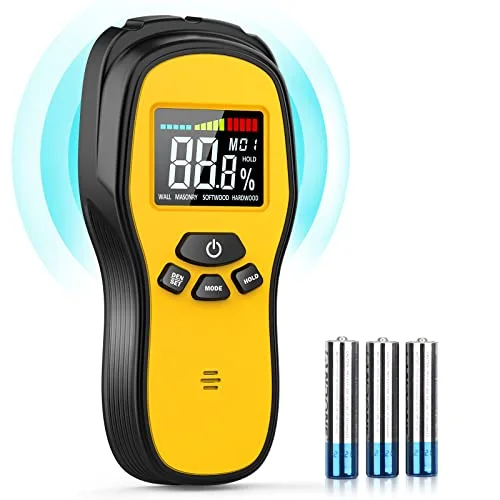 |
Digital Pinless Wood Moisture Meter – $27.99 Published load values assume seasoned wood around 12-15% moisture — wetter wood measurably loses strength, so checking moisture first keeps your calculation honest.
|
- Identify the species and grade — allowable stress values differ significantly even within “hardwood” or “softwood” categories
- Measure the piece’s width and thickness to calculate section modulus (S = width × thickness² ÷ 6 for a rectangular cross-section)
- Look up the species’ allowable bending stress (Fb), typically published in pounds per square inch (psi)
- Multiply Fb × S to get the beam’s moment capacity, then relate that to the actual span and load pattern to get ultimate load
- Divide the ultimate load by a safety factor of 4:1 to 6:1 to get your safe working load
- Check the wood’s moisture content — published stress values assume seasoned wood around 12-15% moisture, and wetter wood carries measurably less
Why Species and Grain Direction Change the Numbers
Allowable bending stress varies by a wide margin between common species. As rough reference points, framing-grade Douglas Fir-Larch runs around 900-1,000 psi allowable Fb, Southern Yellow Pine runs slightly higher, and construction-grade pine (SPF) typically sits lower, around 700-875 psi — grade stamps and regional lumber standards shift these numbers, so treat them as a starting comparison, not a substitute for your specific grade stamp. Hardwoods like oak generally handle more stress before failure than construction softwoods, but oak lumber is far less commonly graded and sold with published structural values, which is exactly why span tables and safe-load charts are built almost entirely around a handful of structural softwoods.
Grain direction matters as much as species. Wood loaded along the grain (compression, like a post standing vertically) handles dramatically more force than the same wood loaded across the grain (like a shelf bending under weight). A piece strong enough to support a heavy load as a vertical post can fail at a fraction of that weight used flat as a shelf — they are not the same load path, even though it’s the same piece of wood.
Applying a Safety Factor Correctly
The “ultimate load” from the Fb × section modulus calculation is the load at which the wood is expected to fail — not a number you should ever design toward. A safety factor divides that number down to a load you can actually rely on day to day. For general-purpose lumber projects, 4:1 is a common minimum; for anything supporting people (a loft bed, a bench, a step) or subject to repeated dynamic loading, 6:1 is the more conservative and generally recommended choice. A safe working load of 200 lb, for example, implies an ultimate failure load somewhere around 800-1,200 lb depending on which factor you applied — the gap is the margin for knots, unknown moisture history, and load types the original calculation didn’t account for.
Load Duration: Why a Number Isn’t the Same for 5 Seconds vs. 10 Years
Wood is unusual among structural materials in that it can carry noticeably more load briefly than it can carry safely for years at a time. Engineering span tables build in a “duration of load” adjustment: allowable stress values published for normal (roughly 10-year) duration get increased for short-term loads like wind or a brief impact, and reduced for permanent, continuous dead loads. A shelf holding books indefinitely is a permanent-load case and should be sized more conservatively than the same shelf just used to briefly set something down.
This is part of why a published allowable stress value already has real conservatism baked in before you even apply your own safety factor — it’s not simply “this is exactly what the wood can hold.” For everyday DIY calculations, the practical takeaway is simple: size anything meant to carry a load permanently (a shelf, a loft bed frame, a bench seat) more conservatively than something loaded briefly and occasionally.
Worked Example: A Shelf or Small Piece Under Bending
Take a 1×2 piece of oak, 24 inches long, supported at both ends and loaded in the middle (a small shelf bracket or display piece). Its actual cross-section is about 0.75″ × 1.5″. Section modulus S = (0.75 × 1.5²) ÷ 6 ≈ 0.28 in³. Using a conservative allowable bending stress for oak around 1,200 psi, moment capacity works out to roughly 336 in-lb. For a center-point load on a 24″ span, that translates to an ultimate center load in the range of 55-60 lb — and after a 5:1 safety factor, a safe working load around 11-12 lb at the center. That’s a genuinely small number for a piece that looks sturdy, which is exactly why thin oak strips make poor unsupported shelving without added support underneath.
Compare that to a 2×12 pine plank, 12 feet long, used flat as a work platform or scaffold board. At full nominal thickness, its section modulus is far larger (roughly 31 in³), and even with pine’s lower allowable stress, the much larger cross-section supports several hundred pounds at mid-span before any safety factor is applied — this is why board thickness affects load capacity far more than most people expect: section modulus scales with the square of thickness, so doubling thickness roughly quadruples bending capacity.
Wet-Service Conditions Lower the Numbers Further
All the reference stress values discussed so far assume dry-service conditions — wood that stays under about 19% moisture content in use, which covers most interior furniture, shelving, and framing. Outdoor structures, anything near a pool or in a consistently damp basement, or lumber that was installed before it had a chance to season fully all fall under wet-service conditions, where published allowable stress values get reduced again, sometimes by 20% or more depending on species and the specific stress being calculated.
If you’re building anything load-bearing outdoors — a deck bench, a planter box someone might sit on, an outdoor shelf — treat the wet-service reduction as mandatory, not optional. Combining that reduction with a 6:1 safety factor rather than 4:1 is the more conservative and appropriate choice for exterior work exposed to weather cycles.
Columns and Posts: A Different Calculation Entirely
A vertical wood post or column carries load in compression parallel to the grain, not bending — and wood is considerably stronger in that direction. The limiting factor for a tall, slender post usually isn’t crushing strength at all, it’s buckling: a post that’s too tall and thin for its cross-section can fail by bowing sideways well before the wood itself crushes. This is why a 4×4 post rated for a given load at 8 feet tall carries meaningfully less at 12 feet even though the wood and cross-section haven’t changed — the slenderness ratio (height relative to the narrowest cross-section dimension) is doing real work in the calculation, separate from the species’ raw compressive strength.
Common Mistakes That Throw Off a Load Estimate
- Ignoring knots and defects: published stress values assume a specific lumber grade’s defect limits — a large knot near the edge of a board can cut its real capacity well below the grade-stamped value at that exact point
- Using nominal dimensions instead of actual: a “2×4″ is actually 1.5″ × 3.5″ after milling, not 2″ × 4” — using nominal size overstates section modulus and load capacity
- Skipping the safety factor entirely: the “ultimate load” number is a failure point, not a design target — always divide it down before treating it as a real-world limit
- Treating a point load and a distributed load the same: a single heavy weight in the center of a span stresses a board differently than the same total weight spread evenly across it — span tables typically assume uniform distributed load unless stated otherwise
Frequently Asked Questions
What safety factor should I use for wood load calculations?
4:1 is a common minimum for general lumber projects. Use 6:1 for anything supporting people or subject to repeated dynamic loading, since it leaves more margin for knots, moisture variation, and unexpected load types.
Does moisture content really change wood’s load capacity?
Yes, measurably. Published allowable stress values assume seasoned wood around 12-15% moisture. Wetter wood is weaker, which is why checking moisture content before relying on a load calculation matters, especially for outdoor or recently-milled lumber.
Is a wood column’s load capacity the same as a beam’s?
No. A column carries load in compression parallel to the grain and is often limited by buckling rather than crushing strength, especially when tall and slender. A beam or shelf carries load in bending across the grain, governed by section modulus and allowable bending stress. They require different formulas.
Why does board thickness matter more than width for load capacity?
Section modulus for a rectangular board scales with the square of its thickness but only linearly with width. Doubling thickness roughly quadruples bending capacity, while doubling width only doubles it — so a thicker board resists bending far more effectively than a wider one of the same thickness.
Does a load calculation change for outdoor wood?
Yes. Outdoor and consistently damp lumber falls under wet-service conditions, where allowable stress values are reduced, sometimes by 20% or more, compared to dry interior lumber.
Why use actual lumber dimensions instead of nominal size?
A “2×4” actually measures 1.5 by 3.5 inches after milling. Using the nominal 2×4 size in a section modulus calculation overstates the board’s real load capacity.
Conclusion
Wood load capacity comes down to three real inputs — species/grade allowable stress, cross-section (section modulus for bending, or slenderness for columns), and a safety factor — not a single universal number. Check moisture before trusting the result, keep bending and compression calculations separate, and lean toward a 6:1 safety factor whenever the load involves people rather than just static storage weight. If you’re sizing temporary support rather than a permanent beam, see our jack screw post guide for matching a post’s rated capacity to the load.
Sponsored / affiliate links. As an Amazon Associate I earn from qualifying purchases. I may earn additional commission from eligible campaigns.