How to Cut a 65-Degree Angle With a Miter Saw
No stock miter saw swings to a 65-degree miter — even wide-range DeWalt and Makita compound saws max out around 50-60 degrees. The workaround: clamp a scrap board pre-cut to 45 degrees against the fence, then set the saw itself to just 20 degrees (65 minus 45). Skip this and rake-board returns or staircase base-cap joints will not close tight. Below: the jig setup, the exact math, and where a 65-degree cut actually gets used.
What You’ll Need
Best Angle-Setting Pick
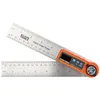
Klein Tools 935DAF Digital Angle Finder
Reads inside and outside angles to within 0.2°, so you can confirm the guide board is really at 45° before you clamp it down.
- Best for: verifying the guide board angle and the saw’s 20° setting before cutting good stock
- Why we picked it: a speed square gets you close, but this jig relies on two angles stacking correctly — a digital readout removes the guesswork
- Main drawback: needs a battery and a flat reference edge to zero out accurately
Compare more angle-cutting jig options
 Option 1 Swanson 7-Inch Speed Square
|
 Option 2 IRWIN Quick-Grip Mini Bar Clamps (4-Pack)
|
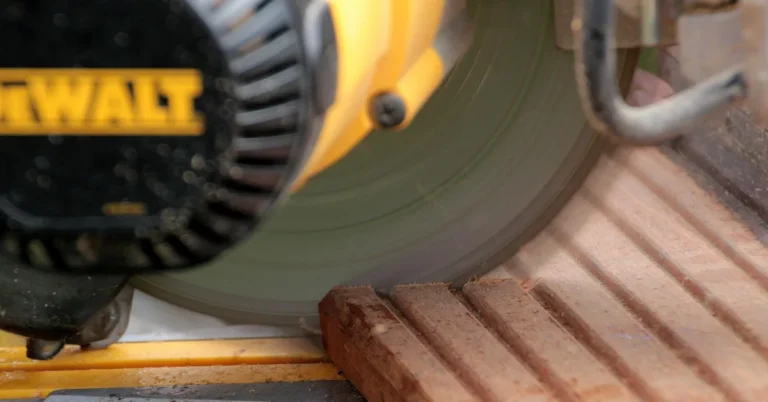
 Option 3 DEWALT DWS715 12-Inch Compound Miter Saw
|
As an Amazon Associate we earn from qualifying purchases.
This jig works with any miter saw, regardless of its native miter range, because the guide board — not the saw’s angle scale — does most of the work.
- Miter saw (single-bevel is fine — no compound or sliding features required)
- A straight scrap board for the guide, at least 12 inches long (1×4 or 1×6 works well)
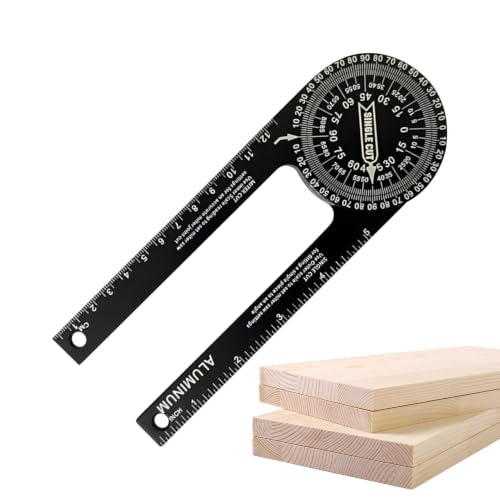
- Speed square or a digital angle finder
- At least two bar or C-clamps
- Pencil, tape measure, and safety glasses
- Sharp, unworn blade — check ours on when to replace a miter saw blade if yours is due
Why No Miter Saw Cuts 65° on Its Own
Even the widest-swinging consumer compound miter saws stop 5 to 15 degrees short of 65°. See our full guide to cutting angles with a miter saw for how these ranges work day to day.
| Saw Type | Typical Miter Range | Reaches 65°? |
|---|---|---|
| DeWalt compound (e.g. DWS715, DWS780) | 0-60° right / 0-50° left | No — 5° short on the wide side |
| Makita compound (e.g. LS1018) | 0-60° both sides on some models, 0-47° on others | No, or 18° short on narrower models |
| Entry-level / benchtop miter saws | 0-45° to 0-50° both sides | No — 15-20° short |
That gap is the entire reason the guide-board jig exists — it is not a workaround for a cheap saw, it is a workaround for the tool category itself.
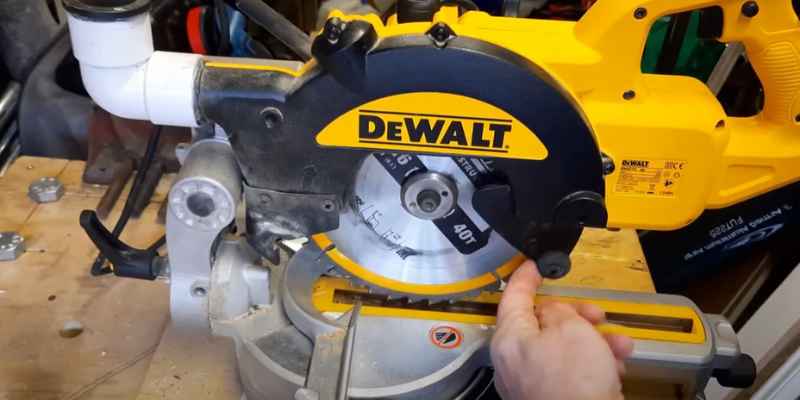
How to Cut a 65-Degree Angle With a Miter Saw (Jig Method)
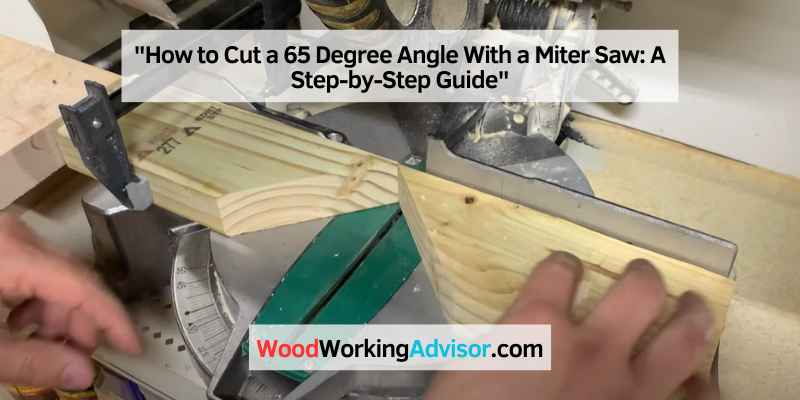
This method stacks a fixed 45° guide board with a 20° saw setting to reach a true 65° cut. Once you have the guide board built, you can reuse it for any angle between 45° and 90° by changing only the saw’s miter setting.
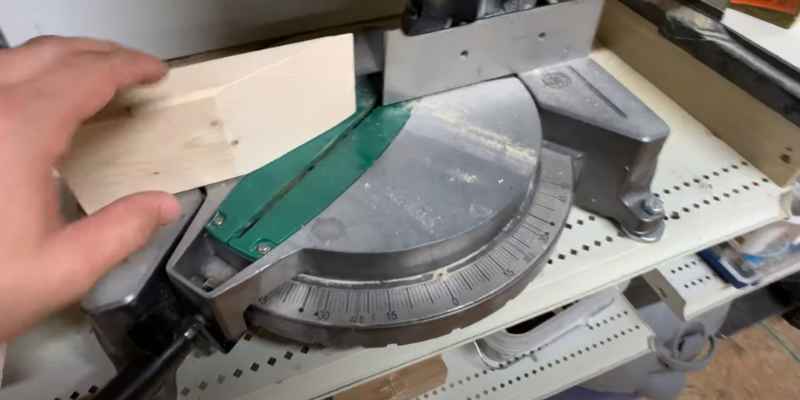
- Cut the guide board at 45°: Set the miter saw to 45° and cut one end of your scrap board (1×4 or 1×6). This angled end is what the workpiece will register against — it needs to be a clean, accurate 45°, so verify it with a speed square before moving on.
- Set the saw to 20°: Reset the miter saw to 20° (65° minus the 45° guide board angle). Leave the guide board off the saw table for this step — you are only setting the blade angle right now.
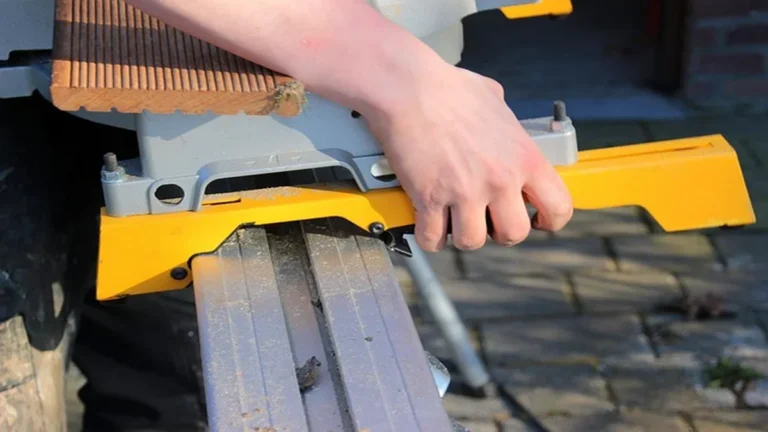
- Clamp the guide board to the fence: Position the guide board’s angled end toward the blade and clamp it firmly to the saw’s fence so it cannot shift during the cut. Double-check it is flush against the fence along its whole length.
- Position and clamp the workpiece: Place your actual workpiece flat against the angled edge of the guide board, mark your cut line, then clamp the workpiece down. Never hand-hold stock for a cut this acute — the offcut can bind or kick back.
- Make the cut slowly: Start the saw, let it reach full speed, and feed it through the workpiece slowly and steadily. Because the effective cutting angle is extreme, the blade is engaging more material per pass than a standard 90° crosscut — do not force it.
- Verify the angle before committing more stock: Check the finished cut with a speed square or digital angle finder before cutting the rest of your pieces. If it is off, the guide board’s 45° edge is the most likely culprit — re-cut it rather than trying to compensate at the saw.
The Math: Why 65° Minus 45° Equals 20°
The guide-board angle and the saw’s miter setting add together to form the final cut angle. Because the guide board is fixed at 45°, whatever you set on the saw gets added directly on top of it. For 65°, that means 65 − 45 = 20° on the saw dial. This is not specific to 65° — the same subtraction works for any angle between 45° and 90°, and it is worth checking against our full miter saw angle chart or the miter angle calculator before you cut.
| Target Angle | Saw Setting (Target − 45°) |
|---|---|
| 50° | 5° |
| 55° | 10° |
| 60° | 15° |
| 65° | 20° |
| 70° | 25° |
| 75° | 30° |
Need one of the other angles on this list instead? Our 75-degree miter saw guide and 60-degree miter saw guide walk through the same jig at those settings. If your saw itself is out of calibration, start with how to adjust a miter saw before trusting either number.
📊 Bevel ranges are often asymmetric too: the DEWALT DWS715 listed above bevels 0-48° to the left but only 0-3° to the right. Always check both directions on a spec sheet before assuming a compound cut needs no jig. Source: manufacturer listing, DEWALT DWS715.
Where a 65-Degree Cut Actually Gets Used
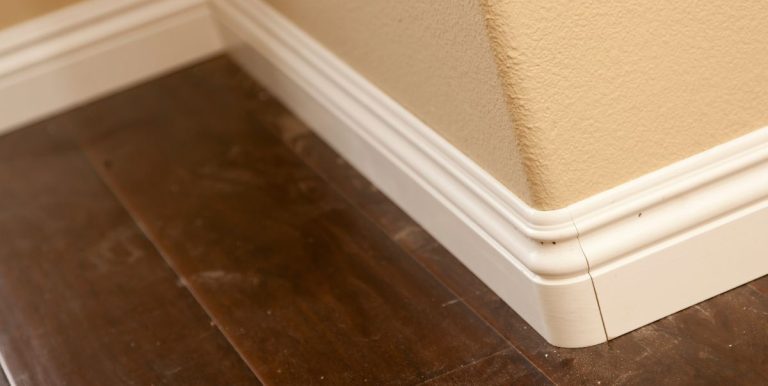
A 65-degree angle is not a standard trim spec — it shows up when a project’s geometry demands it, not because it is a common preset. According to Fine Homebuilding’s trim-carpentry coverage, cuts beyond a saw’s standard 45-degree range come up on rake-board trim where molding dies into a Greek Revival cornice return, on base-cap transitions at staircases, and on trim for trapezoid-shaped windows and built-ins. In each case, the wall or roof pitch sets the angle — you measure the actual joint first, then cut to match it, rather than assuming it will land on a round number.
Safety Tips and Common Mistakes When Cutting Extreme Angles
Extreme acute-angle cuts behave differently than a standard 45-degree miter, and most of the mistakes here come from treating them the same way.
“A 65-degree offcut is thinner and less stable on the table than anything you get from a normal miter — it wants to tip or slide under the blade instead of sitting flat. Clamp both the guide board and the workpiece before you touch the trigger, and re-clamp if either one shifts even slightly between marking and cutting.”
- Hand-holding the workpiece: at this angle the offcut has almost no flat surface left to grip — clamp it every time.
- Skipping the guide-board check: if the 45-degree edge on the guide board is off by even a degree or two, that error carries straight through to your final angle.
- Using a dull or wrong-tooth blade: an acute cut asks more of the blade per pass; a worn edge tends to burn or wander instead of tracking straight.
- Skipping the test cut: always verify on scrap before committing your actual trim or molding.
- Forcing narrow stock: anything under about 3 inches wide is hard to clamp safely at this angle — add extra support or size up the offcut you are working from.
FAQ
Can a miter saw cut a 65-degree angle by itself?
No. Most compound miter saws max out between 45° and 60° on their miter scale, and no consumer model reaches 65° natively. You need a 45° guide board clamped to the fence, with the saw itself set to 20°, to reach a true 65° cut.
What do you set a miter saw to for a 65-degree cut?
Set the saw to 20° and clamp a guide board pre-cut to 45° against the fence. The two angles add together (45° + 20° = 65°) to produce the final cut. Setting the saw directly to 65° will not work on most saws because the miter scale does not go that far.
Is a 65-degree cut a miter cut or a bevel cut?
It’s a miter cut — the angle is set by rotating the saw table (and, with the jig, the guide board) rather than tilting the blade. A bevel cut tilts the blade itself and is used for a different kind of joint, though the same 45-degree offset trick works for bevels on saws with a limited bevel range too.
Why won’t my miter saw cut past 45 or 50 degrees?
Miter saws are built with fixed detents and a limited swing radius because most trim work — door casing, baseboard, crown molding on standard 90-degree corners — only ever needs up to 45 degrees. Anything past that is a deliberate design cutoff, not a defect, which is why a guide-board jig exists for the rest.
Can I use this same jig method for other angles besides 65 degrees?
Yes. Subtract 45° from whatever angle you need and set the saw to the result — 15° for a 60° cut, 25° for a 70° cut, and so on. The guide board itself never changes; only the saw’s miter setting does.
A 65-degree cut is not something any miter saw handles out of the box, but the fix is a five-minute jig, not a new tool. Cut a guide board to 45°, set the saw to 20°, clamp everything twice, and test on scrap first. For the rest of the angles a stock saw can’t reach on its own, see our complete guide to cutting angles with a miter saw.
Sponsored / affiliate links. As an Amazon Associate I earn from qualifying purchases. I may earn additional commission from eligible campaigns.