How to Glue a Wood Backing to a Wall for Heavy Décor
Glue the wood to the wall only after the wall can carry the load mechanically: use construction adhesive plus screws into studs or suitable anchors, and do not rely on adhesive alone for heavy décor. Skip the load path, and the backing can peel off, crack tile or plaster, and drop the décor. This guide shows how to choose the attachment method for drywall, plaster, tile, masonry, and mixed surfaces.
What you’ll need
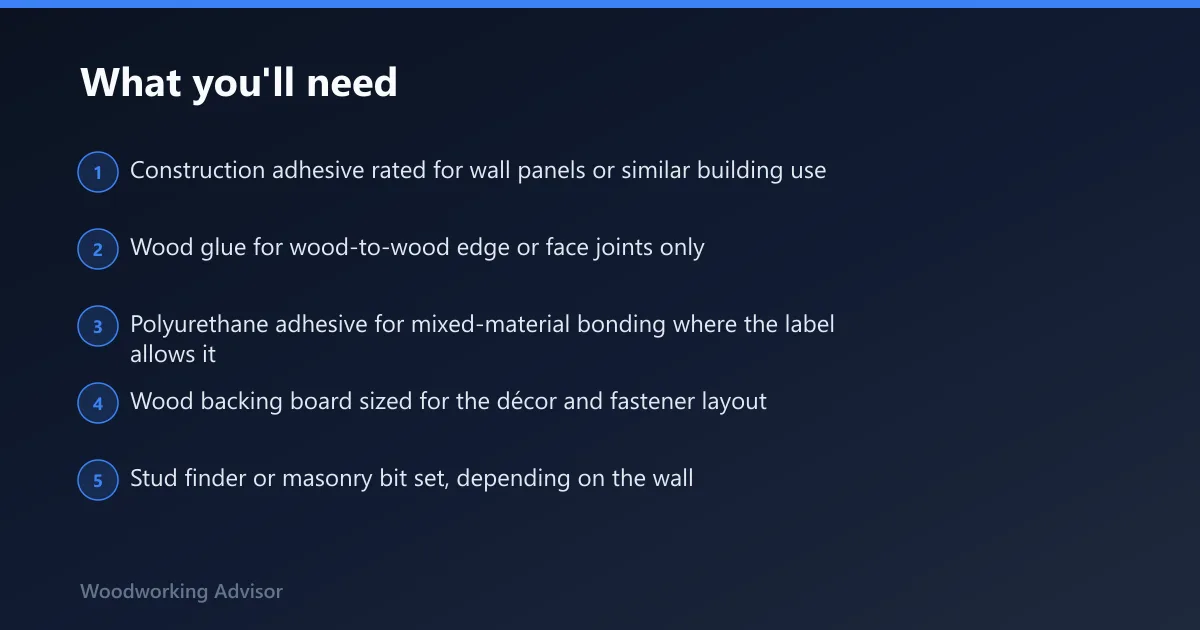

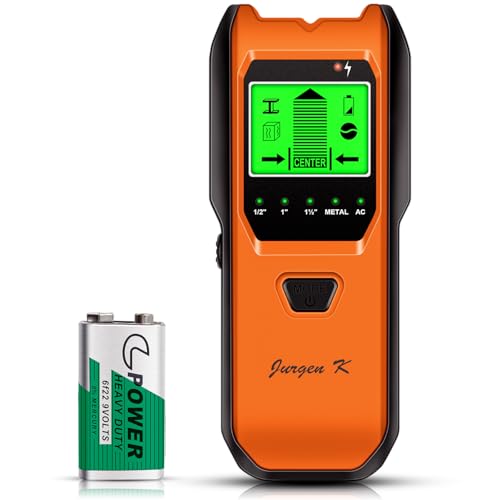

- Construction adhesive rated for wall panels or similar building use
- Wood glue for wood-to-wood edge or face joints only
- Polyurethane adhesive for mixed-material bonding where the label allows it
- Wood backing board sized for the décor and fastener layout
- Stud finder or masonry bit set, depending on the wall
- Screws, washers, toggle anchors, or masonry anchors as needed
- Clamps, temporary braces, or a support cleat for vertical hold
- Level, tape measure, pencil, and straightedge
- Utility knife, scraper, sandpaper, and dust brush
- Degreaser or cleaner, rags, and a solvent recommended by the adhesive label
- Caulk gun for cartridge adhesive
- Putty knife for squeeze-out cleanup
Wall-mount decision table for backing weight and décor weight
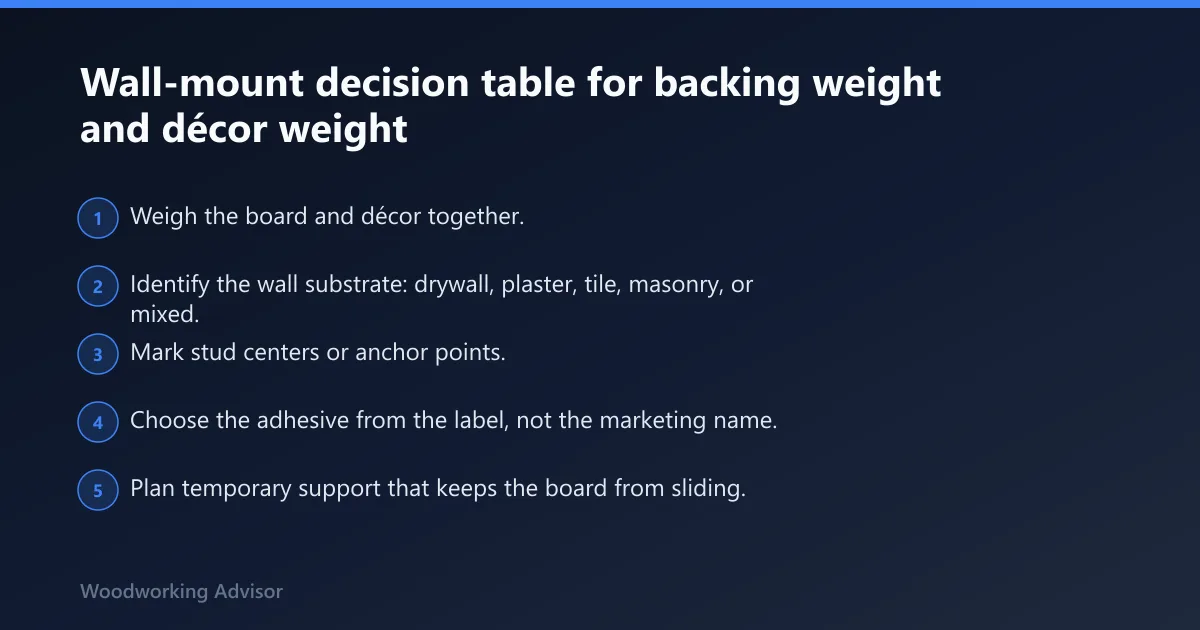
Start with the wall substrate and the total load, then choose the bond and fastener plan. A light backing with light décor can sometimes stay on a sound substrate with adhesive and temporary support, but heavy décor and weak wall surfaces move the job into mechanical fastening territory fast.
| Backing weight | Décor weight | Wall substrate | Adhesive choice | Mechanical fasteners mandatory? | Support until full cure |
|---|---|---|---|---|---|
| Light | Light | Unpainted drywall or wood | Construction adhesive | Recommended if the décor can swing or be bumped | Yes, with tape, brace, or clamp |
| Light to medium | Medium | Drywall with studs available | Construction adhesive | Yes, screws into studs | Yes |
| Medium | Heavy | Plaster or drywall without studs in the right place | Construction adhesive plus rated anchors | Yes, anchors or toggles | Yes, with a brace or temporary cleat |
| Medium to heavy | Heavy | Tile or masonry | Construction adhesive or polyurethane adhesive only if the label allows the substrate | Yes, masonry anchors or fasteners in joints/structure | Yes |
| Heavy | Very heavy or subject to pull | Any surface | Construction adhesive as secondary bond only | Yes, load must transfer to structure | Yes, plus a longer hold period if the adhesive label calls for it |
Check cure and support before loading
Wood glue is often off-white or yellow, works for wood and other porous materials, and usually needs clamps for full holding power. Construction adhesive is the wall product I reach for here, especially where it has to bridge between a board and a stud face, drywall, or masonry. Polyurethane adhesive can bond wood, stone, metal, plastic, and other materials, but it needs moisture to cure and may expand as it dries.
- Weigh the board and décor together.
- Identify the wall substrate: drywall, plaster, tile, masonry, or mixed.
- Mark stud centers or anchor points.
- Choose the adhesive from the label, not the marketing name.
- Plan temporary support that keeps the board from sliding.

How do I glue a wood backing to a wall for heavy décor?
Use construction adhesive as part of a load path, not as the only load path. For heavy décor, the board should land on studs, masonry anchors, or other rated fasteners, with adhesive filling contact areas and reducing rattle. On drywall alone, adhesive-only mounting is a bad bet once pull and creep enter the picture.
- Measure the décor footprint and place the backing board where the load will sit.
- Find studs or determine anchor locations before opening the adhesive.
- Clean the wall and the board face until both are dry and dust-free.
- Apply construction adhesive in vertical beads or spaced zigzags, leaving room for squeeze-out.
- Set the board, press firmly, and slide it slightly to wet out the adhesive.
- Drive screws into studs or install anchors while the adhesive is still workable.
- Hold the board with clamps, a temporary brace, or a support cleat until full cure.
- Clean squeeze-out before it skins over.
Prep the wall and board correctly
Drywall often carries paint, and paint changes bond reliability. Glossy paint, dust, and residue weaken the adhesive grip. A wall panel bond is only as good as the surface beneath it, so scrape loose material, wipe away dust, and let moisture flash off before applying adhesive.
Set the board without slip
Vertical installs fail when the board creeps before the adhesive sets. A support cleat, brads into a sacrificial batten, or temporary clamps can keep the board from sliding down the wall while the bond develops. That matters more on smooth or painted surfaces, where the adhesive film has less bite.
Do you need screws in addition to construction adhesive?
Yes, when the load is heavy, the décor can move, or the wall surface is not a clean structural match. Adhesive can spread the load, but screws, toggles, or masonry anchors carry the pull-out risk. On vertical wall mounts, fasteners stop creep and help the backing resist peel failure over time.
When adhesive alone is too risky
If the décor can be bumped, tilted, or pulled, adhesive-only attachment is unsafe. A picture frame is one thing. A shelf-backed mirror, cast-metal art, or cabinet-style décor is another. Heavy décor load changes the design from a bond question to a structural one.
When anchors or studs should carry the load
Use studs on drywall whenever possible. Use masonry anchors on block or brick, and use rated toggles where studs are unavailable and the wall can accept them. The adhesive becomes the filler and stabilizer; the fastener becomes the load path.
Will wood glue work on painted drywall?
Wood glue is usually a poor choice for painted drywall. Wood glue is made for wood and other porous materials, and it won’t bond metal, glass or plastic well. Painted drywall is smoother than bare wood, so the glue cannot key into the surface the way it can on bare porous stock.
Why painted drywall is a weak match for PVA
Wood glue usually needs clamps for full holding power, and it loses that advantage when the surface does not absorb it. On painted drywall, the bond can shear, then peel. That failure often starts at an edge and grows as the décor flexes the backing.
When a different adhesive or fastener plan makes sense
Use construction adhesive with mechanical fasteners, or switch to a polyurethane adhesive only if the label allows the wall surface and the load is still controlled by anchors or studs. On painted drywall, surface prep helps, but it does not turn PVA into a wall-mount adhesive.
When should I use construction adhesive instead of wood glue?
Use construction adhesive when the joint is part of a wall assembly, not a furniture-style wood joint. It is suited to securing subfloors to joists and wall panels to studs, and that is the right family of task for wall-mounted backing boards. Use wood glue for wood-to-wood joints where clamps can hold the parts.
Choose by material, not by habit
Wood glue is for porous materials, including wood and paper, and some formulations are suitable for wet conditions. Construction adhesive bonds to multiple materials and is better when the wall, the board, and the fastener pattern all matter at once. Polyurethane adhesive sits between them for mixed materials, but it still needs moisture and can expand while curing.
Substrate-by-substrate notes
- Drywall: Use construction adhesive plus studs or rated anchors for heavy décor.
- Plaster: Expect brittleness; fasteners should reach structure, not just finish layers.
- Tile: Use a label-approved adhesive and avoid relying on tile face alone for load.
- Masonry: Use masonry anchors or structure-mounted fasteners with adhesive as backup.
Common mistakes
The worst failures come from treating the wall like a flat board. Heavy décor changes the load direction, and a vertical bond must resist peel, slip, and long-term creep. Adhesive squeeze-out is a smaller issue, but it still matters because it can telegraph through finish edges and starve the joint if the board is over-squeezed.
Skipping surface prep
Dust, loose paint, and moisture break the bond. Clean both faces, let them dry, and check the wall for chalky paint or flaking finish before committing.
Using the wrong adhesive for the substrate
Do not use wood glue on painted drywall, metal, glass, or plastic. Use construction adhesive for wall-panel-type work, and use polyurethane adhesive only where the label supports the substrate mix.
Removing support too soon
Clamps and temporary support are generally needed on a vertical install. Leave them in place until the adhesive reaches full cure time from the label, not just until it feels tacky.
Trusting adhesive to resist peel and creep on its own
Adhesive can spread load, but it is weak against peel at an edge. Mechanical fasteners, proper spacing, and a backing board with enough surface area keep the mount from slowly walking off the wall.
Prevention: Lay out the fasteners before spreading adhesive, because a dry-fit that confirms stud or anchor placement is the easiest way to avoid a failed load path.
Frequently asked questions
What is the strongest glue for mounting wood to drywall?
For drywall, the strongest practical choice is usually construction adhesive used with mechanical fasteners. Adhesive-only mounting is a poor match for heavy décor, because drywall face paper and paint do not provide the same grip as structural wood or masonry.
Do I need screws in addition to construction adhesive for heavy wall décor?
Yes, for most heavy wall mounts. Use screws into studs where possible, or rated anchors when studs are not available. The adhesive helps distribute load and limit movement, but the fasteners should take the pull-out force.
Will wood glue work for attaching wood to painted drywall?
No, not as a dependable wall-mount choice. Wood glue is for porous materials like wood and paper, and it usually needs clamps for full holding power. Painted drywall is smoother and less reliable, so use construction adhesive and fasteners instead.
How long should construction adhesive cure before hanging heavy décor?
Use the cure time on the product label, then wait longer if the board was braced under load or the wall is cool or damp. Do not remove temporary support just because the surface feels set; full cure is what matters for heavy décor.
What kind of adhesive bonds wood to metal, plastic, or drywall?
Polyurethane adhesive can bond wood, stone, metal, plastic and other materials, and it forms a flexible, waterproof bond. It needs moisture to cure and expands as it dries, so it still needs proper clamping or support and a label match to the substrate.
Sponsored / affiliate links. As an Amazon Associate I earn from qualifying purchases. I may earn additional commission from eligible campaigns.