How to Layout a Woodshop: Real Clearance Numbers (2026)
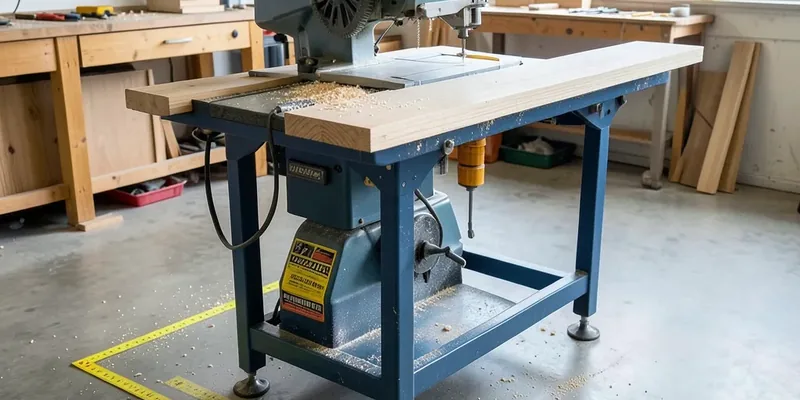
A table saw ripping an 8-foot board needs 8-10 feet of clear floor space on both the infeed and outfeed sides, plus 3-4 feet to each side for crosscutting — not the 2-foot gap most garage shops leave. Undersize that clearance and every rip becomes a two-person job or a board you have to re-feed. This guide covers the cutting/assembly/finishing zone layout, real clearance numbers for major tools, and the one upgrade (mobile bases) that makes a small shop’s layout flexible instead of fixed.
Make Your Layout Flexible With Mobile Bases
EASIEST WAY TO MAKE A LAYOUT RECONFIGURABLE
 |
WEN MB500 Universal Heavy-Duty Mobile Base, 500 lb – $54.53 Bolts under a table saw, bandsaw, jointer, or planer and turns it into a wheeled unit — the single change that lets you actually use a flexible layout instead of one fixed floor plan.
|
As an Amazon Associate we earn from qualifying purchases.
Real Clearance Numbers for Major Shop Tools
Most woodshop layout guides say “leave room to move” without a number. Here’s what tool clearance actually requires, since this is the single biggest layout mistake in small shops.
| Tool | Clearance needed | Why |
|---|---|---|
| Table saw | 8-10 ft infeed/outfeed, 3-4 ft each side | Full sheet goods and long rips need to pass all the way through |
| Miter saw | 4-8 ft total (split both sides of blade) | Crosscutting long boards requires support on both ends |
| Jointer/planer | 3-4 ft infeed and outfeed each | Board must travel the full length before and after the cutterhead |
| Workbench | 3 ft clear aisle on the working side | Room to plane, clamp, and step back without hitting another tool |
In a shop under 300 sq ft, you almost never have 8 clear feet on every side of the table saw permanently — which is exactly why mobile bases matter more in a small shop than a large one. Put the saw on wheels, and its outfeed path can double as your jointer’s infeed path when you’re not ripping sheet goods.
The Cutting-Assembly-Finishing Triangle
Group your shop into three zones and connect them in the order material actually flows: cutting near the entrance (where raw lumber comes in), assembly in the middle, finishing farthest from the dusty cutting zone (so drying finish doesn’t collect sawdust).
| Zone | What goes here | Placement rule |
|---|---|---|
| Cutting | Table saw, miter saw, bandsaw | Near the entrance/lumber storage, most floor clearance |
| Assembly | Workbench, clamps, glue-up space | Between cutting and finishing |
| Finishing | Spray/brush area, drying rack | Farthest from dust sources, near ventilation |
Tool Placement and Dust Collection
Fixed tools that create the most dust (table saw, planer, jointer, sander) should sit closest to your dust collector or have the shortest duct run — static pressure loss in flex hose adds up fast over distance, so the dustiest, most-used tool gets first priority for a short, straight duct run, not the tool that happens to be closest to an outlet.
- Stationary tools: anchor position, shortest dust-collection run, dedicated 20A circuit if it draws over 12 amps.
- Mobile tools (on wheels): flex to fill gaps in the layout; a mobile base for a table saw or jointer does double duty as clearance-on-demand.
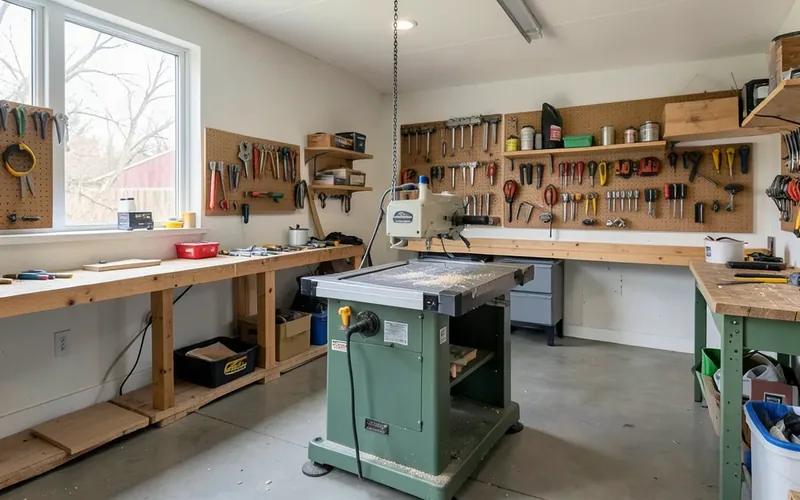
- Hand-tool storage (pegboard, wall racks): within arm’s reach of the workbench, not the cutting zone, so grabbing a chisel doesn’t mean walking through the saw’s outfeed path.
Lighting, Outlets, and Electrical Layout
Put outlets on every wall a mobile tool might land on, not just where the tool sits today — that’s the whole point of a reconfigurable layout. Dedicated circuits matter more than outlet count: a table saw or dust collector drawing 12-15 amps will trip a shared 15A circuit if a shop vac or heater is running on the same line. Task lighting directly over the table saw’s blade and the workbench matters more than overall room brightness for cut-line visibility and finish inspection.
Common Layout Mistakes
- Measuring the room but not the tools’ clearance needs: a table saw fits in a 10×10 space by its footprint alone, but not with the infeed/outfeed room it needs to actually rip a board.
- Fixed layouts in a small shop: under 300 sq ft, a layout that can’t reconfigure (via mobile bases) runs out of clearance on the very first long rip.
- Underestimating storage, then blocking clearance zones with it: shelving added later often ends up inside a tool’s infeed/outfeed path because that “empty” floor space looked available.
Frequently Asked Questions
How much clearance does a table saw actually need?
Plan on 8-10 feet of clear space on both the infeed and outfeed sides for ripping full sheet goods or long boards, plus 3-4 feet on each side for crosscutting. In a shop that can’t spare that much permanently, a mobile base lets the saw roll into that clearance only when you need it.
How do I start planning my woodshop layout?
Measure your space, then list your tools with their actual infeed/outfeed clearance needs, not just their footprint. Group tools into cutting, assembly, and finishing zones in the order material flows through them, and check that no storage or walkway crosses a tool’s clearance path.
How can I optimize space in a small woodshop?
Put stationary tools on mobile bases so one tool’s outfeed clearance can double as another tool’s infeed clearance at different times. Use vertical wall storage (pegboard, shelves) for hand tools so floor space stays open for the clearance zones the big machines need.
What safety measures matter most in a woodshop layout?
Keep walkways clear of a table saw’s infeed/outfeed path so no one crosses behind a board mid-cut, put dedicated circuits on high-draw tools to avoid overloaded outlets, and position dust collection close to the dustiest tools rather than wherever is most convenient to duct.
Conclusion
A woodshop layout succeeds or fails on clearance math, not floor plan aesthetics — 8-10 feet in front of and behind the table saw, 3-4 feet to the sides, and matching space for the jointer and planer. In anything under 300 sq ft, mobile bases are what make those numbers work without a shop twice the size.
Sponsored / affiliate links. As an Amazon Associate I earn from qualifying purchases. I may earn additional commission from eligible campaigns.