How to Make a Spear Out of Wood: Step-by-Step Guide
A wooden spear is a carved hardwood staff with a tapered tip, and most woodworkers build one as a reenactment or costume prop, a display piece, or a sturdy garden pole. Hickory is the strongest common choice, but fire-hardening the tip makes it weaker, not tougher. This guide covers species data, shaft prep, tip carving, a blunt-tip option, finishing, and carving safety.
Choosing The Right Wood
Best Tip Carving Knife Pick
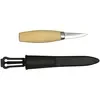 |
Morakniv Wood Carving Knife 120 ($46.16) Its short 2.4-inch (60 mm) blade gives the control that the push cuts in Step 2 call for when you taper or round the tip of the shaft.
|
As an Amazon Associate we earn from qualifying purchases.
Pick the species by what the shaft has to do: survive bumps, resist bending, and stay light enough to hold at arm’s length. Hickory, ash, and white oak are the usual hardwood choices, and you can compare more species in our types of wood guide. Look for a branch or sapling that is straight, 1 to 1.5 inches thick at the middle, and free of knots near the tip end.
Freshly cut wood carves easily but shrinks and can check (crack) as it dries, so carve it slightly oversize and let the finished shaft season before you finish it. For a branch this thick, plan on months rather than weeks. If you would rather start with dry stock, a hardwood dowel or closet-pole blank skips the wait. Oak carves well with sharp tools, as covered in our guide on whether oak is good for carving.
Best Wood for Making a Spear: Comparison Table
Hardness alone is a poor guide for a long shaft, so this table pairs Janka hardness (resistance to denting) with bending strength (modulus of rupture) and dried weight, all from The Wood Database. The last column is our own division of bending strength by weight, which shows how much strength you get for each pound the shaft adds.
| Wood | Janka hardness (lbf) | Bending strength (psi) | Dried weight (lb/ft3) | Strength per weight (calculated) |
|---|---|---|---|---|
| Shagbark hickory | 1,880 | 20,200 | 50 | 404 |
| Black locust | 1,700 | 19,400 | 48 | 404 |
| Hard maple | 1,450 | 15,800 | 44 | 359 |
| White ash | 1,320 | 15,000 | 42 | 357 |
| Osage orange | 2,620 | 18,650 | 54 | 345 |
| Eastern white pine | 380 | 8,600 | 25 | 344 |
| White oak | 1,350 | 14,830 | 47 | 316 |
Two things stand out. First, hickory and black locust tie for the best strength per pound, and hickory has the highest bending strength of the common hardwoods here, which is why it is the traditional pick for tool handles. Second, pine is not weak for its weight; what it lacks is dent resistance. At 380 lbf, a pine tip bruises and crushes easily, while the 1,300 to 1,900 lbf hardwoods keep their shape. A straight, knot-free pine pole is fine for a light prop or garden pole, but choose hardwood for a tip that will take knocks.
Bamboo is technically a grass rather than a wood. It makes a quick, light pole, but it splits along its length and cannot be carved into a smooth taper the way solid hardwood can.
Tools And Materials Needed
| Item | Purpose |
|---|---|
| Fixed-blade carving knife (2 to 3 inch blade) | Tapering and rounding the tip, stripping bark, cutting lashing notches |
| Saw or hatchet | Cutting the shaft to length and roughing out the taper |
| Cut-resistant glove and thumb guard | Protecting the hand that holds the shaft |
| 80, 120, and 220-grit sandpaper | Smoothing the shaft and spearhead |
| Paracord or rawhide | Lashing a head to the shaft and wrapping the grip |
| Linseed or tung oil | Penetrating finish that protects the shaft |
| Cork or rubber tip | Capping a pointed tip for storage and transport |
Carving Safety and Local Rules
A carved tip is a real cutting hazard while you work and a sharp object afterward, so set the ground rules before the first cut:
- Keep your blood circle clear. That is the sphere within reach of your arm plus the blade, and anyone who steps inside it means you stop and close the knife.
- Cut away from your body and away from your holding hand. Brace the shaft against a bench or the ground rather than your leg.
- Wear a cut-resistant glove and thumb guard on the holding hand. Gloves resist slicing, but a knife point can still stab through, so they back up good technique and do not replace it.
- Default to a blunt, rounded tip for props, costumes, and anything children will handle, and supervise young carvers closely.
- If you carve a point, cap it with a cork or rubber tip for storage and transport. Many events, venues, and public places restrict pointed props or sharp objects, so check local laws and event rules before you build or carry one.
- Treat it as a craft piece, never a toy to throw, and never throw it toward people or animals.
How to Make a Spear: Step-by-Step
Step 1: Select and Prepare the Shaft
Cut the shaft to the length you need (see the FAQ below for typical ranges) with a saw or hatchet. Strip all the bark using a drawknife or your knife held at a low angle, then check the whole length for knots, especially near the tip end, where a knot makes the point split as you carve. Sand with 80-grit to remove rough spots, then 120-grit for a smooth finish.
If the shaft has a slight bend, warm the bend gently over a heat source or steam it, flex it straight, and hold it until it cools. Do this before carving, and keep the wood well back from scorching.
Step 2: Carve the Tip
Mark the start of the taper about 6 inches from the end. Use the push-cut method: brace the shaft, keep your thumb behind the blade, and push the knife forward in short, controlled strokes. Work downhill with the grain, from the thicker part toward the tip, so the blade does not dig in and tear fibers. Rotate the shaft a quarter turn between passes so all four faces taper evenly, then knock off the corners to make eight sides and finally round them.
You have two choices for the end. For a prop or anything children may handle, stop the taper at about three-quarters of an inch and round it into a smooth, blunt bullet. For a traditional pointed look, continue the taper to a point and fit a cork or rubber cap when it is not on display. The most common mistakes are carving too fast, which leaves uneven angles, and cutting uphill against the grain, which tears out chunks.
Step 3: Fire-Harden It or Skip It
Many guides tell you to harden the tip over coals, but the measured results say otherwise. A 2016 study in Biology Letters fire-hardened hazel poles and compared them with naturally seasoned ones. The treated wood was slightly harder on a Shore D test, but its bending strength dropped by 30 percent and its work of fracture (the energy it absorbs before breaking) dropped by 36 percent. The authors concluded that fire-hardened tips would be more likely to break off in use.
That makes fire-hardening a poor trade for a working shaft. For a strong tip, start with dry, straight-grained hickory or ash and leave it unburned. If you only want the darkened look of an aged prop, scorch the tip lightly and briefly. Work outdoors on bare ground, keep water nearby, stay away from dry grass, and let it cool completely before handling.
Step 4: Carve and Attach a Spearhead (Optional)
A separate carved head adds a classic silhouette. Use a dense hardwood blank, carve a leaf-shaped head with a short tang at the base, and keep the edges rounded, about an eighth of an inch thick, rather than knife-sharp. Saw a shallow slot about 1.5 inches deep in the shaft end instead of splitting it, which weakens the wood, then seat the tang in the slot.
Lash the joint in a tight figure-eight with paracord or wet rawhide. Rawhide shrinks as it dries and grips harder, while paracord ends can be sealed with a flame by an adult. A bead of epoxy behind the wrap gives extra security. Let everything dry or cure fully before you handle the finished piece.
Step 5: Sand and Finish
Sand the whole shaft through 80, 120, and 220 grit, wiping off dust between grits. Apply a penetrating oil such as linseed oil to protect the wood and keep it from drying and checking, and see our wood finishing guide for other options. Wrap the lower third of the shaft with paracord for grip, and finish by checking the whole length for splinters.
How to Carve a DIY Wooden Spearhead
A carved wooden spearhead is a satisfying standalone project, and it is more durable than a thin sharpened shaft end because the grain runs the full length of the blank. Here is the process:
- Choose the wood: Dense hickory or maple work well. Orient the grain lengthwise along the head, not across its width, so it does not snap at the narrowest point.
- Rough cut the blank: Cut a piece roughly 8 to 10 inches long, 2 inches wide, and three-quarters of an inch thick, and draw a leaf-shaped outline on it.
- Remove the bulk: Use a saw and coarse rasp to cut to your outline, then shape the two faces into a gentle bevel with long push strokes of the knife.
- Refine the shape: Round the tip and edges, and add a shallow center ridge if you want the look of a real blade.
- Create the tang: Narrow the base to a tang about three-quarters of an inch wide and 1.5 inches long to fit the slot in the shaft.
- Sand and finish: Sand to 220-grit and oil it to match the shaft.
If you want a smaller practice project before committing to a full-length shaft, work the same push and pull cuts on a short stick first. Our simple stick carving patterns are a good place to start.
Using, Storing and Maintaining a Wooden Spear
Most finished wooden spears live as display pieces, costume or reenactment props, or garden and bean poles. Inspect the shaft for cracks after each outing, particularly near the tip and at any lashing, and re-tighten or re-wrap loose lashings.
Re-oil the shaft every few months if it lives outdoors or in a dry room, which stops the wood from drying out and checking. Store it flat on two wall pegs or hung from the top end. A shaft that leans against a wall for months can bow, and a capped tip protects both the point and anyone who walks past.
Frequently Asked Questions
How do you start making a wooden spear?
Start with a straight hardwood branch or dowel about 1 to 1.5 inches thick and as long as your project needs, usually 5 to 6 feet for a prop or staff. Hickory, ash, and oak are the usual choices. Strip the bark, sand the shaft smooth, check it for bends, then carve the tip with a sharp knife, working downhill with the grain and cutting away from your body.
What is the best wood for making a spear?
Hickory is the strongest common choice: The Wood Database lists shagbark hickory at 1,880 lbf Janka and 20,200 psi bending strength, ahead of white ash (1,320 lbf, 15,000 psi) and white oak (1,350 lbf, 14,830 psi). Ash is lighter and easier to carve. Eastern white pine (380 lbf) works for a light prop, but its tip dents easily.
How do you harden a wooden spear tip?
You mostly should not. A 2016 Biology Letters study found that fire-hardening hazel poles raised surface hardness only slightly, while cutting bending strength by 30 percent and work of fracture by 36 percent, so the tip becomes more brittle. For a stronger tip, use dry hardwood and leave it unburned. If you want a darkened prop look, scorch lightly outdoors.
How long should a wooden spear be?
For a staff-style prop or display piece, 5 to 6 feet is a common range, roughly from the floor to just above your head. Garden poles run longer, since part of the length is buried. Pick the length for how you will carry and store it, and keep the diameter near 1 to 1.5 inches so the shaft stays light and does not flex too much.
How do you attach a spearhead to a wooden shaft?
Saw a shallow slot about 1.5 inches deep in the shaft end, cut a matching tang on a carved wood head, and seat it. Wrap tightly in a figure-eight with wet rawhide or paracord, which grips harder as rawhide dries. Add epoxy behind the wrap for extra hold and let it cure fully. Keep the head’s edges rounded for a safe prop.
Sponsored / affiliate links. As an Amazon Associate I earn from qualifying purchases. I may earn additional commission from eligible campaigns.