How to Secure Plywood in a Truck Bed: Straps & Load Law
Two ratchet straps rated for at least 400 lbs each, cinched over the stack and hooked to the truck bed’s front and rear anchor points, keep plywood from shifting on the road. Federal DOT cargo-securement rules only apply to commercial vehicles over 10,001 lbs GVWR, but every state still fines drivers for an unsecured load in any vehicle — California’s penalty runs $200 to $800 per offense. This guide covers strap placement, the 4-foot overhang flag rule, and why a 4×8 sheet fights so much wind at highway speed.
Quick Answer
Lay plywood flat against the cab, use two ratchet straps (not bungees) — one crossing the stack, one anchored to the tailgate or a rear D-ring to stop backward slide — and add a red flag if the sheets extend more than 4 feet past the tailgate. Re-check strap tension after the first 10–15 minutes of driving.
What You Need to Secure Plywood in a Truck Bed
Best Ratchet Strap Pick for Plywood
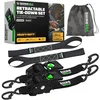
Rhino USA Retractable Ratchet Straps (2-Pack), 2in x 10ft, 3,033 lb Break Strength
A self-retracting reel keeps loose webbing from flapping loose or whipping in the wind at highway speed — the same slack that lets bungees and rope work free.
- Best for: full-size 4×8 plywood sheets, two straps crossing the stack
- Why we picked it: 3,033 lb break strength gives a wide safety margin over a typical plywood stack’s weight, and the wide 2-inch webbing spreads load instead of biting into edges
- Main drawback: pricier per strap than basic ratchet straps; the retract mechanism adds bulk versus a plain strap
Compare more ratchet strap options
 Budget Pick Rhino USA 1″ x 15′ Ratchet Straps, 4-Pack with S-Hooks
|
 Best for Big Loads 4-Pack 2″ Ratchet Straps, 20ft, 10,000 lb Break Strength
|
 Best Value 4-Pack HOKINETY Retractable Ratchet Straps, 1″ x 10′, 4-Pack (1,500 lb)
|
As an Amazon Associate we earn from qualifying purchases.

Ratchet straps, not bungee cords or rope, are the only tie-down that reliably holds a flat sheet load at highway speed — bungees stretch under wind load and rope has no mechanical advantage to re-tension once it loosens.
- 2–4 ratchet straps, 1–2 inches wide, rated at least 400 lbs working load limit (WLL) each — more straps for stacks over 6 sheets or trips longer than 30 minutes on the highway.
- Furniture blankets or foam edge protectors anywhere a strap crosses a plywood edge or corner — a tensioned strap will saw through a raw edge over a few miles of vibration.
- A red or orange flag, at least 18 inches square, if the load overhangs the tailgate by more than 4 feet (required in most states, see below).
- A tape measure and a truck bed with working anchor points (factory D-rings, stake pockets, or a cargo track) — if your bed has none, a bed-mounted tie-down anchor kit is worth adding before hauling sheet goods regularly.
Step-by-Step: Loading and Strapping Plywood in a Truck Bed
- Load flat, front-heavy: Lay sheets flat against the cab wall rather than standing them on edge — a flat stack has a lower center of gravity and can’t tip sideways in a turn. Keep the weight as far forward as the bed allows.
- Pad every strap contact point: Slide a folded moving blanket, carpet scrap, or foam pipe insulation under each spot where a strap will cross a plywood edge or corner before you tension anything.
- Cross-strap the stack: Run one ratchet strap side-to-side over the top of the stack and hook both ends to the bed’s side anchor points or stake pockets. This is what stops the sheets from sliding sideways or lifting in a crosswind.
- Anchor front-to-back: Run a second strap from a front anchor point, over or through the load, back to a rear D-ring or the tailgate hinge. This is the strap that stops the load from sliding backward and out under braking or on an incline.
- Ratchet evenly, don’t overtighten: Tension both straps until the stack can’t shift by hand, working side to side rather than cranking one strap fully before starting the other — overtightening one side first can bow or crack a thin sheet.
- Flag any overhang past 4 feet: If the sheets extend more than 4 feet beyond the tailgate, tie a red or orange flag at least 18 inches square to the rearmost point (two flags if the overhang is wider than 2 feet).
- Re-check after 10–15 minutes: Straps seat and webbing stretches slightly once the load starts moving. Pull over after the first few miles and re-tighten before getting on the highway.
For loads that regularly run long or heavy — full sheets of 4×8 plywood stacked several deep — check your plywood load capacity against your truck’s payload rating before you strap anything down; an overloaded bed changes how the truck handles regardless of how well the load is tied.
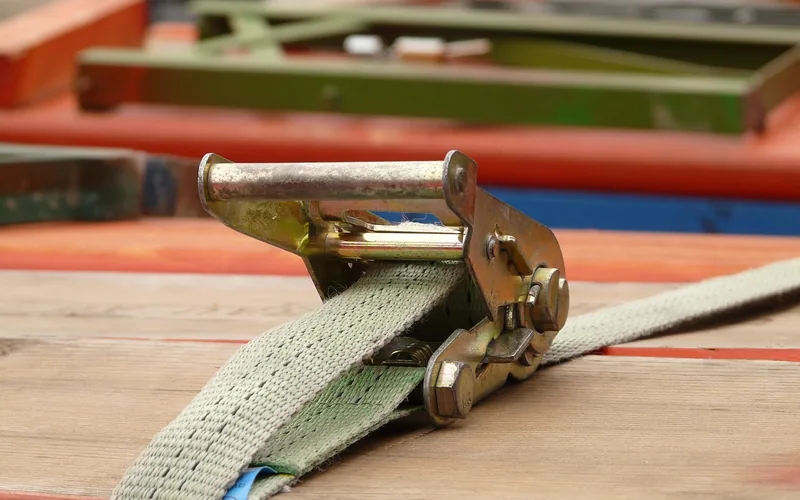
Is Securing Your Load Actually the Law?
Most articles on this topic just say “it’s the law” without saying which law applies to a personal pickup truck — and the two sets of rules that actually exist are easy to mix up.
Federal DOT cargo securement rules (49 CFR Part 393 Subpart I) are written for commercial motor vehicles over 10,001 lbs GVWR operating in interstate commerce — a personal pickup hauling plywood from the lumber yard usually isn’t covered by these specific federal tie-down requirements. But that doesn’t mean an unsecured load is legal.
Every state has its own “unsecured load” statute that applies to any vehicle on public roads, commercial or not. California Vehicle Code §23114, for example, requires that a vehicle be “so constructed, covered, or loaded as to prevent any of its contents or load… from dropping, sifting, leaking, blowing, spilling, or otherwise escaping” — and violating it is an infraction carrying a $200 fine for a first offense, $400 for a second within a year, and $800 for a third. Most other states carry similar unsecured-load statutes with their own fine schedules. This is the law that actually applies to a plywood run in a personal truck, not the federal commercial rule.
📊 California’s unsecured-load fine escalates from $200 (1st offense) to $400 (2nd within a year) to $800 (3rd within a year) — Source: California Vehicle Code §23114
The 4-Foot Overhang Flag Rule
If plywood or lumber extends more than 4 feet past the rear of the truck bed, most states require a red or orange warning flag at least 18 inches square tied to the end of the load, plus a red light in the same spot after dark. A single flag covers a load 2 feet wide or narrower; a wider load needs a flag on each side of the overhang. Check your specific state’s code before a long hauling trip — the 4-foot threshold is consistent across most states, but exact flag size and lighting rules vary.
Why Plywood Flies Out of a Truck Bed at Highway Speed
The danger with a flat sheet isn’t really its weight — it’s that a 4×8 sheet of plywood acts like a sail. Air moving under the leading edge at 60–70 mph creates enough lift and lateral force to work a loose strap free within a few miles, even though the same sheet sits perfectly still when the truck is parked.
“Sheet goods flying loose isn’t a hypothetical: an unsecured panel that comes off a truck bed at speed can go straight through a windshield. Treat every sheet load like it wants to become airborne the moment you hit highway speed, not just a heavy object riding in the back.”
That’s the practical reason to keep speeds under about 65 mph with a plywood load, use two straps at minimum instead of one, and re-check tension after the load has had a few minutes of wind exposure — the failure point is almost always a strap that was tight in the driveway and loosened once air started moving under the sheet.
Common Mistakes That Let Plywood Come Loose
- Using bungee cords or rope instead of ratchet straps. Bungees stretch under load and lose tension exactly when wind force increases; rope has no re-tensioning mechanism once it stretches or the knot works loose.
- One strap instead of two. A single strap over the top does nothing to stop the load sliding backward under braking — you need a separate front-to-back anchor point, not just a cross-strap.
- Skipping edge protection. A tensioned ratchet strap will saw a groove into a raw plywood edge over a few miles of highway vibration, weakening the strap right where you need it most.
- Never re-checking tension. Straps seat and settle in the first several minutes of driving. A strap that was hand-tight at your driveway can be noticeably loose by the time you reach the highway.
- Ignoring the overhang flag rule. Even a well-strapped load that extends past the tailgate without a flag is a separate citable offense in most states, independent of how well it’s tied down.
If you’re hauling shorter, thinner offcuts rather than a full sheet, see our guide on cutting plywood down to size before loading — smaller pieces are easier to strap flat and less prone to sail in the wind than a full 4×8 sheet. For raw dimensional lumber and boards rather than sheet goods, the strapping principles are similar but the load shape is different — see our dedicated guide to securing lumber in a truck bed. For a closer look at exactly why a flat sheet catches highway wind and a step-by-step walkthrough of the front-and-rear X-pattern anchor placement, see our companion guide on how to tie down plywood in a truck.
Frequently Asked Questions
Is it illegal to drive with unsecured plywood in a truck bed?
Yes, in nearly every state. Federal DOT cargo securement rules only cover commercial vehicles over 10,001 lbs GVWR, but every state has its own unsecured-load statute that applies to personal trucks too. California’s law, for example, carries fines from $200 to $800 depending on how many prior offenses you have within a year.
Do you need a flag if plywood sticks out past the tailgate?
Yes, if the overhang is more than 4 feet past the rear of the bed. Most states require a red or orange flag at least 18 inches square at the end of the load, with a second flag if the overhang is wider than 2 feet, plus a red light after dark.
How many ratchet straps do you need for a stack of plywood?
Two straps minimum for most loads: one crossing the stack side-to-side to stop sideways shift and wind lift, and one running front-to-back to stop the load sliding backward under braking. Add a third or fourth strap for stacks over six sheets or trips that stay on the highway for more than 30 minutes.
Can bungee cords or rope secure plywood instead of ratchet straps?
Not reliably at highway speed. Bungee cords stretch under wind load and lose holding tension exactly when the force on the sheet increases, and rope has no mechanical way to re-tension once it stretches. Ratchet straps rated 400+ lbs WLL are the only tie-down that holds a flat sheet load consistently.
What happens if plywood flies out of a truck bed at highway speed?
A sheet that comes loose at 40+ mph can become a serious road hazard for other drivers, capable of going through a windshield on impact. Beyond the safety risk, most states hold the driver liable for any resulting damage or cleanup costs, on top of the unsecured-load citation itself.
A properly strapped load takes an extra five minutes at the lumber yard — two rated ratchet straps, padded edges, a flag if you’re overhanging the tailgate, and a re-check once you’re moving. That’s the difference between plywood that arrives at the jobsite and plywood that ends up as road debris behind you.
Sponsored / affiliate links. As an Amazon Associate I earn from qualifying purchases. I may earn additional commission from eligible campaigns.
 Baltic Birch Plywood Sheets Box of 45 - Laser Engraving Cutting, Scroll Saw Nature Veneer Color, Stronger Than Basswood, A/A Grade,12 x 12 x 1/8”, 3mm Thickness Perfect for Wood Burning
 30 Pack 12"x18"x1/16 Basswood Sheets for Crafts- Thin Plywood Sheets - Balsa Wood Sheets -Unfinished Wood Boards for Painting,Laser Cutting,Engraving, Burning and CNC Cutting