Best Plywood Rack Casters for Heavy Sheets (2026): We Compared
Choose heavy-duty casters rated for at least about 1.5x the loaded rack weight; for plywood stacks, 6-inch polyurethane wheels with ball or roller bearings are commonly used as a solid default. Undersized casters flat-spot, chatter on rough concrete, and can crack a loaded rack or make steering dangerous. This guide compares casters for straight-pull, pivoting, and rarely moved sheet-goods racks, with load margin and floor condition as the deciding factors.
Quick comparison
| Product | Badge | Best for | Price | ||
|---|---|---|---|---|---|
 |
Peouo 4 Inch Caster Wheels, Swivel Casters Set of 4, HeavyPeouo | Our pick | 4 Inch · 1200 lbs · Swivel | $54.99
Price as of 27 Oct 2026
|
View |
 |
NINOSO 4 inch Heavy Duty Casters, Casters Set of 4 withNinoso | Budget pick | 4 Inch · 1200 lbs · Rigid | $38.80
Price as of 27 Oct 2026
|
View |
 |
Nefish Swivel Caster Wheel for Cart, 5 Inch IndustrialNefish | Also great | 5 Inch · 2200 lbs · Swivel Brake | $32.99
Price as of 27 Oct 2026
|
View |
 |
Homhoo 4" Leveling Plate Rubber Caster Wheels,Set of 4Homhoo | Upgrade pick | 4 Inch · 1800 lbs · Leveling | $59.99
Price as of 27 Oct 2026
|
View |
The safest rule is to size the set for the rack’s full loaded weight, then keep a margin above that number so one wheel does not become the weak point. The most common mismatch is a small swivel wheel on a rack that is expected to track straight across seams, cracks, or sawdust.
How we chose
The picks below are based on manufacturer specs, listing details, and published buyer feedback. The ranking also uses a simple margin rule, plus the way the rack actually moves: straight-pull, pivoting, or parked most of the time.
Floor condition matters too. Concrete cracks, epoxy, OSB, seams, and dust buildup all change how a wheel rolls, scrubs, or hangs up.
For the load rule, use the rack’s fully loaded weight, then choose a caster set that leaves extra capacity in reserve. The table below shows the decision pattern in plain terms.
What load should a plywood rack caster handle?
Start with the total loaded rack weight, not the empty frame. A plywood dolly estimated at about 900 lbs gives a useful reference point: that kind of load needs a caster set with real reserve, not a catalog number that only works on paper. For sheet goods, the margin matters as much as the rating.
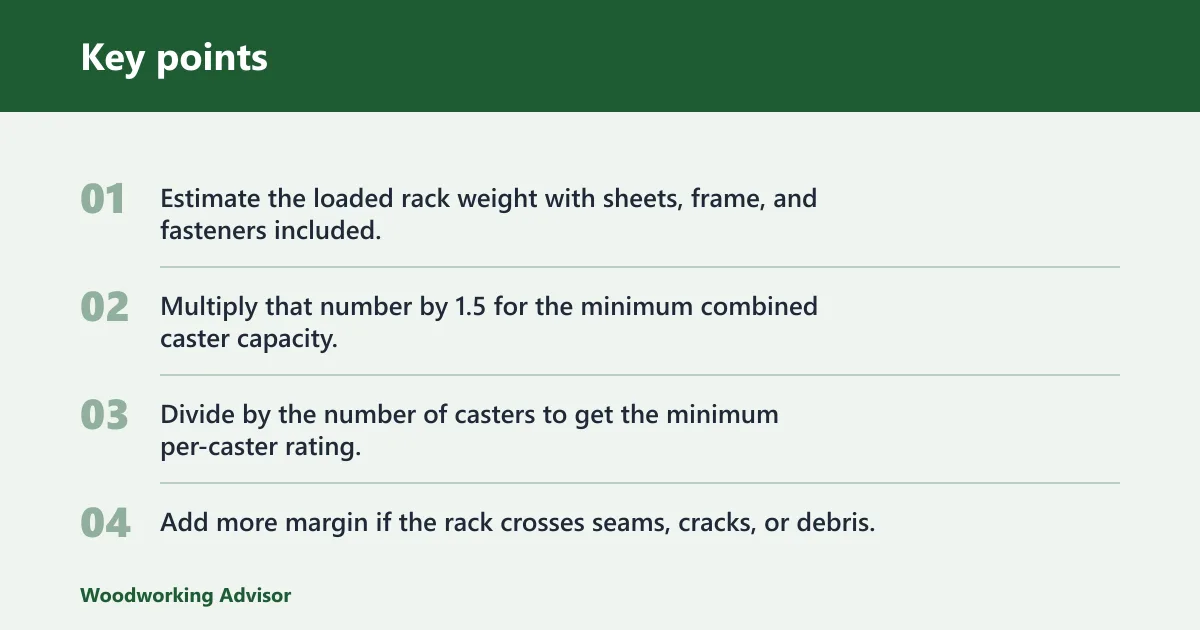
Per-caster rating matters because the load is not always shared evenly. A floor seam, an uneven frame, or a turning motion can put more weight on one wheel for a moment. A practical rule is to target at least 1.5x the loaded rack weight as the combined caster capacity, then add a little more if the floor is rough or the rack must pivot.
Simple load check
- Estimate the loaded rack weight with sheets, frame, and fasteners included.
- Multiply that number by 1.5 for the minimum combined caster capacity.
- Divide by the number of casters to get the minimum per-caster rating.
- Add more margin if the rack crosses seams, cracks, or debris.
Say your rack holds a stack of full-size sheets and sits on a 3/4-inch T&G plywood subflooring surface. The floor may be flat, but the wheels still need enough reserve to handle turning force, not only static weight. That is why the rating should not be chosen right on the edge.
| Loaded rack weight | Wheel diameter | Wheel material | Brake need | Floor condition | Recommended caster type | Safety margin rule |
|---|---|---|---|---|---|---|
| Up to 500 lbs | 4 inches | Polyurethane or rubber | Optional | Smooth concrete or epoxy | Swivel with lock if you need to position the rack often | Use at least 1.5x the loaded weight combined |
| 500 to 900 lbs | 5 to 6 inches | Polyurethane, rubber, or steel depending on floor wear | Yes, if the rack must stop in place | Concrete with seams or light dust | Mixed set or locking swivel set for controlled movement | Use 1.5x to 2x the loaded weight combined |
| 900 lbs and up | 6 inches or larger | Polyurethane for floor protection; steel only where floor wear is acceptable | Yes | Cracked concrete, debris, or rough shop floor | Large-wheel caster set with positive locking or a fixed-track layout | Use 2x the loaded weight combined if the rack moves often |
| Rarely moved rack | 4 to 5 inches | Rubber or polyurethane | Yes, or leveling feet | OSB or a floor with seams | Leveling caster set or casters with a strong brake | Use 1.5x the loaded weight combined, plus extra brake control |
Peouo 4 Inch Casters: best for pivoting racks
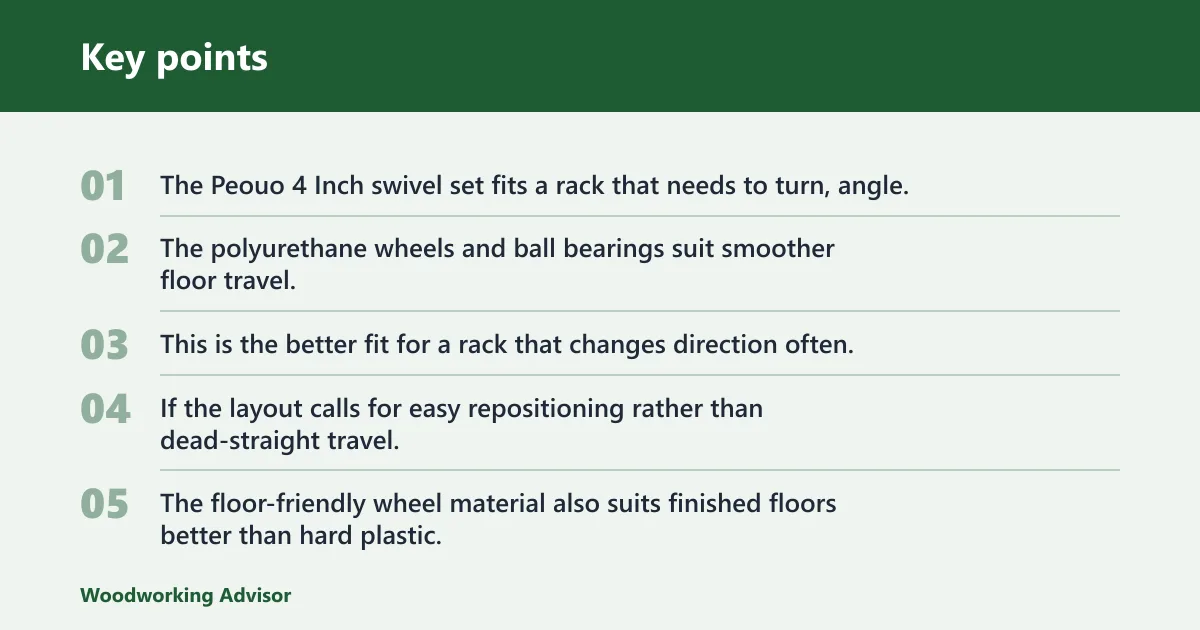
The Peouo 4 Inch swivel set fits a rack that needs to turn, angle, and slide into position without fighting the wheels. The polyurethane wheels and ball bearings suit smoother floor travel, and the swivel layout makes sense when the rack must pivot in tight space.
This is the better fit for a rack that changes direction often. If the layout calls for easy repositioning rather than dead-straight travel, swivel casters are easier to live with than rigid wheels. The floor-friendly wheel material also suits finished floors better than hard plastic, especially where marking matters.
The drawback is control. A full swivel set can drift or scrub if the rack is meant to travel only in one line, and that makes alignment more work. For a straight-pull sheet-goods rack, this style is the wrong match.
NINOSO 4 inch heavy duty casters: best for straight-pull racks
The NINOSO rigid caster set fits a rack that should move in one direction and stay predictable. Fixed wheels track better than swivel wheels, so the rack is less likely to yaw or scrub when you pull it out from a wall or slide it back into place.
That tracking behavior matters on a sheet-goods rack. A rigid wheel helps the rack follow a straight path, which is easier when the rack sits low and has shelves above it. The rubber wheels also give a little wear resistance where the floor is not perfectly smooth.
The drawback is turning. A rigid set does not help much if you need to spin the rack around in place or push it through a tight corner. It is the right choice for straight travel, not for frequent steering.
Nefish 5 inch swivel brake casters: best for rough shop floors
The Nefish 5 inch swivel brake set is the better fit when the floor is rough, the load is heavy, and you still need control at the stop point. The larger wheel diameter helps with seams and small debris, and the brake adds control when the rack must stay put.
Polyurethane is a sensible middle ground here. It rolls better than hard plastic on imperfect floors and is easier on finished surfaces than steel. That matters in shops where concrete cracks, epoxy transitions, or sawdust buildup can interrupt a smaller wheel.
The drawback is that swivel behavior can still scrub if you expect straight tracking all the time. It is also more wheel than a light rack needs. If the rack is small and rarely moved, the extra size may be unnecessary.
Homhoo 4 inch leveling casters: best for occasional movement
The Homhoo leveling caster set suits a rack that moves only now and then, then needs to sit solidly in place. The leveling feet help keep the rack steady when parked, which is useful when sheet goods sit above the rack and any drift would be annoying.
Rubber helps soften noise and floor wear, and the swivel design still gives maneuverability when you need it. That makes this style useful for a rack that has to roll across the floor, then lock down in one spot for storage.
The drawback is complexity. Leveling feet add another adjustment step, so this is not the simplest choice for a rack that gets moved constantly. It also is not the best answer if you want the easiest possible roll over rough debris.
Which one should you buy?
Choose by movement pattern first, then by floor. If the rack must travel in a straight line, the NINOSO rigid set is the cleanest match. If the rack needs to pivot or turn in a cramped space, the Peouo swivel set is easier to position. If the floor is rough and the rack still moves often, the Nefish 5 inch brake set gives the best blend of roll and control.
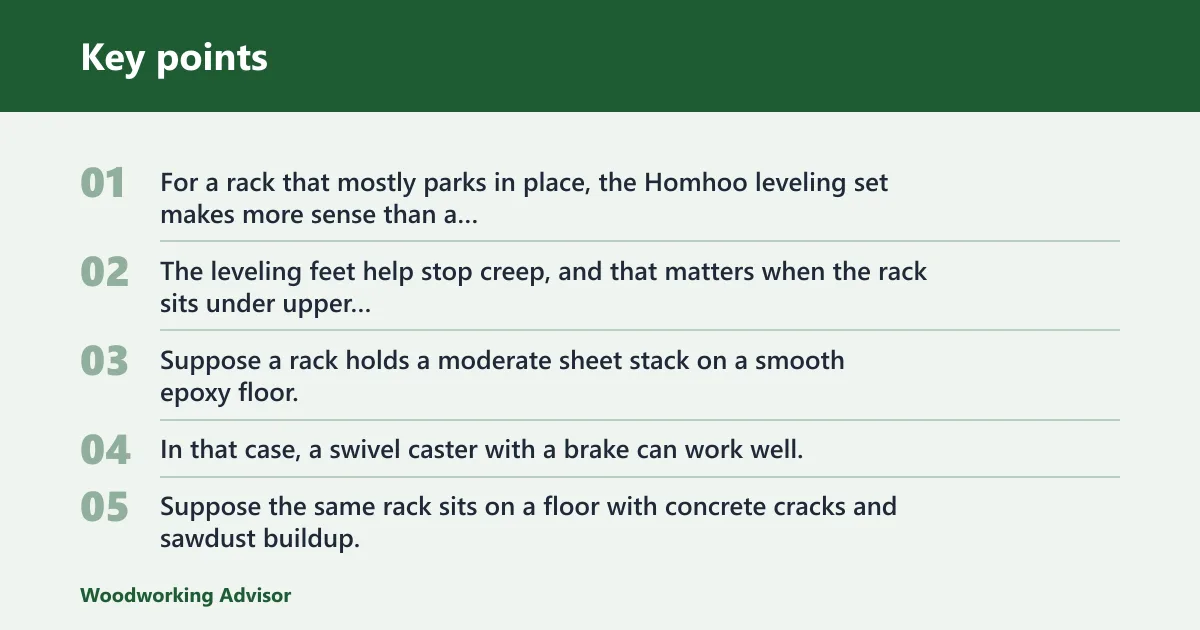
For a rack that mostly parks in place, the Homhoo leveling set makes more sense than a free-rolling layout. The leveling feet help stop creep, and that matters when the rack sits under upper shelves or next to a wall where even a slight roll can be annoying.
Suppose a rack holds a moderate sheet stack on a smooth epoxy floor. In that case, a swivel caster with a brake can work well. Suppose the same rack sits on a floor with concrete cracks and sawdust buildup. Then a larger wheel with more clearance is the better choice, even if the rack is not moved every day.
Floor rollers can make sense when the rack only travels along a fixed path and you can build in the track geometry. They are less attractive when the rack must turn, stop, or cross uneven floor seams. For most woodshops, casters are simpler and more flexible unless the layout is very controlled.
How do I keep a plywood rack from drifting or rolling away?
Use a brake, a locking caster, or leveling feet. A brake stops the wheel from turning, while a locking caster may also prevent swivel motion depending on the design. For a sheet-goods rack, that extra hold matters because a full load can keep pushing after a small bump or slope.
Do not rely on friction alone. On a smooth floor, even a heavy rack can creep if the floor has a slight slope or the wheels are light. If the rack needs to sit still under shelving, a positive lock is better than hoping it will stay put.
Common locking choice
- Use a wheel brake when you still want easy rolling.
- Use a swivel lock when the rack tends to wander while turning.
- Use leveling feet when the rack should sit rigidly after movement.
Will hard plastic casters roll over shop dust and debris?
Hard plastic can roll over light dust, but it is the most likely of the common wheel materials to get annoyed by debris. On a similar rack, one user suggested 4-inch hard plastic casters, then noted that small debris made them stop rolling well. That is the failure mode to watch for.
Hard plastic is also less forgiving on rough floor transitions. It can feel fast on a clean, smooth floor, but small chips, dust piles, and seams can create chatter or sudden drag. If your floor is not kept very clean, a softer or larger wheel is usually the safer bet.
Material tradeoffs
Rubber absorbs shock better and gives more grip. It usually rolls with less noise and less floor wear, though it may not feel as free-rolling as harder materials on a perfectly smooth surface.
Steel has the highest durability potential and very good load capacity, but it is the least gentle on floors and can feel harsh over seams. It belongs where floor wear is acceptable and the rack needs a tough wheel more than a quiet one.
Polyurethane is the practical middle ground for many plywood racks. It protects the floor better than steel, rolls better than sticky soft rubber on some surfaces, and often handles mixed shop conditions well.
Should I use swivel casters or fixed casters on a sheet goods rack?
Use fixed casters when the rack should track straight and stay aligned. Use swivel casters when the rack needs to turn, angle, or pivot in place. The wrong choice shows up fast: swivel wheels can scrub instead of rolling in a straight-pull layout, while fixed wheels resist turning in tight spaces.
The wheel layout also matters. If the wheels must be angled to the radius drawn from the pivot point, the rack can steer properly and avoid binding. That is why layout and caster type have to match the rack’s movement pattern, not just its weight.
For a rack that sits close to the floor because shelves are above it, tracking stability matters even more. A low rack with sheet goods on top is not a place for casual wheel selection. Choose the caster type that matches the path the rack actually follows.
Best-fit rule
- Straight-pull rack: fixed wheels.
- Pivoting rack: swivel wheels.
- Occasional move, then park: swivel plus brake or leveling feet.
What wheel size works best for moving heavy plywood racks?
For heavy plywood racks, larger wheels usually roll easier than small ones, especially when the floor has seams, cracks, or sawdust. A 5-inch or 6-inch wheel is often a better practical choice than a small wheel when the rack is loaded and the floor is not perfectly flat.
Wheel diameter matters because it changes how the caster bridges a defect. A small wheel drops into cracks more easily and may chatter over debris. A larger wheel spreads the impact and reduces the chance of the rack hanging up on floor transitions.
If the floor is clean, smooth, and flat, smaller wheels can still work. But the moment the rack has to cross rougher concrete or OSB seams, a larger wheel starts to make more sense.
Are floor rollers better than casters for a heavy plywood rack?
Floor rollers are better only when the rack has a fixed travel path and you can build the floor or track to match it. They can reduce steering effort, but they are less flexible than casters and are harder to adapt when the rack needs to turn, stop, or move around obstacles.
For most plywood racks, casters are the more useful choice. They handle the common shop problem better: move the rack, park it, then move it again from a slightly different angle. Floor rollers start to make sense only when the movement is repetitive and controlled.
A common first-timer mistake is choosing a caster type for the rack weight and ignoring the path. A heavy rack on a smooth floor may still behave badly if the wheels fight the direction of travel. The movement pattern should come first.
Frequently asked questions
What casters are best for a plywood rack carrying heavy sheets?
The best caster depends on whether the rack travels straight, pivots, or parks most of the time. For a straight-pull rack, fixed casters are the cleaner match. For a pivoting rack, swivel casters work better. For a rack that sits still after movement, a locking or leveling caster is the safer choice.
How much weight should plywood rack casters support?
Use the rack’s fully loaded weight, then size the caster set for at least 1.5x that number. If the load is near 900 lbs, the floor is rough, or the rack turns in place, add more reserve. The total set rating matters more than one wheel’s label.
Can I use locking casters on a plywood storage cart?
Yes. Locking casters are useful when you want the cart to stay put after moving it. A brake helps prevent runaway movement, especially on a smooth floor. If the rack must sit very still, leveling feet can add more security than a simple wheel brake alone.
Sponsored / affiliate links. As an Amazon Associate I earn from qualifying purchases. I may earn additional commission from eligible campaigns.