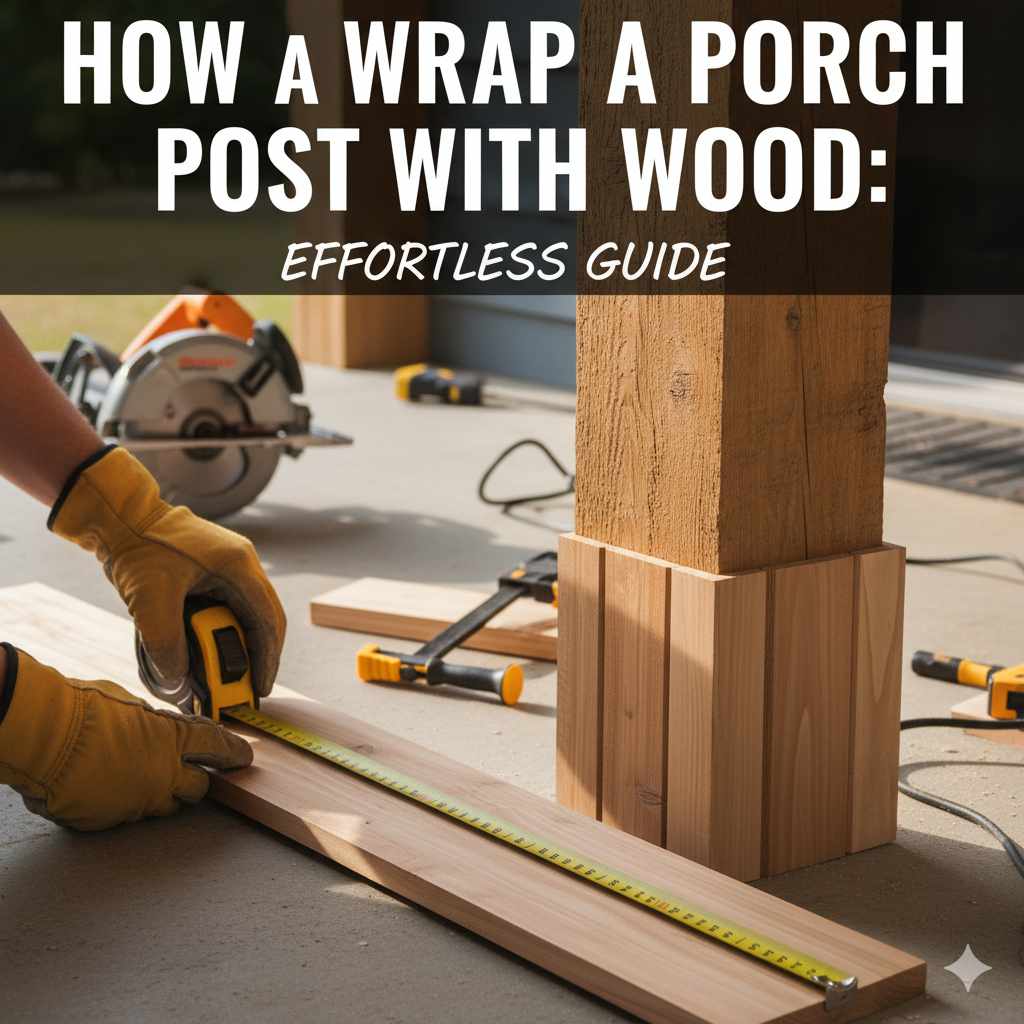
How to Wrap a Porch Post with Wood (Even Round Ones)
To wrap a porch post with wood, cut four boards to the post height and screw them together into a box around the existing post. For a standard 4×4 post (actual 3.5″×3.5″), use 1×4 or 1×6 boards — always run them vertically for strength and to prevent joint gaps from seasonal expansion. Cedar and redwood resist exterior rot best without any treatment. The full project takes 2–4 hours with basic tools.
⚡ Quick Reference — Post Wrap Sizing
| Existing Post | Actual Size | Use These Boards | Finished Size |
|---|---|---|---|
| 4×4 | 3.5″×3.5″ | Four 1×4 boards | ~4.5″×4.5″ |
| 4×4 | 3.5″×3.5″ | Four 1×6 boards | ~6″×6″ |
| 6×6 | 5.5″×5.5″ | Four 1×6 boards | ~7″×7″ |
| 6×6 | 5.5″×5.5″ | Four 1×8 boards | ~8″×8″ |
Board thickness: use 3/4″ (1× nominal) for most wraps. Run all boards vertically — full post height.
Why Wrap Your Porch Posts with Wood?
Adding a wood wrap to your porch posts isn’t just about looks; it’s a smart decision for several reasons. It’s like giving your existing posts a stylish new coat that also offers a layer of protection.
- Boost Curb Appeal: A fresh wood wrap instantly elevates the look of your porch, making your home more inviting and valuable.
- Protect Existing Posts: It shields the original post from weather damage, pests, and rot, extending its lifespan.
- Increase Home Value: A well-maintained and attractive exterior is a major selling point.
- Customization: You can choose the wood type and finish to perfectly match your home’s style.
- Cost-Effective: It’s often more affordable than replacing an entire support post.
Tools and Materials You’ll Need
Gathering your supplies before you start is key to a smooth project. Here’s a handy list to get you prepped for wrapping your porch posts.
Essential Tools:
- Tape Measure: For accurate measurements.
- Pencil: To mark your cuts.
- Saw: A miter saw is ideal for precise angles, but a circular saw or hand saw works with care.
- Orbital Sander or Sanding Blocks: To smooth edges and surfaces.
- Drill/Driver: For pre-drilling holes and driving screws.
- Level: To ensure your wood pieces are straight.
- Clamps: To hold pieces in place while you work.
- Safety Glasses and Work Gloves: Always protect your eyes and hands.
Recommended Materials:
Wood Boards: For a square or rectangular post, you’ll need four boards to create a box around the existing post. Run them vertically — full height of the post — and use exterior-grade screws rated for outdoor use. For round posts, build a square box first, then apply decorative trim over it.
- Exterior Wood Screws: 2″ to 2.5″ length for 3/4″ boards.
- Exterior Wood Glue: Adds strength at the corner joints.
- Wood Filler (optional): To fill screw holes for a clean finish.
- Exterior Finish: Stain, paint, or clear sealant.
- Exterior Caulk: Seal the base and top of the wrap against moisture.
Wood Selection Tips:
Choosing the right wood is the most important decision for a lasting exterior wrap. Here’s how the main options compare:
| Wood Type | Rot Resistance | Cost | Notes |
|---|---|---|---|
| Western Red Cedar | Excellent | Moderate | Natural oils repel insects and moisture. Lightweight, easy to work with. Top choice for most climates. |
| Redwood | Excellent | Higher | Premium appearance, tannin-rich heartwood lasts 30+ years untreated. Best for high-moisture areas. |
| Pressure-Treated Pine | Good | Low | Budget-friendly. Must be rated for ground contact if touching the porch floor. Allow to dry fully before painting. |
| Douglas Fir | Fair | Low–Moderate | Strong and stiff. Needs paint or sealant. Good structural option. |
| Mahogany | Very Good | High | Premium look, very durable. Best for high-end projects. |
For board thickness, 3/4″ (nominal 1×) is the standard for post wraps. Avoid boards with pith (the center of the tree) — those are most likely to warp and twist after installation.
Step-by-Step Guide to Wrapping Your Porch Post
This guide focuses on creating a simple but elegant wood wrap for a standard square or rectangular porch post.
Step 1: Measure and Plan
Accurate measurements are the foundation of any successful DIY project.
- Measure the Existing Post: Use your tape measure to get the exact width and depth of your current porch post. A 4×4 post has actual dimensions of 3.5″×3.5″.
- Determine Your New Post Dimensions: Decide how much you want to enlarge the post. A common approach is to wrap a 4×4 post to a 6×6 or 8×8 profile for a more substantial look.
- Example Calculation: If your 4×4 post is 3.5″×3.5″ and you want a 6×6 profile, use 1×6 boards (actual 5.5″ wide). Two opposite boards sit flush against the post; the other two overlap the edges of those boards to complete the box.
- Calculate Board Lengths: Measure the height of your post from the porch floor to the beam. Cut all four boards to this exact height.
Step 2: Cut Your Wood Boards
Precision is key here. Measure twice, cut once.
- Mark Your Cuts: Mark the desired lengths on your boards. Length = height of your porch post.
- Make the Cuts: For a simple square wrap, cut four identical pieces to the post height with square (90°) ends. For a more finished look, cut a 45° bevel on the meeting edges — this creates a cleaner corner joint.
- Prepare the Boards: Lightly sand all edges after cutting to remove splinters and rough spots.
Step 3: Dry Fit and Adjust
Before gluing and screwing, verify the fit.
- Position the Boards: Place all four cut boards around the existing post.
- Check for Gaps: Minor gaps can be filled later with exterior caulk. Significant gaps indicate a cut issue — re-cut before proceeding.
- Confirm Squareness: Use your level to ensure the new assembly is plumb (perfectly vertical) on all four sides.
Step 4: Assemble the New Post Wrap
Now permanently attach the wood.
- Apply Wood Glue: Apply a thin, even bead of exterior wood glue along each joining edge.
- Assemble One Corner: Bring two boards together. With square cuts, one board overlaps the edge of the other — this creates good surface area for fastening.
- Pre-Drill and Drive Screws: Drill pilot holes through the face of the outer board into the edge of the inner board (prevents splitting). Drive exterior-grade screws into each pilot hole, countersinking them slightly. Two to three screws per corner section is usually sufficient.
- Repeat for All Four Corners to form the complete box around the post.
- Attach to Existing Post (Recommended): Drive a few screws from the inside of your new wrap into the old post for maximum stability.
| Component | Description | Purpose |
|---|---|---|
| Existing Post | Original post you are covering | Structural support |
| New Wood Boards | Cut to height, run vertically | New profile and aesthetic |
| Exterior Wood Glue | Applied to joining edges | Adds strength, seals joints |
| Exterior Screws | Driven through boards to join them | Primary fastening method |
Step 5: Finishing Touches
- Fill Holes and Gaps: Use exterior-grade wood filler to fill countersunk screw dimples. Let it dry fully.
- Sand Smooth: Lightly sand the entire wrapped post, paying attention to filled areas.
- Apply Primer (if painting): Use a high-quality exterior primer for better paint adhesion.
- Apply Finish: Stain with two coats of exterior stain, paint with two coats of exterior paint, or apply a clear UV-protectant sealant for cedar and redwood to preserve their natural color.
- Caulk All Seams: Apply exterior-grade caulk around the base of the new post where it meets the porch floor, and at the top where it meets the beam. Smooth with a wet finger before it dries. This step prevents rot.
Which Direction Should Wood Run on a Porch Post?
Always run your boards vertically — from the porch floor to the top beam — on all four sides of the post. Here’s why this matters:
- Prevents joint gaps: Wood expands and contracts along its width. Vertical boards all expand in the same direction (side to side), so corner joints stay tight. Mixing directions causes one board to pull against another.
- Sheds water better: Vertical grain channels rain downward off the post rather than trapping it at horizontal seams.
- Stronger assembly: Full-height vertical boards are structurally stiffer than shorter horizontal courses.
Maintain consistent grain direction throughout all four sides of a single post. If you need to splice boards for a very tall post, use a scarf joint and ensure it’s sealed with caulk and exterior glue.
Recommended Product
Weatherables 4×4 Vinyl Post Wrap (4″×4″×96″)
Weatherproof vinyl wrap fits over existing 4×4 deck, patio, and porch posts. UV-resistant, won’t fade or warp. Snaps together in minutes — no fasteners or adhesive needed. Ideal for refreshing old posts without a full wood wrap build.
Check Price on Amazon →Frequently Asked Questions (FAQ)
Can I wrap a round porch post with wood?
Yes, but it requires an extra step. Build a square box around the round post first using four flat boards, then add decorative trim or custom-milled curved pieces over the box for a rounded appearance. For beginners, the square box finish looks clean and is far easier to execute.
What is the best type of wood for exterior porch posts?
Cedar and redwood are the top choices — both contain natural oils that resist rot and insects without any treatment. Pressure-treated pine is the budget option and works well if rated for ground contact. Avoid untreated pine or fir for exterior post wraps unless you plan to paint and seal them thoroughly.
How much bigger should the wrapped post be?
A standard 4×4 post (actual 3.5″×3.5″) is commonly wrapped to a 6×6 or 8×8 profile. This provides a more substantial, architectural look. Use the sizing chart at the top of this guide to match your board choice to your desired finished size. Ensure the new dimensions are proportionate to your porch and home style.
Do I need to attach the new wood to the old post?
Yes — always secure the wrap to the existing post. While the four boards can be joined into a sleeve on their own, screwing the wrap to the existing post prevents shifting and adds stability, especially if the original post is slightly bowed or uneven. Pre-drill through the inside of your wrap and drive screws into the old post.
How do I ensure the wrapped post is straight?
Use a level at every stage — when placing individual boards and again after assembling the full box. Check all four faces for plumb (vertical alignment) before the wood glue cures. Make adjustments while the glue is still wet. Checking for plumb before caulking saves you from a crooked finished post.
What if my porch posts are different sizes or shapes?
For irregular shapes, build a simple square or rectangular box frame around the existing post first, then clad that frame with your chosen wood. This approach works for most non-standard shapes. For uniquely complex posts, consult with a local lumberyard — they can help with custom-cut solutions.
Pro-Tips for Beginners
- Start Small: Practice wrapping smaller decorative posts before tackling full porch posts.
- Test Cuts First: Make test cuts on scrap wood to verify your saw angles before cutting your main boards.
- Take Your Time: Rushing leads to measurement errors. Pause and reassess at each step.
- Safety First: Always wear safety glasses and work gloves. Keep your work area stable and clear of tripping hazards.
Conclusion
Wrapping a porch post with wood is a rewarding project that adds beauty and longevity to your home’s exterior. Use cedar or redwood for the best rot resistance, run boards vertically for a tight long-lasting assembly, and always caulk the base and top seams to keep moisture out. Follow the five steps above and your posts will look custom-built and hold up for years.
Sponsored / affiliate links. As an Amazon Associate I earn from qualifying purchases. I may earn additional commission from eligible campaigns.