How Much Does a Bandsaw Blade Cost?
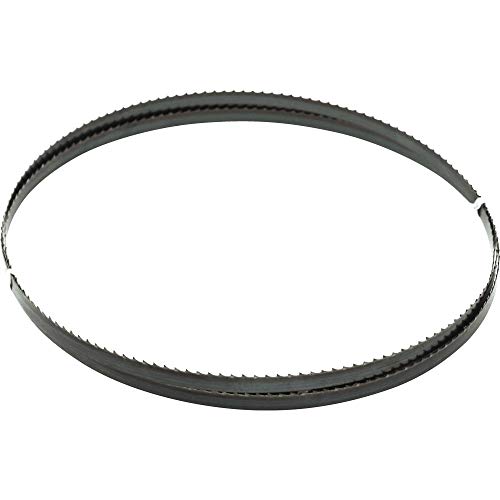
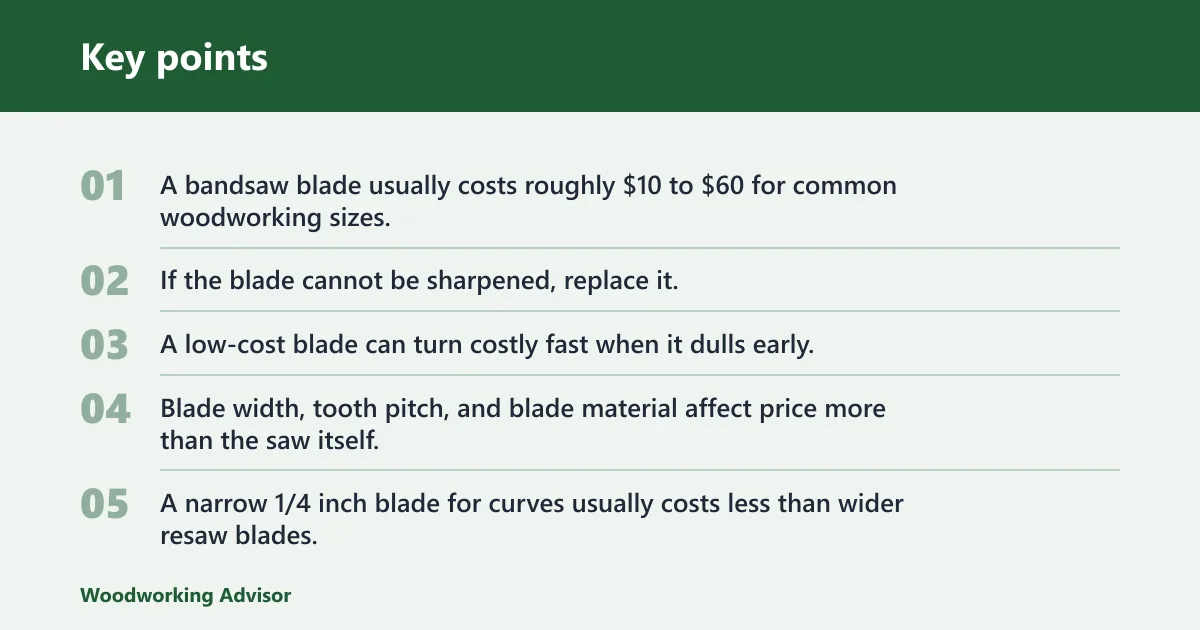
A bandsaw blade usually costs roughly $10 to $60 for common woodworking sizes, while resharpening often runs about $5 to $20. If the blade cannot be sharpened, replace it. A low-cost blade can turn costly fast when it dulls early, because the real figure is what you spend per useful cut hour, not the sticker price.
Bandsaw blade prices by type


What changes the price
Blade width, tooth pitch, and blade material affect price more than the saw itself. A narrow 1/4 inch blade for curves usually costs less than wider resaw blades, and blades with specialized tooth forms or carbide tips cost more up front. The width at the base of the teeth matters for fit and for how much steel is actually carrying load.
For a common 1/4 inch woodworking blade, the thickness is about 0.026 inch and the width at the base of the teeth is 0.190 inch. That narrower effective section helps explain why the profile at the tooth tips does not determine tension capacity. The steel below the tips is what matters for stretch and for cost decisions tied to blade life.
What a 1/4 inch blade usually costs
A 1/4 inch blade is often a budget buy because it is used for general curved cuts and lighter work. Wider blades for straighter cuts, resawing, or thicker stock usually cost more, especially if they use premium steel or carbide teeth. If you mainly need a replacement for a common 14-inch saw, the low end of the range often covers basic carbon-steel blades, while specialty blades push toward the top.
How much does sharpening cost?
Sharpening often costs roughly $5 to $20 per blade, though shipping and service fees can change the total. If you mail blades out, the final bill may approach the price of a low-cost replacement. Sharpening makes the most sense when the blade body is sound and the teeth still have enough material left to grind cleanly.
When shipping changes the total
Some sharpening services charge by blade length, by tooth count, or by the job, and shipping can matter as much as the grinding fee on small blades. A single inexpensive blade may not justify round-trip shipping if the total lands close to a new replacement. For a shop that rotates several blades, batch shipping usually lowers the cost per blade.
How sharpening compares with replacement
If a blade costs $10 to $60 and sharpening costs $5 to $20, sharpening is usually cheaper on a one-time basis. The catch is blade condition. A blade that lasts only a short time before dulling again can end up costing more per cut than a better blade that sharpens cleanly and stays in service longer.
Bandsaw blade cost table
| Blade type and width | Typical replacement price range | Estimated cost per cut hour or per sharpening cycle |
|---|---|---|
| Carbon-steel, 1/4 inch | $10 to $20 | $5 to $20 per sharpening cycle; replacement is the full $10 to $20 if discarded |
| Carbon-steel, wider general-purpose blade | $15 to $35 | $5 to $20 per sharpening cycle; replacement cost rises with width and tooth count |
| Premium steel or specialty tooth pattern | $25 to $60 | $5 to $20 per sharpening cycle if resharpenable; otherwise full replacement price |
| Carbide-tipped specialty blade | $40 to $60+ in common woodworking sizes | Sharpening value depends on service availability; if service is unavailable, replacement is the only cost path |
This table is meant for ownership cost, not just checkout cost. A $15 blade that dulls fast and cannot be sharpened can be more expensive in use than a $35 blade that sharpens well and stays straight. That is the comparison that matters for woodworkers who cut often.
What size bandsaw blade do I need?
Match the blade length to your saw model, then choose a width that your guides, tires, and work type can support. Most manufacturers list the blade length in the owner’s manual or in the model listing. For pricing, the key point is that a wrong length is wasted money, while a width mismatch can cause tracking or tension problems.
Why blade width at the teeth base matters
The width at the teeth base is the part that matters for fit and tension, because the tips do not carry the full load. That is why a blade’s profile can look wider at the tooth tips without meaning it has more tension-carrying steel. The effective cross-sectional area depends on the steel section that is actually stretched.
In the sample calculation, the blade thickness is about 0.026 inch and the width at the base of the teeth is 0.190 inch, producing a computed cross-sectional area of 0.00494 square inches. That smaller area is what enters the tension calculation, not the full tip outline.
Confirming size before you buy
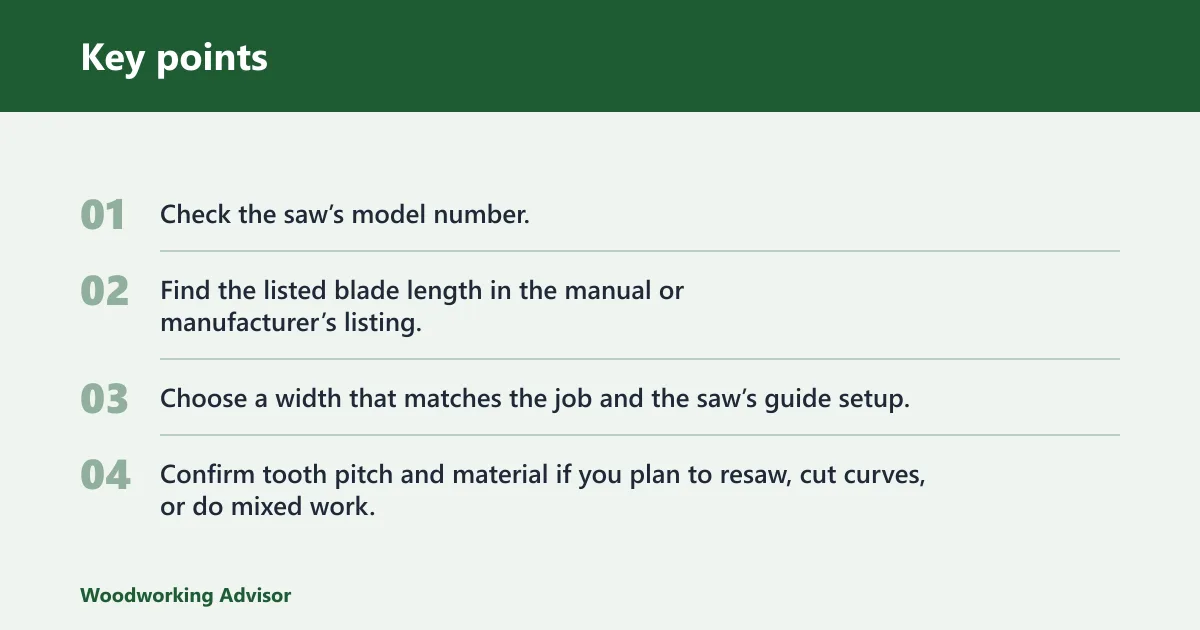
- Check the saw’s model number.
- Find the listed blade length in the manual or manufacturer’s listing.
- Choose a width that matches the job and the saw’s guide setup.
- Confirm tooth pitch and material if you plan to resaw, cut curves, or do mixed work.
Say your 14-inch bandsaw calls for a specific blade length and you want to cut 3/4 inch oak for small curves. A 1/4 inch blade is often the practical choice, but buying the wrong length turns a modest purchase into a useless one. The cheaper blade is not the cheaper choice if it does not fit.
When is sharpening no longer worth it?
Sharpening stops making sense when the teeth are missing, rounded badly, or damaged by heat. If the gullets are packed with metal blueing, if several teeth are gone, or if the set is uneven enough to affect tracking, replacement is usually the better buy. A blade that cannot be restored cleanly is not a sharpening candidate.
Signs the blade should be replaced
- Missing teeth in more than one section.
- Severe heat discoloration or visible cracking.
- Tooth wear that has changed the cutting pattern.
- Uneven set that makes the blade cut off line.
- Damage that would require more grinding than the tooth height can spare.
A common first-timer mistake is assuming a cheap blade that starts wandering through cuts is worth keeping instead of replacing when the cost of a new one is low. If a budget blade dulls after very little use, and the sharpening fee plus shipping nearly equals a new blade, replacement may be the lower-risk choice. That is especially true when the blade has already lost tooth height.
How blade tension affects cost
Bandsaw blade tension is usually based on measured elastic stretch. Bandsaw tension gauges measure relative stretch between two points, and commercial gauges tend to be kind of expensive. The basic idea is simple: if the blade stretches correctly, it tracks better and tends to wear more evenly, which protects your blade budget.
Using stretch and PSI as a cost check
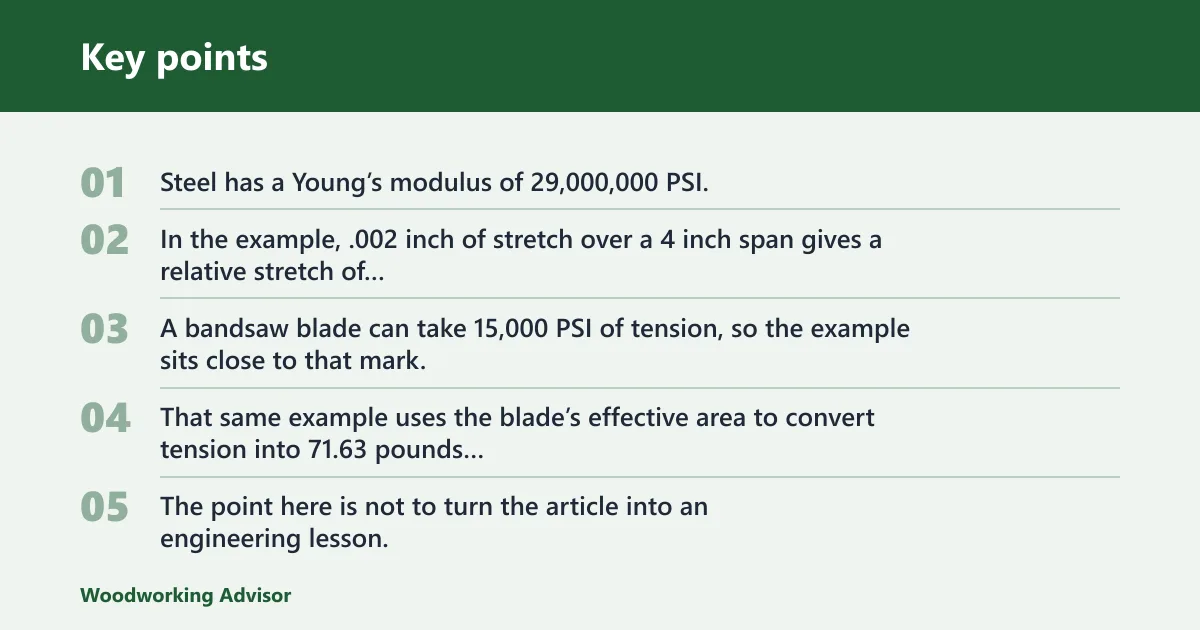
Steel has a Young’s modulus of 29,000,000 PSI. In the example, .002 inch of stretch over a 4 inch span gives a relative stretch of 0.0005. That converts to 14,500 PSI. A bandsaw blade can take 15,000 PSI of tension, so the example sits close to that mark.
That same example uses the blade’s effective area to convert tension into 71.63 pounds of tension. The point here is not to turn the article into an engineering lesson. It is to show why a blade that is under-tensioned or over-tensioned can cost more in wear, drift, or premature failure.
Why a 14-inch bandsaw matters
A 14-inch bandsaw is a common small-saw example because it has less room for measurement and less margin for error than larger machines. On a smaller saw, tiny setup changes matter more, so a tension gauge can be useful even if it is not cheap. If the saw cannot hold stable tension, blade life usually suffers.
Commercial tension gauges are convenient but can be expensive. A homemade gauge can use a dial indicator, and the method multiplies dial movement by 2.9 times. For cost planning, that matters because the gauge itself may cost enough to rival several blade sharpenings.
Replace or sharpen?
For hobbyists, sharpen the blade when the teeth are dull but the blade body is straight, uncracked, and still has enough tooth height left. Replace it when teeth are missing, the cut has gone rough very quickly, or the sharpening quote plus shipping comes close to the price of a new blade. The cheapest blade is not always the cheapest choice.
Simple checklist for hobbyists
- Choose sharpening if the blade is dull, intact, and resharpenable.
- Replace if the teeth are missing or badly heat-damaged.
- Replace if the sharpening bill is close to a new blade.
- Replace if the saw needs a fresh blade for accurate work now.
Simple checklist for light-production users
- Track blade cost per cycle, not just purchase price.
- Use sharpening only when turnaround time will not slow work.
- Replace blades that cut poorly after one short run.
- Favor blades that can be sharpened repeatedly without quality loss.
Suppose a light-production shop buys a $30 blade and gets one sharpening for $15. If the blade is still sound after that service, the ownership cost is $45 before shipping. If a cheaper $12 blade cannot be sharpened and must be thrown away after one short run, the lower sticker price stops being a bargain.
Frequently asked questions
How much does a bandsaw blade cost?
A common woodworking bandsaw blade usually costs about $10 to $60, depending on width, tooth pattern, and material. Narrow carbon-steel blades sit near the low end, while wider or specialty blades cost more. If a blade can be sharpened, that lowers the cost per use.
How much does it cost to sharpen a bandsaw blade?
Sharpening often runs about $5 to $20 per blade. Shipping and service fees can raise the total, especially on single blades. If the sharpening bill is close to a replacement price, or the teeth are too worn, replacement is usually the better choice.
How do I know when my bandsaw blade is too dull to resharpen?
Replace the blade if teeth are missing, the cutting edge is badly rounded, or heat damage has changed the blade body. If sharpening would remove too much remaining tooth height, the blade is no longer a good candidate. A clean, repeatable grind is the test that matters.
Is it cheaper to sharpen or replace a bandsaw blade?
Sharpening is usually cheaper when the blade is still in good shape and the service fee stays below the replacement price. Replacement wins when the blade is damaged, shipping is high, or the sharpening quote nearly matches a new blade. The real comparison is cost per useful cut hour.
How do I measure bandsaw blade tension?
Bandsaw tension is usually based on measured elastic stretch. Tension gauges measure relative stretch between two points, and the example calculation uses .002 inch over a 4 inch span to reach a relative stretch of 0.0005 and about 14,500 PSI. That is close to 15,000 PSI.
Sponsored / affiliate links. As an Amazon Associate I earn from qualifying purchases. I may earn additional commission from eligible campaigns.