Is Bloodwood Good for Cutting Boards? 2,900 Janka, Safety, Cost
Bloodwood (Brosimum rubescens) can make a cutting board, but it is a poor whole-board choice: at 2,900 lbf Janka it is about twice as hard as hard maple, it blunts cutters, and its dust is a reported irritant. It works best as accent strips in a maple or walnut board. This guide covers the hardness and weight numbers, food-contact facts, real cost, and how to build and oil one.
Is Bloodwood Good for Cutting Boards? The Short Answer
BEST BOARD OIL PICK |
Howard Food Grade Mineral Oil for Cutting Boards, 12 oz, $8.75
|
Only for the right job. Bloodwood has a vivid red heartwood that most cutting board woods cannot match, and it is dense enough to last for years of light use. The tradeoff is that it is one of the hardest woods you can put under a kitchen knife, it is heavy, it is brittle to machine, and it costs more than the usual maple or walnut. For a board you will chop on daily, a knife-friendly wood like hard maple is the better surface. For a serving board or a striped design, thin bloodwood strips are a good use of it.
Everything below on the wood itself comes from the Wood Database bloodwood profile, and the maple comparison from the Wood Database hard maple profile.
Bloodwood Hardness and Weight vs Common Cutting Board Woods
Most articles just say bloodwood is “very hard.” The numbers show how far it sits from the woods people normally use. The Wood Database lists bloodwood at 2,900 lbf Janka and 66 lbs/ft³ dried weight. The last two columns below are my own arithmetic from those published figures: the ratio to hard maple, and the approximate weight of a 12 x 18 x 1.5 inch board (0.1875 cubic feet) at dried weight.
| Wood | Janka (lbf) | Dried weight (lbs/ft³) | Hardness vs hard maple | 12 x 18 x 1.5 in board |
|---|---|---|---|---|
| Black cherry | 950 | 35.0 | 0.66x | about 6.6 lb |
| Black walnut | 1,010 | 38.0 | 0.70x | about 7.1 lb |
| Hard maple | 1,450 | 44.0 | 1.0x | about 8.3 lb |
| African padauk | 1,710 | 46.5 | 1.2x | about 8.7 lb |
| Purpleheart | 2,520 | 56.4 | 1.7x | about 10.6 lb |
| Bloodwood | 2,900 | 66.0 | 2.0x | about 12.4 lb |
Two things follow from the table. First, a full-size bloodwood board weighs roughly 4 pounds more than the same board in hard maple, which matters if you lift it to the sink every day. Second, bloodwood is harder than even purpleheart, which is itself well above the woods most board makers use. Janka is measured on the side of a plank, so it does not settle how a board behaves on the end grain, but it is a fair guide to how dense the fibers are. For more species on one scale, see our wood hardness scale.
What Hardness Means for Your Knives
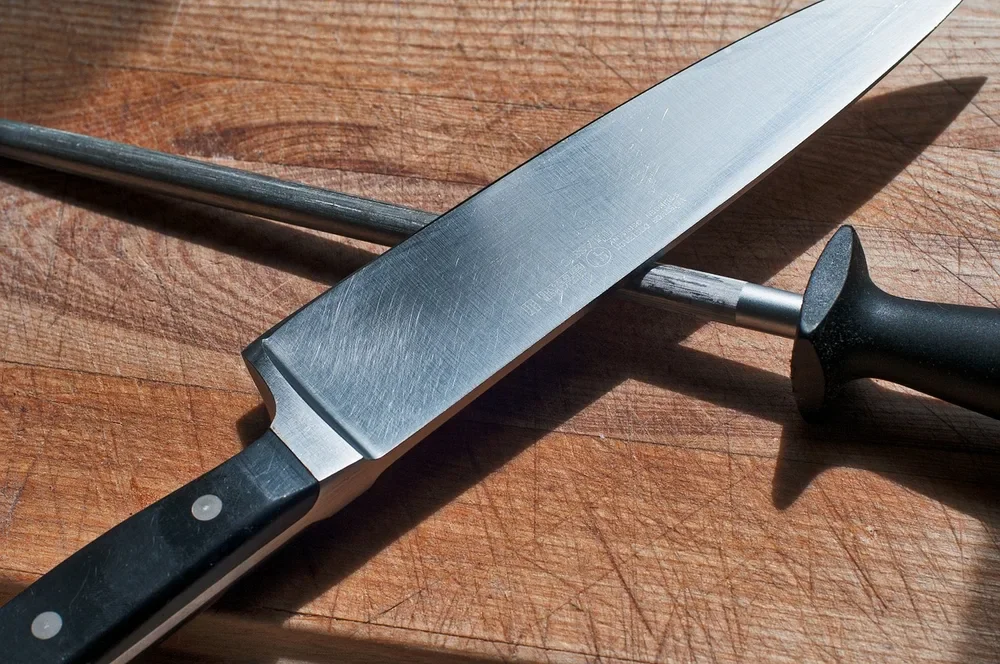
A harder surface gives a knife edge less to sink into, so in general it wears an edge faster than a softer one. That is the main reason maple, walnut and cherry are the standard board woods: they are hard enough to resist deep cuts but soft enough to let the edge bite in a little. At about twice the hardness of maple, bloodwood sits well past that comfortable range, so expect to hone more often if you cut on it regularly.
Bloodwood does not dent or scar easily, which is the good half of the story. The bad half is that the board stays flat and clean at your knife’s expense. If you love the look, keep the bloodwood in narrow strips and let softer wood carry most of the cutting surface.
Is Bloodwood Food Safe? What Is and Is Not Known
The honest answer is that the evidence is thin in both directions. The Wood Database reports that bloodwood dust has occasionally caused thirst, salivation and nausea, and can cause skin irritation. Those are reports about sanding and machining dust, not about a finished board. I did not find a source that declares a finished bloodwood board unsafe for food, and I did not find one that certifies it as food safe either, so treat that question as open rather than settled.
Many pages claim bloodwood is “naturally antibacterial.” The Wood Database profile does not mention any such property, and I could not source the claim, so this article does not repeat it. Any wood board, bloodwood or not, still needs to be washed and dried properly; our guide on wood cutting boards and bacteria covers that.
A practical way to handle the uncertainty:
- If anyone in your home reacts to exotic woods, choose maple, walnut or cherry for the board instead.
- Sand with a dust collector or outdoors, and wear a dust mask, since dust is where the reported effects come from.
- Finish the board with a food grade oil, then wipe off the excess and let it soak in before use.
- If you get a rash, nausea or other symptoms while working the wood, stop and ask a doctor.
How Much Does a Bloodwood Cutting Board Cost?
The Wood Database rates bloodwood as moderate to moderately high in price for an imported hardwood. To turn that into numbers, I checked live Amazon listings for unfinished bloodwood boards on 2026-09-30. Prices move, so treat these as a snapshot, not a quote.
| Listing (unfinished bloodwood) | Price | Board feet | Price per board foot |
|---|---|---|---|
| 3/4 x 5 x 24 in | $36.30 | 0.625 | about $58 |
| 1/2 x 2 x 12 in | $14.70 | 0.083 | about $176 |
A 12 x 18 x 1.5 inch board is 2.25 board feet before waste. At the larger listing’s roughly $58 per board foot, the bloodwood alone would run about $130, and trimming and planing waste pushes that higher. Small strips are far more expensive per board foot, but a few thin strips in a maple board is where bloodwood makes financial sense. That is why a stripe design costs a fraction of a solid board.
Working Bloodwood: What to Expect at the Bench
The Wood Database notes that bloodwood is extremely dense with a pronounced blunting effect on cutters, and that it tends to be brittle and can splinter easily. That shapes how to build with it:
- Use sharp carbide tooling and take light passes; expect to sharpen or replace blades sooner than with maple.
- Back up cuts on the table saw and router with scrap to limit splintering at the exit edge.
- Keep bloodwood strips narrow and glue them between tougher woods so the brittle wood is supported.
- Sand progressively to at least 220 grit, and wipe off dust before oiling.
For glue, choose a waterproof wood glue and check its label for indirect food contact use; our Titebond III review covers one common option.
Will the Red Color Last?
Not exactly. The Wood Database says the bright red heartwood can darken to a brownish red over time with light exposure. If you want a board that stays vivid, keep it out of direct sun when it is not in use, and expect the color to mellow either way. For a comparison with another red exotic that also shifts color, see our bloodwood vs padauk comparison.
Bloodwood vs Other Options for a Cutting Board
- Hard maple: the safe default, lighter and easier on knives; see the numbers in the table above.
- Black walnut: softer than maple, dark and knife friendly.
- Purpleheart: another hard exotic with a strong color; read our purpleheart cutting board guide.
- Padauk: similar red-orange look at a lower hardness; see padauk for cutting boards.
- Teak: a different kind of exotic; see our teak cutting board article.
How to Build a Bloodwood-Accent Cutting Board
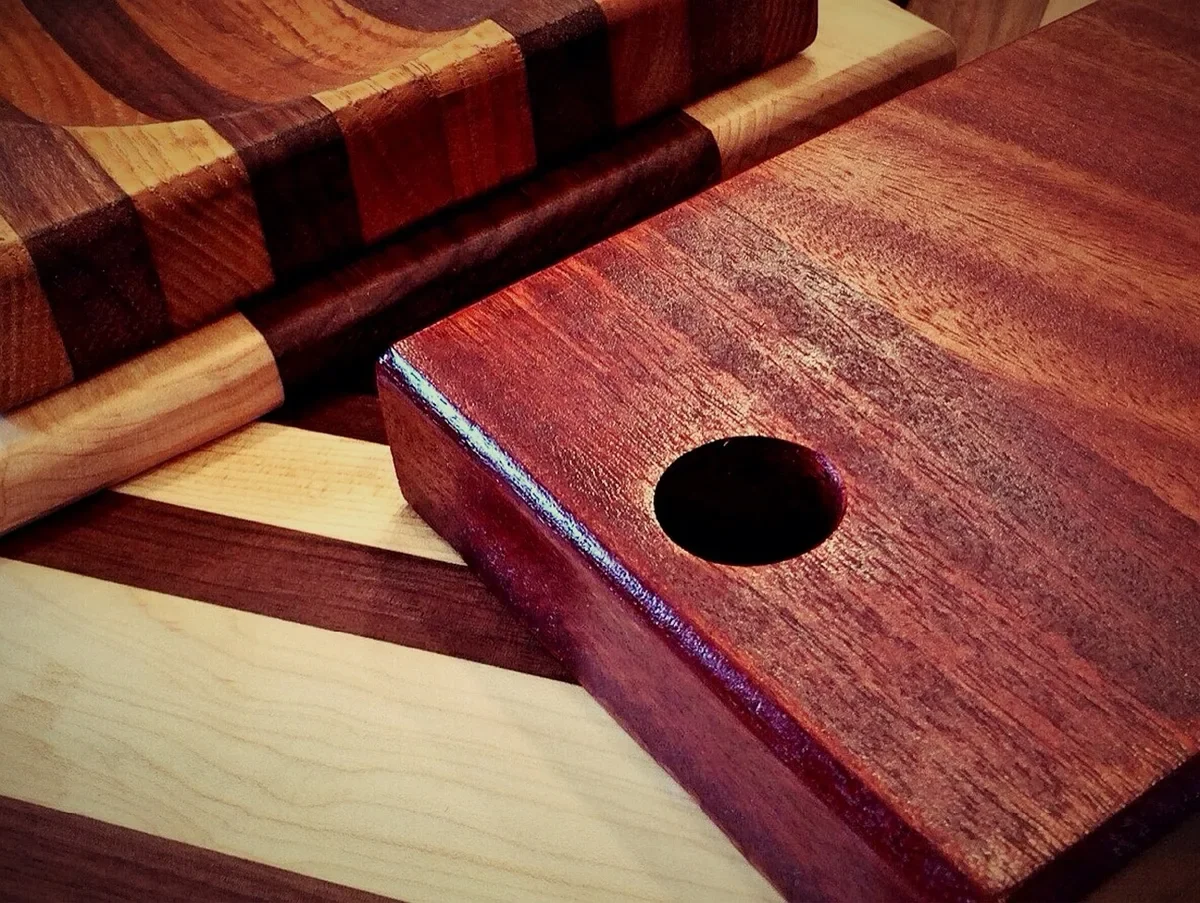
- Mill hard maple or walnut strips to equal thickness, and mill the bloodwood strips narrower, around 1/2 inch, so they show as accents.
- Dry-fit the strips and check that the faces are flat before you glue.
- Glue up with a waterproof wood glue and clamp evenly, wiping squeeze-out before it skins over.
- Flatten and sand the board, with dust collection running, up to 220 grit.
- Round the edges slightly to reduce chipping on the brittle strips.
- Apply food grade mineral oil, let it soak in, and wipe off the excess.
For finish choices beyond oil, see our guide on how to finish wood for a cutting board, and for how oils differ, mineral spirits vs mineral oil.
Caring for a Bloodwood Board
- Wash by hand with mild soap and warm water, then dry it promptly and stand it on edge.
- Do not soak it or run it through the dishwasher, since water swings can crack any wood board.
- Oil it whenever the surface looks dry, about monthly at first, then as needed.
- Store it away from a stove or sunny window, which dries the wood and speeds color change.
Frequently Asked Questions
Is bloodwood safe for cutting boards?
There is no published source I found that declares finished bloodwood boards unsafe, but there is also none certifying them as food safe. The Wood Database reports that the dust can cause irritation and nausea in some people, so choose maple or walnut if you are sensitive, and control dust while building.
How hard is bloodwood compared to maple?
Bloodwood is rated 2,900 lbf on the Janka scale and hard maple is 1,450 lbf, so bloodwood is about twice as hard. It also weighs 66 lbs/ft³ against 44 for maple.
Will a bloodwood cutting board dull my knives?
In general a harder surface wears a knife edge faster than a softer one, and bloodwood is far harder than maple, so expect to hone more often. Using it as narrow accent strips limits the effect.
How much does bloodwood cost for a cutting board?
The Wood Database calls the price moderate to moderately high. On 2026-09-30, one Amazon listing worked out to about $58 per board foot, and a full 12 x 18 x 1.5 inch board would need about 2.25 board feet before waste.
Does bloodwood stay red?
The Wood Database says the bright red heartwood can darken to a brownish red over time with light exposure, so the color mellows rather than staying vivid.
Bottom Line
Bloodwood is a good wood for a striking accent and a poor choice for a board you cut on every day. Use it in thin strips, choose a food grade oil, control the dust, and keep hard maple or walnut as the main cutting surface.
Sponsored / affiliate links. As an Amazon Associate I earn from qualifying purchases. I may earn additional commission from eligible campaigns.