Best Maple Plywood for Cabinet Boxes (2026): We Compared
For many cabinet boxes, 3/4-inch hardwood plywood with a birch or veneer core, a Grade A1 or A2 maple face, and a balanced back is a common choice. That combination stays flatter and holds screws better than lower grades. Pick the wrong core or face grade and you get sagging shelves, telegraphed patches, and joinery that fights you. This guide compares maple plywood grades, cores, thicknesses, and finishes so you can match each sheet to carcasses, shelves, and visible cabinet parts.
Quick comparison
| Product | Badge | Best for | Price | ||
|---|---|---|---|---|---|
 |
Proflex Maple Plywood 6pcs, 1/8" x 12” x 24” Real WoodPRO FLEX | Our pick | $59.99
Price as of 25 Oct 2026
|
View | |
 |
Custom Size 3/4” (18mm) X 24” X 24” Maple Plywood (1DGwood | Also great | 3/4" x 24" x 24" · Maple Plywood · Project Panel | $57.90
Price as of 25 Oct 2026
|
View |
 |
6 mm Baltic Birch Plywood 1/4 x 12 x 12 Inch, Box of 8 B/BBWoodpeckers | Also great | $27.02
Price as of 25 Oct 2026
|
View | |
 |
Edge Supply Maple Wood Veneer Sheet Flat Cut, 24” x 96”,Edge Supply | Also great | $79.99
Price as of 25 Oct 2026
|
View |
Use the comparison table to separate appearance grades from structural choices. A sheet that looks right for a door face can still be wrong for a hidden carcass.
How we chose
The comparison below prioritizes face grade, back grade, core type, thickness, finish state, and what each sheet is likely to do in a cabinet box. It also flags defects that matter at the lumberyard: warp, voids, uneven veneer, poor edge quality, and thickness drift.
The goal is to buy the right panel for the exact cabinet part, not a single panel that only works on paper.
Maple plywood spec matrix
| Visible face | Hidden carcass | Moisture exposure | Finish type | Recommended face grade | Back grade | Core type | Thickness | Red-flag defects to reject |
|---|---|---|---|---|---|---|---|---|
| Clear-finished door, drawer front, or exposed end panel | No | Low | Stain or clear coat | A1 or A2 | 1 or 2 | Veneer core or combination core | 3/4-inch or 18 mm equivalent | Color patchiness, open knots, torn veneer, edge voids, visible repairs |
| Painted cabinet door or painted face frame panel | No | Low to moderate | Paint | B2 or A2 | 2 | MDF core or combination core | 3/4-inch or 18 mm equivalent | Raised grain, uneven sanding, edge breakout, surface waves, thickness mismatch |
| Cabinet side or shelf | Yes | Low | Paint, clear, or edge banded | B2 or C2 | 2 or 3 | Veneer core | 3/4-inch or 18 mm equivalent | Warp, internal voids, delamination, crushed corners, uneven thickness |
| Cabinet back | Yes | Low | Usually hidden | C2 or D2 | 2, 3, or 4 | Veneer core or lighter panel option | 1/2-inch or thinner, depending on design | Gross warp, loose plies, cracked edges, corner damage, open voids |
| Production interior panel | Yes | Low | Prefinished | B2 or C2 | 2 | Veneer core or combination core | 3/4-inch or 18 mm equivalent | Finish holidays, sticky spots, bowed sheet, edge chatter, oversized sanding marks |
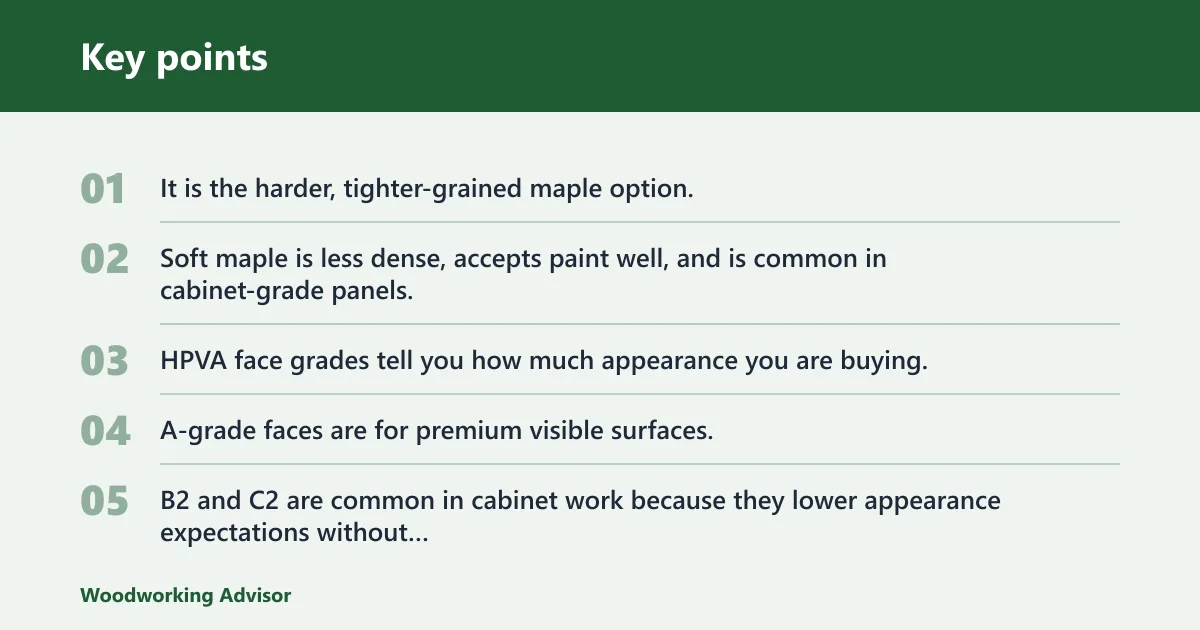
Hard maple veneer comes from Acer saccharum. It is the harder, tighter-grained maple option, with a Janka hardness of approximately 1,450 lbf, so it is a better visual choice for clear-finished faces and doors than for hidden carcasses. Soft maple is less dense, accepts paint well, and is common in cabinet-grade panels, but it can show more color variation from sheet to sheet.
HPVA face grades tell you how much appearance you are buying. A-grade faces are for premium visible surfaces. B2 and C2 are common in cabinet work because they lower appearance expectations without turning the sheet into a throwaway. HPVA back grades work the same way on the hidden side: Grade 1 is cleanest, Grade 2 is common for cabinets, and lower grades tolerate more defect on the back.
Veneer core maple: best for cabinet boxes
Veneer core maple is usually the best all-around buy for cabinet boxes because it gives you an all-wood core, practical fastening, and a familiar plywood edge. It also tends to be lighter than denser panel constructions, which matters once you start hanging full-height pantry sides or wide shelf spans. For most carcasses and shelves, that balance is hard to beat.
Compared with MDF core, veneer core is better when screw-holding and a more traditional plywood edge matter more than a glass-flat paint surface. Compared with a cheap, low-grade sheet, it is far less likely to give you edge banding trouble, crushed screw zones, or surprise voids near a dado or hinge screw.
Use 3/4-inch or 18 mm equivalent sheets for cabinet sides, shelves, and full carcasses. Use 1/2-inch only when the design supports it, such as backs, light-duty partitions, or narrower components where rigidity is not the main load issue.
What to inspect before buying
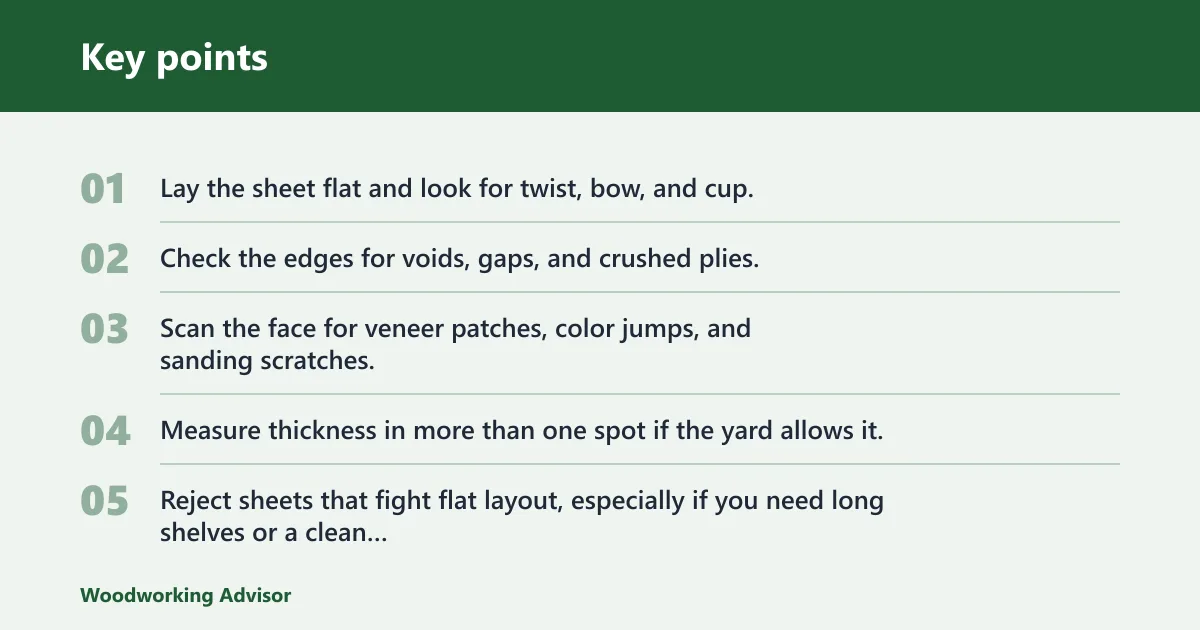
- Lay the sheet flat and look for twist, bow, and cup.
- Check the edges for voids, gaps, and crushed plies.
- Scan the face for veneer patches, color jumps, and sanding scratches.
- Measure thickness in more than one spot if the yard allows it.
- Reject sheets that fight flat layout, especially if you need long shelves or a clean edge-band line.
A common first-timer mistake is to buy a face-grade panel for a hidden carcass and ignore the core. The panel may look great on the rack, then fight you with weight, thickness drift, or poor screw purchase once you start building a 24-inch-deep base cabinet.
Quick picks
- Best for clear-finished cabinet faces: A1 or A2 maple face, veneer core, 3/4-inch or 18 mm equivalent.
- Best for painted cabinet boxes: B2 or A2 face, MDF core or combination core, 3/4-inch.
- Best for hidden shelves and sides: B2 or C2 face, veneer core, 3/4-inch.
- Best for production interiors: UV-prefinished maple, B2 or C2 face, veneer core or combination core.
- Best budget alternative: birch plywood when exposed edges and cost matter more than maple’s cleaner face.
UV-prefinished maple: best for interiors?
UV-prefinished maple plywood is worth considering when you want to cut finishing labor, especially on cabinet interiors or repeat production work. UV1S means one side finished, and UV2S means two sides finished. For interiors that will stay visible, a factory UV-cured finish can save sanding, spraying, and cure time.
The tradeoff is cost and flexibility. Prefinished sheets are less forgiving if you need to alter sheen, tint, or stain tone later. If you expect to hand-finish the field, plain unfinished maple is often the better buy.
Where prefinished panels save labor
Prefinished panels make the most sense when the part count is high and the exposed interior is part of the finished look. Think drawer boxes, cabinet interiors, or shop-built runs where you want consistent sheen without a separate finishing step.
They are less attractive for one-off work where trimming, edge banding, and touch-up will erase much of the labor savings. In that case, paying for factory finish can add cost without enough payoff.
Maple vs birch for cabinets
Birch plywood is often the smarter choice when cost and exposed edge behavior matter more than maple’s cleaner face. Birch plywood is listed at about 1,260 lbf for Janka hardness, while hard maple is approximately 1,450 lbf. Maple is usually chosen when you want a cleaner-looking face or matching maple parts; birch is often more cost-effective for cabinet boxes.
That edge difference matters. If your cabinet design leaves plywood edges visible, birch is often easier to justify because it is widely used in cabinet work and can be a better value for exposed edges. Maple still has a place when the face will stay visible and the parts need to match adjacent maple components.
Say your kitchen run uses a stained maple face frame and you need 8-foot side panels. Maple plywood keeps the visual tone closer to the rest of the build. Say the same run is paint-grade and the edges will be banded anyway. Birch may be the cleaner purchase because it lowers material cost without changing the final look.
When birch is the smarter choice
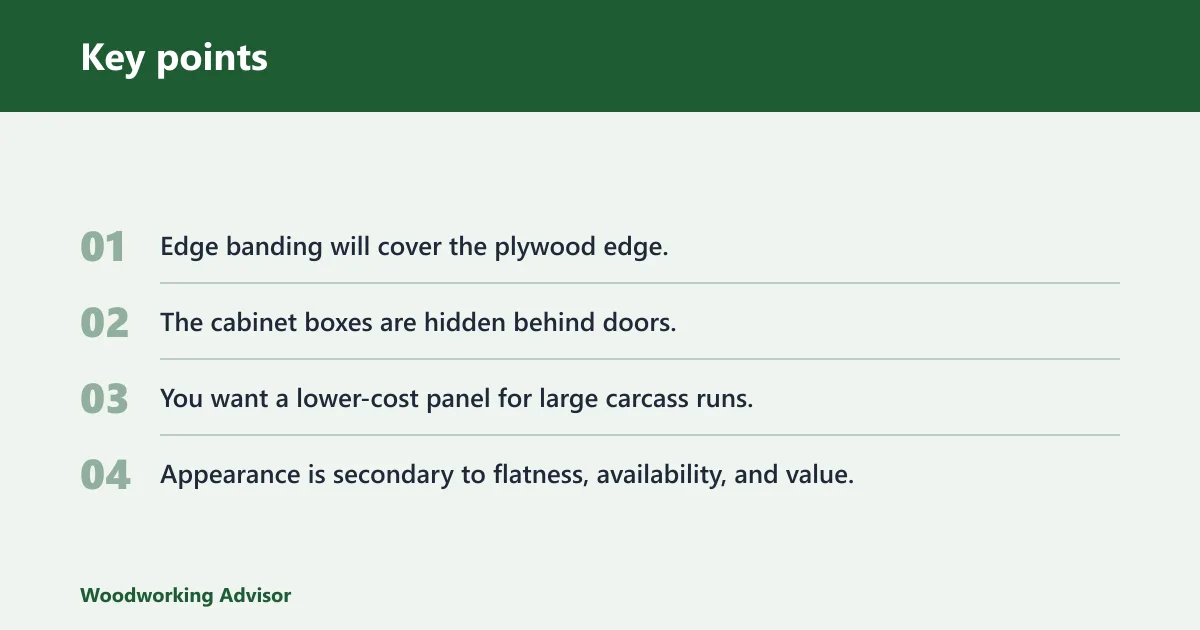
- Edge banding will cover the plywood edge.
- The cabinet boxes are hidden behind doors.
- You want a lower-cost panel for large carcass runs.
- Appearance is secondary to flatness, availability, and value.
Proflex Maple Plywood: best for small visible parts
1/8-inch A-grade maple sheets are better suited to small visible parts, crafts, laser work, and mockups than cabinet boxes. The smooth sanded finish is the main draw, and the small sheet size makes handling easy.
The drawback is obvious for cabinet work: 1/8-inch material is far too thin for carcasses, shelves, or hinge-bearing cabinet parts. Treat it as a specialty panel, not a cabinet-box solution.
DGwood Maple Plywood: best for cabinet panels
DGwood’s 3/4-inch, 24 by 24 inch maple plywood is the closest match here to a true cabinet-box panel. The true 3/4-inch thickness is the important part, because it gives you the rigidity and screw-holding you want in cabinet sides and short runs.
The drawback is size. A 24 by 24 inch sheet is useful for projects and sample panels, but it is not a substitute for full cabinet carcass sheets unless your layout is compact or your design is modular.
Woodpeckers Baltic Birch: best for small parts
Woodpeckers Baltic birch is a practical choice for small boxes, jigs, and cut parts where consistency matters more than maple appearance. Birch is often more cost-effective than maple, and the panel format is easy to manage for repeat cuts.
The drawback is that it is not maple, so the face tone will not match maple cabinetry. It is also sized and marketed for craft and CNC use, which makes it better for parts than for full-size cabinet boxes.
Edge Supply maple veneer: best for refinishing
Edge Supply’s maple veneer sheet is for resurfacing, restoration, and face work, not structural cabinet boxes. The A-grade veneer face and paper backing make it useful when you need a maple look over a stable substrate.
The drawback is that veneer is not plywood. It solves appearance, not carcass structure, so you still need a proper core panel underneath for cabinet construction.
Which one should you buy?
For painted cabinet boxes, buy a B2 or A2 maple face on MDF core or combination core if you want a flatter paint surface, or veneer core if screw-holding and edge durability matter more. For clear-finished parts, A1 or A2 on veneer core is the safer buy. For budget builds, birch often beats maple on value, especially for hidden carcasses.
For production interiors, UV-prefinished maple can be worth the premium if it saves a full finishing step and the exposed interior stays visible. If the box will be trimmed heavily, edge-banded, or painted later, unfinished veneer core is usually the more flexible choice.
Decide in one pass: pick the finish first, then the core, then the thickness. After that, check the back grade and reject any sheet with warp, voids, patchy veneer, or a rough edge that will cause problems at the saw or router.
Suppose you are building a 30-inch base cabinet with adjustable shelves and painted doors. A B2 maple face on 3/4-inch MDF core is a strong paint-grade starting point, but only if the sheet is flat and the edges are clean enough to band. If the same cabinet will stay clear-finished, move up to A1 or A2 and accept the higher sheet cost.
How to choose
Start with the cabinet part, not the species. A visible door or drawer front calls for a better face grade than a hidden side panel. A shelf that carries load needs thickness and core stability. A back panel can usually tolerate a lower grade because it is hidden.
Then match the finish to the core. MDF core gives a very flat surface and a smooth, uniform edge, which helps on painted parts and large flat panels. Veneer core is the practical all-wood choice for carcasses and shelves. Combination core sits between those two and is better suited to architectural panels and interior millwork than to basic box builds.
Thickness is not a minor detail. 3/4-inch and 18 mm equivalent are the common cabinet-box sizes because they improve rigidity and screw-holding. 1/2-inch works for backs and select parts, but it should not be treated as a universal substitute.
Frequently asked questions
What is the best maple plywood for cabinet boxes?
The best maple plywood for cabinet boxes is usually 3/4-inch veneer core maple with a B2 or C2 face and a Grade 2 back. That combination gives you useful structure, acceptable hidden-side quality, and a cabinet-friendly balance of cost, weight, and screw-holding.
Is maple plywood good for cabinets?
Yes. Maple plywood is good for cabinets when you match the face grade, back grade, core, and thickness to the job. It is especially useful for visible parts and matching maple cabinetry, but it should not be treated as a one-spec-fits-all panel.
What thickness of maple plywood should I use for cabinet boxes?
Use 3/4-inch or 18 mm equivalent for most cabinet sides, shelves, and carcasses. Use 1/2-inch for backs or lighter components when the design supports it. Thicker panels generally improve rigidity and screw-holding, but they also add weight.
What grade of maple plywood is best for painted cabinet boxes?
B2 or A2 is a strong choice for painted cabinet boxes because the face quality is good enough for paint without paying for the highest appearance grade. If the panel must also stay very flat, MDF core or combination core can help with the paint finish.
Should I choose maple plywood or birch plywood for cabinets?
Choose maple when the face will be visible and you want a cleaner maple match. Choose birch when cost matters more or when exposed edges are part of the design. Birch is often the better value for hidden carcasses, while maple is more appealing on visible parts.
What core type is best for cabinet-grade maple plywood?
Veneer core is usually the best all-around core for cabinet-grade maple plywood because it is lighter and has practical fastening. MDF core is better for very flat painted surfaces. Combination core is more of a specialty choice for architectural panels and interior millwork.
Is prefinished maple plywood worth it for cabinet boxes?
It can be, but only when the finished interior will stay visible and you want to save labor. UV1S and UV2S panels reduce finishing work, yet they also limit flexibility if you plan to stain, tint, or alter the sheen later.
Sponsored / affiliate links. As an Amazon Associate I earn from qualifying purchases. I may earn additional commission from eligible campaigns.