How Much Does It Cost to Refinish Maple Cabinets?
Refinishing maple cabinets is often priced around $3,000 to $8,000 for an average kitchen, with smaller projects near $1,500 and larger finish-change jobs sometimes reaching $12,000 or more. Poor prep or color changes can leave blotchy grain, peeling topcoats, and a bill that is higher than replacement for the same cabinets. This guide breaks down cost by condition, door count, and finish type so you can estimate a fair quote.
Typical cost range
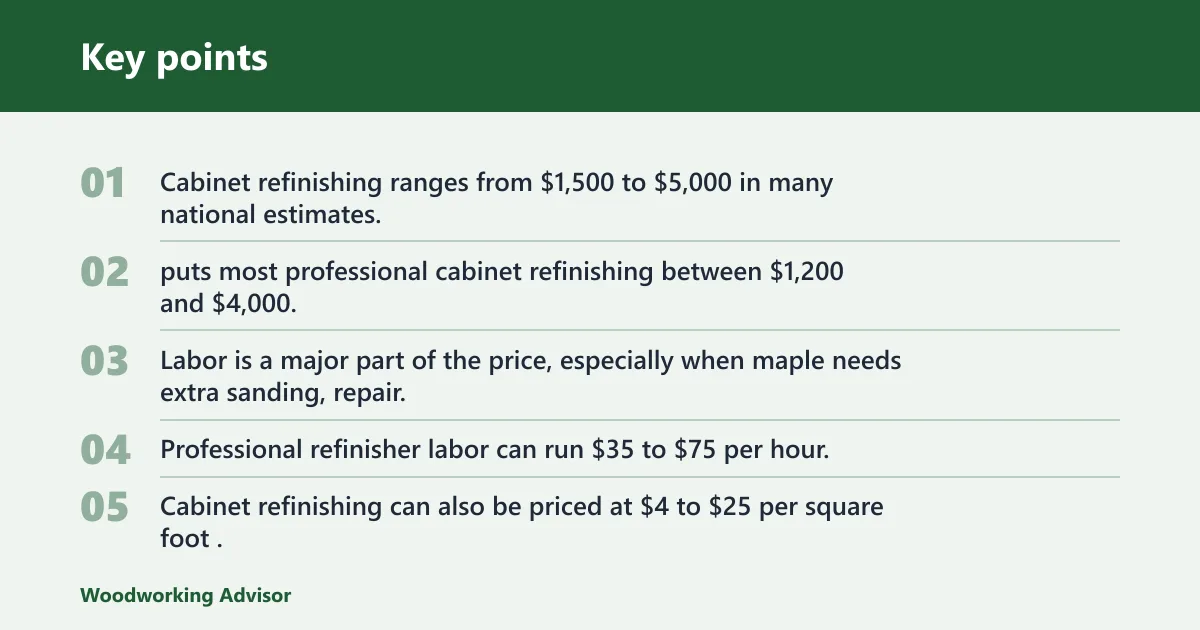

Cabinet refinishing ranges from $1,500 to $5,000 in many national estimates, with Bob Vila listing a national average of $2,975. Custom Decorators Co. puts most professional cabinet refinishing between $1,200 and $4,000, while kitchen cabinets are the most common refinishing location. Labor is a major part of the price, especially when maple needs extra sanding, repair, or stripping.
Professional refinisher labor can run $35 to $75 per hour, and Bob Vila says the average total labor comes in around $500 to $1,000. Cabinet refinishing can also be priced at $4 to $25 per square foot. A typical kitchen has about 150 square feet of cabinet materials, so even small changes in prep scope can move the total quickly.
Maple changes the estimate because it often has a smooth surface that still needs careful prep. Solid maple, maple veneer, hard maple, and soft maple all behave differently. The existing finish matters too. A sound clear coat is easier to sand than a failed painted finish, and a deep color change takes more steps than a simple refresh.
Maple cabinet cost estimator
Use this table as a planning tool, not a fixed bid. Door count, drawer fronts, damage, and finish change drive the range. A kitchen with about 18 to 25 doors can fall near the middle of these figures, while a larger layout with island panels and tall pantry fronts can move higher quickly.
| Scenario | Estimated labor hours | Key prep steps | Risk factors | Sample low-to-high project range |
|---|---|---|---|---|
| Light refresh | 12 to 20 | Clean and degrease, light sanding, minor fill, stain or clear-coat touchup, topcoat | Surface grease, uneven sheen, minor scratch-throughs | $1,500 to $3,000 for a smaller door count; $2,500 to $4,000 with more drawers or hardware work |
| Full strip-and-restain | 25 to 45 | Remove doors and hardware, strip or sand existing finish, repair dents and open grain, restain, seal, topcoat | Failed finish, blotching, prior stain mismatch, longer cure time | $3,500 to $7,500 for a medium kitchen; $6,500 to $10,000+ when repair level is high |
| Stain-to-paint conversion | 30 to 55 | Strip or sand, clean, fill grain as needed, prime, paint, topcoat, cure between coats | Grain telegraphing, adhesion failure, old finish bleed-through, extra masking | $4,500 to $9,500+ for a typical kitchen; $8,000 to $12,000+ with damaged doors and many panels |
What changes the price?
Door count, drawer fronts, condition, and finish change all affect the quote. Maple can be straightforward when the clear coat is stable, but damaged surfaces, veneer lift, or a major color change add labor. Regional rates matter too, because labor and minimum charges vary by market.
Door and drawer count
More doors and drawer fronts mean more removal, more labeling, more prep, and more finish work. A small galley kitchen may have only a dozen fronts, while a larger U-shaped kitchen with a pantry and island can have 30 or more. Some contractors price per door, while others use a project minimum and adjust for extra panels.
Cabinet condition and repairs
Water damage, failed finish, grease buildup, veneer lift, cracks, loose joints, and bad prior paint jobs all raise labor. A cabinet that needs only cleaning and sanding is far cheaper than one that needs patching, clamping, or veneer repair. If the old coating is peeling, stripping often takes longer than sanding a stable finish.
Solid maple versus veneer
Solid maple tolerates sanding better than thin veneer, which can be damaged quickly if the old finish is uneven. Veneer lift, edge chips, and thin factory faces limit how aggressive the prep can be. That often pushes the job toward careful scuff sanding, repair, and paint instead of heavy stripping.
Finish type and color change
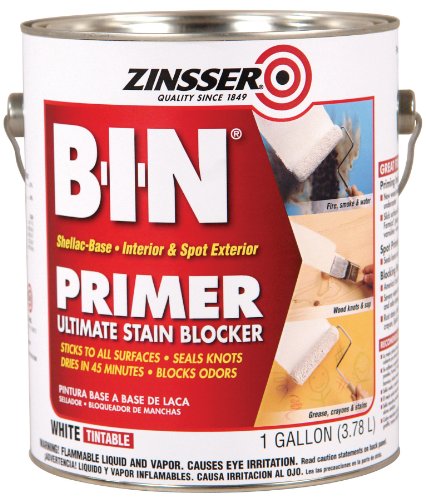
Stain-to-stain work is usually simpler than stain-to-paint. Natural-to-painted cabinets need more degreasing, more sanding, and a primer that blocks old color. Dark-to-light changes are usually the hardest stain jobs because existing color often needs to be removed more fully before a lighter stain can read evenly.
Suppose a 20-door maple kitchen has a sound clear coat and no water damage. A refinisher may only need cleaning, light sanding, and a new topcoat. Now change one variable: the same kitchen has a failed amber finish and two swollen sink-base doors. The quote rises because stripping, repairs, and extra cure time are now part of the job.
Can maple cabinets be restained or painted?
Yes, maple cabinets can be restained or painted, but the finish change sets the difficulty. Stain-to-stain work is usually the simplest. Dark-to-light changes are harder, and painting often costs more than a stain refresh because it adds primer, extra sanding, and more steps to keep grain from showing through.
Stain-to-stain refinishing
Stain-to-stain refinishing works best when the old finish is stable and the new color stays in the same general range. Maple’s smooth grain can take stain evenly after proper sanding, but it can still blotch if the surface is not prepared well. A test area is wise before committing to a full kitchen.
Dark-to-light changes
Dark-to-light color changes are usually the most labor-heavy stain projects. Removing enough of the old color to get a lighter result can mean more stripping or sanding, more risk at edges, and more time on doors with profiles. If the cabinets are already heavily coated, the labor can jump enough to make paint the simpler choice.
When paint is the better choice
Paint can be the better choice when the goal is a uniform look, when old stain is uneven, or when the maple has repair patches that would show under clear finish. Custom Decorators Co. says kitchen cabinet painting is priced separately at $1,500 to $4,500, and Bob Vila notes cabinet painting averages $895. Painted maple still needs careful prep.
What should a refinishing quote include?
A solid cabinet refinishing quote should spell out removal, prep, coatings, reinstallation, and cleanup. It should also say whether primer, topcoat, and cure time are included. If the bid is vague, you may end up paying extra for hardware removal, touchups, or return visits after the finish flashes or cures.
Removal and prep scope
The quote should list door and drawer removal, hardware removal, cleaning and degreasing, sanding or stripping, and any repairs. For maple, that scope matters because the grain can reveal sanding marks or leftover contamination if prep is rushed. Ask whether veneer damage, crack repair, or joint tightening is included.
Primer, topcoat, and cure time
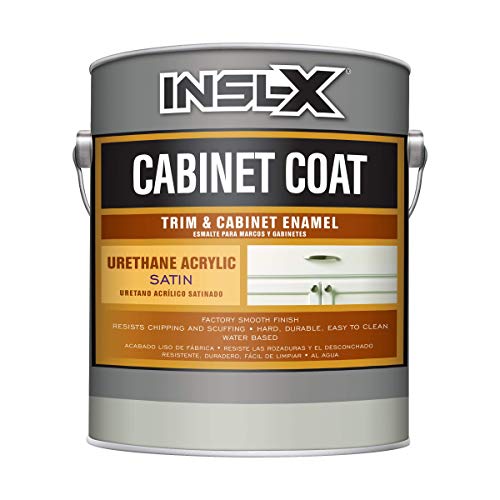
For painted cabinets, the bid should state the primer type and number of coats. For stained or clear-finished cabinets, it should state the stain, glaze if any, shellac or varnish if used, and the topcoat system. Cure time matters because doors may need to stay off the cabinets longer than a homeowner expects.
Reinstallation and cleanup
A complete quote should include reinstallation of doors, drawer fronts, and hardware, plus site cleanup. Some contractors also include hinge adjustment and small touchups after hangback. If those items are absent, the final bill can climb even if the base price looked low.
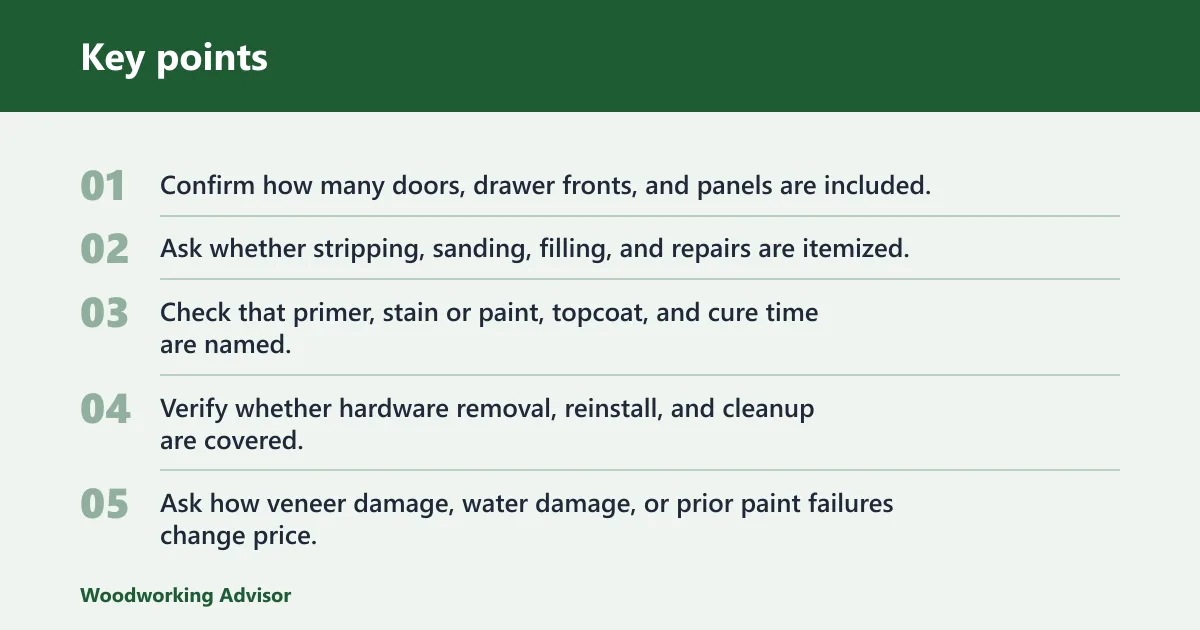
- Confirm how many doors, drawer fronts, and panels are included.
- Ask whether stripping, sanding, filling, and repairs are itemized.
- Check that primer, stain or paint, topcoat, and cure time are named.
- Verify whether hardware removal, reinstall, and cleanup are covered.
- Ask how veneer damage, water damage, or prior paint failures change price.
When is refinishing worth it?
Refinishing is often worth it when the maple boxes and doors are structurally sound and the finish problem is mainly cosmetic. Refacing costs from $4,000 to $9,500, so refinishing can save money when you want to keep the existing layout. Replacement makes more sense when the cabinets are failing structurally or the layout needs a full reset.
Refinishing versus refacing
Refinishing keeps the cabinet structure and changes the surface. Refacing replaces doors, drawer fronts, and visible veneer while leaving the boxes in place. If your maple doors are solid and the boxes are square, refinishing can be the cheaper route. If the door style is dated but the boxes are fine, refacing may fit better.
Refinishing versus replacement
Replacement is usually for cabinets with widespread structural damage, warped boxes, or a layout that no longer works. If the finish is the only problem, replacing maple cabinets rarely makes sense. If the cabinets are also water-damaged, badly repaired, or badly altered, the repair bill can creep toward replacement territory.
When damage changes the decision
Can damaged maple cabinets still be refinished? Sometimes, yes. Small cracks, minor veneer lift, and loose joints can often be repaired before finishing. Large sink-area swelling, repeated water damage, or major delamination can push the job toward refacing or replacement because the repair time outweighs the surface savings.
Does hard maple cost more to refinish?
Hard maple can cost a bit more to refinish when the job requires more sanding, more prep control, or more correction of blotching. Soft maple is easier to cut and shape, but both species can show grain issues if the old finish is removed unevenly. The real price driver is often condition, not species alone.
Hard maple and soft maple prep differences
Hard maple is denser, so aggressive sanding takes longer and can leave marks if the contractor moves too fast. Soft maple is a little easier to abrade, but it can still take stain unpredictably if the surface is uneven. Either way, maple needs careful surface prep before stain or paint goes on.
Grain, porosity, and sanding behavior
Maple has a fine grain and lower porosity than open-pored woods, which can make stain application less forgiving. That smooth surface is one reason stain blotching shows up so clearly. Good prep means cleaning, sanding in stages, and choosing the right sealer or conditioner when the finish system calls for it.
Common finish failures on maple
Common failures include peeling topcoat, grease bleed-through, blotchy stain, and paint that chips at edges. Previous bad paint jobs often hide these problems until sanding starts. If the old finish is already failing, the refinisher may need to strip more aggressively or switch to a coating system that can bond reliably.
Frequently asked questions
How much does it cost to refinish maple cabinets?
Larger kitchens, damaged doors, and stain-to-paint conversions can run higher, especially when multiple coats and extra cure time are needed.
Is it cheaper to paint or refinish maple cabinets?
Painting is often cheaper than a full strip-and-restain when the existing stain is dark, uneven, or badly damaged. But a simple clear refresh can cost less than paint if the current finish is stable. The cheaper option depends on prep, not just the color you want.
What affects the price of refinishing maple cabinets?
The biggest drivers are door count, drawer count, cabinet condition, finish type, and whether the cabinets are solid maple or veneer. Labor rates and project minimums also matter. A damaged sink base, a failed finish, or a major color shift can add far more than a small kitchen size change.
Can damaged maple cabinets still be refinished?
Yes, if the damage is repairable. Small cracks, loose joints, minor veneer lift, and isolated water marks can often be fixed before finishing. Cabinets with large swollen areas, severe delamination, or repeated moisture damage may be poor candidates because the repair labor can outweigh the savings.
What should a professional cabinet refinishing quote include?
A proper quote should list door and drawer removal, hardware removal, cleaning, sanding or stripping, repairs, primer or stain, topcoat, reinstallation, and cleanup. It should also say whether cure time is included and whether extra charges apply for veneer repair, heavy grease, or bad prior paint jobs.
Are maple cabinets worth refinishing instead of replacing?
Usually, yes, if the maple boxes and doors are structurally sound and the layout still works. Refinishing can deliver a major visual change for less than refacing or replacement. If the cabinets are warped, rotted, or badly out of date in layout, replacement may be the better spend.
Sponsored / affiliate links. As an Amazon Associate I earn from qualifying purchases. I may earn additional commission from eligible campaigns.