Is Wood a Good Insulator? R-Value by Species (Heat & Electricity)
Wood is a good thermal insulator compared with metal, concrete, or glass, but a poor one compared with real insulation, and dry wood is also a good electrical insulator, until it gets damp. Softwood at 12% moisture conducts about 0.10 to 0.14 W/m-K, roughly 2 to 4 times more than insulating materials. This guide gives the numbers by species, the moisture effect, and the safety limits.
Wood Insulates Best When It Is Dry
Best Pin Moisture Meter Pick
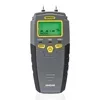 |
General Tools MMD4E Pin-Type Moisture Meter, about $39.98 A pin-type meter reads the electrical resistance between two steel pins pushed into the wood, the same moisture-and-conductivity relationship this article explains. Use it to check whether a board is dry enough to insulate well.
|
Moisture is the biggest variable you can actually control. Per the USDA Forest Products Laboratory Wood Handbook (FPL-GTR-282), Chapter 4, wood’s thermal conductivity rises with density, moisture content, temperature, and extractive content. For wood below 25% moisture the Handbook gives a working formula, k = G(0.1941 + 0.004064 x MC) + 0.01864, where G is specific gravity and k is in W/m-K.
Running that formula for a wood with a specific gravity of 0.50 (about Douglas fir or silver maple) shows the trend. These are my calculations from the Handbook equation, and the Handbook warns that real values can differ from tabulated ones by as much as 20%.
| Moisture content | Conductivity (W/m-K) | Change vs oven-dry |
|---|---|---|
| 0% (oven-dry) | about 0.12 | baseline |
| 12% (typical indoor lumber) | about 0.14 | about 20% higher |
| 20% (damp framing) | about 0.16 | about 35% higher |
| 24% | about 0.16 | about 40% higher |
The practical takeaway: a wet stud wall or a green log is a worse insulator than the same piece dried down, and it is also more prone to rot. If you want to know where a board really sits, measure it instead of guessing. A pin meter like the one above takes seconds.
How Well Does Wood Resist Heat Flow?
The Wood Handbook puts structural softwood at 12% moisture at 0.10 to 0.14 W/m-K, and lists the comparison values below. I added the R-value per inch by taking the reciprocal of the Handbook’s own Btu-in figures, which is how the Handbook defines R-value.
| Material | Conductivity (W/m-K) | Approx. R-value per inch | Compared with softwood |
|---|---|---|---|
| Aluminum | 216 | about 0.0007 | roughly 1,800 times more conductive |
| Steel | 45 | about 0.003 | roughly 375 times more conductive |
| Glass | 1 | about 0.14 | roughly 8 times more conductive |
| Concrete | 0.9 | about 0.17 | roughly 7 times more conductive |
| Plaster | 0.7 | about 0.2 | roughly 6 times more conductive |
| Softwood lumber, 12% MC | 0.10 to 0.14 | about 1.0 to 1.4 | baseline |
| Mineral wool | 0.036 | about 4.0 | about 3 to 4 times better insulator |
That is the honest answer to the title question. Wood beats metal, glass, and concrete by a wide margin, which is why it is used for pot handles, tool grips, and sauna benches. Against fiberglass or mineral wool it loses by a factor of about three or four per inch.
For a framed wall, a 3.5-inch stud works out to roughly R-3.5 to R-5 by the same arithmetic, against about R-14 for the same thickness of mineral wool. If you are comparing framing systems, see our metal frame vs wood frame comparison.
R-Value by Species: Light Woods Insulate Better
Denser wood conducts more heat, because there is more solid cell wall and less trapped air per cubic inch. The Handbook’s Table 4-7 shows this clearly. These values are at 12% moisture, and the last column is R-value per inch of thickness.
| Species | Specific gravity | Conductivity (W/m-K) | R-value per inch |
|---|---|---|---|
| Western red cedar | 0.33 | 0.10 | 1.5 |
| Eastern white pine | 0.37 | 0.11 | 1.3 |
| Basswood, American | 0.38 | 0.11 | 1.3 |
| Ponderosa pine | 0.42 | 0.12 | 1.2 |
| Douglas fir, coast | 0.51 | 0.14 | 1.0 |
| Black cherry | 0.53 | 0.15 | 0.98 |
| Sugar maple | 0.66 | 0.18 | 0.81 |
| White oak | 0.72 | 0.19 | 0.75 |
| Shagbark hickory | 0.77 | 0.21 | 0.70 |
Western red cedar comes out at about R-1.5 per inch, and shagbark hickory at about R-0.70, so the lightest common softwood insulates roughly twice as well as the densest hardwood. Heat tolerance is a separate question, and our guide on how much heat wood can withstand covers it.
Two other factors matter. Heat moves along the grain 1.5 to 2.8 times faster than across it, with an average of about 1.8, and it moves at nearly the same rate in the radial and tangential directions. Knots and checks also change conductivity. So a post insulates best when heat has to cross the grain, and worst when it runs the length of the timber.
Why Wood Feels Warm and Metal Feels Cold
A steel bar and a pine board left in the same room are at the same temperature, but the steel feels colder because it conducts heat about 375 times better than softwood (45 vs 0.12 W/m-K from the table above), so it drains warmth from your hand faster. Wood does not create warmth. It just refuses to drain yours quickly, which is why pot handles and stair rails are made of it.
This is also where the popular claim that wood is a great insulator goes wrong. Wood is a good insulator for the hand and a middling one for the house. A solid wood wall is only as good as its thickness: by the Handbook figures, a 6-inch softwood log wall is about R-6 to R-8 at 12% moisture, which is well below what a modern insulated wall reaches. That number is my calculation from the values above.
Is Wood an Electrical Insulator?
Dry wood is an excellent electrical insulator, and wet wood is not. The Handbook reports conductivity of about 10-15 to 10-16 S/m for oven-dry wood and 10-3 to 10-4 S/m at fiber saturation, a change of more than ten orders of magnitude. From fiber saturation to full saturation, the further increase is under a hundredfold.
| Condition | Conductivity (S/m) | What it means |
|---|---|---|
| Oven-dry wood | 10-15 to 10-16 | Behaves as a true insulator |
| Wood at fiber saturation (cell walls fully wet) | 10-3 to 10-4 | More than 10 orders of magnitude more conductive |
| Fully saturated wood | Under 100 times the fiber-saturation value | Conducts enough to matter around live circuits |
Three more details from the Handbook are worth knowing. Conductivity is greater along the grain than across it (roughly 1.0 : 0.55 : 0.50 for longitudinal, radial, and tangential). Wood conductivity increases with temperature, unlike metals. And preservative or fire-retardant treatment, water-soluble salts, or prolonged contact with seawater can raise conductivity substantially.
This moisture dependence is exactly why pin meters work: they measure resistance between two pins and convert it to a moisture percentage.
Safety note: do not treat a wooden ladder, pole, or tree branch as protection near overhead power lines or mains wiring. Damp, dirty, or treated wood can carry current. Keep ladders and long tools well clear of power lines, and call the utility if a line is down.
Practical Ways to Use Wood’s Insulating Ability
- Handles and grips: wood stays comfortable to hold near heat. See why cookware has wooden handles.
- Choose light species for warmth: cedar, basswood, and white pine give the most insulation per inch, while oak and hickory give the least.
- Keep it dry: check moisture before enclosing wood, since damp lumber conducts more heat and invites decay.
- Do not count on sheet goods alone: see whether plywood is good insulation before relying on it.
Frequently Asked Questions
Is wood a better insulator than metal?
Yes. Softwood at 12% moisture conducts about 0.10 to 0.14 W/m-K, against 45 for steel and 216 for aluminum in the Wood Handbook comparison. That makes wood hundreds of times less conductive than steel.
What is the R-value of wood per inch?
About R-1.0 to R-1.4 per inch for common softwoods at 12% moisture, and about R-0.7 to R-1.0 per inch for dense hardwoods such as white oak and hickory. Western red cedar reaches about R-1.5 per inch.
Does wood conduct electricity?
Dry wood barely conducts electricity, but wet wood conducts far better. Conductivity rises by more than ten orders of magnitude between oven-dry and fiber-saturated wood, so never rely on damp wood for electrical protection.
Does wood keep heat in and cold out?
Wood slows heat flow in both directions, so it helps keep warmth in and heat out. It is still about 3 to 4 times less effective per inch than mineral wool, so it works as a modest barrier rather than a full insulation layer.
Which wood insulates best?
Light, low-density woods such as western red cedar, basswood, and eastern white pine. They have specific gravities of about 0.33 to 0.38 and R-values of about 1.3 to 1.5 per inch.
The Bottom Line
Wood is a good insulator when the comparison is metal, glass, or concrete, and an average one when the comparison is insulation. Pick light species, keep the wood dry, and remember that its electrical insulation disappears when it gets wet.
Sponsored / affiliate links. As an Amazon Associate I earn from qualifying purchases. I may earn additional commission from eligible campaigns.