Maple vs Birch: Which Is Better for Cabinets?
For painted cabinets, Birch is often the better buy. For stained or natural-finish cabinets, Maple is usually the better choice. Pick the wrong wood, and you can pay more for the look you want or fight visible grain, blotchy stain, and early wear. This guide compares Maple and Birch by finish type, durability, and budget so you can pick the right cabinet wood.
| Factor | Maple | Birch | Winner |
|---|---|---|---|
| Painted finish smoothness | Very uniform, fine grain helps paint read smoother | Can telegraph grain more, especially in humid kitchens | Maple |
| Clear or natural finish | Very uniform pale tone with a clean look | Light cream to light yellow color with some reddish variation | Maple |
| Dark stain | More predictable under stain, though not perfect | Risk of blotching, not ideal for dark stain | Maple |
| Budget value | Slightly higher cost | More affordable than maple | Birch |
| Cabinet box use | Works well, but not the usual structural standard | Birch plywood is a common standard for cabinet construction | Birch |
Maple vs birch cabinets: the short answer
Maple wins more often for painted cabinets and stained doors. Birch stays competitive when budget matters, and it is especially common in cabinet boxes because birch plywood is a standard structural choice. If you want the safest finish result, Maple is the cleaner bet; if you need a lower-cost cabinet material, Birch makes sense.
Cabinet finish comparison matrix
| Scenario | Maple | Birch | Winner | Recommendation |
|---|---|---|---|---|
| Painted white | Fine grain, lower telegraphing risk | More grain visibility over time | Maple | Choose Maple for the cleanest painted surface over time. |
| Clear or natural finish | Very uniform pale tone | More color variation is common | Maple | Choose Maple when you want a calm, even wood look. |
| Dark stain | More predictable under stain | Higher blotch risk | Maple | Choose Maple if stain color consistency matters most. |
| Humid kitchen | Better painted-finish stability in appearance | Can show grain through paint more in humid spaces | Maple | Choose Maple for painted doors in a moisture-prone kitchen. |
What is birch for cabinets?
Birch for cabinets usually means a light-colored hardwood with a pale cream to light yellow base and some reddish variation. It has a subtle grain and is labeled moderate in durability, so it fits everyday kitchen use without pretending to be a premium finish wood.
Color and grain
Birch reads as lighter than oak and often looks calm at first glance. The catch is that its grain can remain visible under clear finish, and under paint it may still show texture as the cabinet ages, especially in humid rooms.
A common first-timer mistake is assuming all light woods finish the same. A 30-inch painted birch shaker door in a steamy kitchen can look smooth on day one and then start to show grain lines later if the finish system is not forgiving enough.
Durability and stability
Birch is durable enough for kitchen doors and drawer fronts, and the sourced material labels it moderate. That is enough for normal household wear, but it does not outrank Maple on durability or finish predictability.
Where birch fits best
Birch fits best when budget matters and when you are using it as part of a broader cabinet package, especially birch plywood for the box. It is also a practical choice for painted, simple shaker doors where the grain does not need to disappear completely.
What is maple for cabinets?
Maple for cabinets usually means a very uniform, consistent pale tone with fine grain and high durability. It costs a bit more than Birch, but it is the safer finish choice when you want a cleaner painted surface or a more controlled stain result.
Color and grain: maple’s biggest visual advantage
Maple’s biggest visual advantage is its consistency. The fine grain and very uniform color make it easier to get a flat-looking paint film and a more even natural finish than with Birch.
Durability and stability: maple is labeled high
Maple is labeled high in durability, which makes it a solid everyday cabinet wood for doors, drawer fronts, and visible face-frame parts. The finish result is usually the main reason to pay for it, not a massive difference in kitchen toughness.
Where maple fits best
Maple fits best on cabinets where appearance matters more than the last dollar saved. It works well for painted kitchens, clear-finish projects, and stain jobs where board-to-board color control matters.
Which is better for painted cabinets?
Maple is usually better for painted cabinets. Its tighter, more uniform grain gives you a smoother-looking finish, and the sourced material calls Maple “the safer choice” for perfectly smooth painted white cabinets. Birch can work, but it is more likely to show grain telegraphing over time, especially in humid kitchens.
Grain telegraphing risk
Paint hides a lot, but not all texture. Birch’s subtle grain can still read through the coating as the door ages, and humidity can make that more noticeable. Maple’s fine grain gives paint a flatter visual base.
Long-term painted appearance
For a white shaker kitchen, Maple usually keeps the cleaner look longer. That matters most on wide flat surfaces and on doors with large center panels, where small texture shifts are easier to see.
When birch is still acceptable
Birch is still a sensible painted-cabinet choice when cost matters and the design does not demand a showroom-smooth surface. If you are painting a utility kitchen, rental, or secondary space, Birch can be the practical pick.
Which wood stains more evenly?
Maple stains more evenly. Birch has a risk of blotching and is not ideal for dark stain, while Maple is more predictable under stain even though it is not perfect. If you want a medium or dark stain without fighting color inconsistency, Maple is the safer starting point.
Blotch risk
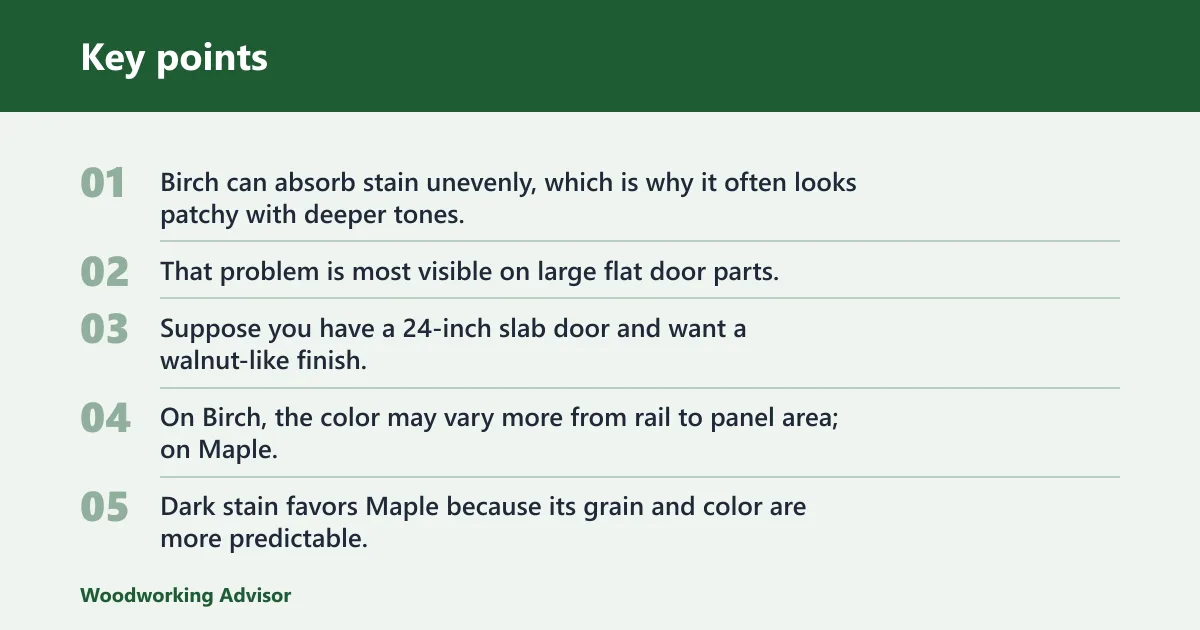
Birch can absorb stain unevenly, which is why it often looks patchy with deeper tones. That problem is most visible on large flat door parts, where uneven absorption shows up as darker and lighter zones.
Suppose you have a 24-inch slab door and want a walnut-like finish. On Birch, the color may vary more from rail to panel area; on Maple, the result is usually more controlled, though the final look still depends on the finish system and the board itself.
Dark stain performance
Dark stain favors Maple because its grain and color are more predictable. Birch can still be stained, but it asks more of the finisher and gives less forgiveness if you want a consistent dark tone across a full set of doors.
How each wood reads in natural light
Under daylight, Maple tends to look calmer and more even. Birch can show more color shift from piece to piece, which is not always bad, but it is less controlled if you want a uniform stained kitchen.
Choose Maple if… / Choose Birch if…
Choose Maple if your cabinets are painted white, stained dark, or meant to read as clean and consistent under natural light. Choose Birch if budget is tighter, if you need a common plywood standard for the cabinet box, or if the project uses simpler painted doors where some grain presence is acceptable.
Painted kitchens
Maple is the better pick for a painted kitchen when you care about smoothness and long-term visual consistency. Birch works when the budget must come down, but the finish is more likely to reveal texture later.
Stained kitchens
Maple is the better pick for stained kitchens because it gives you more predictable color. Birch is the riskier choice for dark stain, especially when you want all doors to match closely.
Budget-driven projects
Birch is usually the better value when quotes need to stay down. The price gap can vary by region and by whether solid wood, veneer, or plywood parts are being compared, so the cabinet quote is usually more useful than a blanket rule.
Cabinet boxes and doors
Birch plywood is a common structural standard for cabinet boxes because it balances stability, strength, and availability. For doors, Maple has the edge when the finish matters most, while Birch is fine when the door style and budget can absorb a little more grain or color variation.
Frequently asked questions
Is maple or birch better for cabinets?
Maple is better for cabinets when your priority is painted smoothness or predictable stain behavior. Birch is better when cost matters and the cabinet box or a simpler painted door can make use of a common, cabinet-grade plywood standard. The better choice depends on finish, not one universal rule.
Maple vs birch for cabinets
Maple vs Birch comes down to visual control versus cost. Maple has the more uniform color, finer grain, and better finish predictability; Birch is usually less expensive and still cabinet-appropriate. For painted doors, Maple leads. For budget-sensitive boxes and simpler builds, Birch stays in the running.
Is birch or maple better for kitchen cabinets?
Maple is usually better for kitchen cabinets if the doors will be painted or stained and you want a cleaner final look. Birch is a good option when you need a common structural material for cabinet boxes or want to save money without stepping outside normal cabinet practice.
Which wood is more durable for kitchen cabinets, birch or maple?
Maple is listed as the more durable of the two in the supplied ratings, with Maple rated high and Birch moderate. That does not mean Birch is weak. Both are durable enough for everyday kitchen use, but Maple has the edge where surface wear and finish longevity matter.
Does birch look like maple once stained?
Not reliably. Birch can resemble Maple at a distance under a lighter stain, but the color variation and blotch risk make the result less consistent. Maple is more predictable under stain, so it is the better choice if you want a Maple-like evenness without surprises.
Which is better for painted cabinets, birch or maple?
Maple is usually better for painted cabinets. Its very uniform color and fine grain give paint a smoother visual base, and it is the safer choice for the cleanest painted white cabinets. Birch can still be painted, but grain telegraphing is more likely over time in humid spaces.
Are birch cabinets cheaper than maple cabinets?
Yes, Birch cabinets are usually cheaper than Maple cabinets. Birch is described as more affordable than Maple, though the real-world difference changes by region and by whether you are comparing solid wood doors, veneer parts, or plywood cabinet boxes. Quotes matter more than broad price claims.
Which wood stains more evenly, birch or maple?
Maple stains more evenly. Birch has a noted risk of blotching and is not ideal for dark stain, while Maple is more predictable under stain, though still not perfect. If the plan is a medium or dark stain, Maple gives you the better chance at a consistent result.
Which door styles suit each wood?
Shaker, flat-panel, slab, and raised-panel doors do not hide wood behavior in the same way. Simple shaker doors are a safe match for either wood, and they are the best fit for Birch when you want a clean, straightforward look. Slab doors expose the most grain and color variation, so Maple usually looks better there.
Raised-panel doors can mask some material variation because they have more profile and shadow, but they do not erase poor stain behavior. Flat-panel and slab doors put the finish on display, which is why Maple usually wins when the design is minimal and the surface is large.
- Use Maple for painted white doors when you want the smoothest finish.
- Use Maple for dark stain when you want more even color.
- Use Birch for cabinet boxes when you want a common plywood standard.
- Use Birch for budget-driven projects that still need cabinet-grade material.
Finish and budget verdict
Maple wins for painted doors, clear finishes, and dark stain. Birch wins on budget and remains a solid choice for cabinet boxes, especially in birch plywood. If you are choosing one wood for visible doors, Maple is usually the safer answer; if you are trying to control cost without leaving cabinet-grade territory, Birch is the practical choice.
Cabinet Wood-Carving: Guiseppe Ferrari, New York, NGA 217367, is not the main point here. The point is matching the wood to the finish you actually want. For most homeowners, that means Maple for the front-facing parts and Birch for cost-conscious structural parts when the quote demands it.
Sponsored / affiliate links. As an Amazon Associate I earn from qualifying purchases. I may earn additional commission from eligible campaigns.