Best Maple Species for Kitchen Cabinets (2026): we compared
For kitchen cabinets, hard maple (sugar maple) is the best all-around choice; use soft maple only when you want a lower-cost cabinet and can accept slightly lower dent resistance and more finish variation. Pick the wrong maple, and you can get blotchy stain, visible wear on doors and rails, or durability you do not need to pay for. This guide compares hard maple, soft maple, and related cabinet options by finish response, traffic level, appearance, and budget.
This guide is part of our Maple Species Hardness Chart: Janka Rating Compared series.
Quick comparison
| Product | Badge | Best for | Price | ||
|---|---|---|---|---|---|
 |
American Walnut Wood Cutting Board, End Grain Butcher BlockBABILONIA | Pair with it | 1.7" Thick American Walnut 3-in-1 Butcher Block | $69.99
Price as of 9 Oct 2026
|
View |
 |
DuraSteel 24×30 Butcher Block Countertop – Maple Solid WoodDuraSteel | Our pick | 24×30 Solid US Maple Wood Butcher Block Countertop | $149.49
Price as of 9 Oct 2026
|
View |
 |
FOBSME 2 Pcs Thanksgiving Wooden Serving Platters PumpkinFOBSME | Budget pick | 2-Piece Pine Wood Pumpkin & Maple Leaf Platters | $16.99
Price as of 9 Oct 2026
|
View |
Use this table to match the wood to the cabinet job, not to the marketing label. Maple is a group of woods, and the best pick changes with finish, traffic, and how closely the whole kitchen must match.
Hard maple, soft maple, and maple veneer all belong in different parts of a cabinet plan. The first is the safest default for a clear finish in a busy kitchen, while the others fit better when cost control or paint coverage matters more.
How we chose
The comparison here uses five cabinet-focused filters: dent and impact resistance, finish behavior, color consistency across multiple doors, machining and assembly, and value for the use case.
That matters because cabinet species choice is not only about hardness. Grain pattern, moisture content, and how a finish sits on the wood can matter just as much in a kitchen.
| Maple cabinet option | Dent resistance | Stain risk | Color consistency | Best-use scenario |
|---|---|---|---|---|
| Hard maple | High | Moderate blotch risk on plain stain | Best of the three for a natural look | Busy kitchens, clear finish, light stain, cabinet fronts |
| Soft maple | Medium | Moderate to high depending on grain variation | Less uniform than hard maple | Budget builds, painted parts, easier machining |
| Maple veneer and paint-grade parts | Depends on substrate | Low when painted; finish is controlled by primer and topcoat | High once painted | Painted cabinets, color matching, stable panels and doors |
Hard maple: best for high-traffic kitchens and clear finishes
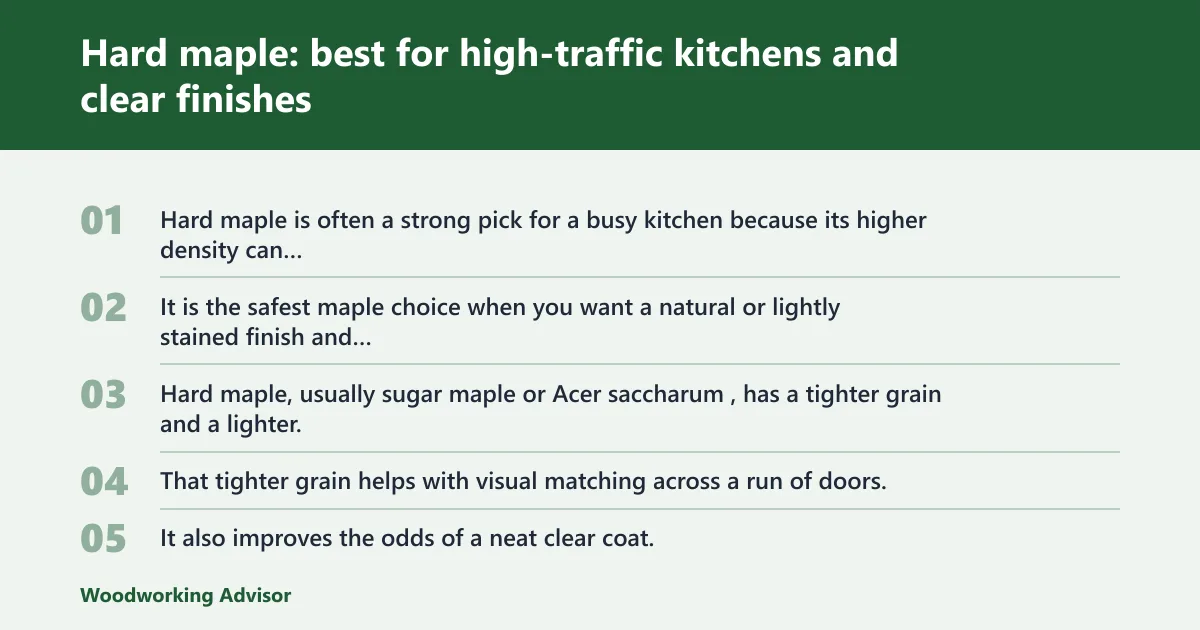
Hard maple is often a strong pick for a busy kitchen because its higher density can improve dent resistance and give a fairly predictable cabinet-grade look. It is the safest maple choice when you want a natural or lightly stained finish and expect daily abuse on doors, drawer fronts, and face frames.
Why its tighter grain matters
Hard maple, usually sugar maple or Acer saccharum, has a tighter grain and a lighter, more uniform cabinet look than many soft maple boards. That tighter grain helps with visual matching across a run of doors, and it usually gives cleaner edges on rails, stiles, and panel parts.
It also improves the odds of a neat clear coat. Maple still takes stain unevenly unless you manage the surface, but hard maple generally gives you fewer wild color swings than a more variable substitute.
Where it can be worth paying more
Hard maple earns its price when the kitchen is used hard, the cabinet fronts stay visible, and you want a light wood tone rather than paint. It is a strong choice for face frames, drawer fronts, and door rails because those parts get the most hand contact.
Say your kitchen has a 30-inch-deep work zone beside the range and sink, with doors opening dozens of times a day. Hard maple is the safer species choice there because dents and corner bruises are more likely to show up first on the most touched parts.
Hard maple is not magic, though. It still moves with seasonal humidity, so cabinet construction and moisture content matter. For interior joinery, the stock should be properly dried and built with room for panel movement.
Soft maple: best for budget-minded cabinet builds and easier machining
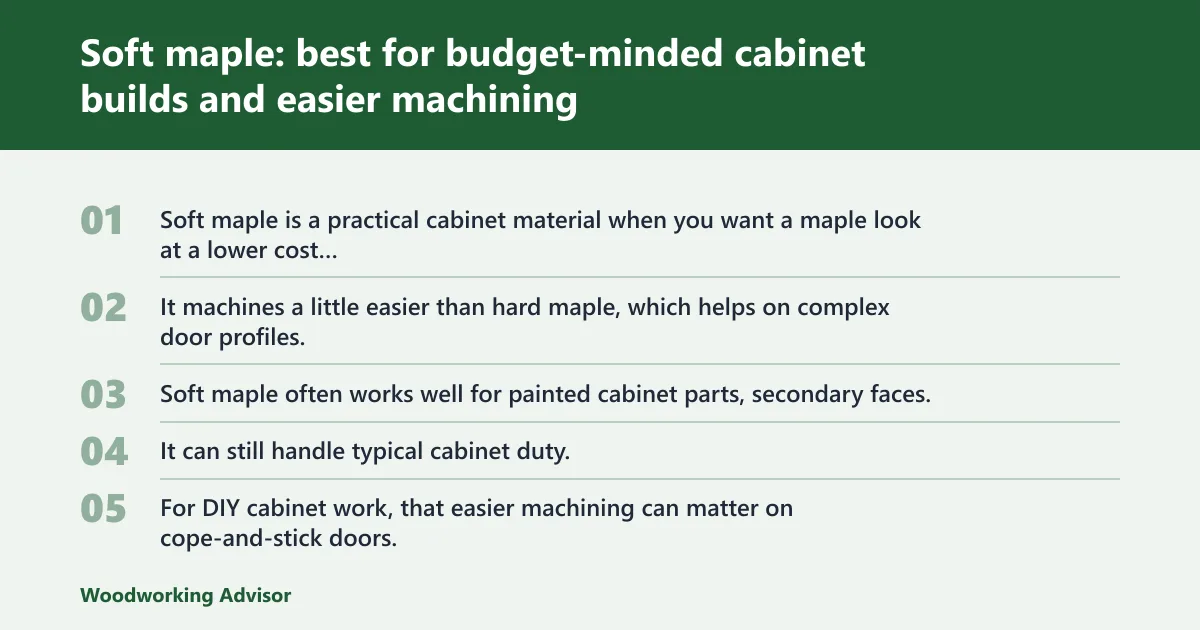
Soft maple is a practical cabinet material when you want a maple look at a lower cost and can accept slightly lower dent resistance and more variation in appearance. It machines a little easier than hard maple, which helps on complex door profiles, but it is not as tough under daily kitchen abuse.
Where soft maple can be a smart substitute
Soft maple often works well for painted cabinet parts, secondary faces, and budget-conscious replacements where the goal is simply a pale, paintable hardwood. It can still handle typical cabinet duty, and maple’s dense structure helps it withstand impacts better than many softer woods.
For DIY cabinet work, that easier machining can matter on cope-and-stick doors, routed profiles, and trim details. Clean cuts are easier to get, which can save time during fitting and sanding.
Limits to watch in finish matching and appearance
The drawback is consistency. Soft maple, usually red maple and other soft maple species, is more variable in appearance, and the grain patterns in maple vary enough already without adding extra color change from species mix. That makes it harder to line up a whole kitchen if you want all doors to read as one continuous surface.
Soft maple also shows stain decisions more clearly. If your sample door looks good, another board from the same stack can still land a shade lighter or darker. That is not a defect; it is the cost of a less uniform substitute.
Maple veneer and paint-grade parts: best for painted cabinets and color control
Maple veneer and paint-grade parts are often a good choice when your main goal is color control rather than showing the wood. They give you a stable base for paint, help hide species variation, and avoid the blotchy stain problems that can show up on natural maple.
When veneer or paint-grade stock beats solid maple
Painted cabinet doors, end panels, and drawer fronts often perform better with paint-grade maple parts or veneer over a stable core than with random solid boards. That is especially true when you need wide panels, long runs, or a uniform white, gray, or deep-color finish.
Maple cabinets can be stained to achieve different finishes, but painted maple parts give you more control if the cabinet design calls for a precise color. For modern kitchens with flat fronts and minimal grain showing, that control is often worth more than solid-wood showiness.
How to avoid telegraphing and movement issues
Use stable substrates, consistent thickness, and proper panel construction so joints do not telegraph through paint. A painted cabinet still has to handle seasonal expansion, so face frames, door panels, and drawer fronts should be built to move where the design allows.
Picture a full-wall pantry in a humid kitchen with a matte white finish. If the builder uses mismatched solid parts with poor drying, panel movement can show as seams or slight ridges later. A paint-grade system reduces that risk.
What is the best maple species for kitchen cabinets?

Hard maple is the best maple species for kitchen cabinets when you want the strongest mix of dent resistance, finish consistency, and long-term cabinet-grade performance. Soft maple is a workable second choice for budget builds or paint-grade work, while maple veneer and paint-grade parts are better when color control matters more than showing the wood.
Why hard maple leads the field
Hard maple gives you the most predictable cabinet face in a busy room. It resists wear and tear well, and its lighter, tighter grain makes it easier to line up doors and drawer fronts across the whole kitchen.
Maple wood is known for its impressive durability, and hard maple sits at the top of that range for cabinet use. That matters where pots, elbows, and cleaning tools regularly bump the fronts.
When another maple type makes more sense
Choose soft maple when budget or machining ease matters more than maximum dent resistance. Choose maple veneer or paint-grade parts when you plan to paint everything and want the most stable visual result.
Do not choose the species by name alone. Ask whether the cabinet is meant to stay natural, be lightly stained, or be fully painted, because each goal changes the right material.
Is hard maple better than soft maple for cabinets?
Yes, hard maple is generally a better choice than soft maple for many cabinet fronts because it is denser, tends to resist dents better, and is often more consistent in appearance. Soft maple still works for cabinets, but it gives up some impact resistance and tends to show more variation from board to board.
Where the difference matters most
The biggest difference shows up on doors, drawer fronts, and exposed rails where hands and hardware hit the wood daily. Maple’s dense structure helps it withstand impacts, but the harder species has the edge when a kitchen sees constant use.
If the cabinet is hidden behind a painted finish, the difference is less important. In that case, build quality and paint prep matter more than choosing the harder maple species.
What soft maple still does well
Soft maple can be easier to machine cleanly, which helps on detailed profiles and some custom cabinet parts. It is also common as a maple substitute, so it can lower cost without moving to a much softer species.
The tradeoff is appearance and wear. You may save money, but you may also accept a cabinet that picks up dents sooner and varies more in color tone.
Should I choose sugar maple or red maple for kitchen cabinets?
Choose sugar maple, which is hard maple, if you want the best cabinet-grade balance of dent resistance, consistency, and a clear-finish look. Choose red maple only when you want a lower-cost maple option, easier machining, or a painted cabinet that does not depend on perfect natural grain matching.
How to think about sugar maple
Sugar maple is the safer choice for visible cabinet faces because it gives you a lighter, tighter grain and better everyday durability. For natural finishes, that often means fewer surprises when the stain and topcoat go on.
How to think about red maple
Red maple can make sense when the cabinets are painted or when the buyer wants a maple look without paying for the hardest cabinet-grade stock. It is still a maple species, but it is not the same material in feel, appearance, or wear behavior.
A common first-timer mistake is choosing red maple for a clear finish because the sample looked acceptable in one small panel. On a full kitchen, the more variable appearance becomes much easier to spot.
Do maple cabinets take stain evenly?
Maple can take stain well, but it does not always take it evenly, especially on plain stain without prep. The grain patterns in maple vary, and that variation can cause blotch risk, color swing, and darker spots unless you use the right surface prep and finish system.
What causes blotching
Blotch risk comes from how unevenly the wood absorbs stain. Maple’s tight grain can still pull color in patches, especially on softer sections, end grain, and pieces with mixed grain direction.
That means one door rail can look darker than the next even if both came from the same batch. Visual match across the kitchen is more reliable when the boards are selected carefully and the stain system is controlled.
How to improve the result
Use pre-stain conditioning when the finish plan calls for visible stain on maple. Start with sample pieces, not just one door, because maple may behave differently on face grain, end grain, and routed edges.
Clear topcoats also matter. They can deepen the tone and add a slight amber cast over time, so the final color should be checked under the lighting the kitchen actually has.
Are maple cabinets durable enough for a busy kitchen?
Yes, maple cabinets are durable enough for a busy kitchen, especially hard maple. Maple cabinets can handle daily kitchen wear, resist wear and tear, and hold up well against impact compared with many softer cabinet woods, though they still need sensible care and good construction.
What durability means in a kitchen
Kitchen durability is not only scratch resistance. It also means dent resistance, edge survival, and how well the cabinet front keeps its shape when doors and drawers are used constantly.
Maple’s dense structure helps it withstand impacts, which is why it is often a dependable cabinet species choice for family kitchens and high-use spaces.
What maple still cannot ignore
Maple is still wood. It moves with humidity, can be damaged by harsh chemicals, and can fade in prolonged sunlight. Proper care can help maple cabinets last for many years, but “durable” does not mean “maintenance free.”
How do maple cabinets compare with birch or cherry?
Maple is usually the better choice than birch when you want a stronger, more consistent cabinet front, and it often beats cherry when you want a lighter tone or a lower starting cost. Birch is a common painted or stained cabinet alternative, while cherry offers a warmer color shift that some buyers want and others do not.
Maple versus birch
Birch can be economical and is often used in cabinet work, but maple usually gives a cleaner, more predictable look for clear finishes. If your goal is a light, uniform cabinet that resists daily wear, maple is often the better cabinet-species decision.
Maple versus cherry
Cherry starts warmer and darkens more with time, which can be desirable in traditional spaces. Maple stays lighter, from creamy white to light reddish brown, so it fits better when you want brightness, paint flexibility, or a more neutral base for hardware and counters.
If matching existing cabinetry is the goal, color tone matters as much as species. A light maple door may be a poor match for older cherry fronts even if both are solid hardwood.
What finish looks best on maple cabinets?
The best finish on maple cabinets depends on your goal, but a clear topcoat or a lightly toned finish usually looks best on hard maple. If you want color control or a very uniform surface, paint is often the better option, especially on veneer or paint-grade parts.
Clear finish on hard maple
Clear finishes work well when you want to keep the pale, clean look of hard maple visible. The result is usually crisp and modern, with grain that stays subtle rather than loud.
Keep in mind that clear coats can add warmth and slight yellowing over time. That shift is normal, but it should be expected when choosing a natural cabinet finish.
Paint on maple parts
Paint is the best way to hide grain variation and color mismatch. It is also the most forgiving choice for mixed maple grades, end panels, and cabinet swaps where old and new parts must look alike.
Hardware changes can alter the look of maple cabinets, but paint changes it even more. The same door can read modern with slim black pulls or traditional with warmer brass, and that effect comes from the design package, not the wood species alone.
How do I keep maple cabinets from looking too yellow?
Use a finish plan that accounts for natural color shift, because maple can warm or yellow with age and light exposure. The best way to keep the look lighter is to choose a clear coat with minimal ambering, avoid overly warm stains, and limit prolonged sunlight where possible.
Finish and lighting choices
Choose test samples under the kitchen’s actual lighting before committing to a full run. A finish that looks clean in the shop can read much warmer under incandescent or warm LED light.
Prolonged sunlight can cause fading, and it can also change the way the clear coat and wood tone appear together. Window treatment and UV-aware finish planning both help keep the color closer to the original sample.
Matching an existing kitchen
If the goal is to match older cabinets, compare the existing doors after cleaning them. Age, finish chemistry, and light exposure can all shift color, so a new maple door may need more than a stain swatch to blend in.
Which one should you buy?
Choose hard maple if you want a natural or lightly stained cabinet in a busy kitchen, especially for face frames, doors, and drawer fronts. Choose soft maple if you want a lower-cost maple look and easier machining, and choose maple veneer or paint-grade parts if the cabinets will be painted.
Use hard maple when the kitchen works hard
Hard maple is the best fit for family kitchens, frequent cooking, and visible cabinet fronts that need a consistent look. It is the top pick when dent resistance matters and when you want the safest clear-finish result.
Use soft maple when cost or machining matters more
Soft maple fits budget cabinet builds, especially when you can accept more variation and slightly less impact resistance. It can be a practical substitute, but it is not the same tier for a natural show-finish.
Use paint-grade or veneer when the finish is painted
If the design calls for white, gray, or another opaque finish, paint-grade maple parts often make the most sense. That choice reduces blotch risk and gives you a more uniform result across a whole kitchen.
Use a different wood when matching is the priority
If you need a close match to existing cabinets, the species may not be the main issue. Grain pattern, age, finish color, and light exposure can matter more than the name on the lumber sticker.
Frequently asked questions
What is the best maple species for kitchen cabinets?
Hard maple, usually sugar maple, is the best maple species for kitchen cabinets. It gives the best dent resistance, a more predictable cabinet-grade look, and strong performance for clear or lightly stained finishes. Soft maple is better reserved for budget builds or painted cabinets where perfect natural matching is less important.
Is hard maple better than soft maple for cabinets?
Yes. Hard maple is denser, resists dents better, and usually gives a more consistent appearance across doors and drawer fronts. Soft maple is still useful, but it gives up some impact resistance and tends to vary more in color and figure, which matters in a full kitchen run.
Should I choose sugar maple or red maple for kitchen cabinets?
Choose sugar maple if the cabinets will stay natural or lightly stained and need to stand up to daily use. Choose red maple if you want a lower-cost option, a painted finish, or easier machining. For visible natural cabinets, sugar maple is usually the safer choice.
Do maple cabinets take stain evenly?
Not always. Maple can blotch because its grain absorbs stain unevenly, especially on plain stain and routed areas. Pre-stain conditioning, sample testing, and a careful topcoat plan help, but a painted finish is the most reliable way to avoid uneven color when consistency matters most.
Are maple cabinets durable enough for a busy kitchen?
Yes. Maple is a durable cabinet wood, and hard maple is especially strong for daily kitchen wear, impact, and handling. It still needs proper finish care and reasonable humidity control, since wood movement, sunlight, and harsh cleaners can all affect the result over time.
How do maple cabinets compare with birch or cherry?
Maple is often tougher and more consistent than birch for visible cabinet fronts, while cherry offers a warmer look that darkens more with age. Maple suits lighter, cleaner designs and painted options better; cherry is often chosen for deeper, warmer color and a more traditional feel.
What finish looks best on maple cabinets?
A clear or lightly toned finish looks best if you want the wood to stay visible, especially on hard maple with a tight, subtle grain. If you want the most even look or need exact color control, paint is usually the best finish for maple cabinets.
How do I keep maple cabinets from looking too yellow?
Use a finish that limits ambering, keep the cabinets out of prolonged direct sunlight where possible, and test the final color under the kitchen’s real lighting. Maple naturally shifts over time, so the best defense is choosing a cooler-toned finish and matching it to the room.
Sponsored / affiliate links. As an Amazon Associate I earn from qualifying purchases. I may earn additional commission from eligible campaigns.