Miter Saw Angle Chart: Corner, Crown and Compound Settings
A miter saw angle chart turns a corner angle into a saw setting, and the rule is (180 minus the corner angle) divided by 2, not half the corner. A square 90° corner needs 45° per piece, but a 135° corner needs 22.5° and a 60° corner needs 60°. Below: settings for 3 to 12 sided frames, out-of-square walls, crown molding, splayed boxes, and cuts beyond your saw’s range.
Check Your Saw’s Angle Scale Before Trusting Any Chart
Best Saw Angle Check Pick
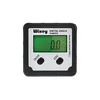 |
Wixey Digital Angle Gauge for Table Saw & Miter Saw, $33.99 Zero it on the saw table, stick it to the blade, and read the real bevel angle to 0.1 degree. That is how you confirm the bevel settings in the crown and splay tables below.
|
As an Amazon Associate we earn from qualifying purchases.
A chart is only as good as the dial it is read from. The click-stop detents on a miter saw are factory settings that can drift, and an error of even half a degree shows up as a visible gap in a mitered corner. Before a trim or frame job, confirm the two settings you use most.
For bevel, lay a digital gauge on the saw table and zero it, then stick it to the blade and tilt to your target. Compare the gauge reading with the saw’s own scale. For the miter swing, cut two scrap pieces at the 45° detent, hold them in a corner against a combination square, and look for light at the joint. If both pieces are cut correctly the corner reads square. If it does not, adjust the pointer or detent per your manual and see our guide to adjusting a miter saw or locking the saw to exactly 45 degrees.
Miter, Bevel and Compound: Which Dial Does What
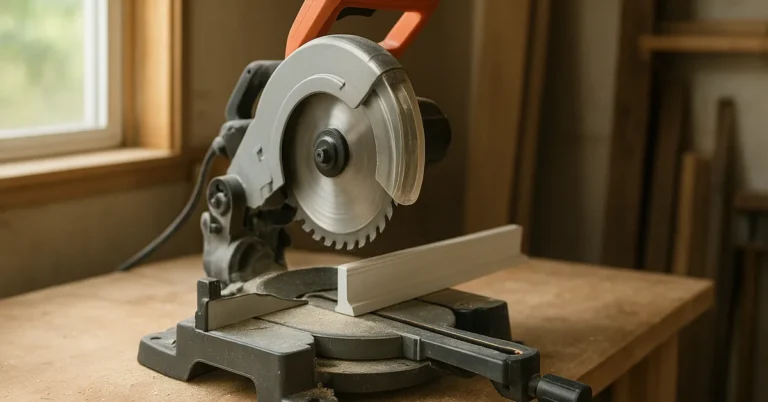
Every saw angle comes from one of two dials. The miter angle swings the blade left or right across the board, as in a picture frame corner. The bevel angle tilts the blade over, as in cutting an edge so two boards meet in a corner. Setting both at once is a compound miter, which is what crown molding and tilted-side boxes need. On both dials, 0° means a square cut, so the scale reads how far the cut departs from square, not the angle of the finished corner. That is why a 90° corner reads 45° on the saw. For a closer look at the machine itself, see what a miter saw is and how it cuts.
The Miter Angle Formula (and Why Corner ÷ 2 Is Wrong)
Many charts, including an older version of this page, state the rule as corner angle divided by 2. That works for a 90° corner only because 90 happens to land on 45. The correct rule counts how far the corner is from a flat line: saw setting = (180° minus the corner angle) ÷ 2. For a frame with N equal sides, it simplifies to 180° ÷ N. A 120° hexagon corner is not cut at 60°; it is cut at (180 minus 120) ÷ 2 = 30°.
| Shape | Corner angle | Miter saw setting per piece |
|---|---|---|
| Triangle (3 sides) | 60° | 60° |
| Square or rectangle (4 sides) | 90° | 45° |
| Pentagon (5 sides) | 108° | 36° |
| Hexagon (6 sides) | 120° | 30° |
| Heptagon (7 sides) | 128.57° | 25.71° |
| Octagon (8 sides) | 135° | 22.5° |
| Nonagon (9 sides) | 140° | 20° |
| Decagon (10 sides) | 144° | 18° |
| 12-sided frame (12 sides) | 150° | 15° |
Most saws have a stop near 22.5° and 45°, which cover the octagon and square. For a pentagon or heptagon you will be setting the pointer between detents, so lock it and test on scrap. A triangle needs 60° per piece, which is beyond the miter range of some saws, so check your own scale. If the setting is out of range, use the technique in the section on cutting past your saw’s limit further down. For picture frames, glue-up and clamping are covered in our guide to gluing a miter joint on trim and picture frames.
Miter Saw Settings for Out-of-Square Walls
Real room corners are rarely 90°. Measure the wall angle with an angle finder, then use the same formula. For baseboard or other trim cut lying flat on the table, the setting is (180° minus the wall angle) ÷ 2 for each piece.
| Measured wall angle | Setting per piece | Note |
|---|---|---|
| 87° | 46.5° | Wall turns in slightly |
| 88° | 46° | – |
| 89° | 45.5° | – |
| 90° | 45° | Square corner |
| 91° | 44.5° | – |
| 92° | 44° | Common drywall drift |
| 93° | 43.5° | – |
| 95° | 42.5° | Visibly open corner |
Never assume the wall is square just because the saw has a 45° detent. If the corner measures 92°, two pieces cut at 45° leave a 2° error at the joint. Stay within a half degree if you can, because the gap grows with trim width.
| Total angle error at the joint | Gap on 3-1/4 in baseboard | Gap on 5-1/4 in baseboard |
|---|---|---|
| 0.5° | 0.028 in | 0.046 in |
| 1° | 0.057 in | 0.092 in |
| 2° | 0.113 in | 0.183 in |
Quick math: gap = trim width × tangent of the error. A single degree of total error opens roughly 0.057 in on 3-1/4 in trim, a little under 1/16 in, which paintable caulk can hide. At 2° the gap is about 0.11 in, which usually needs recutting.
Crown Molding Settings on a Compound Miter Saw
Crown molding sits tilted between wall and ceiling, so each cut needs both a miter and a bevel. When the crown is laid flat on the saw table, the settings depend on two things: the wall corner angle and the molding’s spring angle. The two common profiles are 52/38 and 45/45, where the first number is the angle off the ceiling and the second is the angle off the wall.
The numbers marked on many saws come straight from this. A 52/38 crown at a 90° corner takes a 31.6° miter and a 33.9° bevel. A 45/45 crown at a 90° corner takes a 35.3° miter and a 30° bevel. If you have ever wondered why your saw has 31.6°, 33.9° or 35.3° stamped on it, that is the reason. For other corners, the formulas are: miter = arctan(tan(corner ÷ 2) × sin(spring angle)) and bevel = arcsin(cos(spring angle) × cos(corner ÷ 2)), where spring angle is 38° or 45° (the angle off the wall).
| Wall corner | 52/38 crown: miter / bevel | 45/45 crown: miter / bevel |
|---|---|---|
| 80° (tight inside corner) | 27.3° / 37.1° | 30.7° / 32.8° |
| 90° (square corner) | 31.6° / 33.9° | 35.3° / 30° |
| 92° (slightly open) | 32.5° / 33.2° | 36.2° / 29.4° |
| 100° (open) | 36.3° / 30.4° | 40.1° / 27° |
| 120° (hexagon) | 46.8° / 23.2° | 50.8° / 20.7° |
| 135° (octagon) | 56.1° / 17.6° | 59.6° / 15.7° |
These are for crown laid flat on the table with its back down. Which side of the blade the board sits on, and whether the left or right piece gets the left or right swing, changes between inside and outside corners, so always cut one test pair from scrap before cutting finished stock. Our crown molding calculator handles the layout and material counts.
Compound Miter Angles for Splayed and Tapered Boxes
Boxes, planters and tapered legs with sides that lean outward use the same compound math. Here the lean angle (how far each side tilts from vertical) takes the place of the crown spring angle. The side is held flat on the saw table, so a vertical-sided box would need a 45° bevel and no miter, and the lean adds a miter and reduces the bevel.
| Side lean from vertical | 4 sides: miter / bevel | 6 sides: miter / bevel | 8 sides: miter / bevel |
|---|---|---|---|
| 5° | 5° / 44.8° | 8.6° / 29.9° | 11.9° / 22.4° |
| 10° | 9.9° / 44.1° | 16.7° / 29.5° | 22.7° / 22.1° |
| 15° | 14.5° / 43.1° | 24.1° / 28.9° | 32° / 21.7° |
| 20° | 18.9° / 41.6° | 30.6° / 28° | 39.5° / 21.1° |
| 30° | 26.6° / 37.8° | 40.9° / 25.7° | 50.4° / 19.4° |
For example, a four-sided box with sides leaning 15° takes a 14.5° miter and a 43.1° bevel. At 0° lean the formula returns a plain 45° bevel and no miter, which is the correct answer for an upright box, so the math checks out at both ends. Clamp the pieces, tape the joints together dry, and check the fit before glue.
Cutting Angles Beyond Your Saw’s Range (73 Degrees and Star Points)
First, decide what “73 degrees” means. If you want the cut line to meet the board edge at 73°, the saw reads 90 minus 73 = 17°, well within range. If you need 73° on the saw scale, the cut line would sit only 17° from the board edge, which is beyond what most saws can swing (many stop around 45° to 60°).
For a steep setting that is out of range, turn the board instead of the saw:
- Cut a wedge from scrap with a 45° angle, or any known angle you can build.
- Place the wedge against the fence and rest the workpiece against its angled face. The board is now rotated 45° from square.
- Set the saw to the remainder. For a 73° cut, 73 minus 45 = 28°. Swing the saw in the same direction the wedge turns the board.
- Clamp the board to the wedge and fence, make the cut, and check it with a protractor before cutting good stock.
The same trick covers five-pointed star arms. The tip of a regular star is 36°, so each arm piece needs a (180 minus 36) ÷ 2 = 72° end cut, which is out of range for most saws. A 45° wedge plus a 27° saw setting reaches it. Steep cuts leave long pointed offcuts, so keep hands clear, let the blade stop before lifting, and clamp every piece. For general safety and saw types, see our guide to woodworking saws and cutting techniques.
Common Miter Saw Angle Mistakes
- Reading the corner instead of the cut. Dialing 90° for a square corner instead of 45° per piece is the classic first-time mistake.
- Trusting detents. A detent that clicks at 45° can still be a fraction of a degree off. Verify with a square and scrap.
- Ignoring blade kerf. A standard blade removes roughly 1/8 in of wood. Cut on the waste side of the line or the finished piece comes up short.
- Letting the board creep. Angled cuts push the workpiece along the fence. Clamp it or hold it firmly with hands clear of the blade path.
- Using crown settings for the wrong spring angle. A 45/45 crown cut with 52/38 numbers leaves a visible gap on every corner.
If you also cut angles on a table saw, the matching setup is in our table saw miter gauge guide.
Frequently Asked Questions
What angle do I set my miter saw to for a 90 degree corner?
Set the saw to 45 degrees for each of the two pieces. The two 45 degree cuts add up to the 90 degree corner. If the wall is not exactly square, measure it and use 180 minus the wall angle, divided by 2, for each piece.
What miter angle do I use for a hexagon?
Use 30 degrees for each piece. A hexagon has six 120 degree corners, so each cut is (180 minus 120) divided by 2, which is 30 degrees. For any frame with N equal sides, the setting is 180 divided by N.
What do the 31.6 and 33.9 degree settings on a miter saw mean?
They are crown molding settings for a 90 degree corner. With 52/38 crown laid flat on the table, the miter is 31.6 degrees and the bevel is 33.9 degrees. The 35.3 degree mark is the miter for 45/45 crown, which pairs with a 30 degree bevel.
How do I cut a 73 degree angle on a miter saw?
If you need the cut line to meet the board edge at 73 degrees, set the saw to 17 degrees, which is 90 minus 73. If you need 73 on the saw scale, use a 45 degree wedge against the fence and set the saw to 28 degrees.
Why do my miter joints have a gap?
The usual causes are a corner that is not exactly 90 degrees, a detent that is slightly off, or a board that moved during the cut. One degree of total error opens about 0.057 inch on 3-1/4 inch trim. Measure the wall, verify the saw, and clamp the work.
Conclusion
Start with the formula: (180° minus the corner angle) ÷ 2 for flat miters, or 180° ÷ N for equal-sided frames. Measure the actual corner, verify your saw’s scale, and cut a test pair from scrap. Use the crown and splay tables only for compound cuts, where a miter and a bevel are set together. If you are still choosing a saw, our corded sliding compound miter saw comparison lists the crosscut capacity of each model.
Sponsored / affiliate links. As an Amazon Associate I earn from qualifying purchases. I may earn additional commission from eligible campaigns.