Most Accurate Miter Saw: Shadow-Line vs. Laser Guide Accuracy
The most accurate miter saws pair a rigid glide system with a laser guide or a shadow-line system — shadow-line wins on precision because it accounts for the blade’s kerf, while lasers don’t. A saw off by even a hair can throw a 45-degree miter joint out of square, ruining a trim or cabinetry fit. This guide covers what drives accuracy, which saws hold tolerance best, and how to calibrate any miter saw yourself.
What Makes a Miter Saw Accurate?
Best Accuracy Pick
SKIL 10" Dual Bevel Sliding Compound Miter Saw – $279.00
Dual-bevel capability means you never have to flip the workpiece for crown molding or angled trim — the same calibration steps in this guide apply directly to squaring its fence and bevel stops.
- Best for: Trim and cabinetry work needing repeatable dual-bevel cuts
- Why we picked it: Dual bevel avoids the re-flip errors that hurt accuracy on single-bevel saws
- Main drawback: No built-in laser or shadow-line guide — pair it with a laser accessory below
Compare more miter saw accuracy options
 Option 1 Genesis GMS1015LC Miter Saw – $164.35
|  Option 2 Oshlun LG-M01 Laser Guide – $34.48
|  Option 3 Oshlun LG-M02 Green Laser – $48.79
|
As an Amazon Associate we earn from qualifying purchases.
Miter saw accuracy is how closely the saw’s actual cut angle matches the angle set on the miter and bevel scales, held consistently cut after cut. It depends on three things working together: a cutting-line guide you can trust (laser or shadow-line), a blade that stays true under load, and a fence/table that hasn’t drifted out of calibration. A saw with a great laser but a loose fence will still cut crooked joints. For general setup and model comparisons, see our full miter saw guide hub.
Laser guide systems project a visible line onto the material so the blade follows a marked path. They’re bright and easy to see, but the line has to be re-zeroed whenever the blade is swapped, and most lasers don’t compensate for the blade’s kerf (the width of material the blade actually removes) — which is exactly where the shadow-line approach below does better.
Shadow Line vs. Laser Guide: Which Cutting Guide Is More Accurate?
Most buying guides only mention laser guides — but shadow-line technology, used on DeWalt’s XPS-series saws, is generally the more accurate of the two because it projects the actual shadow of the spinning blade onto the workpiece, factoring in the blade’s real width instead of a fixed laser dot.
| Guide Type | How It Works | Accounts for Kerf? | Best For |
|---|---|---|---|
| Laser Guide | Projects a fixed line from a laser diode near the blade | No — needs manual offset | Budget saws, bright-line visibility |
| Shadow Line (DeWalt XPS) | LED casts the blade’s own shadow onto the cutline | Yes — shows real blade width | Repeat precision work, fine trim |
| No Guide | Pencil mark and eye alignment only | N/A | Rough framing, non-critical cuts |
A common accuracy benchmark for a well-calibrated laser guide is about ±1/32 inch over a 12-inch cut — tight enough for most trim work, but shadow-line still edges it out because the shadow shifts with the actual blade instead of staying fixed.
📊 A well-calibrated laser guide typically holds about ±1/32 inch of accuracy over a 12-inch cut, while an out-of-square fence can throw a 45° miter joint off by several times that. — Source: Concord Carpenter, Laser Guide for Miter Saws
Miter Saws Known for Precision
Among saws professionals cite most often for accuracy: the DeWalt DWS780 pairs the XPS shadow-line system above with a back-fence rail design; the Bosch GCM12SD uses an axial-glide arm instead of sliding rails, which keeps the head from developing play over years of use; and the Festool Kapex is widely regarded as one of the most precise saws made, at a price to match. None of these numbers are lab-measured on our end — they reflect what independent tool reviewers and manufacturer specs consistently report.
| Saw | Guide System | Standout Accuracy Feature |
|---|---|---|
| DeWalt DWS780 | XPS Shadow Line | Rail-forward design resists head play; kerf-aware cutline |
| Bosch GCM12SD | Laser | Axial-glide system (no external rails to drift out of alignment) |
| Festool Kapex | None (optional accessory) | Extremely tight bevel/miter detents; minimal blade deflection |
How to Calibrate a Miter Saw for Accuracy
A brand-new saw can already be out of square from shipping and handling. Run through these 5 checks before trusting any saw — new or old — on a project that needs tight joints.
- Level the table: Place a square against the blade to check it’s parallel to the table. Loosen the calibration screws, rotate the table slightly until the blade aligns, then retighten.
- Zero the angle indicator: If the blade reads square but the miter scale isn’t exactly at 0°, loosen the indicator screw, line it up at 0°, and retighten.
- Square the fence: Use a combination square to check the fence is at 90° to the blade. If there’s a gap behind the blade, adjust the fence until the square sits flush.
- Calibrate the 45° bevel: Lock the saw into its 45° bevel detent, slide a combination square between blade and table, and use the bevel adjustment bolt to close any gap.
- Test-cut and verify: Mark a board, cut it along the line, then fit the two halves back together. If they don’t line up cleanly, repeat the calibration — per Pro Tool Reviews, a gap of more than one or two thousandths of an inch means the setting still needs work.
“A one- or two-thousandths of an inch gap is workable, but no more than that if you want precise cuts.”
What Affects Miter Saw Accuracy Besides the Saw Itself
Material handling matters as much as the saw. An unclamped board can shift mid-cut even on a perfectly calibrated saw — always secure material with a clamp or a stable fence before cutting.
Blade condition degrades accuracy gradually. A dull or warped blade wanders off the marked line even when the laser or shadow-line guide is correctly zeroed — check for wear and replace blades that show chipped or missing teeth. Miter saw blade specs vary by material, so match the blade’s tooth count to the cut you’re making.
Regular cleaning keeps sawdust from building up around the pivot and rail mechanisms, which can introduce play over time. Wipe down the table and rails with a soft brush after each use. If you’re cutting on a table saw instead for repeat angle work, the calibration steps above translate directly — see our guide to the table saw miter gauge and how to calibrate it.
Miter Saw Accessories That Improve Accuracy
A stable stand, a set of clamps, and an accurate fence extension do more for real-world accuracy than most saw upgrades. If you’re still deciding between saw types, our compound sliding miter saw reviews cover which models hold calibration best over time.
| Accessory | Accuracy Benefit |
|---|---|
| Saw stand with fence extensions | Supports long boards so they don’t sag or drift mid-cut |
| Toggle clamps | Hold material firmly in place, removing hand-pressure variability |
| Add-on laser guide (see options above) | Adds a visible cutline to saws without one built in |
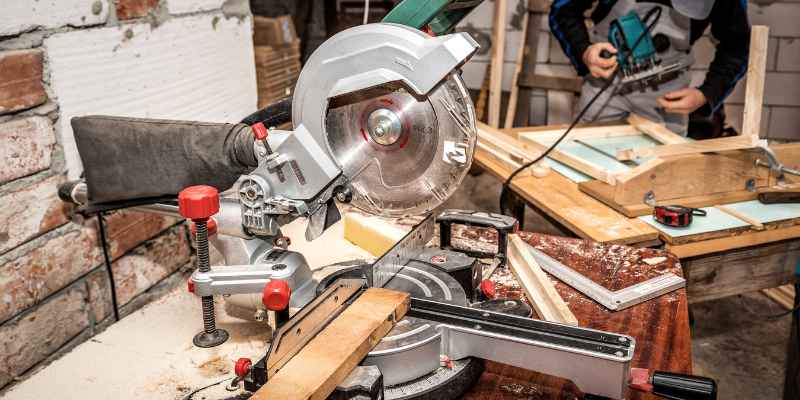
Miter Saw Safety Basics
Accuracy and safety go together — a rushed, unsafe cut is rarely a precise one. Wear safety glasses and hearing protection, keep hands clear of the blade path, use a push stick for small offcuts, and always unplug the saw before changing blades or making calibration adjustments. See our full guide to using a miter saw safely for the complete checklist.
Frequently Asked Questions
What is the most accurate miter saw?
There’s no single “most accurate” saw for everyone, but saws with DeWalt’s XPS shadow-line system (like the DWS780) or a rigid axial-glide arm (like the Bosch GCM12SD) are consistently cited by reviewers as the most repeatable for tight tolerances. Accuracy also depends on keeping the saw calibrated — even a top-rated saw drifts out of square over time.
Is a laser guide accurate on a miter saw?
Yes, within roughly ±1/32 inch over a 12-inch cut when properly zeroed, but a laser has to be re-adjusted every time you change blades and doesn’t automatically account for the blade’s kerf. Shadow-line guides handle both of those automatically, which is why they’re generally considered more accurate.
What is shadow line technology on a miter saw?
Shadow-line technology, used on DeWalt’s XPS-series miter saws, shines an LED onto the workpiece so the spinning blade casts its own shadow directly on the cutline. Because it’s the actual blade’s shadow rather than a fixed laser dot, it reflects the blade’s real width and doesn’t need re-zeroing after a blade change.
How do I choose a miter saw?
Start with blade size — a 10-inch saw is more compact, while a 12-inch handles wider cuts. From there, prioritize a saw with a laser or shadow-line guide and smooth bevel adjustments, and check reviews specifically for calibration drift over time, not just day-one accuracy.
Are expensive miter saws worth it?
For repeat trim, cabinetry, or furniture work, yes — higher-end saws like the Festool Kapex hold calibration longer and have tighter miter/bevel detents. For occasional framing or rough carpentry, a mid-range saw with a laser guide is usually accurate enough.
How often should you calibrate a miter saw?
Check calibration before any project that needs tight-fitting joints, and always after the saw has been dropped, transported, or has had a blade change. For daily shop use, a quick square-and-fence check once a month catches drift before it shows up in a cut.
What features should I look for in a miter saw?
Look for a laser or shadow-line cutline guide, a fence that stays square after repeated use, positive miter stops at common angles, and a bevel lock that doesn’t creep under load. Dust collection isn’t an accuracy feature, but it keeps the cutline visible, which indirectly helps you cut on the mark.
The Bottom Line on Miter Saw Accuracy
The saw matters less than most buying guides suggest — a shadow-line or well-maintained laser guide, a squared fence, and a habit of test-cutting before committing to a project will out-perform an expensive saw that’s never been calibrated. Run the 5-step check above on whatever saw you already own before blaming the tool for a bad joint.
Sponsored / affiliate links. As an Amazon Associate I earn from qualifying purchases. I may earn additional commission from eligible campaigns.