Best Miter Saw Stands With Wheels: Weight Capacity Compared
A miter saw stand with wheels needs a weight rating 50-100 lb above your saw’s actual weight, not just enough to hold it — real models range from the DeWalt DWX726’s 300 lb capacity to the Evolution Miter Saw Stand PLUS’s 661 lb. Undersizing that margin, not thin legs, is what causes tip-overs and inaccurate cuts on job sites. This guide compares real weight capacities across five wheeled stands, what to check before buying one, and how to add wheels to a stand that doesn’t have them.
Every stand below is designed to roll a miter saw between cuts without unbolting it from its mount, which is the entire point of the wheeled category over a fixed bench.
Weight Capacity Compared: 4 Real Miter Saw Stands With Wheels
Best Overall Wheeled Stand
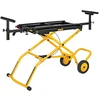
DEWALT DWX726 Rolling Miter Saw Stand – $299.00
Pneumatic-assisted lift raises and lowers a mounted saw with one hand, and 8 ft of material support handles long crown and baseboard stock.
- Best for: Job site work where you set up and break down daily
- Why we picked it: 300 lb capacity plus the pneumatic lift most competitors in this price range skip
- Main drawback: 300 lb capacity is the lowest of the four stands here — not the pick for very heavy compound saws plus long stock
Compare more wheeled miter saw stand options
 Highest Capacity Evolution Miter Saw Stand PLUS – $275.00
|
 Multi-Use Workbench BORA Portacube PM-8000 – $411.68
|
 Budget Pick VEVOR Tabletop Stand – $139.90
|
As an Amazon Associate we earn from qualifying purchases.
Manufacturer weight ratings cover the stand, the mounted saw, and any material resting on the support arms combined — not just the saw by itself. That combined number is what actually protects against a tip-over.
| Stand | Weight Capacity | Material Support | Price | Best For |
|---|---|---|---|---|
| DEWALT DWX726 | 300 lb | 8 ft, pneumatic-assist lift | $299.00 | All-around job site use |
| Evolution Miter Saw Stand PLUS | 661 lb | 10 ft support arms | $275.00 | Long stock, highest capacity |
| BORA Portacube PM-8000 | 400 lb | Rotating workbench top | $411.68 | Doubles as a workbench |
| VEVOR Tabletop Stand | 330 lb | 5-level height adjust | $139.90 | Budget pick |
📊 Most wheeled miter saw stands are rated between 300 and 661 lb — but that figure is the combined stand-plus-saw-plus-material limit, not a per-item number. Source: manufacturer product listings (DEWALT, Evolution, BORA, VEVOR, 2026).
What to Look for When Choosing a Miter Saw Stand With Wheels
Beyond weight capacity, three things separate a stand that survives daily loading from one that loosens up within a year: wheel material, mounting compatibility, and how the stand folds down. For blade selection and cutting-technique guides once the saw is mounted, see our full miter saw hub.
Wheel Material Matters More Than Wheel Size
Pneumatic (air-filled) wheels roll more smoothly over gravel, dirt, and framing scraps on a job site, which is why stands built for outdoor work tend to spec them. Solid rubber or polyurethane wheels never go flat and hold up better indoors on smooth garage or shop floors, but they transmit more vibration over rough ground. If you’re moving the stand mostly on concrete or plywood subfloor, solid wheels are the lower-maintenance choice; if you’re crossing gravel or dirt regularly, pay the extra cost for pneumatic.
Mounting Bracket Compatibility
Most stands use adjustable universal mounting rails that fit the base plate of nearly any compound miter saw, but a few — including the Evolution stand above — explicitly exclude one or two of that brand’s own saw models. Check the listed compatibility against your saw’s exact model number before buying, not just the brand name.
Folding Footprint for Storage
A stand that folds to a narrow vertical profile takes up less wall space in a garage or trailer than one that folds flat and wide. If storage space is tight, check the folded dimensions in the listing, not just the assembled footprint — the two numbers aren’t always proportional between brands.
“The stands worth buying almost always list a capacity higher than what you think you need. A 300 lb-rated stand feels rock solid with a 60 lb miter saw sitting still, but hang a wet 2×10 off one side of the support arm and that safety margin disappears fast.”
Can You Add Wheels to a Miter Saw Stand You Already Own?
Yes — bolt-on locking casters, typically $10 to $20 a set at hardware stores, retrofit most fixed-leg stands without welding. Look for casters rated for at least a quarter of your stand’s total loaded weight per wheel (four wheels sharing the load, with a safety margin for uneven ground), and choose a locking or brake model so the stand stays put while you’re cutting rather than rolling under blade pressure.
If you’re building a stand from scratch rather than retrofitting one, see our 2×4 miter saw stand cut list for a base you can add casters to, or our homemade portable miter saw stand build, which walks through the same caster-retrofit logic used here on a plywood-and-2×4 base.
Maintaining and Safely Operating a Miter Saw Stand With Wheels
- Inspect wheels before each job: check for debris wrapped around axles and confirm locking casters actually engage before you start cutting.
- Check the frame and mounting bolts: tighten any bolts that have backed out from vibration, and replace cracked or bent tubing rather than working around it.
- Re-torque saw mounting bolts monthly: the vibration from repeated folding and rolling loosens saw-to-stand fasteners faster than a fixed bench.
- Never store the saw upright on the stand unless the manufacturer says it’s rated for that — most instructions warn against it specifically because of tip-over risk, not just as boilerplate caution.
FAQ: Miter Saw Stands With Wheels
How much weight can a miter saw stand with wheels hold?
Most rated capacities run 300 to 661 lb, covering the stand, the mounted saw, and any material resting on the support arms combined. The DEWALT DWX726 tops out at 300 lb, while the Evolution Miter Saw Stand PLUS is rated to 661 lb for long stock and heavier saws.
Can I add wheels to a miter saw stand that doesn’t have them?
Yes. Bolt-on locking casters rated for your stand’s total loaded weight retrofit most fixed-leg stands without welding, typically for $10 to $20 a set. Choose locking casters so the stand can’t roll while you’re cutting.
Are pneumatic wheels better than solid rubber for a miter saw stand?
Pneumatic wheels roll more smoothly over gravel, dirt, and uneven job sites but can go flat. Solid rubber or polyurethane wheels never go flat and work well on smooth garage or shop floors, but transmit more vibration over rough ground.
Can miter saw stands with wheels accommodate different saw brands?
Most use adjustable universal mounting rails that fit nearly any compound miter saw regardless of brand. A few stands explicitly exclude specific saw models, so check the listed compatibility against your saw’s exact model number before buying.
How do miter saw stands with wheels improve safety?
A properly rated stand keeps the saw and material stable during the cut and lets you reposition the whole setup instead of lifting and carrying a loaded saw, which is where back injuries and drops happen. Locking the wheels before cutting is what actually delivers that stability — unlocked casters under blade pressure can let the stand creep.
Conclusion
Match the stand’s rated capacity to your saw plus a real safety margin, not just the saw’s weight alone, and the wheel material to where you’ll actually roll it — pneumatic for gravel and job sites, solid rubber for a smooth shop floor. The DEWALT DWX726 covers most job site use at 300 lb, while the Evolution Miter Saw Stand PLUS is the pick for long stock and heavier saws at 661 lb.
Sponsored / affiliate links. As an Amazon Associate I earn from qualifying purchases. I may earn additional commission from eligible campaigns.