How to Cut 45 Degree Angle Trim: Inside and Outside Corners
Set the saw to half of the corner angle you actually measured, not to 45 by default. A true 90 degree corner takes two 45 degree miters, but a 91 degree corner takes 45.5 and a 92 degree corner takes 46. This guide shows how to measure the corner, which end of the trim stays long on inside versus outside corners, and how much gap a small angle error really makes.
How to Cut 45 Degree Angle Trim: The Short Version
Best Corner-Angle Finder Pick
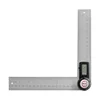 |
GemRed 82305 Digital Angle Finder Protractor, 7-inch stainless steel ($16.99) The whole method on this page starts with one number: the real angle of the corner. This folding ruler-protractor reads inside and outside angles directly, so you can halve the number and set the saw.
|
As an Amazon Associate we earn from qualifying purchases.
- Measure the corner with an angle finder. Do not assume 90 degrees.
- Divide by two. That number is your miter setting. Keep the bevel at 0 for normal baseboard and casing.
- Swing the saw left for one piece and right for the mating piece. The two cuts are mirror images, so the saw does not stay in one position.
- Cut both ends a little long, test the joint on scrap, then trim back a hair at a time.
- Check the long point. On an outside corner the long point sits on the visible face; on an inside corner it sits against the wall.
This page is about the miter joint itself. For the saw controls and general angle charts see our miter saw angle guide, and for the full molding workflow including coping see cutting molding with a miter saw.
Why “Set It to 45.5 Degrees” Is Only Sometimes Right
You will see advice to set the saw to 45.5 degrees to close an outside corner. That works when the wall corner measures about 91 degrees, and it fails when the corner is 90 or 93. The reliable rule has no fixed number in it: miter angle = measured corner angle divided by 2. The two mating pieces share the corner, so each takes half.
| Measured corner angle | Miter saw setting for each piece | Typical situation |
|---|---|---|
| 88 | 44 | Corner closed in by thick drywall mud or bulged framing |
| 89 | 44.5 | Slightly tight corner |
| 90 | 45 | Square corner |
| 91 | 45.5 | Slightly open corner |
| 92 | 46 | Open corner |
| 93 | 46.5 | Noticeably open corner |
| 95 | 47.5 | Out-of-square wall, test the cut on scrap before committing |
The table is plain arithmetic, so it works for any corner. If you measure 92.4 degrees, the setting is 46.2. Most saw scales are marked in half-degree steps, so round to the nearest half degree or use a digital readout if the saw has one.
Inside Corners vs. Outside Corners: Which End Stays Long
The cut angle is the same on both kinds of corner. What changes is which side of the board holds the long point of the miter, and that is the usual reason a joint ends up cut backwards.
| Outside corner (wall sticks out) | Inside corner (wall tucks in) | |
|---|---|---|
| Long point of the miter | On the front (visible) face of the trim | On the back, against the wall |
| Short side of the cut | Against the wall | On the visible face |
| If the joint opens | A V-shaped gap shows on the face: recut, or shim a hairline | Gap shows at the outer edge: fill with paintable caulk, or cope the joint instead |
| Best joint for it | Miter, glued and pinned | Cope, or a miter if the wall is truly square |
For a standard room, baseboard stands on its edge against the saw fence and casing lies flat on the table, face up. In both positions the bevel stays at 0 and you swing the miter table. If you hold the saw to that routine you rarely mix up left and right.
Many installers cope inside corners on baseboard and crown because a coped joint stays closed when the wall is slightly out of square or when the wood shrinks with the seasons, while a mitered inside corner can open. See our molding guide for the coping method. Trimming the floor line with quarter round? See how to install quarter round for where the nails go.
How Much Gap Does a Small Angle Error Make?
A miter seam on flat trim is about 1.41 times as long as the trim is wide (the diagonal of a 45 degree cut). A small angle error between the two mating faces opens a wedge that is widest at the far end of that seam. Using that geometry, the gap is roughly seam length x tan(error). These values are simplified calculations, not measured joints, and they assume the pieces pivot at the heel of the joint.
| Trim width | Miter seam length | Gap at 0.5 degree total error | Gap at 1 degree total error | Gap at 2 degree total error |
|---|---|---|---|---|
| 2.25 in | 3.18 in | 0.028 in | 0.056 in | 0.111 in |
| 3.25 in | 4.60 in | 0.040 in | 0.080 in | 0.161 in |
| 5.25 in | 7.42 in | 0.065 in | 0.130 in | 0.259 in |
Two things follow. A 1 degree error on 5-1/4 inch baseboard opens a gap of about an eighth of an inch, which is visible on stained trim and a caulk job on painted trim. And the same error matters less on narrow casing: wider trim punishes sloppy angles more, so measure the corner on big baseboard even if you skip it on narrow casing.
Step-by-Step: Cut a Tight 45 Degree Trim Corner
1. Measure the real corner angle
Open the angle finder, seat both arms flat against the two walls (or against the door frame legs), lock it and read the number. Measure at the height of the trim, not at the ceiling, because walls and drywall corner bead often differ from top to bottom. Write the angle on the wall in pencil.
2. Set the saw and check the blade
Half the measured angle is your setting. Check that the fence is square to the blade and that the table is locked at the detent or mark. A fine-tooth blade leaves a cleaner face on painted trim; our miter saw blade guide covers options.
3. Cut a test joint on scrap
Cut two short scraps of the same trim, left and right, and hold them in the corner. If the outside edge is open, the saw angle is too small or the corner is wider than measured; if the inside is open, the opposite. Adjust by half a degree and cut again. A few inches of scrap saves a full length of trim.

4. Cut the real pieces long, then sneak up
Leave each piece about a sixteenth of an inch long and trim back until it just fits. Cut the first piece for the left side, then swing the saw to the other side for the mating piece. Hold the trim tight against the fence and let the blade stop before lifting it.
5. Glue, pin and caulk
A thin line of wood glue on the miter face and a pin nail through each side keeps the joint closed. On painted trim, a thin bead of paintable caulk and a light sanding of the seam hides the last hairline. Use wood filler for nail holes; see our wood filler guide if the frame itself needs repair.
Fixing Out-of-Square Walls Without a Gap
- Measure each corner separately. Rooms often have different angles at different corners, so never reuse the number from the last corner.
- Trust the half-angle, not the wall. If one wall is out of plumb and the other is true, the half-angle method still places the seam at the middle of the corner, which looks more natural than a seam that favors one side.
- Cope inside corners where the wall is wavy or the trim is tall.
- Back-cut slightly for a snug fit. A tiny relief on the back of a miter lets the visible edge meet tightly even when the wall surface is slightly bowed.
- Fill what remains. Hairline gaps close with paintable caulk; wider gaps on stained trim call for a recut.
The related cuts have their own rules: 22.5 degree octagon angles split an 8-sided corner, angled rip cuts run along the board, and beveling an edge tilts the cut through the thickness. Trim miters are a different job: a cross-grain cut across the width of the molding.
No Miter Saw? Other Ways to Cut a 45 Degree Trim Angle
- Miter box and back saw: the slots are fixed at 45 and 90 degrees, so this works for square corners and for picture-frame joints.
- Speed square and hand saw: mark a 45 degree line from the square and saw to the waste side, then clean up with a block plane.
- Circular saw with a speed square as a guide: clamp the square to the trim as a fence. It is slower and rougher than a miter saw, so cut long and plane back to the line.
These methods cannot fine-tune the angle by half a degree the way a saw scale can, so on an out-of-square corner plan on fitting the joint with a block plane or sandpaper.
Frequently Asked Questions
What is the easiest way to cut a 45 degree angle on trim?
Use a miter saw. Set it to 45 degrees, hold the trim against the fence and cut. For a square corner you will need one left cut and one right cut. If the corner is not exactly 90 degrees, measure it and set the saw to half the measured angle.
How do I cut 45 degree trim without a miter saw?
Use a miter box and a back saw, or mark a 45 degree line with a speed square and cut it by hand. Cut slightly long and plane the end until it fits.
Do I cut trim at 45 degrees for both inside and outside corners?
Yes, on a square corner both use 45 degrees. The difference is which end holds the long point: the visible face on an outside corner, the back of the trim on an inside corner. Many installers cope inside corners instead of mitering them.
Why is my 45 degree trim joint not fitting tightly?
Most often the wall corner is not exactly 90 degrees, so two 45 degree cuts add up to the wrong angle. Measure the corner, divide by two, and test the cut on scrap. Cutting the pieces on the wrong side of the saw is the next most common cause.
Is crown molding cut at 45 degrees too?
Not on the flat. Crown sits at an angle between wall and ceiling, so it needs a compound cut with both a miter and a bevel setting. See our molding guide for the crown settings.
Sponsored / affiliate links. As an Amazon Associate I earn from qualifying purchases. I may earn additional commission from eligible campaigns.