Mortise and Tenon Sizing Calculator: A Practical Guide
A common rule of thumb is to make the mortise about one-third of the stock thickness for a standard center tenon, while leaving roughly 1/4 in. of wood on each face; for wider rails, the tenon is often several times its thickness. Miss that mark and the joint can split, starve for glue, or look clumsy in the finished piece. I size mortise-and-tenon joints from the actual stock, the rail width, the joint style, and the tool limits before I cut a single shoulder.
How is this calculated?
Press Calculate to see the math with your numbers.
How does a mortise and tenon sizing calculator work?
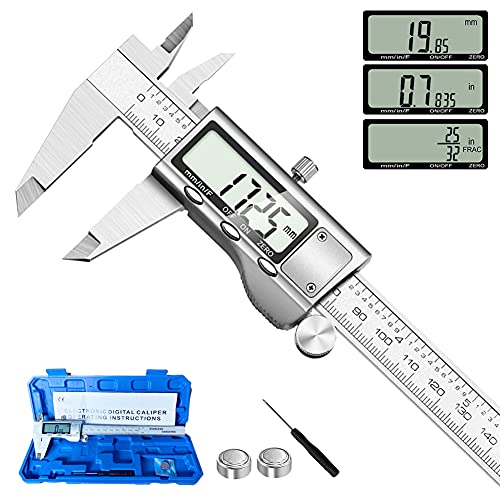
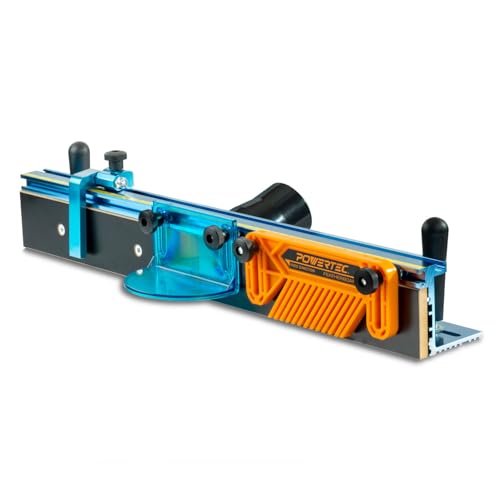

A mortise and tenon sizing calculator turns stock dimensions and joint style into a safe starting layout. It starts with the mortised member thickness, then checks rail width, shoulder layout, fit class, and whether the mortise is blind or through. The result is a buildable size, not a fixed rule.
What inputs matter most
Stock thickness, rail width, and joint style carry the most weight. Thickness sets tenon thickness and mortise wall strength. Width sets shoulder layout and tells you whether one tenon can carry the load. Joint style sets depth, glue relief, and whether the end stays hidden or shows proud.
How the calculator turns stock size into joint parts
A useful calculator breaks the joint into tenon thickness, tenon length, mortise depth, shoulder width, cheek thickness, and fit clearance. That matches what describes: sizing tenon thickness, shoulder width, and mortise depth from real stock dimensions. Always check the output against the actual piece, not the nominal lumber label.
Where the rule of thirds fits
and give the familiar baseline: tenon thickness is stock thickness divided by 3. That works well for many furniture joints because it leaves balanced cheeks and mortise walls. It is only a starting point, though. Thin parts, brittle wood, or wide rails often need a different layout.
According to Mortise and Tenon Calculator – Joint Dimensions & Layout — That same page says tenon thickness is stock thickness divided by 3.
What is the rule of thirds for mortise and tenon?
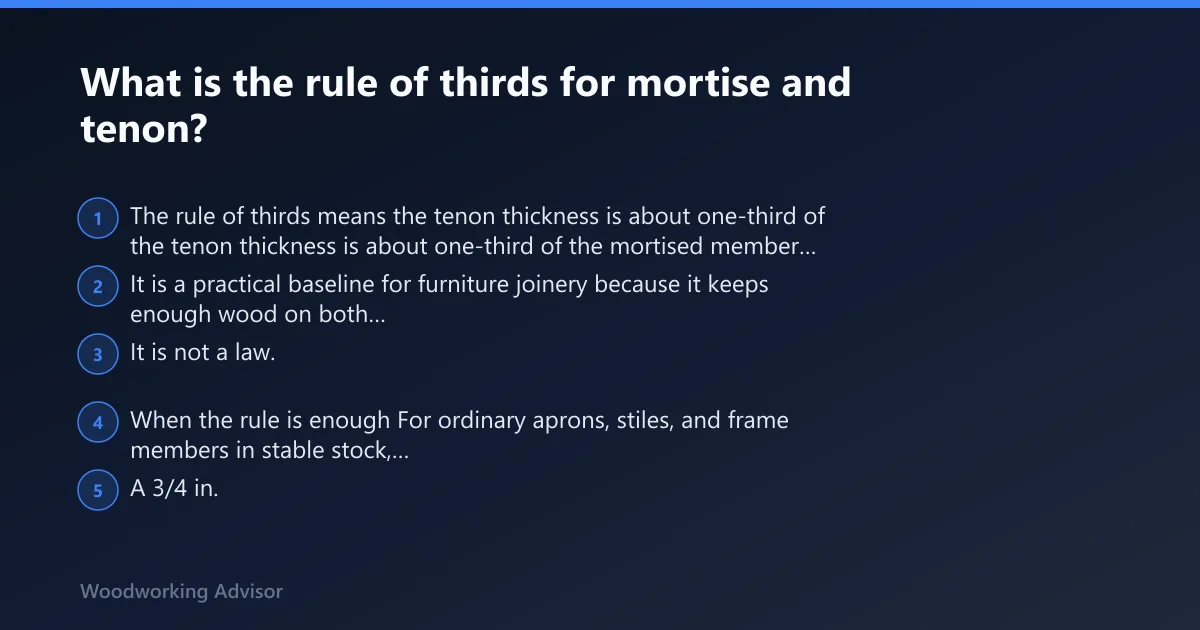
The rule of thirds means the tenon thickness is about one-third of the mortised member thickness. It is a practical baseline for furniture joinery because it keeps enough wood on both faces of the mortise while leaving the tenon stout enough for glue and load transfer. It is not a law.
When the rule is enough
For ordinary aprons, stiles, and frame members in stable stock, one-third usually lands in a safe range. A 3/4 in. member often points to a 1/4 in. tenon, which matches. That keeps layout simple and leaves cheeks thick enough for most hand-cut and machine-cut work.
When the rule is not enough
When the mortised part is thin, the rule can leave too little wall thickness. When the rail is wide, one tenon may look weak or place too much load at the center. When the species is brittle, a slightly smaller tenon and wider shoulders can be a better trade than forcing the textbook proportion.
Which joint style should you use?
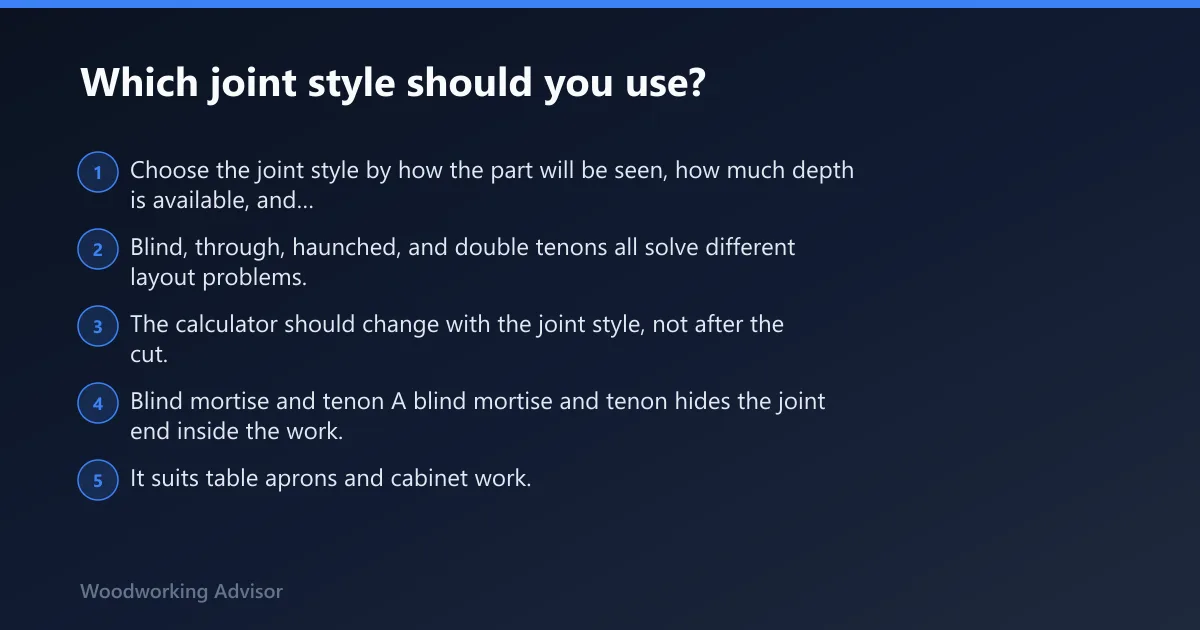
Choose the joint style by how the part will be seen, how much depth is available, and whether the rail is narrow or wide. Blind, through, haunched, and double tenons all solve different layout problems. The calculator should change with the joint style, not after the cut.
Blind mortise and tenon
A blind mortise and tenon hides the joint end inside the work. It suits table aprons and cabinet work. Because the mortise has a bottom, glue relief matters. notes a 1/16 inch glue relief, and gives blind mortise depth as tenon length plus glue clearance.
Through mortise and tenon
A through mortise and tenon runs all the way through the mortised piece. It is common for heavy frames and timbers, and the tenon may be proud or wedged. This style is forgiving on depth but more demanding on appearance, since the tenon end is part of the design.
Haunched tenon
A haunched tenon helps when a groove, panel, or profile cuts into the shoulder area. It keeps the shoulder balanced while reducing the full tenon width where needed. Narrow rails often benefit from this layout because the haunch preserves strength without forcing an overwide or weakened shoulder line.
Double tenon
A double tenon splits a wide rail into two tongues. includes double tenon among common variants. This is the better choice when one thick center tenon would make the cheeks too thin or when a wide member needs load spread across more than one glue line.
How tight should a mortise and tenon joint be?
A mortise and tenon joint should fit according to the cut method. Loose, standard, snug, hand-cut, and CNC or machine fit are all valid when they match the tool and glue plan. The goal is cheek contact, not a crush fit that scrapes glue away or splits fibers.
Fit classes in shop terms
- Loose: small working clearance; useful only when glue can still coat the cheek walls well.
- Standard: light hand pressure during assembly; good for most furniture work.
- Snug: firm by hand, but not forced; often the safest target.
- Hand-cut: slightly more forgiveness for saw and chisel variation.
- CNC / machine fit: tighter repeatability, but still needs room for glue.
Glue clearance and relief
Blind mortises need relief so glue has somewhere to go. A practical target is about 1/16 inch or 1.5 mm. That prevents hydraulic lock and helps the joint close without trapping liquid glue at the bottom. A dry fit should seat fully without pounding.
Tooling changes the fit target
A router jig and CNC can hold closer tolerances than a chisel and saw layout. A hollow-chisel mortiser usually leaves cleaner walls than a rough chop. A tenoning jig can make repeatable cheeks, while hand-cut work often needs a little more clearance. Fit should match the tool, not the other way around.
Use this shop-ready sizing table
This table treats the calculator as a decision aid. It starts with the one-third baseline, then shifts the tenon size, mortise depth, and shoulder strategy when stock thickness, rail width, or joint style changes. These are practical starting points, not a universal formula.
| Stock scenario | Recommended tenon thickness | Mortise depth | Shoulder strategy | Preferred joint style |
|---|---|---|---|---|
| 3/4 in. apron to leg | 1/4 in. | about 1 to 1-1/8 in., plus glue relief if blind | Full shoulder all around | Blind mortise and tenon |
| 1 in. rail to stile | about 5/16 in. | about 1-1/4 in. to 1-3/8 in. | Full shoulder, slight relief at bottom of blind mortise | Blind mortise and tenon |
| 1-1/2 in. heavy frame member | about 1/2 in. | about 1-3/4 in. to 2 in. | Full shoulder or proud through end | Through mortise and tenon |
| Narrow rail with groove at shoulder | about 1/4 in. with reduced central width | match rail thickness, with glue relief if blind | Haunch at interrupted shoulder | Haunched tenon |
| Wide rail carrying door or gate load | two tenons, each about 1/4 in. to 5/16 in. | about 1 to 1-1/2 in. each, depending on stock | Split the shoulder into two bearing areas | Double tenon |
| Thin leg that cannot spare much wall thickness | smaller than one-third if needed | keep shallow enough to preserve walls | Widen shoulders and reduce tenon demand | Blind or alternate joint if walls become too thin |
How do you size a mortise and tenon when the stock is not ideal?
When the stock is not ideal, the calculator should protect the weakest member first. Thin legs may force a smaller tenon. Wide rails may need two tenons. Brittle species often need a safer proportion than the rule of thirds, with more reliance on shoulders and less on an aggressive cheek thickness.
Thin legs and weak mortise walls
If the mortised part is too thin to accept a textbook tenon, reduce tenon thickness before reducing wall thickness below a safe level. Another option is to switch to a different joint style rather than crowd the mortise. If there is not enough material left on both faces, the joint should change.
Wide rails that need load spread
Wide rails are poor candidates for a single oversized tenon. The cheeks can become too thin, and the mortise can weaken the member. A double tenon is often the better answer because it spreads the load and keeps each tongue in a safer proportion.
Brittle species and tight-grained stock
Brittle wood can split before the math fails. In that case, a slightly smaller tenon, clean shoulder support, and careful glue relief are safer than forcing the full one-third proportion. The calculator should favor preserved wall thickness and realistic assembly over a neat fraction on paper.
How do you determine tenon size?
Start with the mortised member thickness, set the tenon at about one-third, then check whether the rail width and shoulder layout still leave enough meat around the mortise. After that, decide whether the joint is blind, through, haunched, or double, because each style changes the useful length and width.
A simple sizing sequence
- Measure the actual thickness of the mortised member.
- Set a one-third baseline for tenon thickness.
- Check remaining wall thickness on both faces.
- Decide whether the rail needs one tenon, a haunch, or two tenons.
- Set mortise depth to suit the joint style and glue relief.
- Match the fit class to the tool being used.
Why shoulder width matters
Shoulders carry much of the visual and mechanical alignment. If the shoulder is too small, the rail can look weak and the joint may drift under clamp pressure. If it is too large, the tenon may become unnecessarily short. The calculator should balance shoulder width with tenon length, not treat them as separate decisions.
Frequently asked questions
how big should a mortise and tenon be
A good starting point is a tenon about one-third of the mortised member thickness, then adjusted for the actual stock and joint style. The mortise must leave sound walls on both sides, and the rail width must still allow useful shoulders. Thin members often need a smaller tenon or a different joint.
how to size mortise and tenon joints
Size the joint from the real thickness of the mortised member, then check rail width, shoulder layout, and tool limits. Start with the rule of thirds, then adjust for blind or through construction, glue relief, and whether the part needs a haunch or double tenon. The safest size is the one the stock can support.
how deep should a mortise be
Mortise depth depends on the joint style. Through mortises run the full depth of the part. Blind mortises are shallower and should include glue relief at the bottom. A practical blind layout uses tenon length plus clearance, so the joint can seat fully without hydraulic lock or trapped glue.
when should I use a haunched or double tenon
Use a haunched tenon when a groove, panel, or profile interrupts the shoulder area, especially on narrow rails. Use a double tenon for wide rails or heavy members when one tongue would be too thick or would leave weak cheeks. Both choices keep the joint inside a safer size range.
Sponsored / affiliate links. As an Amazon Associate I earn from qualifying purchases. I may earn additional commission from eligible campaigns.