Router Bit Size Chart and Uses
Choose router bits by job: 1/4-inch shanks are commonly used for light trim and small routers, while 1/2-inch shanks are often used for most groove, edge, and joinery work because they tend to resist deflection and accept larger cutters. The wrong size can cause chatter, burn marks, tear-out, and unsafe bit flex. This guide gives a job-first router bit size chart for grooves, edge profiles, dados, rabbets, mortises, and common cutter styles, plus the shank and cut direction to match each task.
Router bit sizes, cuts, and common setup mistakes


Use the cut first, then confirm the shank size. That order keeps the bit matched to the task, the collet, and the router’s power. The chart below gives a practical starting point for common woodworking jobs, with the most useful diameter range, shank choice, pass depth, and the most common setup mistake.
| Bit diameter | Shank size | Common cut | Best material | Recommended pass depth | Common mistake to avoid |
|---|---|---|---|---|---|
| Small cutting diameter | 1/4 inch or 6 mm | Straight groove, light dado, small mortise | Softwood, plywood, light hardwood work | Shallow passes; step down in stages | Forcing a full-depth cut in one pass |
| Medium cutting diameter | 1/4 inch or 1/2 inch | Flush-trim, template routing, edge trimming | Solid wood, veneered panels, laminate | Shallow to moderate passes, guided by bearing contact | Letting the bearing ride off the template edge |
| Medium to large cutting diameter | 1/2 inch or 12 mm | Roundover, chamfer, deeper edge profiling | Solid wood, tabletops, shelving edges | Single-pass edge work only if the maker allows it | Using a small router that cannot hold the bit rigidly |
| Medium cutting diameter | 1/2 inch or 12 mm | Rabbeting for cabinet backs and box sides | Plywood, MDF, softwood, hardwood | Multiple passes for wider or deeper rabbets | Setting the bearing or fence before checking the final width |
| Medium cutting diameter | 1/2 inch | Dovetail joinery with a jig | Hardwood and stable sheet goods | Light passes only; let the jig control the cut | Trying to take full-depth joinery in one pass |
Common job, best material, and pass depth
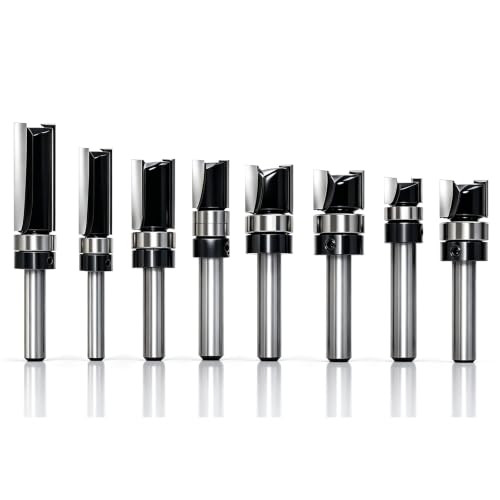
Straight bits are the starting point for many beginners because they cut grooves, dadoes, and mortises cleanly when the setup is controlled. Spiral bits do the same work with a different failure mode: upcut styles pull chips out faster, downcut styles leave a cleaner top edge, and compression bits split the difference for sheet goods. Flush-trim bits are for template work, not freehand shaping.
Roundover bits soften an edge. The bearing sets the finished radius, and common sizes include 1/8, 3/16, 1/4, 3/8, 1/2, and 3/4 inch. Chamfer bits usually cut a 45-degree bevel, which gives a more modern edge than a roundover. Rabbeting bits cut an L-shaped recess, and dovetail bits belong with a jig for joinery.
Mistakes to avoid for each cutter type
Do not choose a cutter by shape alone. A straight bit can make a groove, but a spiral bit often gives cleaner chip removal and a cleaner wall. A roundover bit softens an edge, while a chamfer bit breaks the edge with a bevel. Those differences matter when tear-out, chip packing, or edge profile accuracy is the real problem.
A common first-timer mistake is using a large cutter on a light router because the shank fits. That can leave chatter and poor control even before the cut reaches full depth. Another common error is treating all bearing-guided bits the same. A flush-trim bit follows a template edge; a rabbeting bit uses a pilot bearing and interchangeable cutters to set the recess width.
How do you measure router bits?
Measure the cutting diameter, not the bearing, and read the shank size separately. The diameter tells you what size cut the bit can make and how much speed and power it needs. The shank tells you whether the bit fits the collet. Metric and imperial systems are not interchangeable across 1/4 inch, 6 mm, 1/2 inch, and 12 mm sizes.
Read the cutting diameter first
For profile bits, measure from the widest cutting edge across the bit body, not from the pilot bearing. On flush-trim and rabbeting bits, the bearing does not define the cutter diameter. On roundover bits, the bearing determines the finished radius, so the labeled size usually refers to the profile it produces rather than the total bit width.
Say your roundover bit is labeled 1/4 inch. That does not mean every part of the cutter is 1/4 inch wide. It means the edge profile, set by the bearing and cutter geometry, produces a 1/4-inch roundover on the workpiece edge.
Read the shank size and collet fit
Common router shank sizes include 1/4 inch and 1/2 inch. Metric router shank sizes include 6 mm, 8 mm, and 12 mm. A 1/4-inch shank is 6.35 mm, and a 1/2-inch shank is 12.7 mm. That is why metric and imperial shanks are not interchangeable across systems, even when they look close.
- Check the collet size stamped on the router or listed in the manual.
- Match the bit shank to that collet size exactly.
- Confirm that the cutter type fits the job and the available depth of cut.
- Make a test cut in a matching scrap piece before cutting the final workpiece.
Identify metric sizes before you buy
Metric shanks are common on routers sold in metric markets, but the buying mistake is simple: a 6 mm shank is not the same as 1/4 inch, and 12 mm is not the same as 1/2 inch. If the router collet is imperial, buy imperial shanks. If the router is metric, stay with the matching metric size unless the manufacturer explicitly allows an adapter or alternate collet.
What router bit size do you need for a 1/4-inch shank?
A 1/4-inch shank works best for lighter cutters, small routers, trim work, and shallow passes. It is a good starting point for straight bits, small flush-trim bits, and light decorative edges. For larger diameters, deeper cuts, or harder stock, a 1/2-inch shank is usually the better choice because it is stiffer and less likely to deflect.
1/4-inch shank uses and limits
Use a 1/4-inch shank for light edge profiling, narrow grooves, small dados, and detail work where cutter diameter stays modest. It is also common on compact routers and trimmers. The limit is rigidity: as the cutter diameter grows or the cut gets deeper, deflection becomes more likely and the surface finish can suffer.
When 1/2-inch shanks are the better pick
Choose a 1/2-inch shank for most groove, edge, and joinery work when the router and collet support it. It gives better stiffness, which helps with larger straight bits, deeper rabbets, and heavier edge-forming bits. It is also the safer pick when the cut is long, the stock is hard, or the bit diameter is wide.
Choosing between metric and imperial sizes
Do not cross-size by guesswork. A 6 mm shank may seem close to 1/4 inch, but it is smaller and can fit loosely in the wrong collet. The same problem appears with 12 mm and 1/2 inch. Buy the bit to match the router system you have, not the one that looks close on paper.
Router speed vs bit diameter
Choose router speed from the widest cutting diameter, then check the tool maker’s rating before you turn the router on. Larger diameters need lower speed because the edge travels farther per revolution. Smaller bits can usually run faster, but the maker’s limit still comes first. There is no safe one-size-fits-all setting.
Why diameter changes safe speed
A wider cutter moves more wood at the edge of the bit, so the cutting load rises fast. That affects heat, burn marks, and control. If the bit diameter increases, reduce speed unless the maker says otherwise. This matters most on edge-forming cutters and large profile bits, where too much speed can roughen the cut or stress the router.
Why the tool maker rating comes first
The router and the bit maker know the intended operating range for that cutter. A printed speed chart may give a useful starting point, but the rating on the bit or packaging overrides any generic setting. If the recommendation for the bit is lower than the router’s dial setting, use the lower figure.
How to set up a test cut
Set the collet fully, back the bit out slightly before tightening, and make a test cut in scrap that matches the final workpiece. Start with a shallow pass and listen for chatter or burning. If the router strains, the feed is too slow, the speed is too high, or the bit is too large for the setup.
Picture a 3/4-inch roundover on a hardwood tabletop edge. If the router is set too fast, the edge may burn before the bearing settles into the full profile. Lowering speed, shortening the pass, or moving to a more rigid router can solve the problem without changing the profile bit.
Which bit type fits the task?
Match the bit to the failure mode you want to avoid. Straight bits are the plain cutting choice for grooves, dadoes, and mortises. Spiral bits improve chip evacuation and often leave cleaner walls. Flush-trim bits follow a template. Roundover and chamfer bits shape the edge in different ways. Rabbeting and dovetail bits are for specific joinery tasks.
Straight and spiral bits for grooves, dadoes, and mortises
Use a straight bit when you want a predictable straight cut and the job is basic groove or dado work. Use a spiral bit when chip removal matters more, or when you want a cleaner cut surface. Upcut spirals lift chips out of the cut. Downcut spirals leave a cleaner top face. Compression bits help when both faces of sheet stock matter.
Flush-trim and roundover bits for templates and edges
Flush-trim bits are bearing-guided, and they come in top-bearing and bottom-bearing versions. Top-bearing bits are common when the template sits above the workpiece; bottom-bearing versions work when the template sits below. Roundover bits are for edge-softening. The bearing determines the radius, so the bit size and the finished profile must be read together.
Chamfer, rabbeting, and dovetail bits for joinery and profiles
Chamfer bits usually cut a 45-degree bevel and are useful for decorative edge breaking or a modern profile. Rabbeting bits cut an L-shaped recess for cabinet backs, box construction, and similar work, and interchangeable bearings change the width. Dovetail bits are commonly used with dovetail jigs, and common angles run from 7 to 14 degrees.
Suppose you need a cabinet back groove. A straight bit can make the groove, but a rabbeting bit may be the better choice if the recess must be wide and clean along the edge. If the goal is a decorative edge instead, a chamfer or roundover bit fits better than a joinery cutter.
Shank size and collet fit
Shank size affects rigidity, collet fit, and how much cutter you can safely hang below the router base. Common shank sizes include 1/4 inch and 1/2 inch, and metric router shank sizes include 6 mm, 8 mm, and 12 mm. The bit must match the collet exactly, and metric and imperial shanks are not interchangeable.
1/4 inch, 1/2 inch, and metric shanks
A 1/4-inch shank is 6.35 mm, and a 1/2-inch shank is 12.7 mm. Metric equivalents are not the same thing. A 6 mm bit does not belong in a 1/4-inch collet just because it seems close. The reverse is also true. That small mismatch can cause poor grip and a less secure setup.
Router collet compatibility checks
Check the router manual, the collet marking, and the bit shank before installation. If the router includes removable collets, use the one listed for the bit size. Never force a shank into a nearly matching collet. If the fit is not exact, the correct answer is a different bit or a proper collet, not more tightening.
Why shank size affects rigidity
A thicker shank flexes less under load, which matters as diameter and pass depth rise. That is why 1/2-inch shanks are common for larger profile cutters and heavier joinery work. The increased stiffness helps reduce chatter and can improve cut quality, especially in harder stock or long passes.
Why are router bits important in woodworking?
Router bits matter because they control the cut, the finish, and the fit. They let you make precise grooves, rabbets, joinery cuts, and decorative edges with the same tool body. The bit shape, diameter, and shank size all change how safely and cleanly the router can do the job.
They are also one of the quickest ways to move from rough shaping to repeatable work. A mismatch between bit and task can leave tear-out, inaccurate widths, or a wandering cut. A proper match makes the router easier to control and reduces setup surprises.
Frequently asked questions
What is the difference between 1/4-inch and 1/2-inch router bits?
The main difference is rigidity and the size of cutter the shank can support safely. A 1/4-inch shank suits light work and compact routers. A 1/2-inch shank is better for most groove, edge, and joinery cuts because it deflects less and handles larger cutters more confidently.
How do I choose router speed vs bit diameter?
Start with the widest cutting diameter, then check the maker’s speed rating for that bit. Larger diameters usually need lower speed. Smaller bits can run faster, but the printed limit still controls the setting. Make a test cut in a matching scrap piece and adjust if the cut burns or chatters.
Which router bit type should I use for grooves, rabbets, or joinery?
Use a straight bit for grooves, dadoes, and mortises. Use a rabbeting bit when you need an L-shaped recess, such as for cabinet backs or boxes. Use a dovetail bit with a dovetail jig for joinery. If chip removal or wall finish matters more, a spiral bit may be a better pick.
What do metric router bit sizes mean?
Metric sizes mean the shank diameter is listed in millimeters, commonly 6 mm, 8 mm, or 12 mm. Those sizes do not convert to the imperial sizes by assumption. A 6 mm shank is not a 1/4-inch shank, and a 12 mm shank is not a 1/2-inch shank.
How do I identify router bit types and sizes?
Look at the cutter shape first: straight, spiral, flush-trim, roundover, chamfer, rabbeting, or dovetail. Then check the shank stamp or packaging for 1/4 inch, 1/2 inch, 6 mm, 8 mm, or 12 mm. For profile bits, read the cutting diameter and the bearing arrangement, not just the overall length.
Sponsored / affiliate links. As an Amazon Associate I earn from qualifying purchases. I may earn additional commission from eligible campaigns.