Biscuit Joiner vs Domino Joiner: Which Should You Buy?
Buy a Biscuit Joiner if you mainly need fast alignment for cabinets and face frames; buy a Domino Joiner only if stronger loose-tenon joints and faster repeatable setup will change your build process. Pick the wrong one, and you pay for capacity you will never use, or you fight joints that do not earn their higher cost. This guide compares cost, joint performance, setup, and project fit so you can pick the right tool.
This guide is part of our Woodworking joinery and cutting techniques series.
| Decision factor | Biscuit Joiner | Domino Joiner | Winner | Hobbyist | Pro-sumer | Production |
|---|---|---|---|---|---|---|
| Strength | Best for alignment and light reinforcement; limited shear contribution | Loose-tenon joint with larger glue surfaces and better structural potential | Domino Joiner | Biscuit Joiner for casework; Domino Joiner for furniture | Domino Joiner | Domino Joiner |
| Speed | Very fast for repetitive alignment cuts in sheet goods and face frames | Fast once set up, especially for repeat mortises and matching parts | Domino Joiner | Biscuit Joiner if speed means quick cabinet assembly | Domino Joiner | Domino Joiner |
| Alignment | Excellent for registering parts before clamping | Good alignment plus structural joinery in one step | Domino Joiner | Biscuit Joiner for face frames and carcasses | Domino Joiner | Domino Joiner |
| Repeatability | Consistent, but less flexible for precise structural joints | Very repeatable mortise sizing and depth control | Domino Joiner | Biscuit Joiner for simple layouts | Domino Joiner | Domino Joiner |
| Setup time | Usually quicker for basic alignment cuts | More setup choices, but still efficient after sizing is known | Biscuit Joiner | Biscuit Joiner | Domino Joiner when repeat joints are common | Domino Joiner |
| Consumable cost | Low-cost biscuits in common sizes | Higher ongoing cost for proprietary tenons and cutter wear | Biscuit Joiner | Biscuit Joiner | Biscuit Joiner if the budget is tight | Domino Joiner only if workflow savings matter more |
| Portability | Usually lighter and simpler to carry | Still portable, but the system and cutters add bulk and cost | Biscuit Joiner | Biscuit Joiner | Depends on project mix | Domino Joiner if the casework is worth it |
| Learning curve | Simple for alignment work, with fence and mark-out still mattering | More settings to learn, especially tenon size and mortise depth | Biscuit Joiner | Biscuit Joiner | Biscuit Joiner for occasional users | Domino Joiner for trained repeat work |
| Project fit | Cabinets, face frames, sheet goods, rails and stiles | Small furniture, chairs, tables, and structural casework | Depends on project | Biscuit Joiner for cabinets | Domino Joiner for furniture | Domino Joiner |
| Resale value | Lower buy-in, so less capital at risk | Higher resale interest, but only if the system stays complete | Domino Joiner | Biscuit Joiner | Domino Joiner | Domino Joiner |
Strength, speed, and alignment: where each joiner fits
The split is simple. A Biscuit Joiner cuts 3/4-inch-wide oval mortises for compressed beech biscuits that swell with glue. That makes it a fast alignment tool with light reinforcement value. A Domino Joiner cuts floating-tenon mortises for proprietary tenons in multiple sizes, and that larger glue surface gives it more strength potential at a much higher purchase price and consumable cost.
Strength
Biscuits add some help, but the joint still depends on glue, clamping, stock thickness, and grain direction. That is why biscuits are usually the right answer for cabinet carcasses and face frames, where alignment matters more than structural load.
Domino-style loose-tenon joints put more glued wood into the joint, so they are a better fit when the joint itself carries weight or abuse. That matters in chairs, tables, and structural casework, where you want the joint design to do more than simply line up two parts.
Speed
Biscuit joiners are quick to place and cut, especially on repeated cabinet parts. For sheet goods, that can shorten assembly time without adding much layout burden.
Domino joiners are also fast, but the speed advantage shows up most when you cut many matching mortises or repeat the same joint size across a project run. That is a workflow gain, not a reason to spend more in every shop.
Alignment
For face frames, cabinet carcasses, and rails and stiles, alignment is often the real job. A biscuit’s swell with glue helps draw parts into position while the clamps do the rest.
A Domino can align parts too, but it is usually chosen when alignment is only one part of the goal. The other part is a joint that contributes much more than registration.
Repeatability
Domino-style systems excel when you need the same mortise depth and tenon size over and over. That repeatability helps in production or semi-production work where small errors multiply across a run of parts.
Biscuit joiners are repeatable enough for many cabinet tasks, but they are not built around the same structural sizing workflow. The difference matters most when the joint has to be both fast and load-bearing.
Setup time
Biscuit joiners usually win on quick setup for basic alignment cuts. If the job is a run of cabinet stiles and rails, that simplicity can matter more than absolute joint strength.
Domino-style tools ask for more decisions because tenon width, length, and mortise depth have to match the stock. Once you know the joint recipe, the system is efficient; before that, it takes more planning.
Consumable cost
Biscuits are inexpensive and widely available in common sizes such as 0, 10, and 20, with larger sizes on some models. That keeps the running cost low when you use the tool mainly for alignment.
Domino tenons, cutters, and wear parts add ongoing cost. That higher feed cost is easier to justify only when the tool changes the projects you can build or the time you spend on each build.
Portability
A biscuit joiner is usually the simpler carry because the system is straightforward and the consumable footprint is small. For field work or occasional use, that lower overhead is appealing.
A Domino-style system is still portable, but the machine plus cutters and tenons create a more expensive kit to move around. If the tool lives in a fixed shop and gets used often, portability matters less than the workflow it saves.
Learning curve
Biscuit joiners are easier to understand for alignment tasks, though fence position and mark-out still matter. The tool rewards careful layout, but it does not ask for much joint engineering.
Domino-style tools need a better grasp of stock thickness, mortise depth, and tenon size because those choices affect strength. That added control is useful only if you will use it often enough to justify the learning time.
Project fit
Cabinets, face frames, and sheet-goods assemblies are the sweet spot for biscuit joiners. In those jobs, speed and alignment usually matter more than a high-strength joint.
Small furniture, chairs, tables, and structural casework are where Domino-style joints pull ahead. The joint itself becomes part of the design, not just a way to hold parts while glue sets.
Resale value
Domino-style systems often hold interest because buyers know the category and value the loose-tenon workflow. That does not erase the high entry cost, but it can reduce the long-term penalty if the tool stays complete and maintained.
Biscuit joiners cost less to buy, so the resale question is usually smaller from the start. For many buyers, the lower initial outlay is the real value.
The decision matrix keeps the buying rule tied to project fit and total system cost. A lower-cost tool wins when the job is alignment-heavy; a more expensive system wins only when stronger joints and repeatable loose-tenon workflow change the work you do.
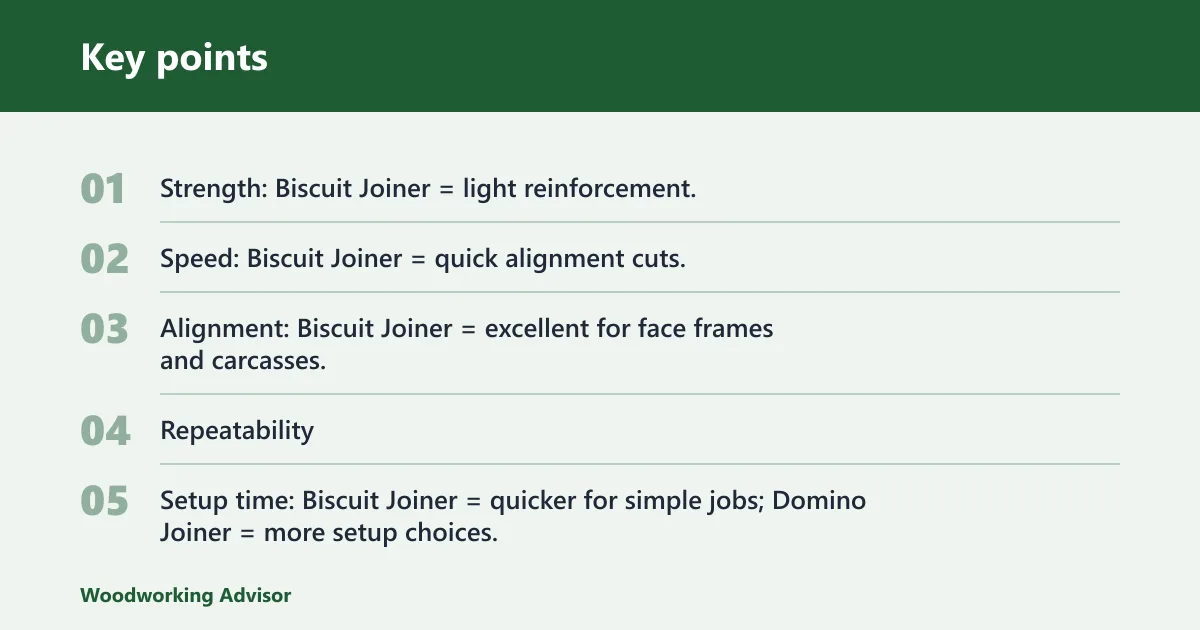
- Strength: Biscuit Joiner = light reinforcement; Domino Joiner = structural loose-tenon potential.
- Speed: Biscuit Joiner = quick alignment cuts; Domino Joiner = faster repeatable joinery on matching parts.
- Alignment: Biscuit Joiner = excellent for face frames and carcasses; Domino Joiner = excellent plus structural value.
- Repeatability: Biscuit Joiner = consistent; Domino Joiner = more precise on mortise size and depth.
- Setup time: Biscuit Joiner = quicker for simple jobs; Domino Joiner = more setup choices.
- Consumable cost: Biscuit Joiner = lower biscuit cost; Domino Joiner = higher tenon and cutter cost.
- Portability: Biscuit Joiner = simpler kit; Domino Joiner = larger system burden.
- Learning curve: Biscuit Joiner = easier for alignment work; Domino Joiner = more settings to manage.
- Project fit: Biscuit Joiner = cabinets and face frames; Domino Joiner = chairs, tables, and structural casework.
- Resale value: Biscuit Joiner = lower capital at risk; Domino Joiner = stronger system value if kept complete.
Say your main work is a run of 3/4-inch plywood base cabinets with face frames. A biscuit joiner fits that job because the mortises help line up rails, stiles, and carcass parts fast, and the biscuit cost stays low across a long assembly.
Suppose you build a dining table with thick aprons and want the joint to help carry load, not just register parts. A Domino-style system fits better because the loose-tenon joint gives more glue surface and a more structural result than a biscuit joint can usually deliver.
Hobbyist, pro-sumer, and production reading
Hobbyist: A biscuit joiner usually makes more sense unless you regularly build furniture that benefits from floating-tenon joints. The lower buy-in and lower consumable cost are hard to ignore when the tool sees occasional use.
Pro-sumer: A Domino Joiner starts to make sense if you build cabinets and furniture often enough that repeatability and joint strength change your workflow. If most work is still sheet goods and face frames, the biscuit tool remains the better value.
Production: A Domino Joiner is the stronger fit when the same joint shows up many times and the output needs consistent structural joints. In that setting, the higher tool and consumable cost can pay back through time saved and better joint control.
What each tool cuts
A biscuit joiner cuts a 3/4-inch-wide oval mortise for a compressed beech biscuit. The biscuit swells with glue and helps the parts align, but the joint is still mainly an alignment aid with limited shear strength contribution.
A Domino joiner cuts mortises for proprietary tenons in multiple sizes. The tenon is a solid wood loose tenon, so the joint gets a larger glue surface than a biscuit joint and can be sized to the stock thickness and job.
Biscuit sizes and fit
Many biscuit joiners use numbered biscuits such as 0, 10, and 20, with larger sizes on some models. The number tells you the approximate biscuit size, not a structural rating.
Glue swells the compressed beech insert, which is why biscuit fit depends on cut quality and clamping. That swelling helps alignment, but it does not turn a cabinet joint into a chair joint.
Domino tenon sizes and fit
Domino tenons come in several widths and lengths, and the mortise cutter must match the chosen size. That lets you tailor the joint to stock thickness and the amount of strength you need.
Fit matters because mortise depth, grain direction, and clamping all affect the finished joint. A loose-tenon joint is only as good as the stock, glue surface, and layout behind it.
Which tool fits cabinets and face frames?
Biscuit Joiner is usually the better buy for cabinets and face frames because those jobs need fast alignment more than maximum joint strength. A Domino Joiner only becomes the better choice when the same cabinet workflow also includes structural casework or repeated loose-tenon joinery.
Cabinet carcass assembly
Cabinet carcasses are often plywood or other sheet goods, so speed and registration matter more than a heavy-duty joint. Biscuit joiners fit that use because they pull parts into line during glue-up without adding much cost.
A Domino can certainly join casework, but it is easy to overspend if the carcass itself is already doing most of the structural work. That is a poor match when your real need is simple, repeatable alignment.
Face frame rails and stiles
Face frame joinery is one of the classic biscuit-joiner jobs because rails and stiles need quick alignment. Accuracy depends on fence setting and mark-out, not on whether the tool can cut a deeper mortise than the project needs.
Domino-style tools can do the job too, but the extra strength rarely matters for a typical face frame. The premium only makes sense if the same setup also supports furniture or structural casework.
Which tool fits furniture and chairs?
Domino Joiner is the better choice for furniture, chairs, tables, and structural casework because floating-tenon joints can be sized for strength and repeatability. Biscuit Joiner still has a place in furniture work, but mainly as an alignment aid, not as the main structural joint.
Floating-tenon joints
Floating-tenon joints matter when the joint itself is part of the structure. A larger glue surface and a sized tenon give you more joint strength potential than biscuits can usually provide.
That is why the Domino-style system shows its value in chairs and tables. Those projects ask more from the joint than a quick face-frame assembly does.
When biscuits still help
Biscuits can still help align wide panels, aprons, or secondary parts in a furniture build. They are useful where alignment matters more than load path.
They are not the best answer when the joint must resist racking, twisting, or repeated stress. In those cases, a loose-tenon system, a dowel jig, or a router-cut mortise is the better category to consider.
Is a Domino joiner worth the extra money?
Domino Joiner is worth the extra money only if the stronger joint, faster repeatable setup, and broader loose-tenon workflow change what you build or how fast you build it. For hobby woodworking that stays in cabinets and face frames, Biscuit Joiner is usually the better value because the running cost stays lower.
Purchase price versus ongoing tenon cost
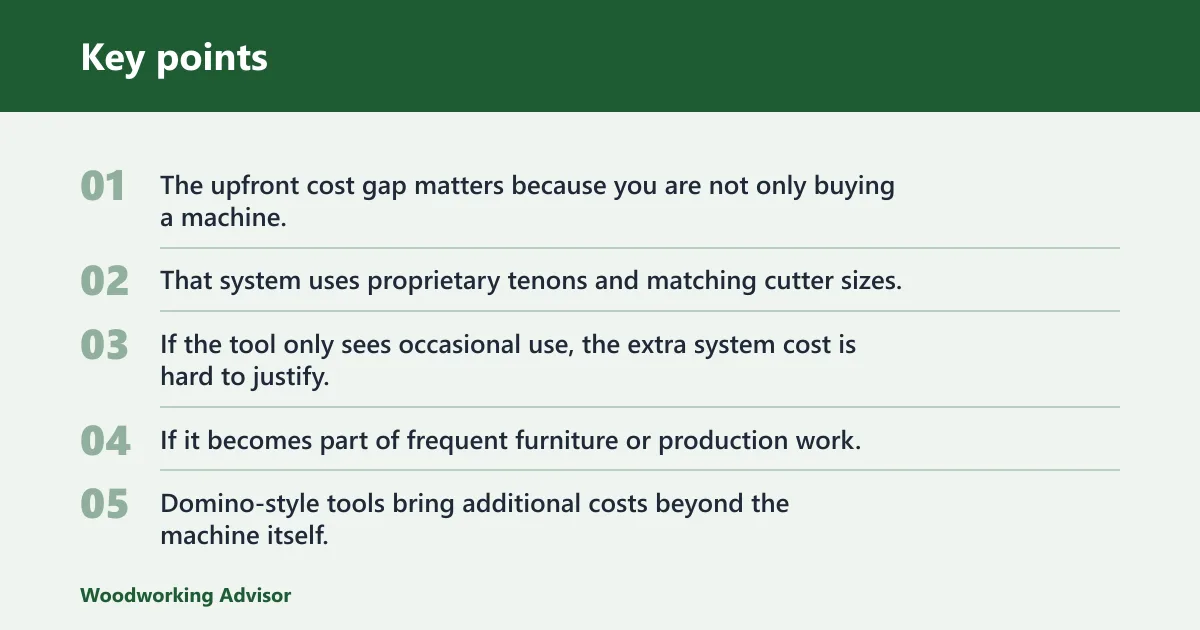
The upfront cost gap matters because you are not only buying a machine; you are buying into a tenon system. That system uses proprietary tenons and matching cutter sizes, so the whole cost picture is higher than a biscuit tool with cheap biscuits.
If the tool only sees occasional use, the extra system cost is hard to justify. If it becomes part of frequent furniture or production work, the math changes because time saved and joint quality start to matter more.
Cutter life and accessories
Domino-style tools bring additional costs beyond the machine itself. Cutters wear, and the matched tenon sizes mean more planned spend over time.
Biscuit joiners also have wear parts, but the ongoing cost is lighter and easier to predict. That is one reason they remain popular for cabinet shops and one-off face-frame work.
Workflow payback
A Domino-style system pays back when repeatable mortises replace slower methods and the joint strength matters enough to change the build. It can be a smart buy for a shop that builds chairs, tables, or structural casework on a steady basis.
For an occasional hobbyist, that payback is much harder to reach. In that case, a biscuit joiner, dowel jig, pocket-hole system, or loose-tenon jig may cover the job for less money.
Choose Biscuit Joiner if… / Choose Domino Joiner if…
Biscuit Joiner: choose it if your work centers on cabinets, face frames, sheet goods, and rail-and-stile alignment. It is also the better pick if you want the lower tool cost, low consumable spend, and a simpler setup for occasional use.
Domino Joiner: choose it if you build chairs, tables, small furniture, or structural casework and want the joint itself to add strength. It also fits better when repeatable loose-tenon workflow saves real time in production or near-production work.
Pick a Biscuit Joiner if your projects are mostly alignment-driven and budget-sensitive. Pick a Domino Joiner if you need structural joints often enough that the higher buy-in and consumable cost change the way you work.
When the Domino-style system is overkill, look first at dowels, pocket-hole joinery, or a lower-cost loose-tenon jig. Those options can cover many furniture and cabinet tasks without committing you to the full machine-and-tenon system.

Frequently asked questions
Should I buy a biscuit joiner or a Domino joiner?
Buy a biscuit joiner if your main jobs are cabinets, face frames, and other alignment-heavy work. Buy a Domino joiner if you need structural loose-tenon joints often enough that stronger joints and faster repeatable setup justify the higher total system cost.
Is a Domino joiner worth the extra money for hobby woodworking?
It can be, but only if your hobby projects regularly move beyond cabinets and face frames. If you mostly need alignment aid and light reinforcement, a biscuit joiner or a lower-cost joinery method usually gives better value.
What joints are best with a biscuit joiner?
Biscuit joiners work best on cabinet carcasses, face frames, sheet-goods assemblies, and rails and stiles. Those joints need quick alignment more than high structural strength, which is where biscuits do their best work.
What joints are best with a Domino joiner?
Domino-style joints are best for furniture, chairs, tables, and structural casework. They are especially useful when you want a floating-tenon joint with more glue surface and better strength potential than biscuits can provide.
Can a biscuit joiner replace a Domino joiner?
No, not for structural work. A biscuit joiner can handle many alignment jobs and some light reinforcement, but it does not replace the stronger loose-tenon workflow you get from a Domino-style system.
How much does a Domino joiner cost compared with a biscuit joiner?
A Domino-style system costs more up front and costs more to feed over time. The difference comes from the machine itself, proprietary tenons, matching cutters, and ongoing consumable expense, while biscuit tools use cheaper biscuits and simpler consumables.
Sponsored / affiliate links. As an Amazon Associate I earn from qualifying purchases. I may earn additional commission from eligible campaigns.