Router vs Table Saw for Dado Joints
Choose a table saw for fast, repeatable dadoes when your saw accepts a dado stack or a proper sled setup; choose a router when you need exact groove width control, end stops, or your saw cannot cut dadoes safely. Poor setup leaves loose joints, chipped edges, or cabinet parts that do not line up. This guide compares router and table saw dadoes by material tolerance, saw compatibility, and the number of identical cuts you need.
| Factor | Router | Table Saw for Dado Joints | Winner |
|---|---|---|---|
| Fit accuracy in plywood | Strong when you can tune the cut with an undersize bit, jig, or test pass | Strong when the stack is dialed in, but fit depends on stack width and fence setup | Router |
| Speed on repeated straight cuts | Slower because width often needs multiple passes or a guided setup | Faster because one setup can cut many matching dadoes | Table Saw for Dado Joints |
| Setup effort | Usually lighter, especially without a dado-capable saw | Higher when you must install a stack, confirm throat plate fit, and check alignment | Router |
| Tool compatibility | Works on a broad range of jobs with straight bits, jigs, or a router table | Depends on arbor length, thread engagement, and manufacturer approval for dado use | Router |
Why material fit comes before tool choice
A dado joint is a square-walled, flat-bottom channel cut across the grain, usually for shelves, cabinet sides, drawer bottoms, and similar joinery. The real choice is not which tool is “better” in every case; it is which tool fits the plywood, the machine, and the number of identical cuts you need.
Say your cabinet sides are all cut from nominal 3/4-inch plywood and the sheets vary enough that a tight stack setting would need tweaking. A router with an undersize bit or a guided straight bit lets you tune one groove to the actual panel thickness. Say the parts are already squared and you need twenty matching grooves at the same offset. The table saw usually wins on speed and repeatability.
What matters first
Fit accuracy starts with the material, not the machine. If the plywood is undersize or inconsistent, a fixed stack width can leave joints too tight or too loose unless you plan for that variation.
Repeatability matters when every groove must land at the same height and depth. That is where a dado stack on a compatible saw can save time.
Router vs table saw: which is better for dado joints?
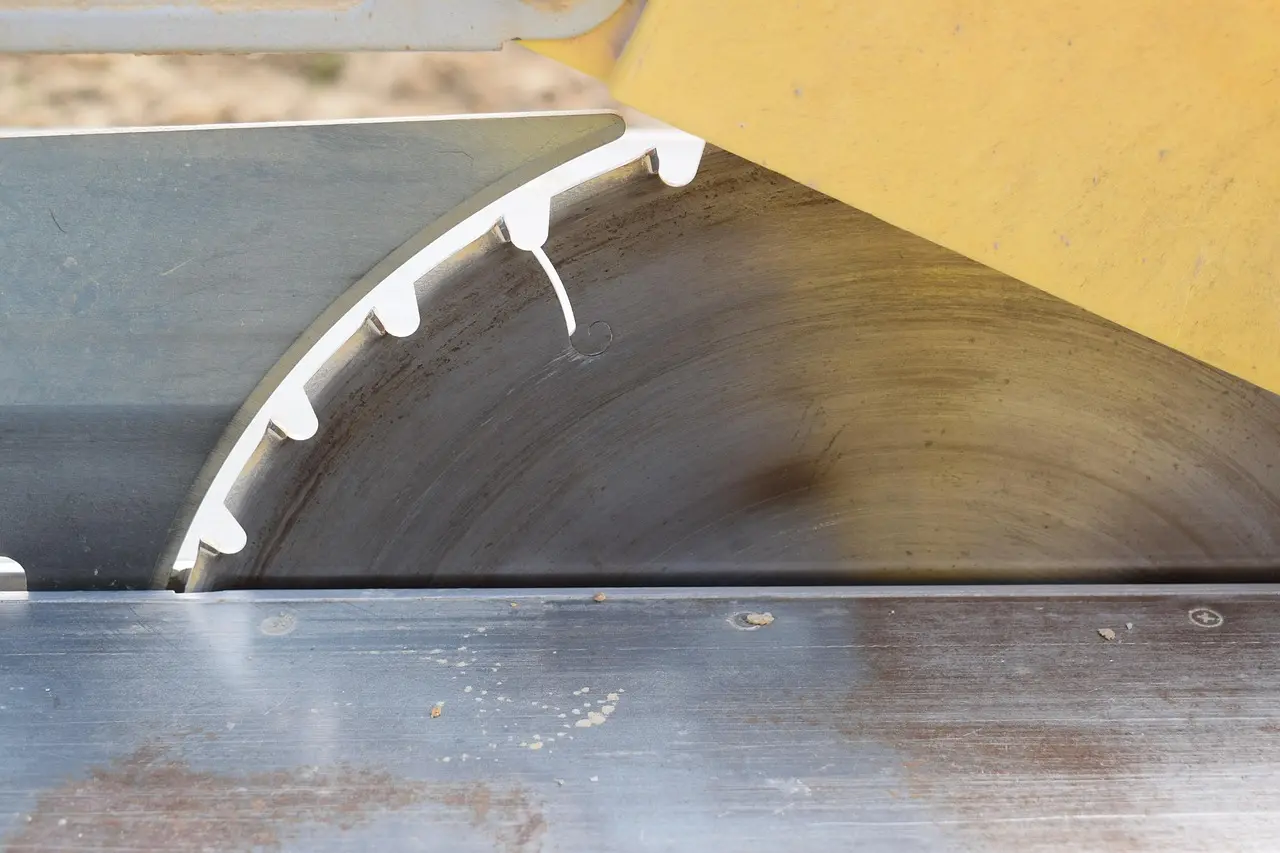
The router is better when you need exact groove width, stopped cuts, or a method that still works on a saw that cannot accept dado blades. The table saw is better when the cut is straight, the setup can stay fixed, and you need many matching dadoes with the same width and depth.
| Decision factor | Router | Table Saw for Dado Joints | Winner |
|---|---|---|---|
| Exact groove width | Easy to tune with bit choice, offset, or jig adjustments | Depends on stack width and shims | Router |
| Repeat cuts on straight stock | Possible, but usually slower | Very efficient once set | Table Saw for Dado Joints |
| Compatibility with small shops | Works even when the saw cannot take a stack | Limited by arbor and saw design | Router |
Fit accuracy
A router can cut a flat-bottomed groove with a straight bit or a dedicated dado bit, and it can be set up to match plywood thickness closely. That matters because nominal 3/4-inch plywood is often a bit undersize, so the groove often needs to be tuned to the actual panel, not just the label.
A table saw with a properly sized stack can also give a clean, square-sided groove. The catch is that the stack width has to match the job, and fit changes if the sheet goods do.
Speed
For long, straight, repeated cuts, the table saw is usually faster. Once the fence, stack width, and depth are set, you can run part after part through the same setup.
A router is slower when you must make several passes to reach full width or full depth. That extra time is often worth it when the saw is not compatible or when you need finer control near a stop line.
Setup effort
Router setup can be straightforward when the cut is narrow and the edge is easy to reference. A router table can help for straight dados, but stopped dados on a router table need careful start-and-stop control and a clear plan for where the bit enters and exits the work.
Table saw setup asks more of the machine. You need the right throat plate, correct dado approval from the manufacturer, and a stack that fits the arbor and the saw body.
Tool compatibility
Many saws do not accept dado stacks at all. Short-arbor contractor saws and some benchtop saws can fail the fit check because the arbor may not leave enough thread engagement for the full stack.
A router avoids that limit. A fixed-diameter bit cutting method works on a wide range of tools, and 1/2-inch shank bits are usually preferred for stability over smaller shanks when the cut gets wider or deeper.

Can routers make dado joints?
Yes. Routers can make dado joints with a straight bit, a jig, a router table, or a dedicated straightedge setup, and they are often the practical choice when you do not have a dado-capable saw. The main limits are bit stiffness, pass depth, and how cleanly you can guide the tool.
Straight bit and jig methods
A straight bit can cut a dado in several passes, especially when paired with a guide fence or straightedge. A jig helps keep the shoulders square and the groove width consistent, which matters in cabinet parts that must line up across multiple panels.
Cutting too aggressively can cause burning, chatter, or a shoulder that leans out of square. That is a sign to slow the feed, reduce the bite, or make the cut in narrower stages.
Router table use for straight dados
A router table can make straight dados easier to reference because the workpiece rides against a fence. It is often best for through grooves and other cuts where start and stop points can be controlled safely.
For stopped dados, be careful. You need accurate entry and exit control, and the bit is exposed in a way that demands a clear hold-down plan and careful hand placement.
Why 1/2-inch shank bits matter
1/2-inch shank bits are often the better pick for dado work because they tend to resist flex better than 1/4-inch shanks. That steadier cut helps when the groove is wide, the stock is hard, or the cut has to stay square over a longer pass.
Use the cutting height to control depth, but do not force a full-depth pass if the bit starts to burn or chatter. Multiple passes are safer and cleaner than asking a small bit to do too much at once.
When undersize router bits help with plywood fit
Undersize router bits are useful when you need a cabinet fit that matches real plywood rather than the nominal label. If the sheet goods are consistently under 3/4 inch, an undersize bit can save you from widening the groove after a test fit.
That is especially useful for casework where the panels must seat without racking the box. A small difference in groove width can affect assembly feel and squareness.
How table saw dado stacks work

A dado stack uses two outer blades plus multiple chippers and shims to build the final groove width. The standard setup is an 8-inch dado stack on a 10-inch table saw, and the width can be adjusted from 1/4 inch to 29/32 inch.
Outer blades, chippers, and shims
The outer blades define the edges of the cut, while the chippers remove the waste between them. Shims fine-tune the final width so the groove lands on the actual stock thickness or joinery target.
Stacked dado sets are flat-bottomed and are generally the better choice for serious woodworking when the saw is compatible. Wobble dado blades are adequate for some work, but they cut a curved bottom and are less appealing when you want a crisp cabinet groove.
Typical width ranges and setup changes
A common stack width range is 1/4 inch to 29/32 inch. Changing width means changing the chipper mix or shim pack, so setup time matters if you are switching between several joint sizes in one project.
An installed stack is often not the slow part; the measuring and test cuts are. The article-level rule is simple: the more exact the fit, the more likely you are to spend time dialing in the stack before cutting the real parts.
Arbor length and thread engagement limits
Arbor length has to fit the full stack, and thread engagement has to remain safe after the blades, chippers, and washers are mounted. That is why many contractor and benchtop saws cannot accept dado stacks even if the blade diameter looks right on paper.
A 10-inch saw with an 8-inch dado stack is the standard setup, but that does not mean every 10-inch saw is approved for it. Manufacturer guidance and the throat plate matter.
When a saw cannot accept a dado stack
If the saw lacks the required arbor length, does not allow a dado throat plate, or the maker does not approve dado use, do not force the setup. In that case, a router is the safer and more practical route.
A full-width dado stack can load a saw motor heavily, so the machine class matters as much as blade size. Portable saws and cabinet saws are not the same here, even when the blade diameter matches.
Plywood thickness and fit tolerance
Nominal 3/4-inch plywood is often undersize, so the label alone is not enough for a clean fit. The groove should match the material you actually have in hand, not the nominal value printed on the sheet.
Why nominal 3/4-inch plywood is often undersize
Panel goods vary by maker, batch, and construction method. A groove sized to exact 3/4-inch nominal stock can end up too tight or too loose when the panel measures a little differently from sheet to sheet.
That is why test cuts matter. They show whether the fit needs a shimmed stack on the saw or an undersize router bit on the router.
How material variation changes groove width
If the parts must match across a whole cabinet run, even a small width mismatch can compound into visible misalignment. A router often gives you more room to tune the cut to the actual material.
Suppose the side panels are all nominal 3/4-inch but one batch runs a little thinner. The router lets you tune one groove slightly tighter or wider without changing the whole saw setup.
When to choose a shimmed stack or undersize bit
Choose a shimmed stack when the saw is compatible and you need the same groove width on many parts. Choose an undersize router bit when the material thickness is the limiting factor or the saw cannot accept the stack at all.
If the groove is only for a drawer bottom or light panel, the fit may tolerate a little more variation. If it is a structural shelf dado in a carcass, the width should be set more carefully.
Dado joint decision matrix
The best method changes with the job. This matrix ties common shop scenarios to fit accuracy, speed, setup effort, and compatibility, then gives one recommendation for each.
| Scenario | Fit accuracy | Speed | Setup effort | Tool compatibility | Recommendation |
|---|---|---|---|---|---|
| Cabinet carcass | High need for exact panel fit | Moderate to high volume | Moderate | Best if the saw accepts a stack | Table Saw for Dado Joints |
| Shelf dado | Needs square shoulders and repeatable depth | Often repetitive | Lower with a simple guide | Router works on almost any setup | Router |
| Drawer bottom groove | Usually narrow and tolerance-sensitive | Moderate | Low to moderate | Both can work | Router |
| Plywood casework | Fit changes with sheet thickness | High if many parts match | Moderate | Router avoids saw limits | Router |
| Small shop | Depends on layout and jig control | Moderate | Low when a saw stack is unavailable | Router is usually easier to fit in | Router |
| Short-arbor saw | Could be accurate, but hardware is the limit | Not the main issue | Not worth forcing | Often cannot accept a stack safely | Router |
| No dado blade | Good with careful passes | Slower than a stack | Moderate | Router is the workable option | Router |
| Visible exterior joint | Shoulders must look clean | Moderate | High if the first pass is off | Depends on edge support | Router |
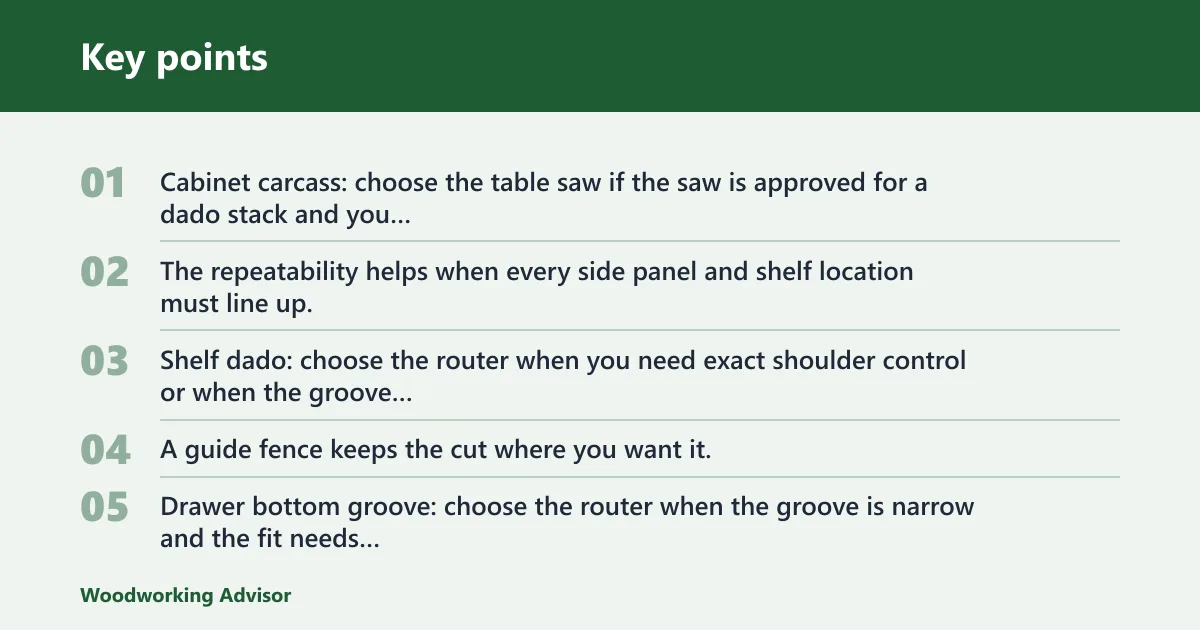
Cabinet carcass: choose the table saw if the saw is approved for a dado stack and you have several matching parts. The repeatability helps when every side panel and shelf location must line up.
Shelf dado: choose the router when you need exact shoulder control or when the groove lands near an end or stop line. A guide fence keeps the cut where you want it.
Drawer bottom groove: choose the router when the groove is narrow and the fit needs close control. The setup is usually easier than swapping a saw stack for a smaller joinery cut.
Plywood casework: choose the router when sheet thickness varies or the saw cannot take a stack. That is often the cleanest path for production cabinet parts cut from nominal 3/4-inch material.
Small shop: choose the router if you do not want a large stack setup or the saw footprint is already crowded. The tool fits more workflows with less machine changeover.
Short-arbor saw: choose the router. The saw may be capable of straight cuts, but a short arbor often blocks safe dado-stack use.
No dado blade: choose the router, full stop. It is the practical replacement when the saw lacks the hardware or approval for dado cuts.
Visible exterior joint: choose the router when the shoulder face will be seen and you want to control the final pass. A clean reference edge helps more here than raw speed.
Choose Router if… / Choose Table Saw for Dado Joints if…
Choose Router if you need to match undersize plywood, cut stopped dados, work on a saw that cannot accept a stack, or tune the groove width with bit selection and test passes. Choose Table Saw for Dado Joints if you have compatible hardware, need a lot of identical straight cuts, and want the fastest repeatable setup for cabinet parts.
Choose Router if the cut is visible, the stock is short, or the saw setup would take longer than the cut itself. Choose Table Saw for Dado Joints if the saw accepts the stack safely, the groove width is fixed, and the job is mostly about volume.
Frequently asked questions
How do you use a router for dado cuts?
Lay out the groove, clamp or reference a guide, and cut in shallow passes until you reach width and depth. A 1/2-inch shank bit is usually the better choice for stability, and test cuts help you match real plywood thickness before you commit to the final parts.
How do you cut a dado without a table saw?
Use a router with a straight bit and a guide, or a router table if the cut is straight and safe to feed. A circular saw can also be used with custom jigs in some cases, but that is a separate setup and should not replace the fine cleanup a router or chisel can do.
What table saws accept dado blades?
Only saws with enough arbor length, proper thread engagement, and manufacturer approval for dado use should run a stack. Many contractor and benchtop saws cannot, even if the blade diameter looks compatible, so you should check the manual and throat plate requirements first.
What router bits work best for dado cuts?
Use a straight bit or a dado bit, and favor a 1/2-inch shank for better rigidity. If the plywood is undersize, an undersize router bit can help you land the groove on the actual panel thickness rather than the nominal size printed on the sheet.
When is a router better than a table saw for dados?
A router is better when saw compatibility is the problem, when the groove must match variable plywood thickness, or when the cut needs end-stop control. It also makes sense when you only need a few precise grooves and do not want the overhead of a dado stack changeover.
Sponsored / affiliate links. As an Amazon Associate I earn from qualifying purchases. I may earn additional commission from eligible campaigns.