Varathane vs Minwax Polyurethane: Which Lasts Longer?
Varathane and Minwax Polyurethane do not have a universal lifespan winner. For the longest service life, choose a well-applied oil-based polyurethane, which is often reported to last longer than water-based polyurethane on heavy-wear wood. Skip prep, film thickness, or cure time, and you can get early scuffs, water rings, and a finish that needs stripping sooner. This guide compares both brands for cabinets, tabletops, trim, and floors, and explains where durability differences matter most.
| Factor | Varathane | Minwax Polyurethane | Winner |
|---|---|---|---|
| Abrasion resistance | Strong when you pick the oil-based line; the brand also markets fast-drying formulas for interior wood use. | Strong when you pick oil-based polyurethane; the line is positioned as durable and long-lasting. | Tie |
| Water resistance | Good for interior wood when fully cured; spar urethane is the outdoor, UV, weather-resistant option. | Good for interior wood when fully cured; oil-based versions usually handle wet cleaning better than water-based film. | Tie |
| Yellowing risk | Water-based polyurethane is marketed as non-yellowing; oil-based formulas can amber over time. | Water-based polyurethane stays clearer; oil-based formulas can also amber over time. | Tie |
| Dry time | Fast-drying positioning; the brand’s basic products are described as fast-drying. | Usually depends on the exact product line; the brand does not win this by name alone. | Varathane |
| Ease of application | Triple Thick Polyurethane gives one-coat coverage and self-leveling film, but thicker coats need care. | Wide product range and easy application positioning make it approachable for beginners. | Minwax Polyurethane |
| Recoat tolerance | Good when you respect the recoat window; fast drying can shorten working time. | Good when you follow the label; wider product range gives more room to choose a comfortable working pace. | Tie |
Varathane vs Minwax Polyurethane at a glance
Both brands are widely used, and both can produce durable clear finishes. The split is chemistry and product line, not brand name alone. Oil-based polyurethane usually gives the longest wear on hard-use wood, while water-based polyurethane dries faster, smells less, and keeps a clearer look.
What each brand line is built to do
Varathane’s basic products are described as fast-drying, and its clear coat line is positioned for outdoor wood protection. The same brand also sells oil-based polyurethane for interior wood surfaces, water-based polyurethane marketed as non-yellowing, and spar urethane for UV and weather resistance.
Minwax Polyurethane is built around a wide product range. That range matters because the best choice for a cabinet door, a tabletop, or a floor is not the same formula, sheen, or dry schedule.
Where brand choice matters less than formula type
Oil-based polyurethane dries more slowly, but it usually builds a tougher film for furniture, cabinets, and floors. Water-based polyurethane is better when quick turnaround matters, and it usually keeps wood lighter in color with lower odor during application.
That means the better answer often starts with oil or water, then moves to brand. A water-based product from either company will usually dry faster than an oil-based product, and an oil-based product from either company will usually give you the more wear-resistant film.
How to read this comparison without mixing up product types
Do not compare all Varathane finishes against all Minwax finishes as if they were one category. A water-based topcoat and an oil-based topcoat can behave very differently on the same board, especially under cleaning cycles, spills, and edge wear.
Say your kitchen cabinet doors need a clear finish that will not amber much over maple. A water-based polyurethane from either brand is the relevant comparison. If the job is a maple dining table that gets constant plate drag and weekly wiping, oil-based protection deserves the first look.
Which polyurethane lasts longer?
For raw service life, oil-based polyurethane usually lasts longer than water-based polyurethane on high-wear wood because it builds a harder, thicker-feeling film after full cure. Between Varathane and Minwax Polyurethane, the longer-lasting finish is the one with the right chemistry, enough coats, and proper cure time, not the logo on the can.
Abrasion resistance and scuffing
Abrasion is the first failure mode on tabletops, floors, and cabinet edges. Oil-based polyurethane generally resists scuffing better than water-based film, so it tends to keep its look longer where chairs slide, shoes scrape, or hands hit the same edge every day.
Varathane and Minwax Polyurethane both sell oil-based options that can stand up well here. The winner is usually the exact oil-based product with the better film build and the cleaner prep, not the brand name by itself.
Water resistance and cleaning cycles
Water resistance matters most where spills, damp cloths, and regular wiping are part of normal use. A fully cured polyurethane film resists common household moisture, but standing water, heat, and repeated cleaning can still dull the surface and wear edges first.
For that reason, cabinets and tabletops need a finish that handles both moisture and friction. Oil-based polyurethane usually gives more margin for error; water-based polyurethane is often fine, but it is less forgiving on abuse-heavy surfaces.
Yellowing and color retention over time
Yellowing is not the same as wear, but it changes the finish people see as “lasting.” Oil-based polyurethane tends to amber more over time, which can be useful on walnut or cherry and less desirable on pale woods that need to stay light.
Varathane’s water-based polyurethane is marketed as non-yellowing, and Minwax Polyurethane also offers water-based options that stay clearer than oil-based film. If color stability matters more than maximum abrasion resistance, water-based is often the better pick.
Does Varathane dry faster than Minwax?
Varathane is commonly positioned as the faster-drying option, and its basic products are described as fast-drying. That does not mean every Varathane product dries faster than every Minwax Polyurethane product, but it does mean Varathane often suits projects that need a shorter turnaround.
Dry time versus cure time
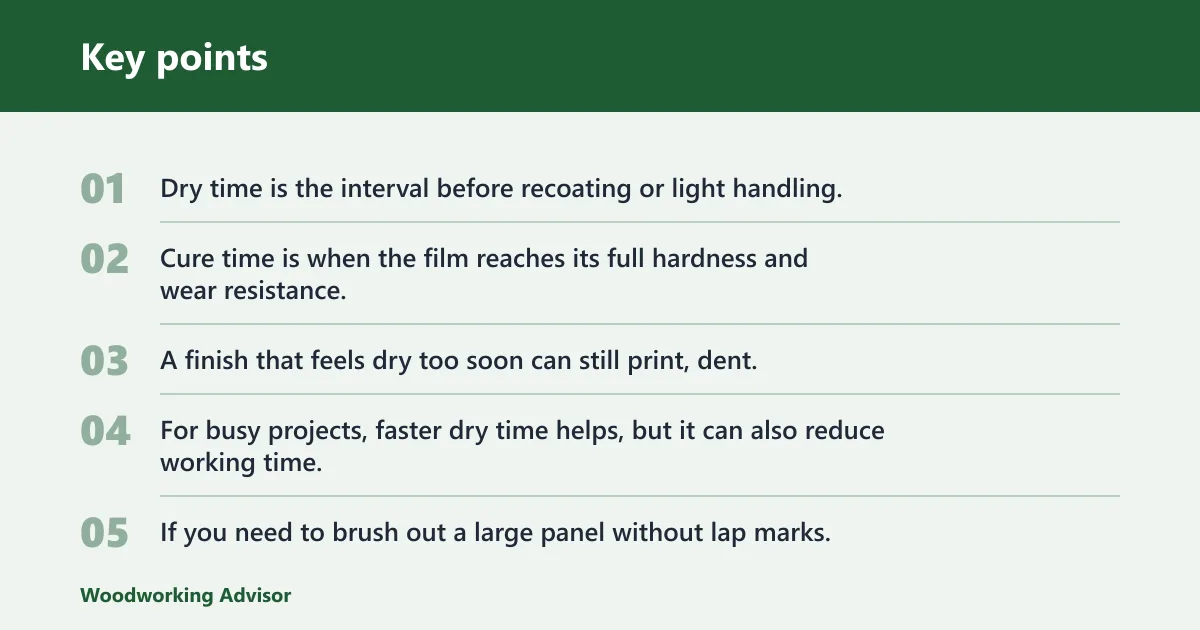
Dry time is the interval before recoating or light handling. Cure time is when the film reaches its full hardness and wear resistance, and that is what matters for long service life. A finish that feels dry too soon can still print, dent, or scuff if you put it into service early.
For busy projects, faster dry time helps, but it can also reduce working time. If you need to brush out a large panel without lap marks, a slower formula can be easier to manage even if it delays the next coat.
Odor and turnaround for indoor projects
Water-based polyurethane usually has lower odor than oil-based polyurethane, which matters for kitchens, bedrooms, and occupied rooms. Faster dry time can also mean you can recoat sooner and finish the job with fewer days of disruption.
That is why water-based finishes often make sense for trim, cabinet interiors, and quick refreshes. If you need a hard-wearing floor finish, though, you may trade speed for a tougher oil-based film.
When faster drying can reduce working time
Fast drying helps only if you can keep a wet edge and lay the film smoothly. On a wide tabletop or cabinet door, a quick set can increase brush marks or lap lines if you pause too long between strokes.
Suppose you are finishing six shaker cabinet doors in one afternoon. A faster-drying finish can let you recoat sooner, but it can also punish slow brushing on the second panel. In that case, short working sections matter more than brand reputation.
Which brand is easier to apply for beginners?
Minwax Polyurethane is often the easier starting point because the line is broad and the application choice is less confusing. Varathane can still be beginner-friendly, especially in fast-drying water-based form, but quicker set time can make brush control more demanding on larger pieces.
Brush marks, leveling, and lap marks
Leveling is the finish’s ability to flatten after you brush it on. A product with better leveling can reduce visible brush marks, while a too-fast formula can trap ridges before they relax.
Thicker products are not automatically easier. Varathane Triple Thick Polyurethane is sold as one-coat coverage and claims three-times thickness, but a thicker film can also trap dust or cure unevenly if the coat is applied too heavy.
Recoat window and sanding between coats
Beginners often struggle most with the recoat window. If you coat too soon, you can disturb the underlayer; if you wait too long, sanding adhesion becomes more important.
Follow the label and scuff-sand when required. That matters more than brand. A clean, dullened surface between coats usually does more for adhesion than choosing one label over the other.
How Triple Thick changes the application tradeoff
Triple Thick Polyurethane is attractive because it promises one-coat coverage. That can save time on decorative pieces, but it is not the best answer for a high-abuse surface where you want controlled film build and even curing.
Use thick-film products when the substrate is sound, dust control is good, and the surface is not a floor or a family-tabletop that will take hard wear. Thicker is not a substitute for proper prep.
Polyurethane decision matrix
| Project type | Abrasion resistance | Water resistance | Yellowing risk | Dry time | Ease of application | Recoat tolerance |
|---|---|---|---|---|---|---|
| Cabinets | Varathane — faster-drying options help on doors and face frames, but oil-based product choice matters more. | Minwax Polyurethane — broad product range makes it easier to match kitchen wipe-downs and spot cleaning. | Varathane, water-based non-yellowing option is useful on light woods. | Varathane, basic products are described as fast-drying. | Minwax Polyurethane, more forgiving choice for first-time brush work. | Minwax Polyurethane, wider range gives more room to choose a comfortable schedule. |
| Tabletops | Minwax Polyurethane, durable and long-lasting oil-based film is the safer pick for plate drag and cleaning. | Varathane, oil-based interior wood formulas and fast-drying positioning fit high-use furniture. | Varathane, water-based non-yellowing option keeps light woods cleaner-looking. | Varathane, shorter dry time helps move from coat to coat. | Minwax Polyurethane, easier application matters on larger flat surfaces. | Tie, both can work well if you respect sanding and label timing. |
| Trim | Varathane, fast-drying finish helps on smaller surfaces that get handled during install. | Tie, trim sees less abrasion than a floor, so both brands can protect well. | Varathane, water-based product keeps painted or pale trim from yellowing as much. | Varathane, speed matters most on trim work. | Minwax Polyurethane, easy application is useful on profiles and corners. | Varathane, quicker recoat cycle fits small parts and punch-list work. |
| Floors | Minwax Polyurethane, oil-based durability is the stronger fit for traffic, shoe grit, and edge wear. | Minwax Polyurethane, high-traffic floors need the tougher interior film. | Varathane, water-based finish keeps wood tone lighter. | Varathane, faster dry time is useful, but only if the floor can stay off limits. | Minwax Polyurethane, easier application helps on large square footage. | Tie, floor success depends more on prep, sanding, and cure than on brand label. |
Cabinets
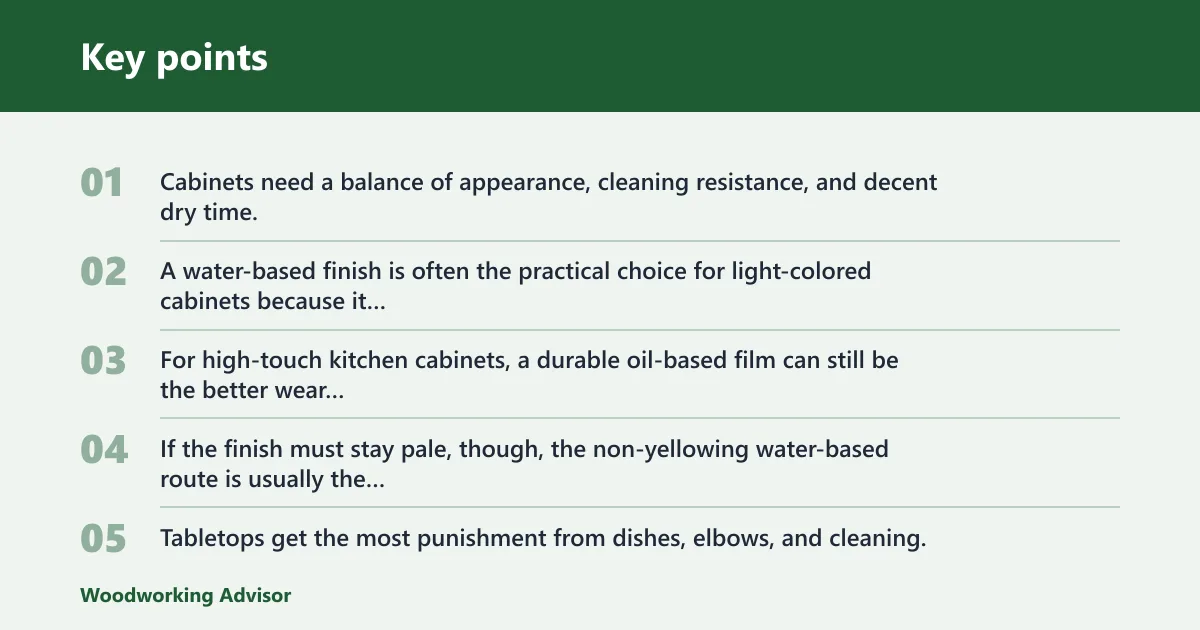
Cabinets need a balance of appearance, cleaning resistance, and decent dry time. A water-based finish is often the practical choice for light-colored cabinets because it keeps the look clearer and gets you back to assembly faster.
For high-touch kitchen cabinets, a durable oil-based film can still be the better wear choice. If the finish must stay pale, though, the non-yellowing water-based route is usually the safer decision.
Tabletops
Tabletops get the most punishment from dishes, elbows, and cleaning. That pushes the choice toward a durable oil-based polyurethane, especially for dining surfaces that need better scratch resistance and water spot tolerance.
One common first-timer mistake is stopping at two thin coats on a dining table and assuming sheen will make up the difference. It will not. Film build matters more than gloss level.
Trim
Trim often rewards faster dry time and lower odor more than maximum abrasion resistance. Because trim is smaller and usually sees less direct wear, a water-based finish is often enough and easier to live with during a remodel.
Varathane fits this use well when turnaround matters. Minwax Polyurethane fits well when easier brushing and a broad product choice are the priority.
Floors
Wood floors need the strongest wear resistance of the four project types here. They face foot traffic, grit, chair movement, and repeated cleaning, so a well-applied oil-based polyurethane is the more durable choice in most homes.
Water-based floors can work, especially when you want a lighter color and faster dry time, but the finish usually has less margin against wear. For floors, surface prep and cure time are as important as product choice.
How many coats do you need?
Most clear polyurethane jobs need multiple coats because durability comes from film build, not sheen. A standard poly often needs two to three coats, while Triple Thick Polyurethane is sold as one-coat coverage and claims three-times thickness, though a single coat is not always the best choice on heavy-use wood.
Standard poly versus Triple Thick
Standard polyurethane gives you more control over leveling and cure. Triple Thick can be useful on decorative pieces or lower-wear surfaces, but a heavier film can also trap dust, sag on verticals, or cure unevenly if you overapply it.
If the goal is long service life on a floor or table, multiple well-sanded coats usually give a safer result than one heavy pass.
When two coats are not enough
Two coats can be enough for light trim or low-use furniture, but it is often thin for tabletops and floors. When the film is too thin, edges wear through first, and that is where the finish starts to fail visually even if the flat field still looks intact.
That is why film thickness matters more than brand preference. A good finish in two weak coats is still weak.
Why sheen does not replace film build
Gloss, semi-gloss, and satin change appearance, not core durability. Gloss reflects more light, satin hides wear a bit better visually, and semi-gloss sits between them, but none of those sheens makes a thin finish last longer by itself.
Choose sheen for the look you want and the amount of surface reflection you can live with. Choose coat count for durability.
Choose Varathane if… / Choose Minwax Polyurethane if…
Choose Varathane if you need faster dry time, want a water-based non-yellowing option for light woods, or are finishing trim and other projects where speed matters more than maximum abrasion resistance. It is also a strong fit if you want an outdoor-specific spar urethane rather than standard interior polyurethane.
Choose Minwax Polyurethane if you want the easier beginner path, need a broad product range, or are finishing tabletops and floors where durable oil-based film is the safer default. It is also the better fit when you want one brand family that covers more application styles and working speeds.
For cabinets, either brand can work well; choose by chemistry first. For floors and hard-use tabletops, oil-based polyurethane from either brand is usually the longer-lasting answer. For trim or light-colored furniture, water-based polyurethane is often the cleaner-looking and faster-turnaround choice.
Skip standard interior polyurethane and use spar urethane when the wood is outdoors or faces UV and weather. Varathane’s spar urethane is positioned for that job, while interior poly is not a substitute for exterior protection.


Frequently asked questions
Is Varathane or Minwax polyurethane more durable?
Neither brand wins every time. The more durable choice is usually the oil-based formula from either brand, because oil-based polyurethane generally resists wear better than water-based film on high-traffic wood. Prep, coat count, and cure time still matter more than the label on the can.
Which polyurethane lasts longer on furniture?
On furniture, oil-based polyurethane usually lasts longer than water-based polyurethane because it builds a tougher film for abrasion and cleaning. For a pale wood table or cabinet, though, water-based polyurethane may be the better long-term look if yellowing is a bigger concern than maximum wear resistance.
Is Minwax or Varathane better for cabinets?
For cabinets, the better brand is the one whose formula matches the wood and the schedule. Water-based polyurethane is usually better for light-colored cabinets and faster recoat timing, while oil-based polyurethane is better when you want more wear resistance and do not mind some ambering.
How many coats do you need of Varathane vs Minwax polyurethane?
Most clear polyurethane projects need two to three coats for solid protection. Varathane Triple Thick Polyurethane is sold as one-coat coverage, but that does not replace the need for careful prep and even application. For floors and tabletops, multiple coats are still the safer route.
Will Varathane polyurethane yellow less than Minwax?
At the brand level, that is the wrong comparison. Water-based polyurethane from either brand is the clearer, less-yellowing choice, while oil-based polyurethane from either brand can amber over time. If color retention matters, compare water-based against water-based, not brand name against brand name.
Which brand is better for high-traffic wood surfaces?
For high-traffic wood surfaces, choose the oil-based polyurethane that fits the job best rather than the brand label. Floors, tabletops, and heavy-use cabinets usually need the harder-wearing film that oil-based polyurethane provides. If faster dry time matters more, water-based is the tradeoff, not the upgrade.
Sponsored / affiliate links. As an Amazon Associate I earn from qualifying purchases. I may earn additional commission from eligible campaigns.