Storing Lumber in the Garage Over Winter
Store lumber in a garage only if it is already dry, flat on stickers, and raised off concrete. Keep hardwoods there about 1–2 weeks before use, and move wet or green wood indoors or to a drier space. Poor storage can cause surface condensation, cupping, sticker stain, mold, and joints that fail after winter. This guide explains how garage temperature swings, humidity, board species, and storage time should change your plan.
What winter changes in a garage
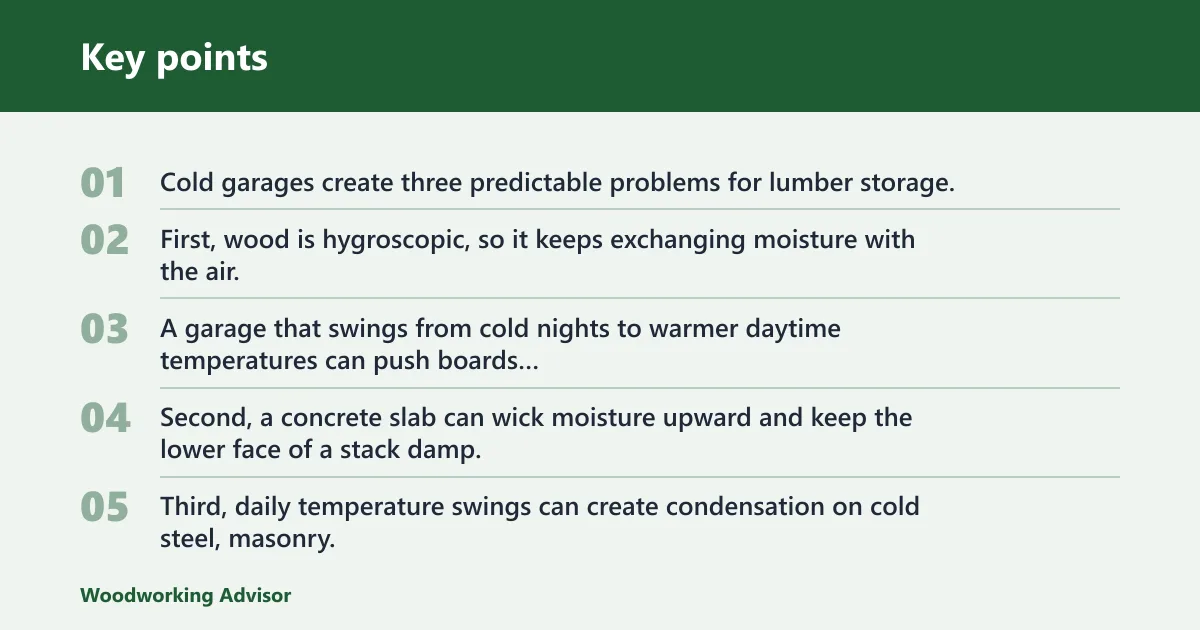


Cold garages create three predictable problems for lumber storage. First, wood is hygroscopic, so it keeps exchanging moisture with the air. A garage that swings from cold nights to warmer daytime temperatures can push boards through repeated wet-dry changes. Second, a concrete slab can wick moisture upward and keep the lower face of a stack damp. Third, daily temperature swings can create condensation on cold steel, masonry, and boards.
That is why winter storage is not one single setup. A board that can sit for a few days before a repair is a different case from stock that will wait until spring. Flatsawn hardwoods tend to move more across their width, softwoods often dry faster, and plywood behaves differently because its layers resist movement better than solid wood. Rough stock still needs the same support and spacing rules.
What you’ll need
- A hygrometer to track garage relative humidity.
- Pallets, runners, or blocks to keep stock off the slab.
- Stickers that are about 3/4 inch to 1 inch thick.
- Flat, straight supports for full-length boards.
- A wall-mounted lumber rack anchored to studs, if you need wall storage.
- Overhead rack hardware, only if the joists can safely carry the load.
- A dehumidifier sized for the garage if moisture stays high.
- A hygrometer with a clear display for checking day-to-day swings.
Can you store lumber in a garage over winter?
Yes, if the wood is already dry and the garage stays reasonably stable. Short-term holding for a few days to a few weeks is usually safer than seasonal storage that runs for months. Keep the stack off the floor, protect it from leaks and damp walls, and move stock indoors if it starts to feel cool and clammy, shows surface condensation, or sits in a garage that repeatedly swings between damp and warm.
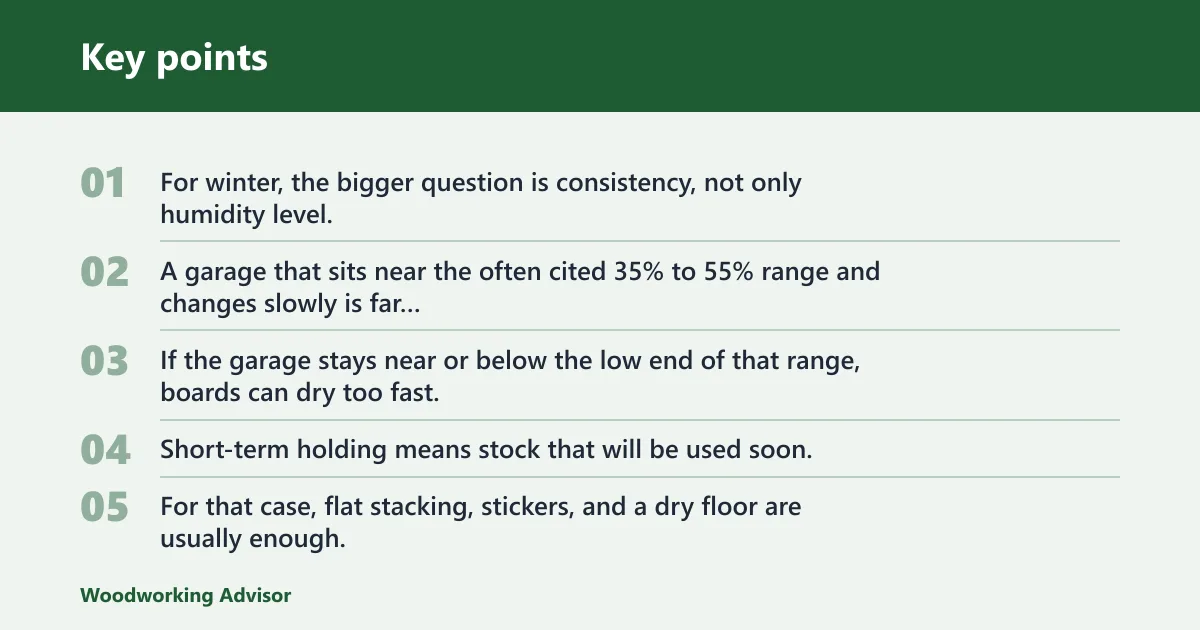
For winter, the bigger question is consistency, not only humidity level. A garage that sits near the often cited 35% to 55% range and changes slowly is far easier on lumber than one that rises overnight and dries hard by afternoon. If the garage stays near or below the low end of that range, boards can dry too fast, so limit exposure instead of ignoring moisture.
Short-term holding vs. seasonal storage
Short-term holding means stock that will be used soon. For that case, flat stacking, stickers, and a dry floor are usually enough. Seasonal storage means lumber will sit through many weather cycles. That calls for better control, more careful species sorting, and a more stable location, such as a wall rack or overhead rack that keeps the stack away from the slab and away from door drafts.
Which garage conditions are acceptable?
Use a hygrometer and look for a stable reading, not a perfect one. A garage that stays dry enough to avoid visible condensation on steel tools, rack hardware, or the lower courses of a stack is a much better candidate than one with wet mornings and dry afternoons. If the floor is visibly damp or the wall behind the stack feels cool and wet, treat the space as unsuitable for long storage.
When the stock should move indoors
Move lumber indoors when it will be used soon, when the garage remains damp after ventilation, or when the wood is thin, flatsawn, or especially prone to movement. Move it as soon as you see mold spots, cup growth, sticker stain, or condensation on the package or stack. Keep green lumber out of an unheated garage unless you have a specific drying plan and enough time for it to equalize safely.
Step 1: Check the garage conditions
- Set a hygrometer at board height, not on the floor, and read it at the same time each day.
- Inspect cold surfaces for beads of water after night-to-day temperature swings.
- Check the slab, lower walls, and corners for dampness before you stack anything.
- Raise a test board 6 inches above the floor and see whether the underside stays dry over 24 hours.
If the reading is high and steady, storage is easier. If the reading jumps or the floor sweats, the stack needs more separation from the slab and possibly active moisture control. A common first-timer mistake is to check only the air and ignore the floor, even though concrete can keep the bottom layer wetter than the top.
Step 2: Choose the storage method
- Use flat stacking with stickers for most rough lumber and boards that will stay more than a few days.
- Use vertical storage only for short boards or stock you will use within a few weeks.
- Use a wall-mounted rack when the garage is small and you still need floor space for parking.
- Use an overhead rack for long boards or sheet goods only if the joists and access path are safe.
Stickers are spacer strips between layers, usually 3/4 inch to 1 inch thick, and they need to line up vertically through the whole stack. Place them about 12 to 24 inches apart, with tighter spacing on thinner or more unstable stock. Wall rack arms are commonly spaced about 16 to 32 inches apart, and the rack should be anchored to studs. Overhead racks work well for long stock, but the joist load and the extra 18 inches below the ceiling matter for access and airflow.
Say your garage has one bay for parking and one wall for storage. A 10-foot hardwood stack can go on a stud-mounted rack, while short offcuts stay vertical near the bench. That keeps a car clear of the lumber and keeps the stack off the slab.
Step 3: Stack and support the boards
- Set pallets, runners, or blocks under the stack so no board touches concrete.
- Lay the first course on straight supports that hold the full length evenly.
- Place stickers directly above one another from layer to layer.
- Keep the pile no more than four feet high unless the support structure is built for more.
The lower face of a stack is the one most likely to pick up moisture from a slab, so keep at least 6 inches of clearance. If a board is long, support it at the ends and at intermediate points so it does not sag. Flat stacking helps reduce bow and twist, while careless support can create the exact defects you are trying to prevent: cup, bow, crook, and twist.
Lumber storage decision table
| Board type | Best orientation | Sticker spacing | Minimum floor clearance | When to use a cover | When to move indoors |
|---|---|---|---|---|---|
| Kiln-dried hardwood | Flat, stickered stack | 12 to 18 inches | 6 inches | Use a breathable cover only if dust is a problem | Within 3 to 5 days before use, or sooner if the garage swings hard |
| Flatsawn hardwood | Flat, stickered stack with tight support | 12 to 16 inches | 6 inches | Use only a loose top cover, not sealed plastic | Move indoors if humidity drops fast or cup starts to appear |
| Softwood framing lumber | Flat stack or vertical short-term storage | 16 to 24 inches | 6 inches | Usually none unless dust or drip risk exists | Move indoors for finish work or if surface drying is uneven |
| Plywood | Flat, fully supported | Not usually needed between sheets for short storage | 6 inches | Use a top cover only if the stack is exposed to dust | Move indoors if edges start curling or the garage stays damp |
| Rough stock for a later project | Flat, stickered stack | 12 to 24 inches | 6 inches | Use a loose cover if the garage is dusty and dry | Move indoors when the project date gets close and conditions differ |
How long should lumber acclimate before use?

Most boards should sit for at least 3 to 5 days before cutting, and a week or more is safer when the garage and workshop differ a lot. Kiln-dried lumber is still exchanging moisture with the surrounding air, so a few cold days in a garage can change how it machines and fits. Hardwood trim stock often needs the most attention because movement shows up quickly in joints and reveals itself after assembly.
Signs the stock is still moving include new bow, fresh cup, sticker marks that stay visible, and faces that feel noticeably different in temperature or moisture. If the wood has not reached a stable feel and shape, wait longer. Suppose a stack of 4/4 oak sat in an unheated garage after a damp spell; if the boards still show a cool underside and a slight cup after 4 days, they need more time.
When longer acclimation is needed
Give more time when the garage humidity is far from the shop, when the wood is thick, or when the stock will be used for face frames, tabletops, or other parts that punish movement. A board that looks flat on day two can still shift after a heater runs or a cold front passes. If the difference is large, a week-plus is the safer assumption.
Common mistakes
Stacking on bare concrete is the fastest way to invite trouble. Tight wrapping with plastic is another mistake because it traps condensation and slows natural adjustment. Putting stock near heaters, sunny windows, vents, or garage doors can dry one face faster than the other and increase warp. Leaving boards unmarked by species or thickness makes it hard to choose the right storage method later.
A dehumidifier can help when winter humidity stays high, and common guidance often puts many garages in the 30 to 50 pint range. If the air is too dry instead, do not run a dehumidifier just because the garage is cold; that can push boards out of balance faster. The better move is to keep the stack out of direct airflow, monitor the hygrometer, and move stock sooner.
- Check the hygrometer.
- Move the stack farther from the door.
- Add a breathable top cover if dust is the issue.
Frequently asked questions
How to store wood in garage
Choose the method by board length and stay time. Short boards can go vertical for a few weeks, while long boards are usually safer flat on a rack or stickers. Keep the stack away from leaks, door drafts, and concrete, and check the garage humidity with a hygrometer.
How to store hardwood lumber
Store hardwood flat on stickers with even support, especially if the boards are flatsawn. Keep them at least 6 inches above the floor and use tighter sticker spacing, about 12 to 18 inches apart, when the stock is thinner or more likely to move.
Is vertical lumber storage okay in winter?
Yes, but only for short boards or stock you will use within a few weeks. Vertical storage is less forgiving for long boards because they can bow under their own weight and pick up moisture unevenly. If the garage is humid or the boards are valuable, flat storage is safer.
Sponsored / affiliate links. As an Amazon Associate I earn from qualifying purchases. I may earn additional commission from eligible campaigns.