Teak Wood Price Chart: Indoor vs Outdoor Grade
Teak quotes are only comparable on a board-foot basis: first normalize for grade, thickness, and surfacing, then expect outdoor-grade, thicker, quarter-sawn stock to cost more than indoor furniture-grade lumber. Without that conversion, you can overpay for rough stock or underestimate flooring, decking, and exterior joinery costs. This guide turns teak grades, surfacing, thickness, and unit pricing into one indoor-vs-outdoor price chart you can use to compare bids fairly.
| Decision factor | Indoor | Outdoor Grade | Winner |
|---|---|---|---|
| Upfront material cost | Lower if you choose plantation teak or Character/Select stock | Higher because exterior and marine use usually demand better defect control and more stable stock | Indoor |
| Weather exposure | Best for furniture, cabinetry, and interior flooring | Best for decking, exterior joinery, and marine use | Outdoor Grade |
| Surfacing and finish readiness | S4S or planed stock is often worth the premium for visible interior work | Rough stock may still be acceptable if you will machine it onsite | Indoor |
| Moisture condition | Kiln-dried stock is easier to finish and fit accurately | Moisture target must match climate and end use; exterior stock is not one universal moisture category | Indoor |
| Best-fit use case | Tables, doors, casework, and interior trim | Decking, exterior doors, docks, and marine joinery | Depends on project |
Teak price basics
Teak costs more than common hardwoods because buyers pay for usable heartwood, cleaner color, fewer defects, and better durability in exposed service. Buyers also pay for the tree parts that remain after grading and milling, so boards with more usable heartwood cost more than boards with a lot of sapwood or reject areas. That premium widens when thickness increases, when the stock is surfaced, and when the quote includes freight or milling.
What buyers actually pay
In teak, the price usually tracks the amount of usable wood you receive, not just the sticker grade. A board with straighter grain, more heartwood, and fewer knots or checks can move into a higher tier even if the species name stays the same.
The smell of teak is woody and familiar to many buyers, but scent does not set price. What matters is how much sound, stable wood remains after grading, drying, and machining.
How grade, origin, and use case change price
Teak is commonly sold by grade, cut, origin, moisture condition, and end use rather than one universal indoor/outdoor system. Plantation teak is often cheaper than premium old-growth or high-heartwood stock because it usually carries less oil, less color uniformity, and shorter service life in demanding outdoor settings.
Higher grades cost more because they have better heartwood quality, more uniform color, and fewer defects. That is true whether the quote is for furniture, flooring, or decking.
Teak price chart
| Price factor | Indoor furniture grade | Exterior/decking grade | Marine-grade |
|---|---|---|---|
| Rough-sawn | Lower starting point; rough boards are usually cheapest before surfacing | Higher than indoor because outdoor stock tends to be selected for service exposure | Highest starting point in most buyer quotes |
| Surfaced / S4S | Adds milling cost, but saves shop time and improves fit for visible interiors | Adds cost, though many outdoor projects can still use rough stock if you will machine it yourself | Usually the most expensive finished stock because the material already has to meet tighter appearance and use expectations |
| Kiln-dried | Common for furniture and flooring, where fit and finish matter | Added cost depends on climate and use, so do not assume one moisture target fits every exterior job | Frequently priced above air-dried stock when the quote includes drying to a specified target |
| Thickness | 4/4 is the usual entry point; thicker stock costs more | 6/4 and 8/4 are more common when stiffness or wear matters | Thicker stock is often specified for demanding joinery and high-wear exposure |
| Freight-adjusted landed cost | Quoted price can rise after inland freight and handling are added | Coastal demand can lift pricing; inland delivery often changes the final total more than buyers expect | Landed cost is usually the highest once freight, handling, and waste are included |
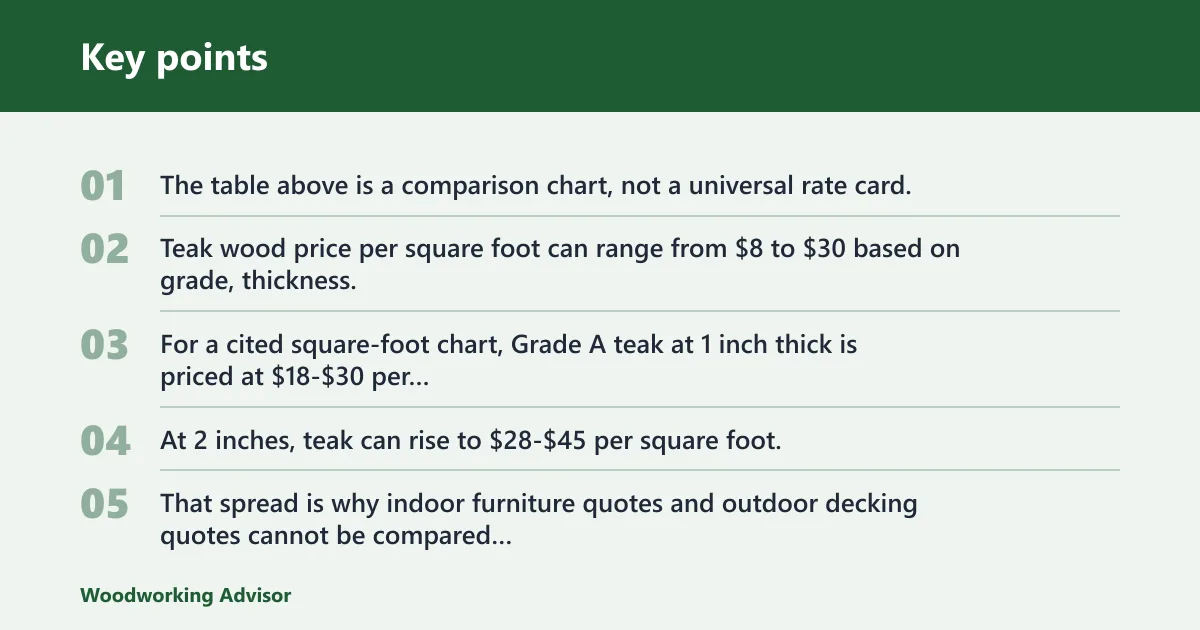
The table above is a comparison chart, not a universal rate card. Teak wood price per square foot can range from $8 to $30 based on grade, thickness, and source, so the quote format matters as much as the lumber itself.
For a cited square-foot chart, Grade A teak at 1 inch thick is priced at $18-$30 per square foot, Grade B teak at 1 inch thick is priced at $12-$20 per square foot, and plantation teak at 1 inch thick is priced at $8-$14 per square foot. At 2 inches, teak can rise to $28-$45 per square foot.
That spread is why indoor furniture quotes and outdoor decking quotes cannot be compared at face value. Outdoor use usually pushes buyers toward better-selected material, thicker stock, and more freight-sensitive sourcing.
How much does teak cost per board foot?
Teak board-foot pricing is the cleanest way to compare rough lumber across sellers. One source places rough-sawn teak at $7.50-$20.00 per board foot, while surfaced or planed teak costs $12.00-$28.00 per board foot, before freight and other add-ons.
Board-foot quotes rise when the board has more thickness, better grade, tighter color, or fewer defects. They also rise when the seller includes surfacing, drying, or selection for a specific end use.
When board-foot quotes need conversion
Board foot is the primary pricing unit in lumber markets, but some sellers quote by linear foot or square foot instead. A linear-foot quote hides width and thickness, so you need the board dimensions before you can compare it with a board-foot quote.
A common first-timer mistake is comparing a cheap linear-foot decking price with a rough-sawn board-foot quote. Those are not the same unit, and they can hide a much higher cost after conversion.
What changes the price per board foot
Grade and moisture condition move the number first. Surfacing, planing, and kiln drying then add cost on top of the base lumber price. One pricing breakdown says milling and surfacing add $1-$3 per square foot, and kiln drying adds $0.50-$1.50 per square foot.
Because of that, a board-foot quote is only useful when you know whether it is rough, surfaced, kiln-dried, or all three. If the seller does not say, ask before you compare bids.
Indoor vs outdoor teak grade
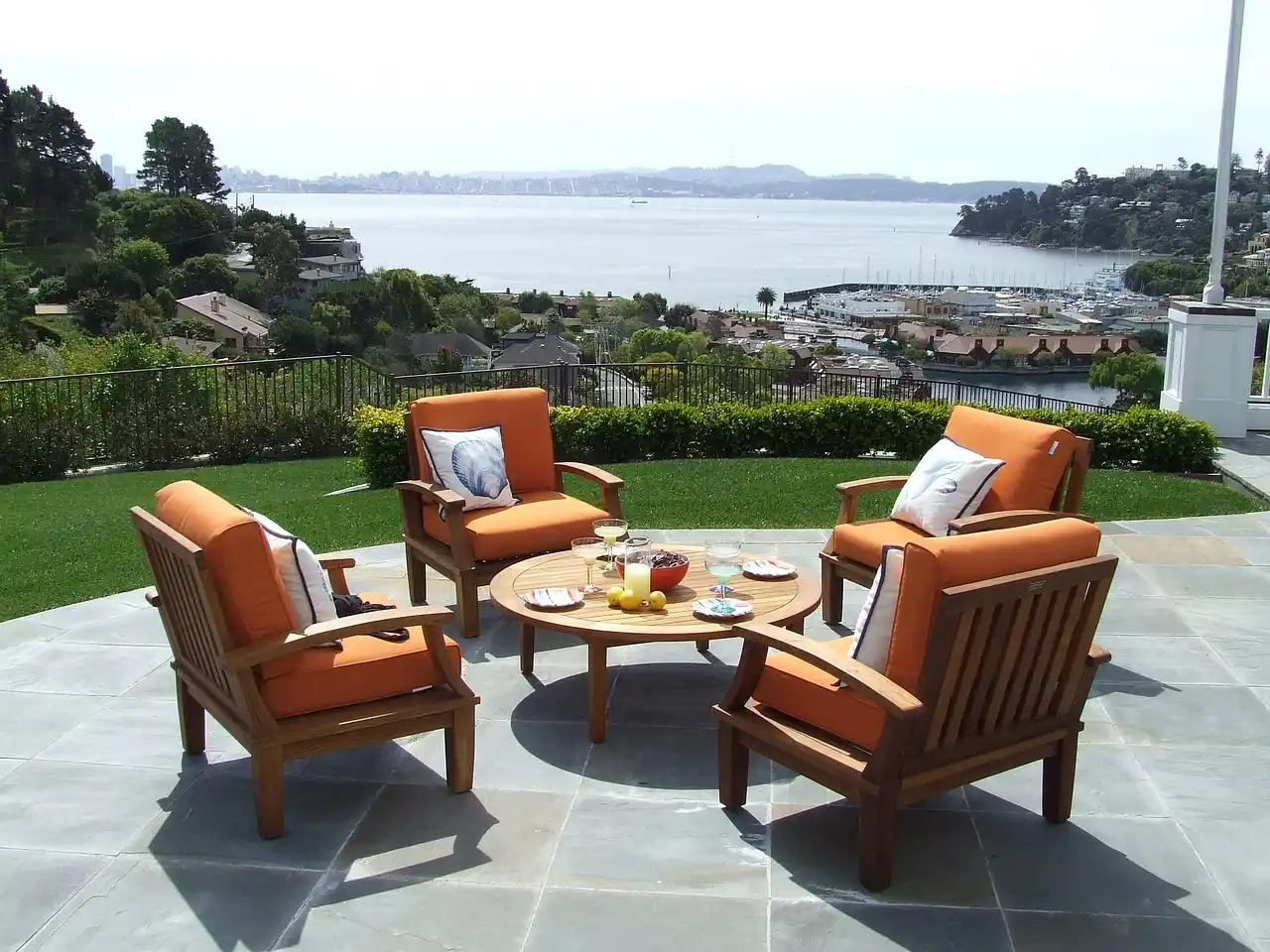
Indoor and outdoor grade are buyer-use categories here, not universal market labels. Indoor typically means furniture, cabinetry, or flooring stock with cleaner appearance and easier finish work; Outdoor Grade means decking, exterior joinery, or marine service where exposure and durability matter more than cosmetic perfection.
Character grade usually allows more color variation and more visible defects, so it is the budget entry point. Select tightens color and defect limits. Premium has more uniform heartwood and better appearance. Marine-Grade sits at the top, with the strictest expectations for quality, stability, and service in wet or exposed conditions.
As the grade rises, price rises with it. That premium is paying for less waste in visible work and more confidence in demanding service.
Heartwood, color consistency, and defect levels
Heartwood content matters because teak’s valuable performance comes from the more durable, oilier portion of the wood. More uniform color usually means less sorting and a cleaner finished look. Fewer knots, checks, splits, and sapwood streaks also push a board into a higher tier.
That is why two boards with the same nominal size can carry very different prices. The one with fewer defects is simply more usable.
Best grade by furniture, flooring, and decking
For furniture, Select or Premium often gives the best balance of cost and appearance. For flooring, a buyer usually wants stable, kiln-dried stock with predictable color and thickness. For decking and marine use, Outdoor Grade or Marine-Grade is the safer match because service conditions matter more than a perfectly matched grain face.
Choose plantation teak if the project can accept lower oil content and less long-term exposure resistance. Choose premium or marine stock when the structure will live outdoors or see frequent moisture.
How much more does surfaced teak cost?
Surfaced teak usually costs more than rough-sawn teak because the mill has already removed saw marks and brought the board to a usable finish. One source gives rough-sawn teak at $7.50-$20.00 per board foot and surfaced or planed teak at $12.00-$28.00 per board foot.
That premium buys time, more predictable dimensions, and a smoother face for finish work. It also reduces the amount you need to flatten in your own shop.
Rough-sawn versus S4S pricing
Rough stock is cheaper because you take on the labor, tool wear, and waste from final surfacing. S4S stock costs more because the seller has already squared and planed it. The added price can be worth it for visible parts, short timelines, or projects with limited milling capacity.
For rough construction, rough stock often wins on cost. For cabinetry and furniture, surfaced stock usually wins on total project efficiency.
How surfacing changes usable size
Surfacing reduces the finished dimensions slightly, so the usable yield is lower than the nominal rough size. That means a board-foot comparison should always note whether the quote is rough or surfaced, because the same nominal size does not produce the same finished yield.
Suppose you need five straight apron parts for a table. A surfaced quote may look higher at first, but it can save enough machining time and waste to make the total project cheaper.
How do you compare teak quotes?

Start by converting every quote to the same unit, then add the same extras to each bid. Use board foot for rough lumber, square foot for decking or flooring, and linear foot only after you know the width and thickness behind the number.
- Check the grade: Character, Select, Premium, or Marine-Grade.
- Check the stock form: rough-sawn or S4S.
- Check thickness: 4/4, 6/4, or 8/4.
- Check moisture condition: air-dried or kiln-dried.
- Add milling, surfacing, freight, and any waste allowance.
Board foot to square foot to linear foot
Square foot pricing is common for decking and flooring comparisons, and board-foot pricing is common for lumber. Linear foot pricing shows up in retail and decking listings, but it only becomes useful after you know width and thickness. A competitor lists teak board pricing at $6-$18 per linear foot depending on grade and condition, and finished or kiln-dried teak can run $8-$22 per linear foot.
Use linear-foot quotes only after you normalize the board’s dimensions. Otherwise, a narrow board and a wide board can look equally priced when they are not.
Thickness conversions for 4/4, 6/4, and 8/4
Teak thickness is usually quoted as 4/4, 6/4, or 8/4. Thicker stock costs more because it contains more wood and is often selected for stronger, more demanding uses. In many quotes, 4/4 is the baseline, 6/4 is a step up, and 8/4 is the heavy-stock option.
That is one reason a 2-inch teak quote can land at $28-$45 per square foot, while 1-inch stock sits lower. Thickness is part of the price, not an afterthought.
A simple landed-cost check for shipping and waste
To compare bids fairly, add freight, handling, milling, and a waste allowance before you choose. Teak prices can be 10%-15% higher in coastal areas due to marine-grade demand, and Grade A teak in Miami may cost $22-$26 per square foot while Denver buyers may pay $26-$30 per square foot.
Freight matters most for inland buyers. A low list price can become the most expensive option once delivery is added.
What makes teak prices vary?
Moisture condition, region, and source quality explain most of the spread. Kiln drying adds cost, but target moisture depends on climate and end use, so it should be treated as a project requirement rather than a fixed outdoor rule.
Moisture condition and kiln drying
Kiln drying reduces moisture and can improve stability and finish quality. One pricing breakdown puts kiln drying at $0.50-$1.50 per square foot. That extra step is common in furniture and flooring work because tighter moisture control helps limit movement after installation.
Do not assume every outdoor project needs the same moisture target. Exterior teak may be specified differently in a dry climate than in a wet coastal one.
Regional freight and inland delivery
Regional pricing changes because freight is distance-driven and handling adds up quickly on dense hardwood. Buyers near ports may see lower landed cost. Inland buyers often pay more after transport, unload fees, and dealer margin are added.
That is why two quotes with the same board-foot price can end far apart in total cost. The delivered number is the number that matters.
Plantation teak is usually the lower-cost option because it tends to have less heartwood consistency and less of the dense, high-oil character associated with premium stock. That makes it useful for many indoor or light-use projects, but it is not the same as high-grade material for exposed decks or marine work.
Picture a homeowner pricing a 60-square-foot entry bench and a 200-square-foot deck at the same time. Plantation teak may be the better value for the bench, while the deck calls for a higher exterior grade that costs more but fits the service conditions.
Choose Indoor if…
Choose Indoor if you are buying furniture parts, cabinetry, trim, or interior flooring and want cleaner color, easier milling, and lower total cost. It is also the better pick when plantation teak or Select/Premium stock gives you enough appearance quality without paying marine-grade pricing.
Choose Outdoor Grade if…
Choose Outdoor Grade if the project will live outside, see frequent wetting, or need decking, exterior joinery, or marine service. Expect a higher landed cost once freight, surfacing, and thickness are added, but the board is being bought for exposure performance rather than cosmetic value alone.
Frequently asked questions
How much does teak wood cost per board foot?
One source places rough-sawn teak at $7.50-$20.00 per board foot and surfaced or planed teak at $12.00-$28.00 per board foot. The exact figure depends on grade, thickness, surfacing, and source, so always compare the same stock form before you judge a quote.
What is the price difference between indoor and outdoor teak grade?
Indoor stock is usually cheaper because it can accept more cosmetic variation and lighter-duty selection. Outdoor Grade costs more when the board must meet stricter expectations for exposure, stability, and service life. Freight and thickness can widen the gap further, especially on deck or marine projects.
Is plantation teak cheaper than marine-grade teak?
Yes. Plantation teak is commonly the lower-cost option, and the cited square-foot range for plantation teak at 1 inch thick is $8-$14 per square foot. Marine-grade stock sits above that because buyers pay for better selection, stronger defect control, and a more demanding service profile.
How much more does surfaced teak cost than rough-sawn teak?
One pricing breakdown puts rough-sawn teak at $7.50-$20.00 per board foot and surfaced or planed teak at $12.00-$28.00 per board foot. The premium reflects milling, better finish readiness, and smaller allowance for your own machining waste. The exact spread depends on thickness and grade.
What factors make teak prices vary by region?
Freight, local demand, and access to port supply change the delivered price. The cited data notes 10%-15% higher prices in coastal areas due to marine-grade demand, with Grade A teak in Miami at $22-$26 per square foot and Denver at $26-$30 per square foot.
How do I compare teak quotes apples-to-apples?
Put every quote into the same unit, then add surfacing, kiln drying, freight, and waste. Board foot works best for lumber, square foot works best for decking and flooring, and linear foot only works after you know width and thickness. That is the only fair way to compare bids.
Sponsored / affiliate links. As an Amazon Associate I earn from qualifying purchases. I may earn additional commission from eligible campaigns.