Travisher Blades: Steel, Bevel Angle and Sharpening
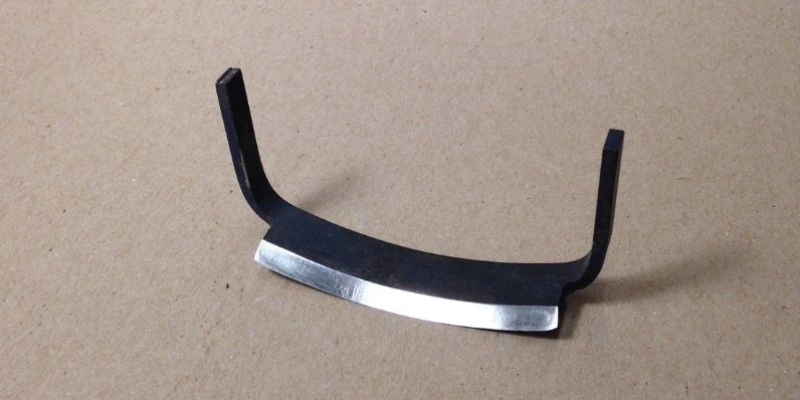
Travisher blades are curved steel blades, usually O1 tool steel with a bevel of roughly 25 to 30 degrees, made to hollow chair seats. They are not knives, and they are rarely interchangeable between makers. A blade ground at the wrong angle, or fitted to the wrong tool, tears grain instead of cutting it. This guide covers steel, bevel angles, sharpening and replacement.
What Is a Travisher Blade and What Does It Cut?
Best Blade Stropping Pick | |
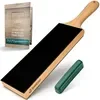 |
BeaverCraft Leather Strop Kit (paddle strop with polishing compound) A two-sided leather paddle strop with a green polishing compound, sold for honing carving knives, chisels and other carving tools.
|
As an Amazon Associate we earn from qualifying purchases. | |
A travisher is a flat-soled, push-style tool with a curved, adjustable blade, used to sweep the rough cuts left by a scorp into one smooth, symmetrical hollow. The blade does the cutting, and the curve of its edge decides how tight a hollow the tool can follow. That is why a tool meant for a deep saddle seat uses a much tighter curve than one meant for a broad, shallow scoop.
Some pages online describe travisher blades as handmade hunting knives. That is wrong for this tool: a travisher blade is a woodworking edge for chair seats, and its job sits in the middle of the coarse-to-fine sequence covered in our guide to contouring a wooden chair seat. The scorp removes bulk, the travisher blade shapes the curve, and a card scraper removes the last tool marks.
Blade curve: tight radius or broad radius
One American supplier sells travisher blades in two curves. The 3.5 inch radius is described as tight enough to fit the deepest chair seats, while the 12 inch radius gives a flatter curve meant to complement it. Which you need depends on the seat, and many chairmakers end up with more than one curve because a single radius cannot follow every part of a saddle.
What Steel Are Travisher Blades Made Of?
The steel most makers publish is O1, an oil-hardening high-carbon tool steel. Ray Iles lists an adjustable O1 blade on its chairmaker’s travisher, and the American supplier above makes blades from 1/8 inch thick O1, tempered to Rockwell C 60-62. That hardness range is typical for hand-tool edges: hard enough to hold an edge through a seat, soft enough to sharpen on ordinary stones.
You will sometimes see A2 suggested as an upgrade. A2 is a common alternative for plane irons and is generally said to hold an edge a little longer but sharpen with more effort, while O1 is said to take a slightly finer edge. That is a general plane-iron comparison, not a travisher test, and the travisher blades and tools I found published are all O1.
- O1 pros: grinds and hones easily, takes a fine edge, and is the steel most travisher makers list.
- O1 cons: it is not stainless, so it rusts if left damp. Wipe it dry after use and store it lightly oiled.
- Blade thickness: 1/8 inch stock is one published example. Thicker stock resists chatter but takes longer to regrind.
Travisher Blade Bevel Angle: What Makers Actually Use
Nobody publishes one correct number, and the figures below come from three sources doing slightly different jobs. Together they show a working range rather than a single answer.
| Source | Angle | What it describes |
|---|---|---|
| Ray Iles chairmaker’s travisher | 25 degrees | Blade angle of the finished tool, in-cannel grind, sharpened with a slipstone |
| Chairmaker Claire Minihan | 27 degrees | Bevel she grinds on her own travisher blades using a grinding wheel and jig |
| Hand-tool supplier selling 1/8 inch O1 blades | 30 degrees | Unsharpened bevel the blades ship with; the buyer sharpens before use |
The pattern is useful. A shallower bevel slices more easily through softwoods such as pine and poplar, which are traditional seat woods. A steeper bevel is stronger and lasts longer against hardwood, at the cost of more effort per stroke. If you are unsure, start near 27 degrees and adjust after a seat or two. That is a starting point drawn from the range above, not a tested optimum.
One detail worth noting: the Ray Iles blade is described as an in-cannel grind sharpened with a slipstone. In-cannel generally means the bevel is ground on the concave side of a curved edge, which is why a rounded slipstone is used instead of a flat stone. Check which face of your own blade carries the bevel before you start.
How to Sharpen a Travisher Blade
The clearest published walkthrough comes from chairmaker Claire Minihan, who grinds and hones her own blades. Her sequence is summarized below; adapt the equipment to what you own.
- Grind the bevel: set the tool rest or jig for your target angle (she uses 27 degrees) and grind as close to the edge as possible without building a burr on the wheel. Keep the steel cool; a blade that turns blue has been overheated.
- Work through the stones: she uses water stones at 1000, 4000 and 8000 grit, rocking the blade while transferring pressure between thumbs.
- Hone the curve: a diamond cone or rounded slipstone follows a curved bevel where a flat stone cannot.
- Polish: she finishes with diamond paste in descending micron sizes on a spinning wooden wheel, then strops.
- Remove the burr: alternate the polishing stone and the strop, pulling from front to back with firm contact. She warns against stropping the flat back surface.
You do not need diamond paste on a lathe to get a working edge. A 1000 grit stone, a fine stone and a leather strop with compound are a reasonable setup for softwood seats. Two safety points apply to any method: keep both hands behind the edge when moving the blade, and if you polish on a lathe or wheel, tie back long hair and loose sleeves, as Minihan advises.
Signs the blade needs sharpening
- The tool skips or chatters instead of curling a clean ribbon.
- The surface looks fuzzy or torn, especially across the grain.
- You are pushing harder than you did on the first pass.
Replacement Travisher Blades: Why They Rarely Swap
Here is the point most pages about replacement blades miss: a travisher is not built around a standard blade the way a bench plane takes a standard iron. One supplier states plainly that its blades may not work as replacements for its travishers, since each tool is fitted to each blade. Curve radius, blade width, tang shape and the way the blade is clamped all vary by maker.
- Measure first: blade width (Ray Iles lists a 50 mm cutting edge), curve radius and thickness.
- Ask the maker: for a fitted travisher, the safest source of a spare is the maker who built the tool.
- Do not assume a plane iron fits: a flat bench plane iron cannot follow a curved sole. For plane irons, see our note on replacement blades for Stanley planes.
If your travisher is shop-made, you can make a new blade from O1 bar stock and heat treat it, or buy a blank sold for the purpose. That is more work, but it gives you a blade matched to your tool.
Common Travisher Blade Mistakes
- Grinding too steep: a very steep bevel makes the tool hard to push and can tear softwood. Stay within the 25 to 30 degree range above.
- Stropping the back: rounding the flat back weakens the cutting edge. Keep the back flat.
- Ordering a spare by width alone: the radius and mounting matter as much as width.
- Leaving O1 damp: surface rust pits the edge, so dry and oil the blade after each session.
- Asking the blade to remove bulk: leave heavy waste to the scorp or an adze. See how to hollow out wood by hand for choosing a tool by depth.
Related Hand-Tool Guides
If you are building a small kit for seat carving, the same edge-care habits apply to other curved-cutting tools. Our guide to shaping wood into curves compares methods, and the overview of hand-held wood cutting tools shows where a travisher sits next to chisels and planes.
Frequently Asked Questions About Travisher Blades
What are travisher blades made of?
Most published travisher blades are O1 high-carbon tool steel. Ray Iles lists O1 for its adjustable travisher blade, and one American supplier describes 1/8 inch thick O1 tempered to Rockwell C 60-62. O1 grinds easily and takes a fine edge, but it rusts if left damp, so wipe it dry and oil it after use.
What bevel angle should a travisher blade have?
Published figures run from about 25 to 30 degrees. Ray Iles gives 25 degrees for its blade, one chairmaker grinds a 27 degree bevel, and another supplier ships blades with a 30 degree unsharpened bevel. A lower angle slices more easily in softwood, while a steeper one holds up better in hardwood.
Can I put any replacement blade in my travisher?
Usually not. One supplier states that its blades may not work as replacements for its travishers because each tool is fitted to its blade. Measure the blade width, curve radius and mounting method, and ask the maker before ordering a spare.
How often should I sharpen a travisher blade?
Sharpen when the tool starts tearing the grain or leaving a fuzzy surface instead of clean ribbons, not on a fixed schedule. A pass on a strop with compound can restore a slightly dull edge, and a return to the stones is needed only when stropping no longer brings it back.
Conclusion
Choose O1 steel, start the bevel at 25 to 27 degrees for softwood seats, keep the blade matched to its own tool, and finish every sharpening with a strop. Those habits do more for the hollow than any brand name.
Sponsored / affiliate links. As an Amazon Associate I earn from qualifying purchases. I may earn additional commission from eligible campaigns.