How Much Clearance Do You Need for Undermount Drawer Slides?
Miss that clearance, and the drawer will bind, sit crooked, or fail to latch. This guide gives you a brand-by-brand clearance calculator for width, height, depth, and drawer-box sizing.
Undermount clearance table
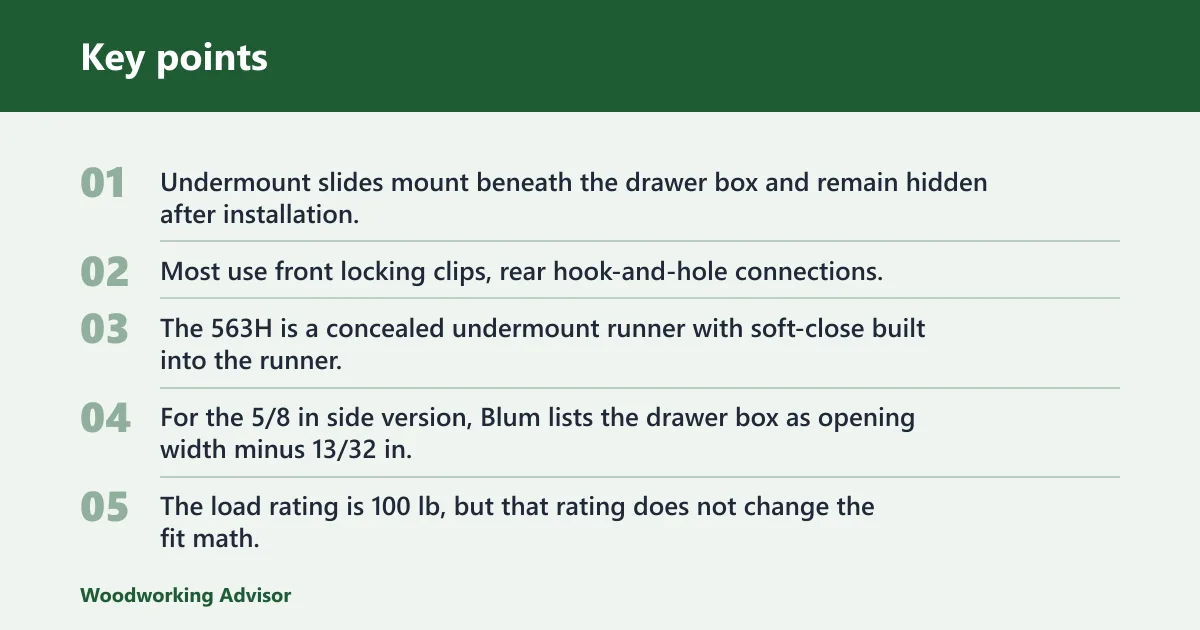
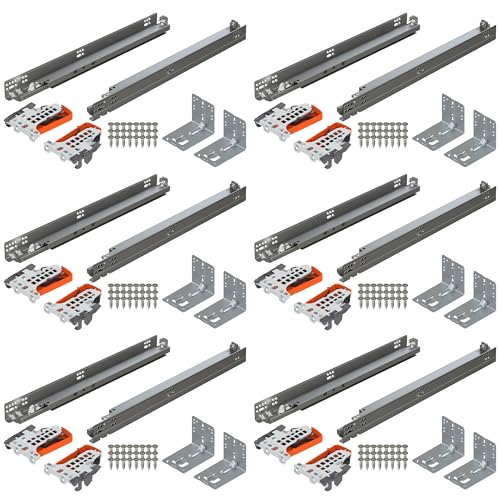

Undermount slides mount beneath the drawer box and remain hidden after installation. Most use front locking clips, rear hook-and-hole connections, and built-in soft-close parts, but the exact mechanism and drawer-box deduction change by brand and model.
| Runner family | Typical side thickness compatibility | Drawer box width deduction | Minimum height clearance | Notes |
|---|---|---|---|---|
| Blum TANDEM PLUS BLUMOTION 563H | 5/8 in and select 1/2 in versions | Opening minus 13/32 in with 5/8 in sides | Opening height minus 20 mm (13/16 in) | 100 lb rating; 21 in example size is common in the brief |
| Blum MOVENTO 763 | Usually 5/8 in and select metric side builds | Follow the MOVENTO chart for the exact side thickness | Follow the MOVENTO chart; height allowance still applies | 125 lb class |
| Blum MOVENTO 769 | Usually 5/8 in and select metric side builds | Follow the 769 chart for the exact deduction | Follow the 769 chart; rear hardware needs room | 170 lb heavy-duty class |
| Grass Dynapro | 12 mm, 16 mm, and select 19 mm versions | Similar to Blum, but not identical | Brand chart governs; check runner body and clip space | 88, 110, or 132 lb classes by model |
| Hettich Quadro V6 | 1/2 in and 5/8 in rules vary by version | Similar to Blum and Grass, but not the same number | Follow the Quadro V6 sheet before cutting parts | Version-specific fit and hardware positions |
Blum TANDEM PLUS BLUMOTION 563H
The 563H is a concealed undermount runner with soft-close built into the runner. For the 5/8 in side version, Blum lists the drawer box as opening width minus 13/32 in, and the drawer height as opening height minus 20 mm, which is 13/16 in. The load rating is 100 lb, but that rating does not change the fit math.
That difference matters. Capacity tells you how much weight the runner can carry. Clearance tells you whether the drawer will move at all.
Blum MOVENTO, Grass Dynapro, and Hettich Quadro V6 compared
Blum MOVENTO, Grass Dynapro, and Hettich Quadro V6 all use concealed undermount geometry, but their width deductions are not interchangeable. Blum MOVENTO includes the 763 version at 125 lb and the 769 heavy-duty version at 170 lb. Grass Dynapro comes in 88, 110, and 132 lb classes. Hettich Quadro V6 uses similar sizing logic, yet the 1/2 in and 5/8 in rules vary by version.
That means you cannot cut one drawer box for “undermount slides” in general. You need the exact runner family and the exact side thickness before you cut the sides, bottom, or back.
When 3/4 in or 19 mm sides apply
Most undermount slides fit about 1/2 in to 5/8 in drawer sides, or 12 mm to 16 mm metric stock. Some select runner versions accept 19 mm or 3/4 in sides, but only on the models listed by the maker. Do not assume the heavier drawer side means a standard deduction will still work.
Say your cabinet opening is 18 in wide and you plan to use 3/4 in maple sides because the drawer will carry heavy tools. If the runner does not list a 3/4 in side option, the drawer may be too wide for the clips or too tight for the runner body, even though the wood itself is square.
How much clearance do you need for undermount drawer slides?
In practice, that usually means the drawer box outside width is the cabinet opening width minus 1 in, then adjusted to the exact brand rule. Height clearance is part of the fit too, because the runner body and rear hardware need room under the drawer.
Cabinet opening width vs. drawer-box outside width
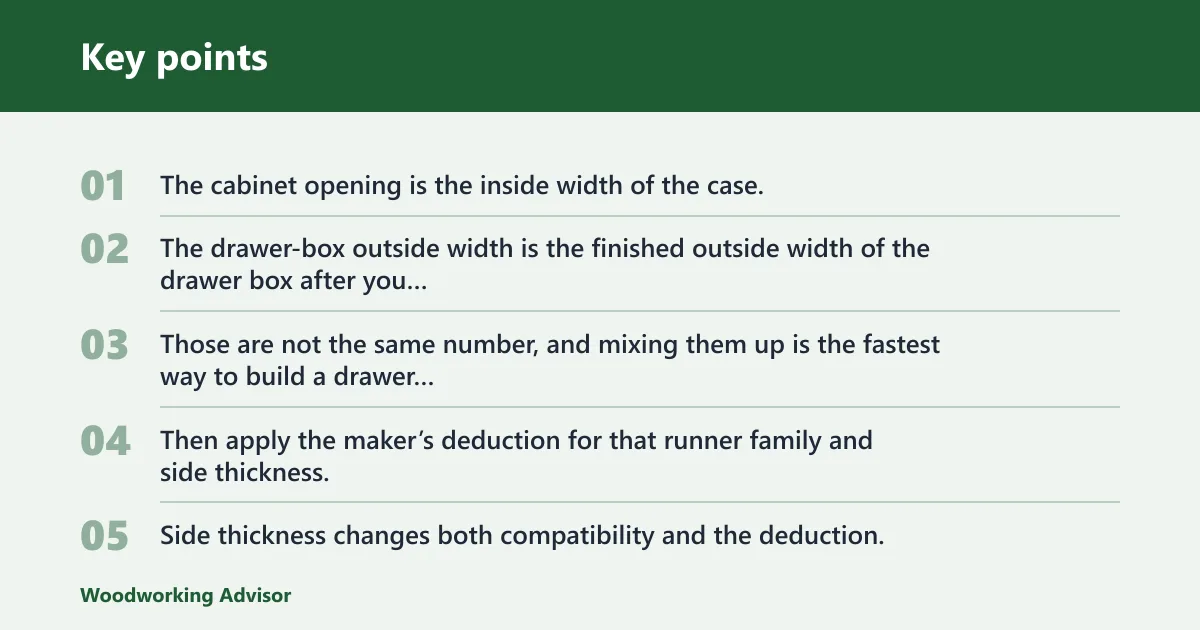
The cabinet opening is the inside width of the case. The drawer-box outside width is the finished outside width of the drawer box after you subtract the runner’s deduction. Those are not the same number, and mixing them up is the fastest way to build a drawer that will not slide.
Use the opening as the starting point. Then apply the maker’s deduction for that runner family and side thickness.
How the side thickness changes the deduction
Side thickness changes both compatibility and the deduction. A 5/8 in side version may call for one width formula, while a 1/2 in side version uses another. Grass and Hettich both vary by model, and Blum lists separate rules for some side thicknesses rather than one universal number.
A common first-timer mistake is to build the drawer box to the same outside width for every side thickness. That can leave the runner too loose, too tight, or unable to engage the front clips correctly.
Why height clearance is part of the fit
Height matters because the drawer bottom, runner body, rear hook, and front clip all occupy space below the box. Blum’s 563H example limits drawer height to opening height minus 20 mm. Other brands use their own height allowances, so do not make the drawer “as tall as possible” unless the sheet says so.
Picture a 7 in tall drawer opening with a runner that needs 13/16 in of height allowance. If the box is built to the full opening height, the drawer may scrape the cabinet, miss the rear hardware, or refuse to seat fully.
Measure the cabinet opening first, then identify the runner family, then build the drawer box to that sheet. The correct sequence matters because the deduction depends on the exact slide line, side thickness, and height rule. Do not start with a guessed drawer size and hope the clips will forgive the error.
Measure the opening first
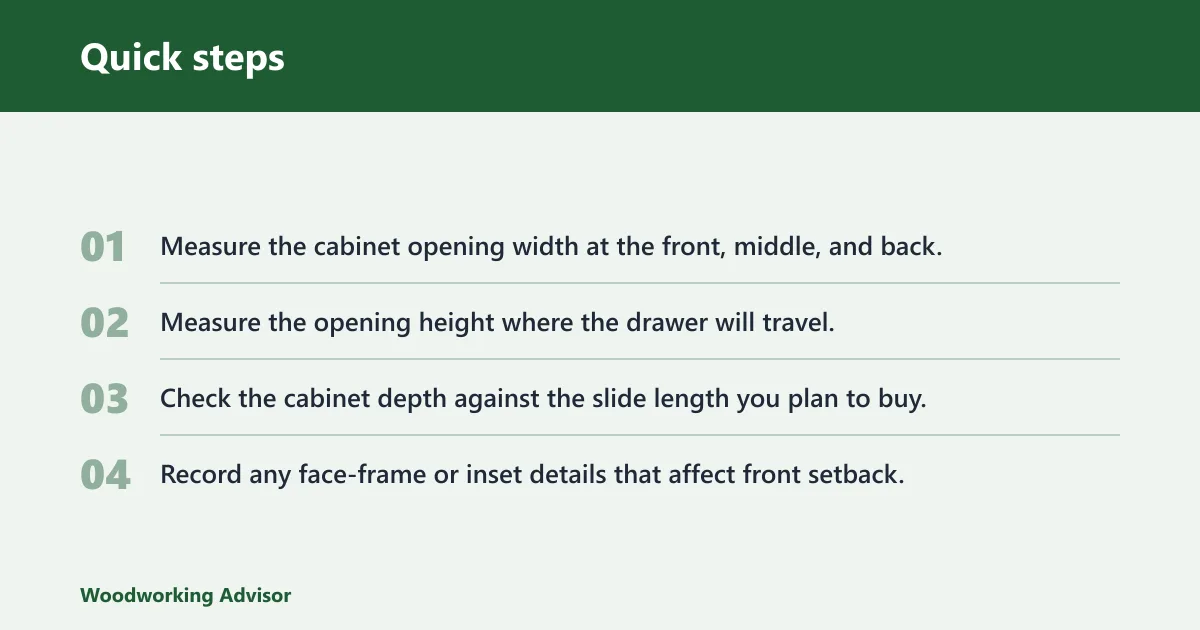
- Measure the cabinet opening width at the front, middle, and back.
- Measure the opening height where the drawer will travel.
- Check the cabinet depth against the slide length you plan to buy.
- Record any face-frame or inset details that affect front setback.
If the opening varies, use the smallest usable width. Concealed undermount slides need a consistent path, not a “close enough” opening.
Confirm the runner family before cutting parts
Choose the exact model before cutting the drawer box. The runner package or sheet should tell you the side thickness, width deduction, minimum height, and rear hardware position.
That matters especially with soft-close undermount runner systems, because the damper location and action can vary by brand. A runner that closes softly may still need a different rear clip or a different notch depth.
Transfer the spec sheet to your drawer-box drawing
Write the exact deduction on the cut list, not just on the order page. Mark side thickness, box width, box height, rear notch size, and hook-hole position on the drawing before milling any parts. That keeps the cabinet opening, drawer box, and hardware geometry in one place.
Suppose a drawer opening measures 21 in wide and the selected runner sheet calls for opening minus 13/32 in with 5/8 in sides. The drawer box outside width is not 21 in, and it is not 20 1/2 in either. It is the opening minus the maker’s deduction, exactly as specified.
What width should a drawer box be for undermount slides?
The drawer box width should match the cabinet opening after the maker’s deduction is applied for that slide family and side thickness. For other brands, use their published chart rather than copying the Blum number.
Opening minus the maker’s deduction
The width rule is always model-specific. Some runners are close to Blum’s deduction, while others differ enough to matter at the front clips and rear hooks. The safest workflow is simple: opening width first, then maker deduction, then drawer-box outside width.
Differences between 5/8 in and 1/2 in sides
Do not treat 5/8 in and 1/2 in as cosmetic choices. They can change the deduction and the slide family that fits the box. Hettich Quadro V6 and several Grass Dynapro versions use side-thickness rules that vary enough to require a separate cut list.
A drawer built for 5/8 in sides can be off by enough to stop the locking clip from snapping in. That failure often shows up at the front, even though the real mistake started at the side thickness.
When select models use 19 mm or 3/4 in sides
Some Grass Dynapro and other select runner versions allow 19 mm sides, and some undermount systems have 3/4 in variants. Those versions are not the default. Check the exact runner code before committing to thicker sides, because the width deduction and rear hardware position may change with the heavier side stock.
Rear notch and hook hole setup
The rear corners usually need matching notches, and one hole drilled for the hook pin. Those details are part of the install geometry, not optional extras. If the rear hardware cannot seat exactly where the maker wants it, the runner may bind or pull the drawer out of square.
Rear corner notch location
Most undermount systems need both rear corners notched to clear the runner body and clip area. The notch location follows the maker’s spec sheet and is usually tied to side thickness and drawer height. Cut the notch after confirming the exact runner family, not before.
Hook-hole position for the rear pin
The rear hook-and-hole connection supports the back of the drawer on the runner. The hole position must match the maker’s published distance from the drawer edge and bottom. If the hole is too high, too low, or too far back, the drawer may sag, bind, or refuse to lock.
Front locking clip placement and check
The front locking clips are part of the system and must meet the drawer front or the drawer-bottom structure in the correct spot. After dry-fitting the drawer, check that the front clips engage cleanly, the rear hooks seat fully, and the drawer runs without rubbing. A small mismatch at the front can hide a bigger problem at the rear.
What goes wrong when the numbers are off?
Wrong numbers usually fail in predictable ways: binding, crooked travel, poor latching, or a drawer that will not stay on the runner. The failure tells you which measurement was wrong, but only if you know where to look. Side thickness, rear notch, hook hole, and model choice each cause different problems.
| Wrong measurement | What goes wrong | What to check first |
|---|---|---|
| Too little side clearance | Drawer binds, scrapes, or will not close fully | Confirm the exact deduction for the runner family and side thickness |
| Side thickness does not match the spec | Front clip will not latch or runner sits off-center | Verify 1/2 in, 5/8 in, 12 mm, 16 mm, 19 mm, or 3/4 in compatibility |
| Rear notch is in the wrong place | Drawer rocks, rubs, or will not seat on the runner body | Measure the notch against the maker’s rear-corner layout |
| Hook hole is off location | Back of drawer sags or will not hook in | Check the rear pin position from the sheet |
| Wrong slide family chosen | All dimensions may be wrong even if the drawer looks close | Match the drawer box to Blum, Grass, Hettich, or KV before cutting |
| Height clearance ignored | Drawer drags, refuses to seat, or hits the runner mechanism | Use the published height allowance, such as Blum’s 20 mm example |
Say a drawer is built for 5/8 in sides, but the runner selected only accepts the 1/2 in version. The drawer may look square on the bench, yet it can sit too tight in the opening or fail to catch the front hardware. The part that looks “almost right” is usually the part that breaks the install.
Frequently asked questions
How much space do you need for undermount drawer slides?
You need enough space for the runner body under the drawer, the rear hook-and-hole connection, and the front locking clips. Width is only part of the equation. Height and rear setback matter too, especially on soft-close runner systems where the damper and catch points take up space.
How much clearance do you need for bottom mount drawer slides?
Bottom-mount drawer slides are not the same as concealed undermount slides. The clearance rules, hardware positions, and attachment points can differ a lot. Use the slide maker’s sheet for the exact bottom-mount model rather than copying an undermount drawer calculation.
Can I use drawer slides as undermount?
Only if the slide is designed and rated as an undermount runner. Standard side-mount or bottom-mount slides are not interchangeable with concealed undermount hardware. The clip positions, rear support, and drawer-box dimensions must match the specific undermount model.
Sponsored / affiliate links. As an Amazon Associate I earn from qualifying purchases. I may earn additional commission from eligible campaigns.