What Does Polyurethane Smell Like? (And How to Get Rid of It)
Polyurethane’s chemical smell comes from isocyanates and VOCs released as the coating cures — strongest in the first 24 to 72 hours after application. Breathing it in an unventilated room can trigger headaches, nausea, and eye irritation, and oil-based formulas smell far stronger than water-based ones. This guide covers what causes the smell, how long it actually lasts, and the fastest ways to clear it from a room.
Why Does Polyurethane Smell So Strong?
Polyurethane is made from two main components — polyols and isocyanates — that react together to form a durable, flexible coating. The smell comes almost entirely from the isocyanates: they off-gas as reactive vapor while the finish cures, which is also why the odor is strongest in the first day or two and then fades as curing finishes. Volatile organic compounds (VOCs) in the carrier solvent add to the chemical scent, especially in oil-based formulas.
For a full rundown of poly types, application, and safety, see our polyurethane guide hub.
How strong the smell gets depends on a few real, controllable factors:
- Type of polyurethane: oil-based emits far more VOCs than water-based, and spray application aerosolizes more of it into the air than brushing.
- Number of coats: each additional coat adds fresh isocyanate off-gassing on top of whatever hasn’t cleared yet.
- Room temperature: heat speeds up curing but also speeds up off-gassing, making the smell more noticeable in a warm room.
- Humidity: high humidity slows curing and can trap odor-carrying vapor near the surface longer.
- Ventilation: the single biggest lever — active airflow is the difference between a smell that clears in a day and one that lingers for a week.
📊 A 2024 peer-reviewed analysis of flexible polyurethane materials found the dominant odor note in most samples was described as “wall paint-like,” with some formulations registering as “rum-like” or “old furniture-like” — a reminder that “chemical smell” isn’t one single scent. Source: peer-reviewed odor-compound study, 2024

Water-Based vs. Oil-Based Polyurethane Smell
The type of polyurethane you choose is the single biggest factor in how bad the smell gets. Water-based and oil-based formulas differ enough in odor and VOC content that the choice is worth making before you buy, not after the smell hits.
| Factor | Water-Based | Oil-Based |
|---|---|---|
| VOC content | Low, typically under 250 g/L | High, often 400–450 g/L |
| Odor strength | Mild, less pungent | Strong, sharp chemical smell |
| Dry-to-touch time | 2–4 hours | 24–48 hours between coats |
| Best for | Light woods, indoor projects, low-odor needs | Traditional amber tone, high-traffic durability |
If you’re finishing floors specifically, our best polyurethane for hardwood floors guide breaks down which formula fits which room.
Best Low-Odor Polyurethane Pick
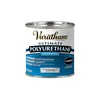 |
Varathane Water-Based Ultimate Satin Polyurethane – $13.49 A low-VOC water-based formula that dries to the touch in 30 minutes, which directly addresses the biggest odor factor covered above — far less off-gassing than an oil-based coat.
|
As an Amazon Associate we earn from qualifying purchases.
VOC Regulations: Why Some Polyurethanes Smell Less
Some of the odor difference between brands isn’t just marketing — it’s regulation. The EPA’s architectural coatings rule caps clear and semitransparent wood coatings at 550 g/L of VOCs, while California’s CARB standard is stricter at 275 g/L for wood coatings, varnish, sanding sealers, and lacquer. That’s a big part of why a “low-VOC” or California-compliant water-based polyurethane smells noticeably milder than an older-formula oil-based can — it’s chemically required to off-gas less.
Checking the VOC content on the can label (usually listed in g/L) before buying tells you more about expected odor than the “low odor” marketing claim alone. See the EPA’s architectural coatings VOC fact sheet for the full limit table by coating type.
How Long Does Polyurethane Smell Last?
The smell follows a predictable curve tied to curing, not a fixed number of days. Expect it to peak early and taper off steadily with decent airflow.
📊 Typical odor timeline: strongest off-gassing in the first 24–72 hours, mostly cleared within 5–7 days, with faint residual trace possible for up to a month in an enclosed, poorly ventilated room. Source: household air-quality and flooring-industry ventilation guidance, 2026.
| Time After Application | Typical Odor Level |
|---|---|
| 0–72 hours | Strong, most noticeable |
| 1 week | Faint, mostly cleared |
| 1 month | Minimal to none with ventilation |
Is Polyurethane Smell Harmful?
The smell itself is a warning sign, not just a nuisance — it’s your nose detecting airborne isocyanates and VOCs. Short-term exposure in a closed room can cause headaches, nausea, dizziness, and eye or throat irritation, usually resolving once you get fresh air. Repeated or prolonged exposure without ventilation is the real risk: it’s linked to respiratory irritation, skin sensitization, and in occupational settings, more serious long-term effects. Isocyanates specifically are a recognized occupational asthma sensitizer — once someone becomes sensitized, even brief low-level exposure can trigger a reaction afterward, which is why professional finishers who apply oil-based polyurethane regularly often wear an organic-vapor respirator rather than relying on ventilation alone.
Smell and toxicity aren’t quite the same question, though they’re related — see our full breakdown of whether polyurethane is toxic for exposure limits and pet safety specifics.
How to Get Rid of Polyurethane Smell Fast
Ventilation does more work than any product you can buy, but a few extra steps speed things up noticeably.
- Cross-ventilate, not just one window: open windows on opposite sides of the room so air actually moves through, not just in and out of one opening.
- Point a fan outward: set a box fan in a window blowing air out, which pulls fresh air in through other openings instead of just stirring the same air.
- Run the HVAC fan with a fresh filter: circulating air through a clean filter helps capture some airborne particulate, though it won’t remove gaseous VOCs on its own.
- Set out bowls of baking soda or activated charcoal: both absorb some ambient odor over 24–48 hours, especially useful overnight when you can’t run a fan.
- Wait for full cure before closing the room back up: shutting doors and windows too early traps the off-gassing that would otherwise have vented out.
- Choose water-based for your next project if odor is a concern: per the comparison above, it cuts VOC exposure dramatically without giving up much durability for most indoor uses.
“In our shop, an oil-based coat left in a closed room still smells noticeably stronger the next morning than a water-based coat treated the same way. Cracking a window and running a box fan for the first 24 hours makes the biggest difference we’ve seen — more than any air freshener or odor spray.”

Frequently Asked Questions
What Does Polyurethane Smell Like?
Polyurethane has a sharp, chemical smell most people compare to paint or varnish. It comes from isocyanates and VOCs released as the coating cures, and is strongest in the first 24 to 72 hours after application before fading over the following week.
Why Does Polyurethane Smell So Strong?
The strength comes from isocyanates off-gassing during curing, made worse by oil-based formulas, multiple coats applied close together, warm room temperature, and poor ventilation. Cutting any one of those factors noticeably reduces how strong the smell gets.
Is Polyurethane Smell Harmful?
In low concentrations with decent airflow, the smell is irritating but not typically dangerous. In a closed, unventilated room it can cause headaches, nausea, dizziness, and eye or throat irritation, and repeated heavy exposure carries more serious respiratory risk, so ventilation isn’t optional.
How Long Does Polyurethane Smell Last?
Expect the strongest smell in the first 24 to 72 hours, tapering to faint within about a week with good ventilation. A trace can linger up to a month in an enclosed room with poor airflow, but active ventilation shortens that window considerably.
Can You Sleep in a Room After Applying Polyurethane?
It’s best to avoid it for at least the first 24 to 72 hours while off-gassing is strongest, especially with oil-based formulas. If you must use the room sooner, run cross-ventilation continuously and consider a water-based product next time to cut exposure.
Are There VOC Regulations for Polyurethane?
Yes. The EPA caps clear and semitransparent wood coatings at 550 g/L of VOCs, and California’s CARB standard is stricter at 275 g/L. Checking a can’s VOC content on the label is a more reliable odor predictor than a “low odor” marketing claim.
Conclusion
Polyurethane’s smell comes from isocyanates and VOCs released during curing, strongest in the first 24 to 72 hours and mostly gone within a week with real ventilation. Choosing water-based over oil-based cuts the odor dramatically, and cross-ventilation plus a fan does more than any odor-absorbing trick. Know the timeline, ventilate actively, and the smell is a short-term inconvenience rather than a lasting problem.
Sponsored / affiliate links. As an Amazon Associate I earn from qualifying purchases. I may earn additional commission from eligible campaigns.