What Is the Strongest Wood for Dowels? Hickory, Oak & Maple Compared
Hickory is the strongest wood for dowels, edging out white oak and hard maple in the bending-strength and shock-resistance numbers that actually determine whether a glued dowel joint holds under load. Oak and maple are excellent, widely available runners-up — and for most furniture and cabinetry joints, either one is plenty strong. But “strongest” and “hardest” aren’t the same measurement, and that mix-up is where a lot of buying guides get this topic wrong.
Below we break down the actual wood-engineering numbers behind dowel strength, compare five common dowel species side by side, and cover the sizing and grain details that affect a joint’s strength more than the species label on the bin at the hardware store.
Which Wood Really Makes the Strongest Dowel?
Shagbark hickory tops published wood-engineering data on nearly every strength measurement that matters for a dowel: modulus of rupture (bending strength), shear strength parallel to the grain, and impact/shock resistance. That last one is the reason hickory has been the standard choice for hammer handles and tool handles for well over a century — a dowel made from it can flex and absorb a sudden shock without snapping, where a more brittle wood would crack.
White oak and hard (sugar) maple aren’t far behind, and for the vast majority of furniture joinery — shelf pins, chair stretchers, cabinet face-frame joints — the difference between hickory and oak in real-world use is negligible. Hickory pulls ahead specifically in situations with repeated stress, impact, or flex, like a stool leg that gets kicked or a jig that takes repeated hits.
Best Hardwood Dowel For Strong Joints
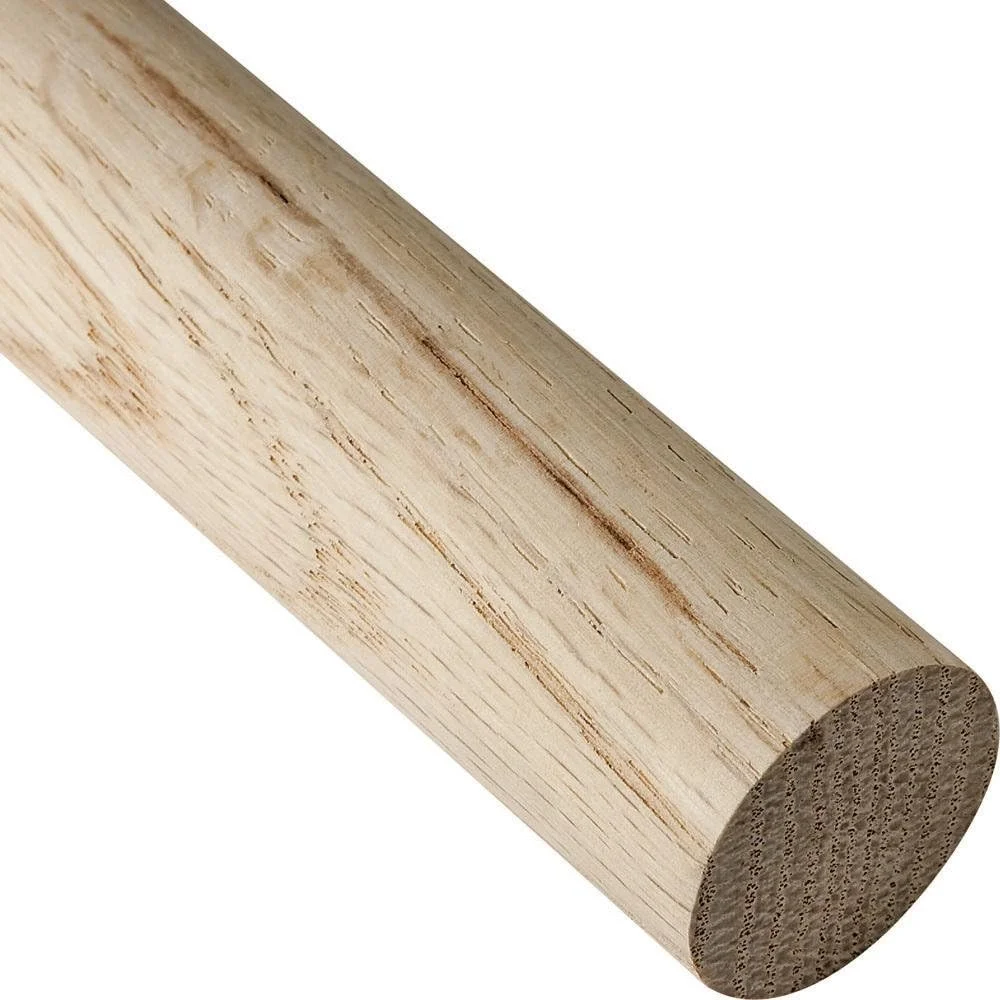 |
Rockler Oak Dowel Rod, 48" x 3/4" – $11.99 A kiln-dried, furniture-grade oak dowel sized right for the joinery strength this article is about.
|
How Wood Strength Is Actually Measured
Three numbers from wood-engineering testing (compiled by the USDA Forest Products Laboratory’s Wood Handbook) explain almost everything about how a species performs as a dowel:
- Janka hardness — resistance to surface denting and wear. This is what most “hardest wood” lists rank by, but it doesn’t measure bending strength.
- Modulus of rupture (MOR) — the bending stress a piece can take before it breaks. This is the number that matters most for a dowel used as a structural pin or peg.
- Specific gravity — ovendry density relative to water. Denser wood is usually (not always) stronger, but density alone doesn’t predict toughness.
Grain orientation matters just as much as species. A dowel is strongest when the grain runs straight down its length — which is how commercially milled dowel rods are cut. A dowel with grain that runs diagonally (called short or cross grain) can snap at a fraction of the load a straight-grained piece of the identical species would hold, which is why a cheap, knotty dowel sometimes fails even when it’s technically the “strong” species.
Strength Comparison: Hickory vs. Oak vs. Maple vs. Ash vs. Birch
These are the five hardwoods most commonly sold as dowel stock, with published Janka hardness and modulus of rupture figures for context:
| Wood | Janka Hardness | Bending Strength (MOR) | Best For |
|---|---|---|---|
| Shagbark Hickory | ~1,820 lbf | ~20,200 psi | Mallet/hammer handles, jigs, high-impact joints |
| Yellow Birch | ~1,260 lbf | ~16,600 psi | Furniture pins, dowel joints under steady load |
| Hard (Sugar) Maple | ~1,450 lbf | ~15,800 psi | Cabinetry, fine furniture, cutting boards |
| White Oak | ~1,360 lbf | ~15,200 psi | Outdoor furniture, structural joinery, flooring pegs |
| White Ash | ~1,320 lbf | ~15,000 psi | Tool handles, curved/steam-bent parts |
For comparison, a softwood like eastern white pine runs closer to 380 lbf Janka hardness and roughly 8,600 psi MOR — workable for lightweight craft dowels, decorative pegs, or cake-support dowels, but not something to rely on for a load-bearing furniture joint.
Diameter, Length, and Moisture: The Factors You Control
Species sets a ceiling on strength, but the dowel you actually cut and glue in has three more variables that matter just as much:
Diameter has an outsized effect because bending resistance scales with the fourth power of radius — doubling a dowel’s diameter makes it roughly 16 times stiffer against bending, not twice as stiff. Going from a 1/4″ to a 3/8″ dowel in a stressed joint is a bigger strength upgrade than switching from oak to hickory at the same diameter.
Length (specifically, how much of the dowel is actually embedded in each piece) determines how much surface area is glued and how much leverage is acting on the joint. A longer glued length spreads shear stress over more surface, which is why most furniture-grade dowel joints use pins at least 1 to 1.5 inches long per side.
Moisture content matters because wood loses strength as it absorbs moisture — a dowel that’s been sitting in a damp garage can test measurably weaker than the same piece kiln-dried and stored indoors. Buy dowels described as kiln-dried, and store extras somewhere climate-stable before using them.
When You Don’t Need a Hardwood Dowel
Not every dowel needs to be hickory or oak. Poplar and pine dowels are fine for cake supports, curtain rods under light loads, shelving pegs in a lightly used closet, or any craft project that never sees real structural stress. Save the hardwood — and the extra cost — for joints that carry weight, flex repeatedly, or take impact: chair and stool legs, table aprons, workbenches, and anything that gets moved or sat on regularly.
How to Choose the Right Dowel for Your Project
Match the dowel to the job with three quick checks: does the joint see repeated impact or flex (pick hickory), is it a standard furniture or cabinetry joint under steady load (oak or hard maple are both excellent and usually cheaper/easier to find than hickory dowel stock), or is it decorative/light-duty (softwood is fine). Then size up the diameter before you upgrade the species — a slightly thicker oak dowel will often outperform a thin hickory one in the same joint.
Frequently Asked Questions
What is the strongest wood for dowels?
Hickory is the strongest wood commonly used for dowels, based on published modulus-of-rupture and shock-resistance figures. White oak and hard maple are close behind and are more widely available as pre-cut dowel stock, making them the more practical choice for most furniture and cabinetry joints.
Are oak and maple dowels actually the strongest, or is that a myth?
It’s a common oversimplification. Oak and maple are genuinely strong and outperform most other woods sold as dowel stock, but hickory beats both of them in bending strength and shock resistance according to USDA Forest Products Laboratory data. Oak and maple earned their reputation because they’re easier to find pre-milled into dowel rods and perform more than well enough for typical furniture joints.
Does dowel diameter or length affect strength more?
Diameter has a much larger effect. Bending resistance increases with roughly the fourth power of a dowel’s radius, so a modest increase in diameter adds far more strength than switching to a harder species at the same size. Length mainly affects how much glued surface area carries shear stress in the joint, which matters most when the dowel is under load rather than pure bending.
Can a hardwood dowel be stronger than a metal dowel?
No — steel or aluminum dowels have far higher tensile strength than any wood, hardwood included. Wood dowels are chosen instead of metal for woodworking joints because they expand and contract with the surrounding wood, take glue, and don’t telegraph through a finish the way a metal pin can, not because they out-muscle metal.
Conclusion
Hickory earns the title of strongest wood for dowels on the numbers, but oak and hard maple are the more practical pick for the vast majority of furniture and cabinetry joints — and diameter, grain orientation, and moisture content will affect a joint’s real-world strength as much as the species you choose. Size the dowel to the job first, then pick the hardest wood that’s actually available and affordable for it.
Sponsored / affiliate links. As an Amazon Associate I earn from qualifying purchases. I may earn additional commission from eligible campaigns.
 PATIKIL 5/8 x 8 Inch Wooden Dowel Rod, 30 Pcs Wood Dowels Unfinished Round Wood Sticks Precut Wooden Rods for Craft DIY Projects Home Decor, Natural Color
 PATIKIL 3/4 x 8 Inch Wooden Dowel Rod, 8 Pcs Wood Dowels Unfinished Round Wood Sticks Precut Wooden Rods for Craft DIY Projects Home Decor, Natural Color