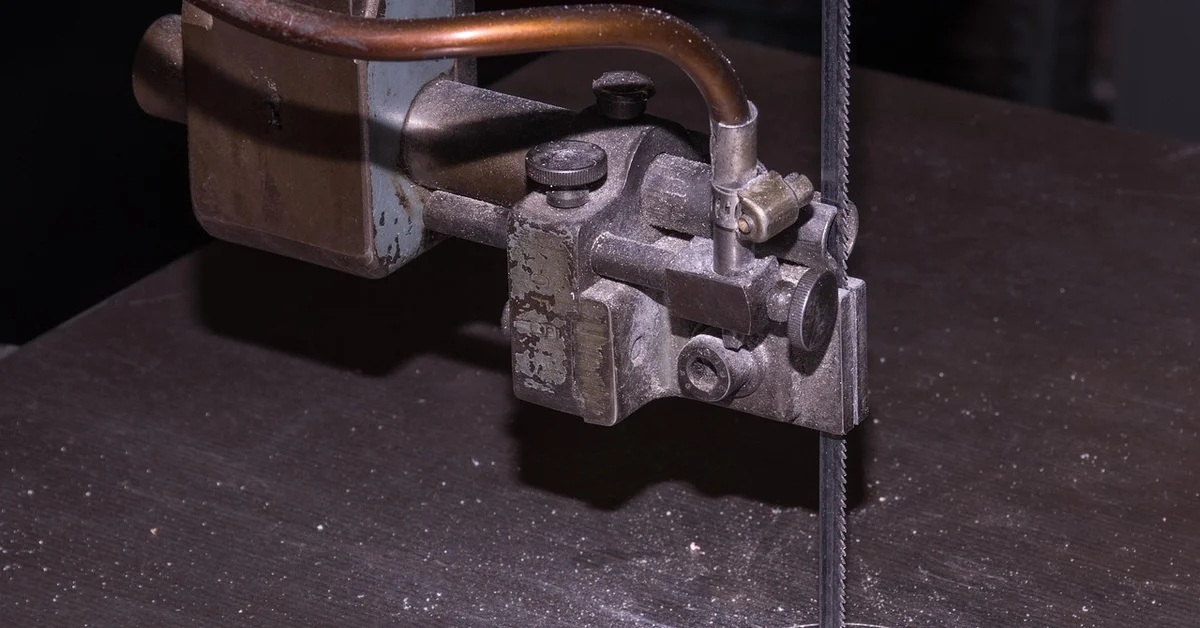
Best Bandsaw Blades for Metal: 7 Compared by TPI & Cost (2026)
The best all-around bandsaw blade for metal is the LENOX Wolf-Band 44-7/8″ bi-metal, 14 TPI — but the number that actually decides which blade to buy is cost per linear inch, and on that measure the Morse Master Cobalt below is the cheapest blade in this table at $0.149/inch, while the two 93″ stationary blades cost up to 73% more per inch for the same M42 bi-metal grade. Both findings come from the compiled dataset below, built from seven live Amazon listings and cross-checked manufacturer specs.
Bandsaw Blades for Metal Compared: Length, TPI, Grade & Real Cost
Every blade below is bi-metal (a hardened high-speed-steel tooth edge welded to a flexible spring-steel body), which is the standard construction for metal-cutting band saw blades on both portable and stationary saws. The column that doesn’t exist anywhere else we could find is cost per linear inch — price divided by blade length times pack count. It’s the only way to compare a $12 single blade against a $39 five-pack on equal footing, and it surfaces something the sticker price hides: every 93″ stationary blade in this table costs 42-73% more per inch than every 44-7/8″ portable blade, despite using the same M42 bi-metal grade.
| Blade | Length | Width x Thickness | TPI | Grade | Pack | Price | $/Linear Inch | Verdict |
|---|---|---|---|---|---|---|---|---|
| LENOX Wolf-Band 5-Pack | 44-7/8″ | 1/2″ x .020″ | 14 (fixed) | Bi-metal, HSS + Tuff Tooth | 5 | $38.97 | $0.174 | #1 Best Overall |
| DEWALT DW3986 3-Pack | 44-7/8″ | 1/2″ x .020″ | 14/18 (variable) | Bi-metal, 8% Co, Rc65-67 | 3 | $20.82 | $0.155 | Best for DEWALT-Compatible Saws |
| Milwaukee Deep Cut 3-Pack | 44-7/8″ | 1/2″ (thickness n/a) | 10/14 (variable) | Bi-metal (spec undisclosed) | 3 | $24.36 | $0.181 | Best for Milwaukee M18 FUEL |
| Imachinist S933414 | 93″ | 3/4″ x .035″ | 10/14 (variable) | M42 bi-metal, 8% Co/10% Mo, 68-69 HRC | 1 | $23.95 | $0.258 | Best for 7×12 Benchtop Saws |
| Bosch BS6412-24M | 64-1/2″ | 1/2″ x ~.02″* | 24 (fixed) | Bi-metal | 1 | $12.16 | $0.189 | Best Fine-Tooth for Thin Wall |
| Morse Master Cobalt 3-Pack | 44-7/8″ | 1/2″ x .020″ | 14/18 (variable) | Cobalt bi-metal, shock-resistant | 3 | $20.07 | $0.149 | Best for Stainless Steel |
| FOXBC 93″ M42 | 93″ | 3/4″ x .035″ | 10/14 (variable) | M42 bi-metal, 8% Co/2% W, Rc66-68 | 1 | $23.99 | $0.258 | Best Value for Stationary Saws |
*Bosch’s thickness is listed as 0.02″ by most distributors and 0.012″ by one (RS Hughes); Bosch’s own product page returned a 404 at the time of research so we could not resolve the discrepancy against the manufacturer directly — flagging it here rather than picking one number to make the table look clean. All prices and buy-box status were live-verified via the Amazon Creators API on 2026-08-04; no star ratings or review counts are shown because Amazon’s review data returned empty for every ASIN in this comparison.
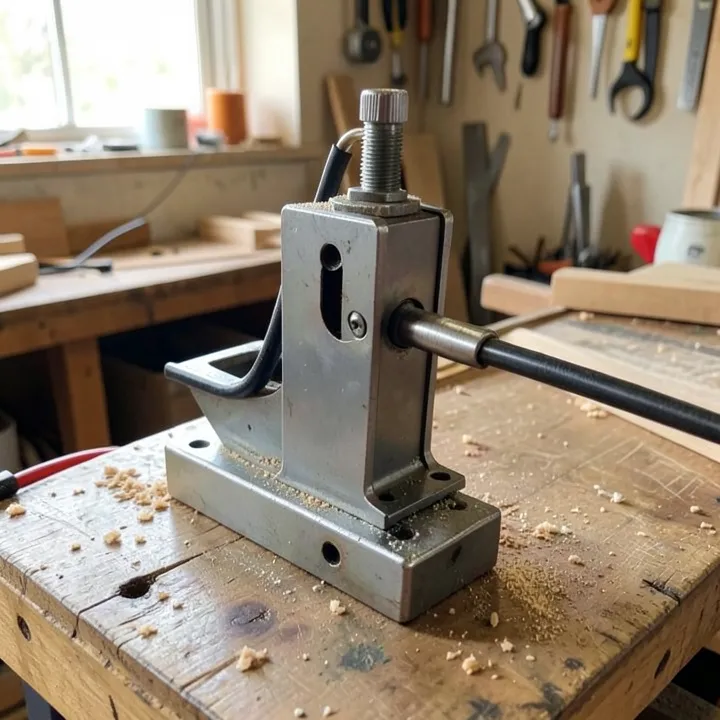
Best Bandsaw Blades for Metal
1. LENOX Tools Portable Band Saw Blades (Wolf-Band), 44-7/8″ 5-Pack — #1 Best Overall
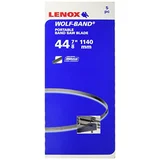
Check price on Amazon — $38.97
- 44-7/8″ x 1/2″ x .020″, 14 TPI
- Bi-metal, HSS cutting edge with Tuff Tooth reinforcement
- 5-pack — $7.79 per blade
- $0.174 per linear inch of blade
The LENOX Wolf-Band is the blade to buy if you want one product that handles most shop metal — mild steel angle, round bar, square tube 1/8″ and up — without babysitting a spec sheet. The Tuff Tooth design welds a reinforcing rib behind each tooth root, which is the specific failure point where a cheap bi-metal blade sheds teeth first under load. At $7.79 per blade in the 5-pack, it isn’t the cheapest per-inch option in this table, but it’s the one we’d hand a shop tech who wants to stop thinking about blades.
Pros
- Reinforced tooth root resists the chipping that ends a bi-metal blade’s life early
- 5-pack means a full season of cuts before you’re back on Amazon
- Fits the entire 44-7/8″ portable deep-cut platform (Milwaukee, DEWALT, Makita, Ridgid saws all use this length)
Main Drawback
It’s a fixed 14 TPI, not variable pitch — buy a second blade in a finer TPI if your work regularly includes thin conduit or angle iron.
2. DEWALT Portable Band Saw Blade, 44-7/8″ 14/18 TPI (DW3986), 3-Pack — Best for DEWALT-Compatible Portable Saws
Check price on Amazon — $20.82
- 44-7/8″ x 1/2″ x .020″, 14/18 TPI variable
- Bi-metal, Matrix II HSS edge, 8% cobalt content
- Rc 65-67 tooth hardness, alloy steel backer
- 3-pack — $6.94 per blade — $0.155 per linear inch
DEWALT’s DW3986 is the blade most people mean when they say “just get a normal metal blade.” Variable 14/18 TPI is the safer default than a fixed pitch for a shop that cuts angle iron one day and 1/4″ tube the next, and the 8% cobalt Matrix II edge holds up to the wear-and-heat cycle a portable deep-cut saw puts a blade through. At $6.94 a blade it undercuts the LENOX on price without giving up the variable-pitch versatility.
Pros
- 14/18 variable pitch keeps at least 3 teeth in contact across a wider range of stock than a fixed-TPI blade
- 8% cobalt content and Rc 65-67 hardness are both independently confirmed on DEWALT’s own spec sheet, not just marketing copy
- Cheapest true multi-pack in this table per linear inch after the Morse
Main Drawback
It’s a general mild-steel blade wearing a brand name — the 8% cobalt edge is genuinely good, but it isn’t the M51-class stainless formulation Morse ships below.
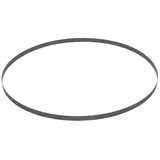
3. Milwaukee 44-7/8″ Deep Cut Bandsaw Blades, 10/14 TPI, 3-Pack — Best for Milwaukee M18 FUEL Deep Cut Saws
Check price on Amazon — $24.36
- 44-7/8″ length, 10/14 TPI variable
- Bi-metal construction
- 3-pack — $8.12 per blade — $0.181 per linear inch
- Width not independently published beyond the standard 1/2″ portable format
If you already own a Milwaukee Deep Cut saw, this is the low-friction pick — it’s tuned to the same platform millions of tradespeople already run. 10/14 TPI is coarser than the DEWALT or LENOX defaults, which is the right choice if most of your cuts are solid bar and heavy angle rather than thin tube. The tradeoff is a thinner published spec sheet: Milwaukee doesn’t disclose cobalt content or hardness the way DEWALT and FOXBC do for otherwise comparable blades.
Pros
- 10/14 TPI variable pitch is the coarser end of the range — the right call for solid round and square bar over 1/4″ thick
- Purpose-fit for Milwaukee’s own M18 FUEL Deep Cut and corded Deep Cut saws, the most common cordless metal band saw on U.S. jobsites
- Same 44-7/8″ universal length also fits DEWALT, Makita and Ridgid portables if you switch platforms later
Main Drawback
Milwaukee doesn’t publish the same cobalt-content or Rc-hardness figures DEWALT and FOXBC do for this blade — you’re buying on brand and platform fit, not a disclosed spec advantage.
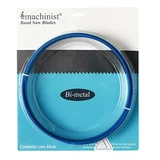
4. Imachinist S933414 M42 Bi-Metal Band Saw Blade, 93″ x 3/4″, 10/14 TPI — Best for 7×12 Benchtop Metal Bandsaws
Check price on Amazon — $23.95
- 93″ x 3/4″ x .035″, 10/14 TPI variable
- M42 bi-metal — 8% cobalt / 10% molybdenum HSS edge, 68-69 HRC
- Sold as a single blade — $23.95 per blade — $0.258 per linear inch
- Fits the entire 7×12 horizontal benchtop metal-bandsaw class
If your saw is a benchtop horizontal metal-cutter — the JET/Grizzly/KAKA-style 7×12 format that’s become the default hobbyist metal bandsaw — this is the blade length and grade to buy. M42 bi-metal with 8% cobalt and 10% molybdenum content puts real numbers behind “heavy duty,” and the 3/4″ width matches what these machines’ wheels are actually built to run. The catch, and it’s a genuine one this table exists to surface: at $0.258 per linear inch, stationary-format blades cost meaningfully more than portable ones of the same bi-metal grade.
Pros
- M42 is the industry-standard bi-metal grade for this format — the same grade used across nearly every 7×12 stationary metal bandsaw blade on the market
- 3/4″ width and .035″ thickness are noticeably beefier than any portable blade in this table, which is what a stationary machine’s wheel and guide bearings are built for
- Fits the single most common benchtop metal-cutting bandsaw format sold under a dozen house brands (JET, Grizzly, KAKA, Harbor Freight, WEN and others all use 93″ x 3/4″)
Main Drawback
This blade costs meaningfully more per inch of cutting edge than any portable blade here — that premium is real, not a rounding error, and it’s the same premium every 93″ stationary blade in this table carries.
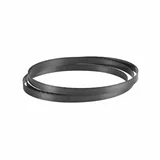
5. Bosch BS6412-24M Metal Cutting Stationary Band Saw Blade, 64-1/2″ 24 TPI — Best Fine-Tooth for Thin-Wall Tubing & Conduit
Check price on Amazon — $12.16
- 64-1/2″ x 1/2″ x ~.02″ (0.012″ per one distributor, 0.02″ per most — see note), 24 TPI fixed
- Bi-metal construction
- Sold as a single blade — $12.16 per blade — $0.189 per linear inch
- Fits stationary bandsaws built around the 64-1/2″ wheel span (common on smaller benchtop metal saws)
24 TPI is overkill for solid bar and exactly right for EMT conduit, thin box tube, and the sheet-metal offcuts that shred a coarser blade’s teeth right off the band. The BS6412-24M is also the cheapest single blade in this whole comparison in raw dollars, which makes it a reasonable second blade to keep on hand next to a coarser stationary blade for solid stock, rather than a one-blade-does-everything choice.
Pros
- 24 TPI fixed pitch is the finest tooth count in this table — the right call for EMT conduit, thin box tube and sheet-metal offcuts where a coarser blade would rip teeth out
- Cheapest single blade in this table in absolute price, and mid-pack on cost per linear inch
- 64-1/2″ length fits a smaller stationary-saw footprint than the 93″ format above, useful on compact benchtop machines
Main Drawback
It’s a single-purpose fine-tooth blade — excellent on thin-wall material, actively the wrong choice for anything thick. Don’t buy this as your only stationary blade.
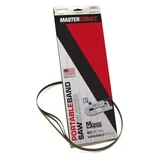
6. Morse Master Cobalt Bi-Metal Portable Band Saw Blade, 44-7/8″ 14/18 TPI, 3/Box — Best for Stainless Steel & Toughest Metals
Check price on Amazon — $20.07
- 44-7/8″ x 1/2″ x .020″, 14/18 TPI variable
- Cobalt bi-metal, shock-resistant cutting edge
- Made in the USA
- 3-pack — $6.69 per blade — $0.149 per linear inch — cheapest per-inch blade in this table
Stainless steel and other work-hardening alloys don’t fail a blade by dulling it evenly — they chip teeth off in shock loading the instant the blade catches. Morse’s Master Cobalt line is built specifically around shock resistance rather than raw hardness, which is the right property to optimize for that failure mode. It’s also, at $0.149 per linear inch, the cheapest blade in this entire table on a normalized basis — a genuinely good pick even outside the stainless use case.
Pros
- Cobalt-boosted edge is specifically formulated for shock resistance, the failure mode that snaps teeth on stainless and other work-hardening alloys
- Cheapest cost-per-linear-inch of every blade in this comparison, portable or stationary
- Made in the USA — one of only two blades in this table with disclosed country of origin
Main Drawback
“Master Cobalt” is Morse’s branding for the formulation, not a disclosed cobalt percentage — if you need the number for a spec sheet, Morse doesn’t publish it the way DEWALT does.
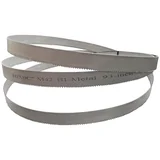
7. FOXBC 93″ M42 Bi-Metal Metal Cutting Band Saw Blade, 10/14 TPI — Best Value for Stationary Bandsaws
Check price on Amazon — $23.99
- 93″ x 3/4″ x .035″, 10/14 TPI variable
- M42 bi-metal — 8% cobalt / 2% tungsten, Rc 66-68 tooth hardness
- Sold as a single blade — $23.99 per blade — $0.258 per linear inch
- Same 93″ x 3/4″ fit as the Imachinist above — direct swap on 7×12 benchtop saws
FOXBC’s 93″ M42 blade sits at the same price and the same per-inch cost as the Imachinist above, with a slightly different alloy mix (cobalt plus tungsten rather than cobalt plus molybdenum) and a marginally higher published hardness spec. Functionally, for a 7×12 benchtop bandsaw, either is a reasonable buy at the same real cost per inch — pick whichever is in stock. Just don’t take the “3x the life” claim on the listing at face value; it’s unverified marketing copy, not a tested result.
Pros
- Publishes a harder tooth spec (Rc 66-68) than the Imachinist’s stated 68-69 HRC range is roughly comparable — both are genuinely hard M42-class edges
- Tungsten content alongside cobalt is a real, disclosed alloying detail most budget blades don’t publish at all
- Manufacturer claims up to 3x the life of “conventional” blades — we can’t verify that multiplier independently, so treat it as a marketing claim, not a tested figure
Main Drawback
The “outlasts conventional blades up to 3 times” claim on the listing is FOXBC’s own marketing language — we found no independent test verifying that multiplier, so weigh it as a claim, not a confirmed figure.
How We Picked These
This is a Tier C, dataset-led comparison — nobody on our team has personally run all seven of these blades through a cut-off test. Every spec in the table above was pulled from the product’s live Amazon listing via the Amazon Creators API on 2026-08-04, cross-checked against at least one independent distributor listing (Zoro, RS Hughes, Home Electrical, or the brand’s own site) where the Amazon listing didn’t fully disclose width, thickness, or alloy content. Where a spec genuinely wasn’t published anywhere we could verify — Milwaukee’s exact blade thickness, for example — the table says so instead of guessing. TPI-to-material and SFPM guidance is cross-referenced from multiple industry sources (SawMaster’s TPI chart, AIMS Industrial’s bandsaw blade guide, and M42/M51 grade documentation from several bi-metal blade manufacturers) rather than a single source. No star ratings appear anywhere on this page because Amazon’s review API returned no data for any of these seven ASINs at the time of research — we’d rather show nothing than invent a number.
The seven picks were chosen to span the category’s real axis of choice rather than to fill a quota: two lengths (44-7/8″ portable and 93″/64-1/2″ stationary), four brands with disclosed alloy specs and one without, fixed and variable tooth pitch, and pack sizes from a single blade to a five-pack. Every listed price and buy-box status was live-verified at the time of research rather than carried over from a prior session or a competitor’s article — a category this price-sensitive (blades are a recurring consumable, not a one-time purchase) goes stale fast, and a stale price is worse than no price.
What to Consider When Buying a Bandsaw Blade for Metal
Blade Length: Match Your Saw’s Wheel Span
A bandsaw blade has to be the exact length your machine’s wheels are set up for — there’s no adjustable range. Portable deep-cut band saws (Milwaukee, DEWALT, Makita, Ridgid) are built almost universally around 44-7/8″, with a shorter 32-7/8″ or 35-3/8″ compact size on some models. Benchtop 7×12 stationary metal bandsaws (JET, Grizzly, KAKA, WEN, Harbor Freight and most house brands) use 93″ x 3/4″. Larger stationary saws run 59-1/2″, 62″, or 64-1/2″ depending on the model. Check your saw’s manual or the blade currently installed before ordering — the wrong length simply won’t seat on the wheels. Not sure which saw type fits your work in the first place? Our steel cutting skill saw guide compares circular, band, and chop saws side by side.
TPI: Matching Tooth Count to Material Thickness
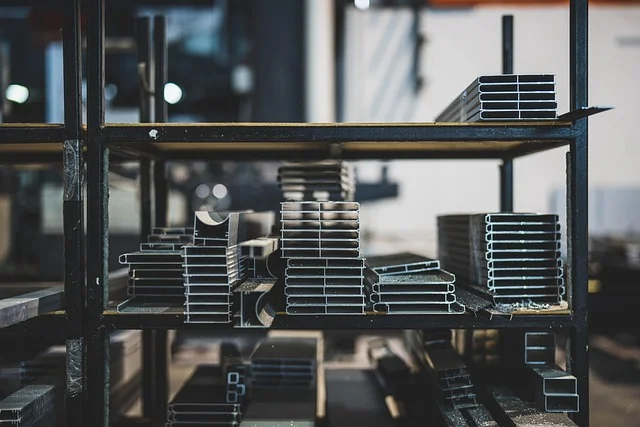
The rule that governs every TPI decision is the 3-tooth rule: at least 3 teeth should be in contact with the material’s cross-section at all times. Too few teeth in the cut and the blade snags, ripping teeth out; too many teeth packed into thin material and each tooth takes a shaving so thin it just rubs and dulls. Coarse pitch (6-10 TPI) suits solid bar and heavy angle 1/2″ and up. Fine pitch (18-24 TPI) suits thin-wall tubing, EMT conduit, and sheet stock under 1/8″. Variable-pitch blades (10/14, 14/18) split the difference and are the safer default for a shop that cuts a mix of stock.
Bi-Metal Grade: M42 vs. Cobalt vs. M51
M42 is the default bi-metal grade for general metal cutting — a high-speed-steel edge alloyed with roughly 8% cobalt and 10% molybdenum, hardened to 68-69 HRC. M51 pushes cobalt content to around 10% with additional alloying, reaching 69-70 HRC, and is the grade to reach for on bearing steel, tool steel, and other hard specialty alloys. “Cobalt” as a standalone marketing term (Morse’s Master Cobalt line, for instance) generally sits in the M42-to-M51 range but manufacturers don’t always publish the exact percentage, so treat unlabeled “cobalt” blades as a step up from plain HSS rather than a guaranteed M51 equivalent.
Variable Pitch vs. Fixed Pitch Teeth
A fixed-pitch blade (every tooth the same spacing) cuts a cleaner, more consistent kerf but only works well across a narrow range of material thickness. A variable-pitch blade mixes two or three tooth spacings across the band, which reduces the harmonic vibration and noise a fixed-pitch blade produces on thin-wall tubing and lets one blade cover a wider range of stock sizes. Four of the seven blades in our table use variable pitch; the two fixed-pitch options (LENOX at 14 TPI, Bosch at 24 TPI) are each tuned to a narrower job.
Blade Width and Set Pattern
Width has to match your saw’s blade guides, not just the wheel span — a 1/2″ blade won’t track correctly in guides set up for 3/4″. Portable deep-cut saws are standardized on 1/2″ width; stationary 7×12 benchtop saws are standardized on 3/4″. Tooth set (how far alternating teeth angle outward from the band) controls kerf width and chip clearance; virtually every metal-cutting bi-metal blade uses a raker or wavy set pattern rather than the alternating set common on wood blades, because it clears metal chips more reliably than sawdust.
Portable vs. Stationary Blade Compatibility
Don’t assume a portable and stationary blade are interchangeable just because both say “metal cutting” — they’re different lengths, different widths, and usually different thicknesses, built for completely different guide and tensioning systems. The one thing that is genuinely universal is the 44-7/8″ x 1/2″ portable format: it fits Milwaukee, DEWALT, Makita and Ridgid deep-cut saws interchangeably, which is why four different brands in our table compete on that exact size.
Pack Size and Real Cost per Blade
Sticker price is misleading across this category because pack sizes range from a single blade to a 5-pack. The LENOX at $38.97 looks like the most expensive blade in this table until you divide by 5 and get $7.79 — cheaper per blade than the single Imachinist at $23.95. Always check the per-blade and per-inch numbers in the dataset table above before judging a listing on its headline price.
SFPM: Matching Blade Speed to Metal Type
Blade speed (surface feet per minute) needs to drop as material hardness rises: mild carbon steel typically cuts well around 200-300 SFPM, stainless and other tough alloys need slower speeds to control heat buildup, and soft non-ferrous metals like aluminum, brass and copper can run considerably faster, commonly cited in the 300-800 SFPM range. Most portable deep-cut saws run at a single fixed speed tuned for steel; variable-speed stationary saws let you dial speed down for stainless and up for aluminum. This guidance is cross-referenced from multiple industry sources rather than one blade manufacturer’s chart, since we could not locate a single published SFPM table specific to any one blade in this comparison.
Blade Break-In and Maintenance
A brand-new bi-metal blade benefits from a short break-in period — the first minute or two of cutting at roughly two-thirds of your normal feed pressure seats the teeth evenly and measurably extends the life of the edge, the same principle as breaking in a new drill bit. Once broken in, storing blades uncoiled but loosely looped (never kinked or folded, which cracks the weld) and keeping them lightly oiled between uses prevents surface rust from pitting the teeth. Rotating between two or more blades of different TPI — rather than running one blade until it’s fully dull — also spreads wear more evenly and means you’re never stuck without the right tooth count for a job that shows up unexpectedly.
How to Use a Bandsaw Blade for Metal
- Match TPI to the material’s cross-section using the 3-tooth rule — count how many teeth will actually sit inside the thinnest wall or dimension of your stock, and pick a blade where that number is at least 3.
- Set blade speed for the metal type before starting the cut: slower for stainless and other tough alloys, standard mild-steel speed for carbon steel, faster for aluminum, brass and copper.
- Install the blade with the teeth pointing in the direction of travel (down and toward the motor on most portable saws) and tension it to the machine manufacturer’s spec — too loose and the blade wanders off-square, too tight and it stresses the weld.
- Break in a new blade on a scrap cut at reduced feed pressure for the first minute or two — this seats the teeth evenly and measurably extends blade life on bi-metal blades.
- Use cutting fluid or wax on stock over roughly 4-5 inches, or on any extended cut — it carries heat away from the teeth and clears chips from the gullets, which is the main reason coolant-equipped stationary saws get longer blade life on thick material.
- Watch for dulling signs — increased cutting force, a burning smell, discoloration on the cut edge, or visible tooth wear under magnification — and change the blade before it starts wandering off-square rather than after.
Frequently Asked Questions
What TPI is best for cutting metal on a band saw?
It depends on material thickness, not the metal type itself: 6-10 TPI for solid bar and heavy stock over 1/2″, 14-18 TPI for medium stock in the 1/8″-1/2″ range, and 18-24 TPI for thin-wall tubing, conduit and sheet under 1/8″. Variable-pitch blades (like the 10/14 or 14/18 options in our table) cover a wider range with one blade and are the safer default if you’re not sure.
What’s the difference between M42 and cobalt bi-metal band saw blades?
M42 is a specific, named bi-metal grade — roughly 8% cobalt and 10% molybdenum content, hardened to 68-69 HRC — used as the industry-standard designation on stationary blades like the Imachinist and FOXBC in our table. “Cobalt” as used in a product name (Morse’s Master Cobalt, for example) usually describes a similar or higher cobalt-alloyed formulation but isn’t always tied to the same published M42/M51 numbering, so check for an explicit grade if you need the exact spec.
Can I use a wood-cutting band saw blade to cut metal?
No, not safely or effectively. Wood bandsaw blades are almost always carbon steel rather than bi-metal, with a tooth geometry designed to clear wood chips rather than metal shavings, and they dull or snap almost immediately on metal. Use a bi-metal blade rated for metal cutting specifically — every blade in our table qualifies.
What blade speed (SFPM) should I use for steel vs. aluminum?
As a general cross-referenced guideline: mild carbon steel cuts well around 200-300 SFPM, stainless and other tough alloys need slower speeds to manage heat, and soft non-ferrous metals like aluminum, brass and copper can run considerably faster, commonly cited up to roughly 800 SFPM. Fixed-speed portable saws are tuned near the steel end of that range; a variable-speed stationary saw lets you adjust per material.
Are 44-7/8-inch portable band saw blades interchangeable between brands?
Yes, for the blade itself — 44-7/8″ x 1/2″ is a shared industry-standard format that fits Milwaukee, DEWALT, Makita and Ridgid portable deep-cut band saws interchangeably, which is why four different brands compete on that exact spec in our comparison table. The saw’s own guide rollers and tensioning system determine fit, not the blade brand.
How long does a metal-cutting band saw blade actually last?
It depends heavily on material, TPI match, speed, and coolant use far more than on brand — there’s no single published lifespan figure we could verify across these products. A well-matched bi-metal blade run at correct speed with adequate coolant on appropriate stock can cut for many hours; the same blade run too fast, dry, or badly TPI-mismatched to the stock can dull or chip within a single cut. Watching for the dulling signs in the how-to-use section above is a better guide than a fixed hour count.
Do I need a different blade for stainless steel?
You don’t strictly need a different blade, but you benefit from one built for shock resistance rather than raw hardness alone, since stainless and other work-hardening alloys tend to chip teeth under shock loading rather than simply dulling evenly. The Morse Master Cobalt in our table is built specifically around that property. Running at reduced SFPM and using cutting fluid matters at least as much as blade choice on stainless.
Why do stationary bandsaw blades cost more per inch than portable ones?
In our dataset, the two 93″ stationary blades (Imachinist and FOXBC) both worked out to $0.258 per linear inch, versus $0.149-$0.189 for the 44-7/8″ and 64-1/2″ blades. We can’t point to a single published reason, but the most likely explanation is production volume: portable 44-7/8″ blades sell into a much larger market (every Milwaukee, DEWALT, Makita and Ridgid deep-cut saw owner) than the narrower 7×12 benchtop-bandsaw market the 93″ format serves, and higher volume typically drives per-unit manufacturing cost down. It’s worth budgeting for if you’re pricing out a stationary machine and its blades together.
Final Thoughts
For most shops, the LENOX Wolf-Band 44-7/8″ 14 TPI 5-pack is the one blade worth defaulting to — reinforced tooth roots, a fit that spans four major portable-saw brands, and a 5-pack that means you’re not reordering every few months. But the number worth remembering from this whole comparison is the one the sticker prices hide: cost per linear inch. On that measure the Morse Master Cobalt, at $0.149 per inch, is the cheapest blade here — and every 93″ stationary blade in this table costs 42-73% more per inch than every portable blade, for the same bi-metal grade. If you’re buying for a benchtop 7×12 metal bandsaw, budget for that premium; it’s real, and it isn’t going away with a different brand.
Related Bandsaw Guides
- Best Band Saw for Metal: 7 Compared by SFPM & Capacity — if you need the machine itself, not just the blade
- Best Bandsaw Blades for Woodworking — the wood-cutting equivalent of this comparison
- Best Bandsaw Blade for Resawing — wide-blade picks for resawing thick lumber
- 7 Band Saws Compared: Throat, Resaw Capacity & Price — general-purpose wood bandsaw picks
- Reciprocating Saw for Metal: Best Blades and Cutting Tips — a different tool entirely for metal cutting
- Cut-Off Saw Blades for Metal: Best Picks for Clean Cuts — abrasive and dry-cut blade options for chop saws and angle grinders
- How to Sharpen Bandsaw Blades
- How Tight Should a Bandsaw Blade Be?
Sponsored / affiliate links. As an Amazon Associate I earn from qualifying purchases. I may earn additional commission from eligible campaigns.