Why Is Wood Cracking in Winter?
Wood cracks in winter because heated indoor air pulls moisture from boards, seasonal shrinkage opens joints, or water-damage splits the grain. If a crack follows a joint, checking, or a humidity shift, the fix changes. Using the wrong repair can leave furniture loose, widen floor gaps, or let structural damage spread. This guide shows how to tell normal checking from movement-related joint failure and moisture-damage splitting, then what to do next.
Why wood shrinks across the grain in winter
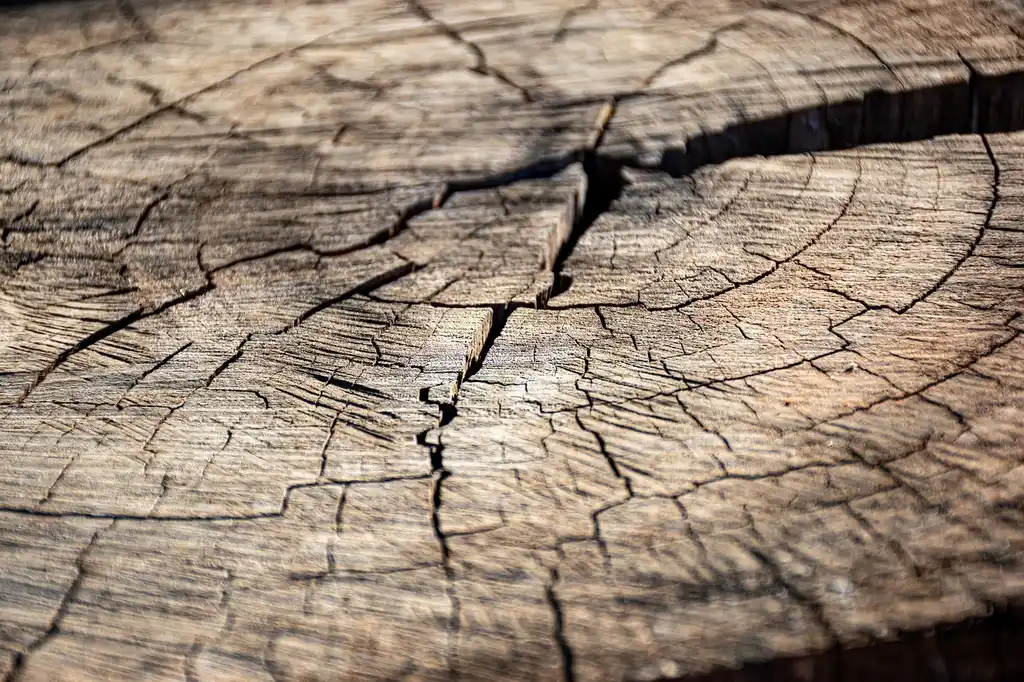


Wood takes on and gives off moisture from the air around it. When heating dries indoor air, wood drops toward a lower equilibrium moisture content, shrinks mostly across the grain, and stress builds where parts cannot move freely. The result can be cosmetic checking, open joints, or a true split.
How low winter humidity dries wood
Winter heat lowers indoor relative humidity, often into ranges that are hard on solid wood. Flooring guidance commonly points to about 30% to 50% indoor humidity, and some wood-floor guidance uses 35% to 55%. As humidity falls, wood loses moisture and changes size; movement is mostly across the grain, not along it.
A common first-timer mistake is to blame any crack on dry air alone. Dry air matters, but the failure mode depends on where the crack appears, how wide it is, and whether the wood is free to move. A board can shrink harmlessly at one edge and still split badly at a restrained end grain or joint.
Why shrinkage happens across the grain
As wood dries, its width changes more than its length. A page-level rule of thumb says wood moves about 1% in width for every 4% change in moisture content, and a 12-inch wide board can move 1/4 inch or more with seasonal humidity swings. Quartersawn wood moves roughly half as much as flatsawn wood, so cut matters.
That difference is why two pieces in the same room do not always react the same way. A flatsawn face may cup, gap, or crack sooner than a quartersawn face of the same species. Grain direction, board width, and restraint from fasteners or joinery all change the risk.
Why the same room can affect parts differently
EMC, or equilibrium moisture content, is the moisture balance point between wood and surrounding air. It changes with indoor and outdoor climate. A heated room can push one part of a piece below the moisture level it had when installed, while a shaded or less-heated area stays closer to its original condition.
That is why the same room can produce a tight panel, a loose frame joint, and a checked timber at the same time. The room is not acting on each piece equally. Surface exposure, finish condition, board thickness, and grain orientation all change how fast moisture leaves.
What winter cracking usually means
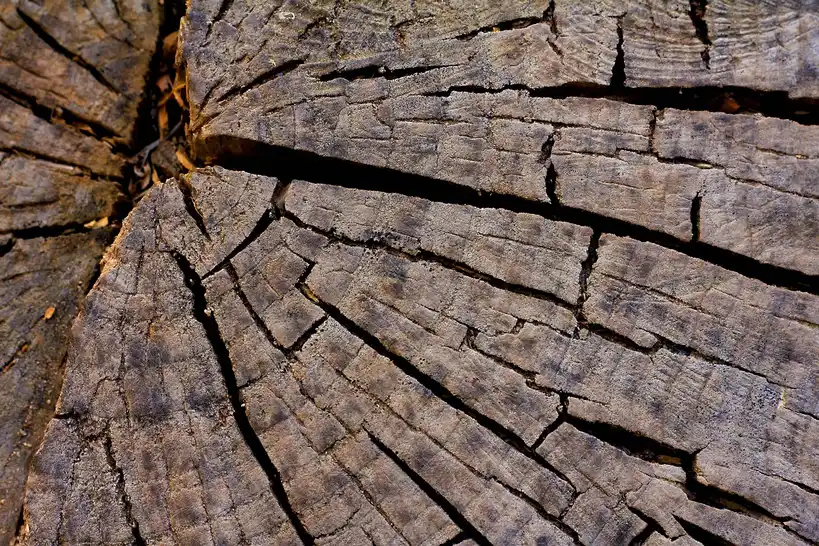
Winter cracking usually falls into one of three problems: normal checking in drying timber, movement-related joint failure, or true splitting from moisture damage. Checking is usually a surface crack that starts as wood dries. Joint failure happens when moving parts are restrained. True splitting runs through the wood and can mean a more serious problem.
Finish cracks are different again. A cracked finish can look alarming while the wood below is still intact. That kind of failure needs a different repair than a split board or a loose mortise-and-tenon joint.
Winter crack triage table
Use this table to match what you see with the likely cause, how urgent it is, and the next step. Start with location, then width, then grain direction, then whether the surrounding part is still fitting or moving normally.
| Item | Crack location | Width and grain direction | Other symptoms | Likely cause | Urgency | Best next step |
|---|---|---|---|---|---|---|
| Floorboard | Across the face, usually near knots, ends, or wide boards | Fine line that follows grain; may start at end grain | Seasonal gaps at board edges; no bounce; finish may stay intact | Normal seasonal checking or shrinkage from low humidity | Low to moderate | Measure indoor RH, raise humidity if needed, monitor for growth |
| Floorboard | At seams, tongues, or board ends near walls | Crack follows a joint or perpendicular to grain | Popping, squeaking, cupping, buckling, or visible pressure at the perimeter | Movement-related joint failure or missing expansion space | Moderate to high | Check expansion gap, humidity, and fastening; inspect before damage spreads |
| Furniture panel | Inside a framed panel or along a tabletop edge | Crack runs with grain in a wide panel | Loose joints, sticking drawers, seasonal gaps, finish crack on top | Cross-grain stress from restrained movement | Low to moderate | Let the panel move, repair finish only if wood is sound |
| Furniture rail or leg | At glue lines, mortises, or dowel joints | Crack opens at a joint rather than through the middle of the part | Wobble, racking, separated joint, lifted veneer | Joint failure from seasonal movement or weak repair | Moderate | Stop loading the piece; re-glue or mechanically repair as needed |
| Timber | Outer surface, usually lengthwise on a beam or post | Narrow surface crack that may stop short of the center | Often appears as timber dries; may not affect serviceability | Checking during drying | Low if shallow | Measure moisture content and inspect depth, especially on green timber |
| Timber | All the way through the section | Crack crosses the full thickness or width | Misalignment, sag, loosened connections, new movement | True split or moisture-related damage | High | Get a prompt structural inspection |
How do you tell checking from a real split?
Checking is a surface crack in drying timber. A real split goes through the section or through a joint and usually changes how the piece carries load. If the crack is shallow, stable, and confined to the outside surface, it is often checking. If it opens through the piece, treat it as more serious.
Look at the crack surface and depth
Start with the surface. Checking often begins on the exterior and, in timber, almost always stops at the heart. A split does not stop there. If the crack can be seen on opposite faces, or if you can see daylight through a beam or post, that is a split, not checking.
Moisture meter readings help here. A moisture meter is used to measure wood moisture content. Surface meters work better on thin boards than on thick timbers, where the outer shell may read drier than the core. That matters because the outside can look stable while the interior is still moving.
Check whether the piece still fits its joint
Loose fit changes the diagnosis. If a tabletop joint opens, a door frame racks, or a floorboard starts popping because it is being forced, the issue is movement-related. If the wood is cracked but the joint is still sound and the piece stays aligned, the problem is more likely cosmetic checking.
Say your 8-inch-wide tabletop has a hairline crack near one end and the breadboard ends are still tight. That points toward normal movement or finish stress. If the same crack comes with a lifted rail, open glue line, and wobble, the joint has failed and needs repair.
Use a moisture meter for a quick check
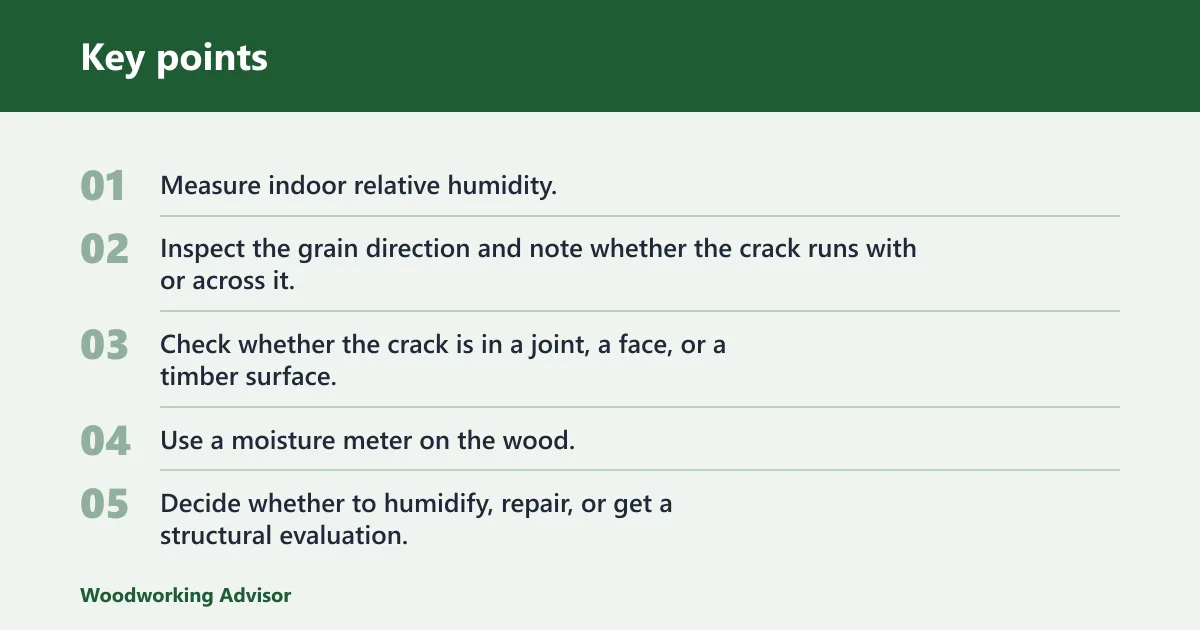
Measure the wood before you fill anything. If the wood is still far from its expected indoor equilibrium moisture content, filling a crack alone may fail again. A meter reading helps you decide whether to humidify, repair, or call for help. On thick timber, check more than one spot.
- Measure indoor relative humidity.
- Inspect the grain direction and note whether the crack runs with or across it.
- Check whether the crack is in a joint, a face, or a timber surface.
- Use a moisture meter on the wood.
- Decide whether to humidify, repair, or get a structural evaluation.
Why do floors, furniture, and timbers fail differently?
Floors, furniture, and timbers fail differently because each one is restrained in a different way. Floors depend on perimeter space and fasteners. Furniture often contains cross-grain construction. Timbers dry more slowly and can show checking first. The same dry room can produce gaps in one item, a loose joint in another, and a checked beam in a third.
Solid wood floors and expansion gaps
A wood floor expansion gap is the perimeter space hidden under baseboards that gives the floor room to move. Without it, seasonal shrinkage and swelling can create pressure that causes popping or buckling. Winter cracks in floors are often linked to low humidity or low moisture in the room.
Engineered wood floors usually move less than solid wood because their layered structure restrains movement. That does not make them immune. If the top layer or joints are stressed, you can still get gapping, edge checking, or noise when indoor humidity drops.
Furniture parts with cross-grain stress
Cross-grain construction creates stress when grain directions conflict. A wide panel trapped in a frame, or a tabletop fastened too rigidly, has to move against the grain in at least one direction. That is where cracking, buckling, or joint failure often begins.
Designers allow movement with tabletop fasteners, wooden buttons, or screws through elongated holes. Do not glue a panel into its frame groove. That traps seasonal movement and turns normal shrinkage into damage.
Picture a dining tabletop about 24 inches wide fixed with screws in round holes through the apron. In a dry month, the top wants to move across the grain, but the screws hold it in place. The result can be a split near the fasteners or a pulled joint at the edge.
Timber framing and surface checking
Timbers dry more slowly than thin boards. A common rule of thumb says timber air dries about one inch per year. Because the outside dries first, surface checks are common and often expected in green timber. Those checks are not always structural if the piece was sized and used correctly.
If the crack goes all the way through a timber, it is a split. That deserves closer attention than ordinary checking. Deep cracks near bearing points, connections, or notches deserve prompt inspection because they can affect load transfer.
What humidity range helps slow cracking?
Keeping indoor humidity in a moderate range slows shrinkage and reduces crack risk, but the right number depends on the wood and the use case. Flooring guidance often points to 35% to 55% RH, while some floor-noise guidance says roughly 30% to 50%. The target is to avoid deep winter dryness, not to keep every room identical.
Indoor relative humidity targets in winter
For many homes, staying near the middle of those ranges is practical. Lower than that, and solid wood moves more aggressively. Higher than that, and other problems can appear, including swelling and finish stress. A stable room matters as much as the exact number.
Relative humidity should also be judged against the wood’s EMC. If the room is heated and the air stays dry for weeks, the wood will continue adjusting toward a lower moisture balance point. That is when seasonal cracks become more likely.
When a humidifier helps and when it will not
Humidifiers can help reduce winter cracking when low indoor RH is the driver. They are less helpful if the crack comes from a loose joint, a bad repair, or water damage. If the piece is already split or the floor is buckling, humidity control alone will not fix the cause.
Humidify first when the damage looks seasonal and the wood is otherwise sound. Repair first when a crack is already opening a joint or changing the way the piece fits. Call for inspection when a timber split, floor buckle, or repeated movement suggests more than seasonal shrinkage.
Start with moisture control before you reach for filler. If the wood keeps moving, putty and caulk can fail again. Prevention means keeping humidity in range, giving wood room to move, and choosing the right repair for the specific failure mode. Not every crack needs epoxy.
Control humidity before filling anything
Check RH first, then measure the wood. If indoor air is too dry, raise it gradually and watch whether the crack stabilizes. For floors, that often means staying within the 35% to 55% range; for many heated rooms, even a move toward the lower-middle of that range can reduce movement.
Choose repair methods for cosmetic cracks
Small cosmetic checking can be filled, but only after movement slows. Putty, epoxy, caulk, or sawdust and glue can work on non-structural defects, depending on finish and location. Use them on stable, shallow cracks. Skip them for active splits, loose joints, or damaged bearing members.
When to call a pro for structural movement
Call for an inspection if a crack passes through a timber, if a floor is buckling, if a furniture joint is separating, or if the same crack keeps reopening after humidity control. Those are signs of active movement or moisture damage, not simple cosmetic checking. Prompt review can prevent a small crack from becoming a larger repair.
Costs rise with delay. A shallow check in a beam may need monitoring and minor sealing. A split near a connection, a lifted floor section, or a failed furniture joint can turn into a more expensive repair if the underlying cause is not corrected.
Frequently asked questions
Does wood crack in winter?
Yes. Wood can crack in winter because heated indoor air lowers relative humidity, wood shrinks toward a new equilibrium moisture content, and restrained parts cannot move evenly. The crack may be normal checking, a loose joint, or a true split. The location and depth tell you which one it is.
Why is my wood cracking in winter?
Most winter cracking comes from low indoor humidity, but the cause can differ by item. A floorboard may gap because it is shrinking across the grain, a tabletop may split because fasteners block movement, and a timber may check as it dries. Measure RH, then inspect the grain and the joint.
Why does indoor wood split when the heat is on?
Heat lowers indoor relative humidity, which pulls moisture out of wood. As the wood dries, it shrinks mostly across the grain. If the piece is wide, heavily restrained, or joined across grain directions, stress builds until the wood splits or a joint opens. A humidifier can reduce that risk.
Is winter cracking normal in hardwood floors?
Some seasonal checking, edge gaps, and small finish cracks can be normal in hardwood floors when indoor air gets dry. Wide cracks, buckling, popping, or repeated movement are not normal. Floors often perform best when indoor humidity stays roughly in the 30% to 50% range, or within the floor maker’s guidance.
How dry does a room get before wood starts cracking?
There is no single cutoff, but many floors and other indoor wood items begin to show problems when winter humidity drops below the recommended range. Some flooring guidance uses 35% to 55% RH, while other pages cite about 30% to 50%. Below that, shrinkage risk rises fast.
How do I tell seasonal checking from a real split?
Seasonal checking usually starts at the surface of a drying timber and often stops before the center. A real split goes through the piece or through a joint, and it often affects fit or load-carrying behavior. A moisture meter can help confirm whether the wood is still drying or has stabilized.
Can humidifiers stop wood from cracking in winter?
Humidifiers can slow or prevent some winter cracking by keeping indoor air from getting too dry. They work best as prevention, not as a repair for an already failed joint or split. If the wood is moving because of a design problem, humidity control alone will not solve it.
Which wood items crack first in winter: floors, furniture, or timbers?
It depends on restraint and exposure, but furniture panels and wide floors often show movement first because they respond quickly to indoor humidity swings. Timbers may show surface checking first, which can be normal. Floors often reveal the problem as gaps or noise, while furniture often shows joint stress or panel cracks.
Why is my wood cracking?
Your wood is probably reacting to moisture change, but the specific cause could be normal checking, movement-related joint failure, or a true split. Look at where the crack is, whether it follows the grain, and whether the piece still fits its joint. Then measure humidity and moisture content before choosing a repair.
Does wood crack in winter: yes, wood can crack?
Yes, wood can crack in winter because indoor heating lowers humidity and wood shrinks toward a lower moisture balance point. The crack may be harmless checking, a joint opening, or structural splitting. The key is to judge depth, location, and whether the wood is still moving after humidity changes.
Sponsored / affiliate links. As an Amazon Associate I earn from qualifying purchases. I may earn additional commission from eligible campaigns.