Wooden Door Shrinks in Winter
A wooden door shrinking in winter is usually normal when indoor humidity drops below about 35% RH; if the gap is larger than about 1/8 inch, or the latch and hinges still fail after humidity rises, it likely needs adjustment. Left alone, it can cause drafts, sticking, rattling, and extra wear on the latch and frame. This guide explains why wood moves, how to tell seasonal shrinkage from a fit problem, and what humidity or hardware fixes to try.
Why wooden doors move in winter
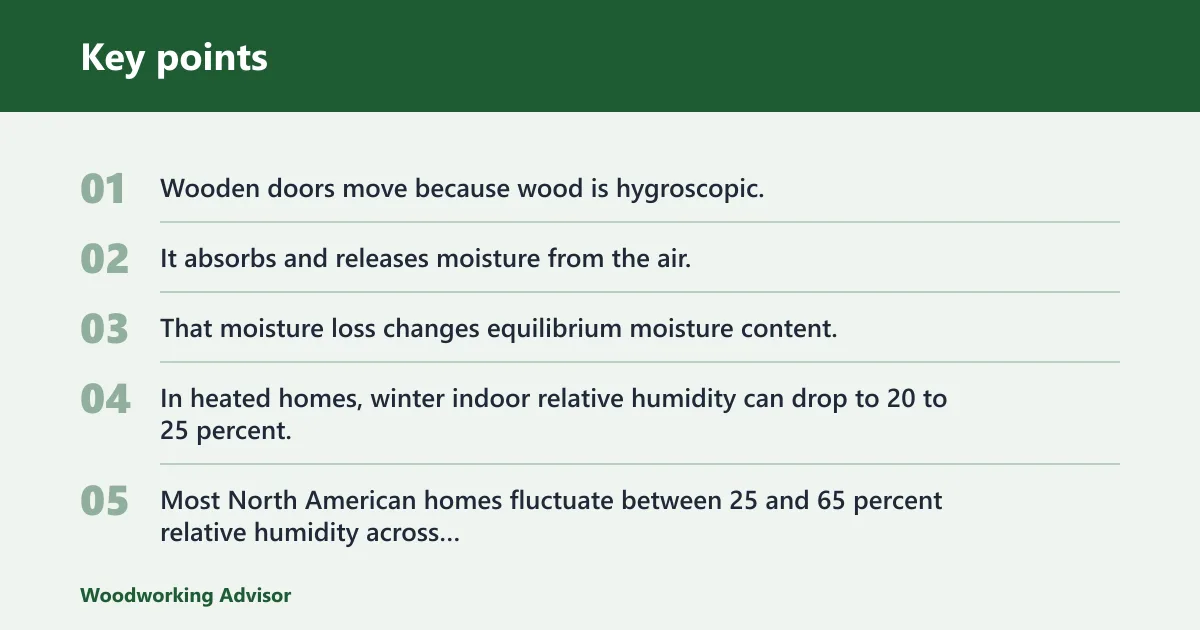


Wooden doors move because wood is hygroscopic. It absorbs and releases moisture from the air, so winter indoor air that turns dry pulls moisture out of the door and lowers its moisture content. As the cell walls dry, the door contracts. Cold alone is not the main cause.
That moisture loss changes equilibrium moisture content, which is the level wood settles toward based on surrounding air. In heated homes, winter indoor relative humidity can drop to 20 to 25 percent, and that is dry enough to shrink many doors and frames. Most North American homes fluctuate between 25 and 65 percent relative humidity across the year.
Why movement shows up across the grain first
Wood shrinks across the grain more than along it. Tangential movement is greater than radial movement, and longitudinal movement is very small by comparison. That is why width changes more than height on a door, even though the whole panel can move a little.
A standard 32-inch-wide door could change by more than half an inch under extreme conditions. Normal seasonal movement is usually smaller than that, but even a modest change can create an edge gap, a latch miss, or a rattle if the frame was fitted tightly in a wetter season.
How equilibrium moisture content changes door fit
When indoor air gets drier, the door loses moisture until it reaches a new equilibrium. If the door was fitted at a higher moisture content, winter can reveal a tighter latch side, a wider gap on the pull side, or a loose fit that was hidden by summer swelling. That is why the same door can feel different from one season to the next.
Does your door shrink or need adjustment?
Seasonal shrinkage is most likely when the problem appears in winter, the door still latches with minor resistance, and the gap or draft improves when indoor humidity rises. A hardware or frame problem is more likely when the same symptom is getting worse, shows up in only one spot, or does not change when humidity changes.
Signs that point to normal seasonal movement
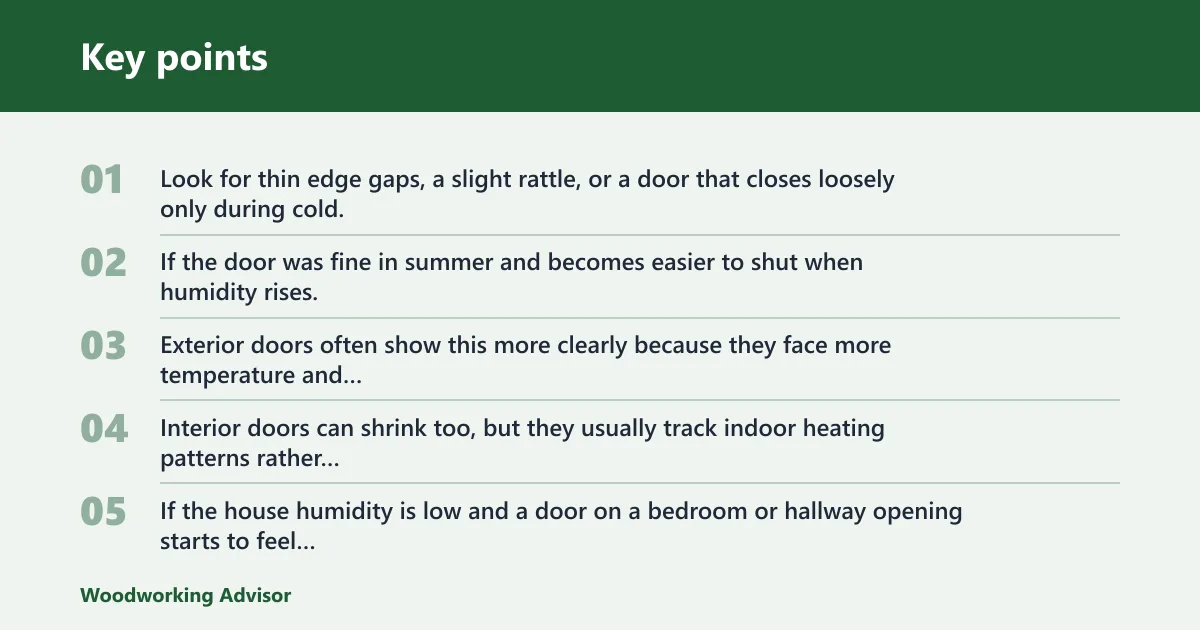
Look for thin edge gaps, a slight rattle, or a door that closes loosely only during cold, dry weather. If the door was fine in summer and becomes easier to shut when humidity rises, wood movement is the likely cause. Exterior doors often show this more clearly because they face more temperature and humidity swing than interior doors.
Interior doors can shrink too, but they usually track indoor heating patterns rather than outdoor weather. If the house humidity is low and a door on a bedroom or hallway opening starts to feel loose, that still fits the same pattern.
Signs that point to hardware, frame, or fit problems
Need adjustment is more likely when the latch misses the strike plate, the hinges sag, the door scrapes the top or side in one season and not another, or the gap is uneven from top to bottom. Those clues can point to hinge settlement, frame movement, or a door that was swollen in summer and damaged by repeated rubbing.
Say your 30-inch interior door rattles at the latch side and leaves a 3/16-inch gap, but the humidity has already climbed into the low 40s and the door still will not close firmly. That is less like harmless winter shrinkage and more like a strike plate or hinge issue.
Interior door versus exterior door clues
Interior doors usually respond to heated indoor air, while exterior doors deal with both indoor dryness and outside weather exposure. Exterior doors also rely more on weatherstripping, so a loose seal can make a normal seasonal gap feel worse. Interior doors may need hardware tuning instead of sealing work.
Winter door diagnosis table
Use this table to sort normal movement from a door that needs a fix. The humidity check column helps separate dry-air shrinkage from a hardware or frame problem.
| Symptom | Likely cause | Best next step | Humidity check | Call a pro threshold |
|---|---|---|---|---|
| Rattling at the latch side | Wood lost moisture and the door no longer fits snugly | Check RH, then add weatherstripping or adjust the strike plate if the gap is small | Below 35% RH is a common shrinkage zone; 35 to 45% is a better target | Call a pro if the rattle remains above 45% RH or the latch still misses |
| Edge gaps | Seasonal shrinkage, especially across the grain | Confirm whether the gap is even; if it is minor, tighten the seal with weatherstripping | Check whether indoor RH has dropped to 20 to 25% | Call a pro if the gap is larger than about 1/8 inch or is uneven |
| Latch failure | Strike plate mismatch, hinge settlement, or seasonal shrinkage | Try a strike plate adjustment before planing the door | Humidity alone should not stop a properly aligned latch from engaging | Call a pro if the latch fails after humidity returns to 35 to 45% |
| Sticking that improves in winter | Summer swelling was the bigger issue | Watch for the rubbing spot and plan a minor fit correction when the door is drier | A return to drier air can reduce the bind | Call a pro if the door has visible damage from past summer rubbing |
| Sticking that worsens in winter | Frame movement, hinge shift, or a door that is out of square | Inspect hinges and frame first; do not plane until the cause is clear | Confirm whether RH is low or if the problem persists after RH rises | Call a pro if the rub spot changes or the frame looks twisted |
What humidity level keeps a door stable?
A winter indoor humidity target between 35 and 45 percent is a practical range for keeping wooden doors steadier. Some guidance also uses 40 to 55 percent, but for many heated homes, staying in the 35 to 45 percent band is a realistic starting point. Below about 35 percent relative humidity, shrinkage becomes more likely.
How to read a hygrometer
A hygrometer measures indoor humidity and gives you a number to work with instead of guessing. Place it in the room where the door problem shows up, away from direct heat vents and out of the bathroom or kitchen during short bursts of moisture. Watch for seasonal swings, not one brief reading.
If the reading sits near 20 to 25 percent, the air is dry enough to pull moisture out of wood quickly. If it stays between 35 and 45 percent, and the door still sticks or rattles, look harder at hardware or frame fit.
When a humidifier makes sense
A humidifier helps when heated indoor air is the main cause of dry-wood movement. It does not fix a bad hinge, but it can cut seasonal shrinkage and help steady winter wood movement. Use it with a hygrometer, or you can overshoot and create the opposite problem later.
Picture a 36-inch exterior door that starts rattling in January, while the house sits at about 22 percent RH. Raising humidity into the 35 to 45 percent range may tighten the fit enough that you only need a small strike plate tweak.
Why finish and construction matter
Sealant and finish control how fast wood exchanges moisture with the air. Paint, varnish, and polyurethane all slow movement, but only if they cover all sides, including the top, bottom, and edges. One-sided finishing can make one face absorb or lose moisture faster than the other, which can warp or twist the door.
Unfinished edges and one-sided coating problems
Top and bottom rails matter because exposed end grain and unfinished edges can lose moisture faster than the faces. If one edge was left raw, or if old finish has worn through, winter shrinkage can appear uneven. That uneven response can be mistaken for a hinge issue when the surface protection is the real problem.
Species, size, and construction differences
Hardwoods are generally more stable than softwoods, though construction matters as much as species. A solid wood door, a veneered core door, and a frame-and-panel door do not all move the same way. Larger doors move more in absolute terms, and construction details can make a change more or less noticeable at the latch.
How to reduce drafts and fit issues
Start with the least invasive fix. If the door mostly has edge gaps and drafts, weatherstripping is often a good first step. It can block air leaks around the stop and jamb, but it does not correct frame movement, hinge settlement, or a door that is rubbing badly.
Weatherstripping for edge gaps
Weatherstripping works best when the door is close to fitting correctly and only needs help sealing the edge gaps. It is a mitigation for shrinkage-related openings, not a cure for a crooked frame. If the latch barely engages, address the hardware too.
Hardware adjustments for hinges, latches, and locks
Minor adjustment to hinges, locks, and latches can restore fit when the problem is small. Tightening loose screws, resetting a strike plate, or adjusting a hinge leaf may be enough. If the door sagged after summer swelling or the frame shifted, those same parts may need a more careful reset.
A common first-timer mistake is planing the latch edge before checking the hinges. That can remove too much material and make the gap permanent. Check screw tightness and hinge alignment first.
Light planing or sanding when needed
Light planing or sanding makes sense only when you have identified one rub spot and humidity is already in a stable range. Remove a little material, then retest the fit. If the sticking moves from season to season, the root issue is more likely humidity or frame movement than a single high spot.
Frequently asked questions
Do wooden doors shrink in winter?
Yes. Wooden doors can shrink during winter months when indoor air becomes colder and drier, especially in heated spaces. The drop in moisture content pulls the door tighter or looser depending on where the fit was set earlier in the year. Small gaps and drafts are common signs.
Do wooden doors expand in winter?
Usually no. In winter, wood more often loses moisture and contracts. Doors are more likely to swell in warmer, more humid periods, such as summer or during damp weather, unless a local moisture source is adding humidity to the room.
Why is my wooden door rattling or gapping in cold weather?
Rattling and gaps usually mean the door has shrunk slightly as indoor humidity fell. That can leave space at the latch side or around the perimeter. If the gap is small, weatherstripping or a strike plate tweak may help. If the gap is large or uneven, check hardware and frame alignment.
How can I stop a wooden door shrinking in winter?
You cannot stop all seasonal movement, but you can reduce it. Keep indoor humidity near 35 to 45 percent, use a humidifier with a hygrometer, and make sure the door is sealed on all sides, including edges. Weatherstripping can also cut drafts caused by minor shrinkage.
What humidity level keeps a wooden door stable?
A practical winter target is 35 to 45 percent relative humidity, with 40 to 55 percent also used in some guidance. Below 35 percent, shrinkage becomes more likely. Above that range, wood usually moves less, and the door fit stays closer to the condition it had when it was installed.
When is shrinkage a sign the door needs adjustment?
It needs adjustment when the latch fails, the gap exceeds about 1/8 inch, the door sticks in one place, or the problem remains after humidity returns to a stable range. Those signs point to hardware, frame movement, or a past swelling problem that left the fit out of square.
Sponsored / affiliate links. As an Amazon Associate I earn from qualifying purchases. I may earn additional commission from eligible campaigns.