Best Fences for Windy Areas (2026): Based on Specs and Reviews
For windy yards, the safest starting point is usually chain link or a well-braced semi-privacy fence because both let some wind through. A solid panel on an exposed site can rack, loosen fasteners, or fail at the posts, so the fence should match the site’s wind load instead of resisting it.
This guide is part of our Winter Wood Care: Decks, Fences, Doors and Furniture series.
Quick comparison
| Product | Badge | Best for | Price | ||
|---|---|---|---|---|---|
 |
Wood Lattice Fence Panels for Outside 13.4"x78.8"Miuwauer | Our pick | $9.99
Price as of 24 Oct 2026
|
View | |
 |
Chain Link Fence Rail End, Aluminium Fence Top End,Use forSZYNLIF | Also great | $18.15
Price as of 24 Oct 2026
|
View | |
 |
AMAGABELI 4 Panels 44 in(H )X 12 ft(L) Decorative GardenAMAGABELI GARDEN & HOME | Also great | $87.99
Price as of 24 Oct 2026
|
View | |
 |
WamBam Cambridge Privacy Fence, White Vinyl No Dig DIY KitWamBam Fence | Also great | $260.00
Price as of 24 Oct 2026
|
View |
Open styles usually handle wind better than solid privacy walls, but posts, footings, and gates still decide whether the line stays straight after a storm. If your lot faces open fields, sits near a bluff, or gets strong valley outflow, you need more airflow, deeper support, and tighter control of gate spans.
For a sheltered suburban lot, a lighter design can work well. On an open inland lot or a coastal, outflow-exposed site, you need more permeability, deeper support, and tighter control of gate spans.
How we chose
The comparison below starts with wind exposure, then checks how much solid surface each fence presents. It also weighs post design, footing demand, gate risk, and the type of maintenance each style tends to need over time.
Only common residential fence types are included. The goal is practical decision-making for homeowners, not a catalog of every specialty product.
Fence material matters, but it does not act alone. A good panel on weak posts can fail faster than a cheaper panel on a correctly built support system.
Wind fence decision matrix
| Fence type | Wind permeability | Privacy | Durability | Reinforcement need | Sheltered suburban lot | Open inland lot | Coastal or outflow-exposed lot |
|---|---|---|---|---|---|---|---|
| Chain link | Highest; most wind-permeable common style | Low | High with sound posts and coating choice | Low to moderate | Easiest fit. Post depth near one-third of post length below grade is often enough if soil is stable. Gate risk is still real. | Strong choice. Tighter post spacing helps spread load. | Best of the common styles, but corners and gates need extra attention. |
| Ornamental aluminum | Very high; open pickets with space between them | Low to moderate | High when powder-coated and properly supported | Low to moderate | Good fit where appearance matters more than privacy. | Works well if the post layout is conservative. | Good near salt air because powder-coated aluminum resists corrosion well. |
| Semi-privacy | Moderate | Moderate to high | Moderate to high with correct framing | Moderate | Often the best compromise. | Needs stronger posts and tighter spacing than open styles. | Can work if height is controlled and the frame is reinforced. |
| Shadowbox | Moderate to high; alternating boards let some wind through | Moderate | Moderate to high | Moderate | Good middle ground for privacy and airflow. | Better than solid boards, but still needs solid support. | Use only with careful post, footing, and gate design. |
| Wood privacy | Low; solid board-on-board panels present a near-unbroken wall | High | Varies with lumber, fasteners, and installation | High | Can work if height is modest and posts are well set. | Needs stronger posts, deeper footings, and tighter spacing. | Use with caution. Solid wood carries the highest wind load among common residential styles. |
| Vinyl privacy | Low unless redesigned with openings | High | Moderate to high | High | Works when the site is sheltered. | Needs reinforcement because solid vinyl catches roughly the same wind load as solid wood panels. | Lattice-top or semi-privacy versions are safer than full-height solid panels. |
| Lattice-top privacy | Moderate; reduced solid area at the top cuts leverage where wind force is often highest | High | Moderate to high | Moderate to high | Often easier to justify than a full solid top. | Better than a flat solid cap, but not a free pass. | Only sensible with strong posts and a conservative height. |
Short take: open designs handle wind best, while solid panels need the most structural support. If the yard is highly exposed, the fence style should change before the wind does.
What is the best fence for windy areas?

The best fence for windy areas is usually chain link, ornamental aluminum, or a well-braced semi-privacy design. These styles either let air pass through or reduce the amount of solid surface, which lowers wind load before it reaches the posts and gates.
That answer changes with exposure. A sheltered lot can accept more solid fencing than an open field edge, while a coastal bluff or outflow corridor usually needs the most open layout available.
Say your lot backs onto open ground and the fence line is 6 feet tall. A full-height solid wall will take far more force than a spaced design of the same height, so a lower or more open fence is usually the safer choice.
Wind exposure first, not material first
Tsawwassen, White Rock, and Point Grey are waterfront communities with little to slow wind. Hope, Chilliwack, Abbotsford, and Langley are Fraser Valley outflow wind locations. Those settings are different, but the lesson is the same: exposure changes the fence choice more than the catalog photo does.
A sheltered suburban lot can often support a privacy fence if the posts are sized and set well. An exposed lot usually needs either more permeability or more structural support, and sometimes both.
Chain link fencing: best for exposed sites
Chain link is the most wind-permeable common style, so it is the safest starting point when wind exposure is the main concern. It works well for security lines, dog runs, and low-maintenance boundaries where privacy is secondary.
The main advantage is simple: there is very little solid area for wind to push on. That lowers stress on posts, corners, and gate hardware.
The drawback is privacy. It also depends heavily on proper post layout, because open mesh does not excuse weak end posts or poor gate framing.
Where chain link fits best
Choose chain link when the yard is open, the soil is already a challenge, or the fence must stand up with less upkeep. It can also be a practical fallback near shorelines or wind corridors where a solid wall would be too aggressive.
Even here, the weak points are usually the same: gate posts, corners, and the first few line posts near a change in direction. Tighter spacing spreads wind load across more anchor points.
Ornamental aluminum fencing: best for coastal wind
Ornamental aluminum fencing uses open pickets with space between them, so wind passes through far better than a solid panel. It is lightweight relative to strength, and powder-coated aluminum is a good match for coastal salt air.
This makes it a strong choice where appearance matters but full privacy is not required. It keeps the line open and reduces the sail effect that hurts solid panels.
The drawback is privacy, which is limited. Post spacing still matters more than the metal alone, and a light frame can still move if it is set too shallow or asked to span too far.
Why aluminum is a good fit near salt air
Coastal sites demand more than wind resistance. Corrosion resistance matters too, and powder-coated aluminum does well there compared with many steel or iron options.
It is still not a free pass. If the site is very exposed, the layout should stay conservative, with posts and footings designed for the load rather than treated as an afterthought.
Semi-privacy and shadowbox fencing: best for balance
Semi-privacy and shadowbox designs let some wind through, so they reduce strain compared with gapless panels. They are often the best compromise when you want more privacy than chain link or open pickets, but less wind load than a solid wall.
Shadowbox fencing uses alternating boards, which keeps the fence from acting like a full sail. Semi-privacy uses board spacing to achieve a similar effect.
The drawback is clear: you give up some privacy, and the fence still needs real support. On exposed lots, the post system matters as much as the board pattern.
When a lattice top helps
Lattice-top panels reduce the solid area at the top of the fence, where wind force is often greatest. That can lower wind pressure on the upper rails and make a tall fence easier to justify on a windy site.
Ground clearance of even an inch or two can also help wind escape. Small gaps do not solve a bad layout, but they can reduce the pressure buildup that causes racking and fastener failure.
Wood and vinyl privacy fences: best only with reinforcement
Solid wood and solid vinyl both catch high wind loads because they present a near-unbroken wall to the wind. Solid wood privacy fences carry the highest wind load among common residential styles, and solid vinyl privacy fences catch roughly the same load.
That does not make them unusable. It means the posts, footings, height, and gate design must be chosen carefully, especially on open or coastal lots.
The drawback is maintenance and repair risk. Wood can move, twist, or rot if details are poor. Vinyl can flex, but that does not cancel the force on the support system.
How to make a solid fence more workable
- Reduce height if local rules and privacy goals allow it.
- Add gaps, choose semi-privacy, or use board-on-board instead of a flat solid face.
- Use stronger posts and set them deeper on exposed sites.
- Keep post spacing tight enough to spread wind load across more anchor points.
- Reinforce gates separately, since they often take the brunt of loading.
A common first-timer mistake is choosing a tall, solid privacy fence for an open lot and then relying on standard posts. The fence may look fine on day one, then start leaning after the first serious wind event because the structure never matched the exposure.
Wood and vinyl are most defensible on sheltered suburban lots, where surrounding houses and trees cut down the wind. They can also work on more open sites if the design is shortened, interrupted with gaps, or built with stronger support than the minimum.
Choose chain link if… / Ornamental aluminum fencing: best for coastal wind
Choose chain link if wind exposure is the top concern and privacy is secondary. Choose ornamental aluminum if you want an open look with better corrosion resistance near salt air.
Choose semi-privacy or shadowbox if you need privacy but want less wind load than a solid wall. Choose wood or vinyl privacy only if you can reinforce posts, footings, and gates for the site.
Specific decision rules
Choose chain link when you want the most wind-permeable common style and the lowest structural demand. It is also the easiest to justify on exposed inland lots where a solid wall would need heavy reinforcement.
Choose ornamental aluminum when salt air is part of the problem and an open appearance is acceptable. Its open pickets reduce wind load, but the layout still needs solid posts.
Choose semi-privacy or shadowbox when the yard needs privacy but not a full barrier. These styles balance airflow and screening better than a solid panel.
Choose wood or vinyl privacy only if the fence can be shortened, broken up, or overbuilt for the exposure. A tall, solid run is the hardest case for wind.
Installation details that keep fences standing in storms
Fence posts and footings matter as much as the panel style. A common baseline for post depth is roughly a third of the post’s total length below grade, and deeper placement is prudent on exposed sites.
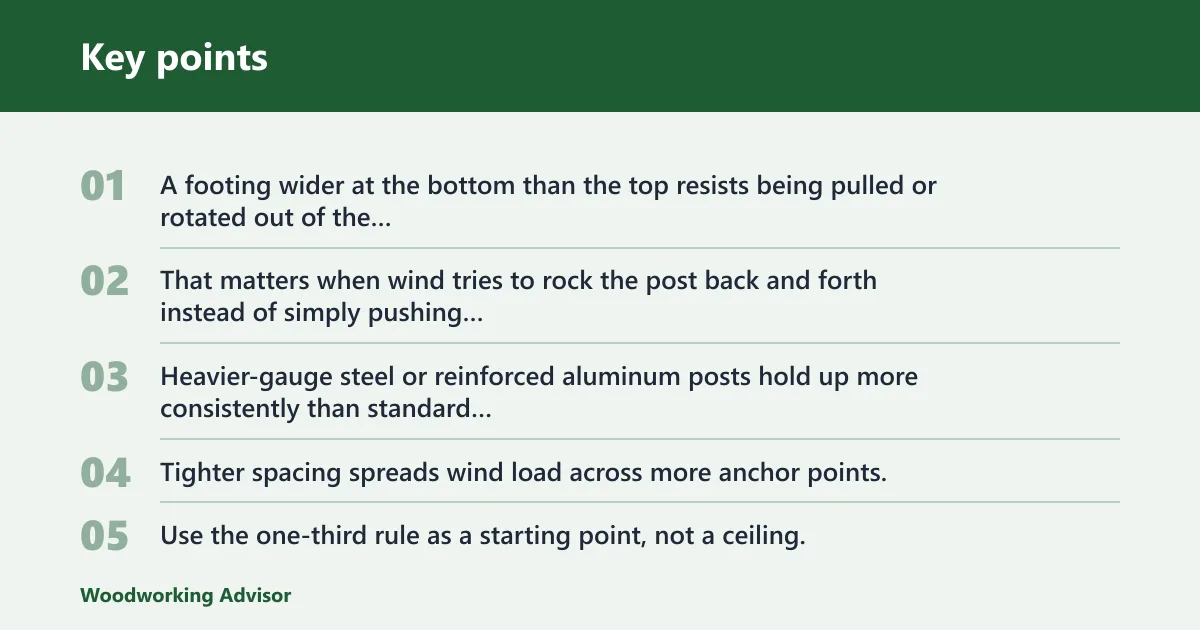
A footing wider at the bottom than the top resists being pulled or rotated out of the ground better. That matters when wind tries to rock the post back and forth instead of simply pushing on the face.
Heavier-gauge steel or reinforced aluminum posts hold up more consistently than standard wood posts. Tighter spacing spreads wind load across more anchor points, which reduces stress on each post.
Post depth, spacing, and gates
Use the one-third rule as a starting point, not a ceiling. If the site is open, the soil is soft, or the fence is tall, deeper footing and closer spacing are often justified.
Gate assemblies deserve special attention because they are a common weak point on many fence lines. They can be the largest moving panel, and they concentrate force every time the wind hits them sideways.
Gate posts often need to be larger, deeper, or both. If the gate is wide, the hinge side in particular needs a design that resists rotation, not just vertical load.
Suppose a 6-foot privacy fence sits on an open lot with sandy soil. If the posts are set too shallow, the first failure may be rotation at the base, not panel breakage. In a more sheltered yard, the same fence might survive because the wind load is lower even though the build is identical.
Frequently asked questions
Is wood or vinyl better for windy conditions?
Neither is inherently better when both are built as solid privacy fences, because solid vinyl catches roughly the same wind load as solid wood panels. Vinyl can flex, but that does not remove the load from the support system. Wood may be easier to modify, but both need stronger posts on exposed sites.
What fence style reduces wind load the most?
Chain link reduces wind load the most among common residential styles because it is the most wind-permeable. Ornamental aluminum also performs well because of its open picket design. Semi-privacy and shadowbox styles reduce load more than solid panels, but they still catch more wind than open fencing.
Do solid privacy fences fail more in wind?
Yes, solid privacy fences fail more often in wind because they present a near-unbroken wall to the wind. The failure may show up first as loose fasteners, leaning posts, or gate sag rather than a total collapse. Good post depth and tighter spacing can delay or prevent that.
How deep should fence posts go in windy areas?
A common baseline is roughly a third of the post’s total length below grade. In windy areas, deeper is often better, especially for tall or solid fences. Wider-bottom footings and tighter post spacing also help the fence resist uplift, rotation, and racking.
What fence is best for a coastal windy backyard?
Ornamental aluminum and chain link are usually the safest choices for a coastal windy backyard because both let wind pass through. Aluminum has an edge where salt air matters because powder-coated finishes resist corrosion well. Solid privacy fences can still work, but only with stronger posts, lower height, and careful design.
Can chain link hold up in high wind?
Yes, chain link can hold up well in high wind if the posts, corners, and gates are built correctly. The mesh itself is not the problem. The weak points are usually the supports, especially where the fence turns, ends, or carries a gate.
Sponsored / affiliate links. As an Amazon Associate I earn from qualifying purchases. I may earn additional commission from eligible campaigns.