Hardwood Floor Shrinking in Winter
Winter gaps are often normal seasonal movement if indoor relative humidity falls to about 35% or lower, but gaps that stay open year-round or change sharply usually point to a problem. Ignored shrinkage can lead to cupping, loose boards, squeaks, and repairs that cost more than fixing humidity first. This guide shows how to read humidity, compare seasonal movement, and tell normal winter gapping from installation, subfloor, or moisture issues.
Winter shrinkage and board movement
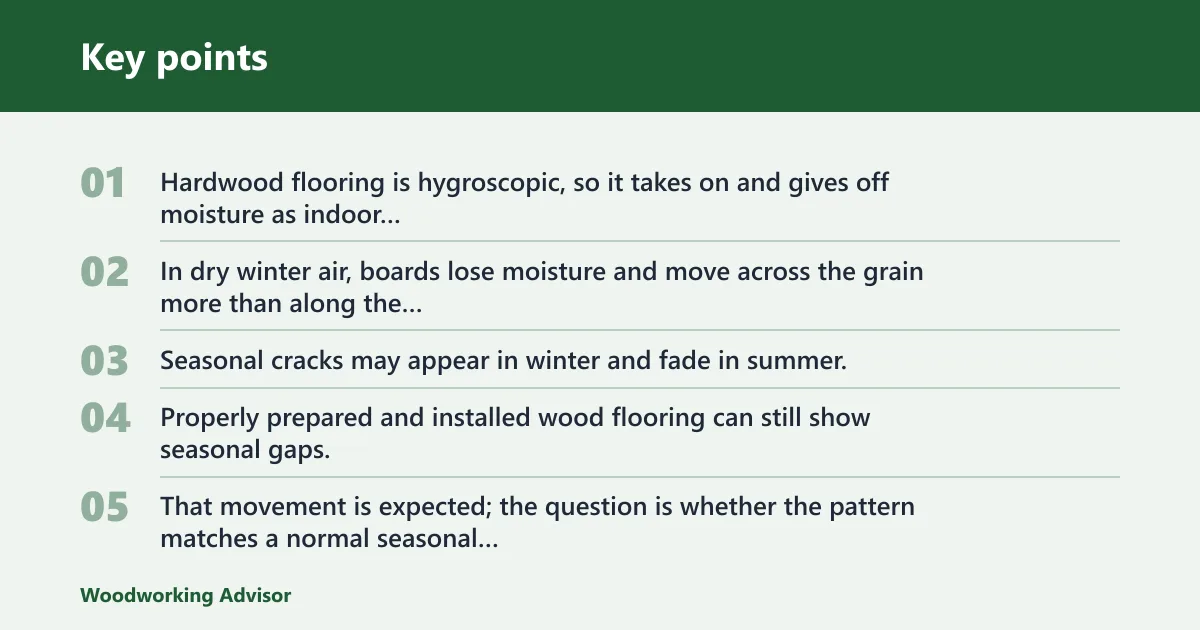


Hardwood flooring is hygroscopic, so it takes on and gives off moisture as indoor conditions change. In dry winter air, boards lose moisture and move across the grain more than along the length, which is why small seams often appear between boards even when the floor was installed correctly.
Seasonal cracks may appear in winter and fade in summer. Properly prepared and installed wood flooring can still show seasonal gaps, especially when a heating system dries the air quickly. That movement is expected; the question is whether the pattern matches a normal seasonal cycle or something else.
Which floor types show gaps most clearly?
Solid hardwood usually shows the largest visible change because it moves more in width than in length. Wider boards also make the same amount of shrinkage easier to see, so a narrow seasonal shift can look more dramatic on a roughly 5- to 7-inch plank than on strip flooring.
Engineered flooring generally moves less than comparable solid wood, but it still contains real wood and can gap in dry air. Wide-plank engineered floors can still show noticeable seams because board width affects how visible any change becomes, even when the actual movement is modest.
What seasonal repeatability tells you
A recurring pattern helps distinguish seasonal gaps from damage. If the same rooms open in winter and close again as humidity rises, seasonal movement is the most likely explanation. If the same seams stay open through humid months, the cause is more likely installation, subfloor, or moisture related.
Repeatability matters more than a single snapshot. One cold, dry week can make a healthy floor look worse than it is. A floor that behaves the same way every winter, and then relaxes in spring or summer, points toward humidity swings rather than a failing floor system.
Diagnostic pattern table
| Symptom pattern | Likely cause | Severity | Check to run | Action |
|---|---|---|---|---|
| Solid hardwood, narrow gaps that appear in winter and ease in summer, with indoor RH near 30–50% | Normal seasonal shrinkage | Low | Compare RH on several cold days and again after a humid spell | Stabilize humidity and monitor the same boards through the next season |
| Engineered hardwood, small seams during heating season, fewer changes than nearby solid wood | Dry winter air plus normal movement | Low to moderate | Check whether the gaps shrink when RH rises | Use humidity control first; inspect only if the pattern does not reverse |
| Wide-plank floors, visible seams that look larger than the amount of board movement would suggest | Width makes seasonal movement more visible | Low to moderate | Measure plank width and compare several adjacent seams | Track RH and watch for repeatability across seasons before calling it damage |
| Localized gaps in one area, while the rest of the room stays stable | Localized installation issue, fast drying near vents, or subfloor condition | Moderate | Check supply vents, exterior walls, and the affected subfloor area | Inspect for site-specific causes instead of treating the whole floor as seasonal |
| Year-round gaps that do not change with the seasons | Poor acclimation, installation error, or persistent moisture imbalance | Moderate to high | Review installation records and compare summer and winter measurements | Arrange professional evaluation |
| Gaps with cupping, loose boards, or squeaks | Moisture imbalance, subfloor trouble, or fastening failure | High | Check RH, board flatness, and subfloor moisture content | Stop guessing and get a flooring inspection |
Are winter gaps normal?
Yes, many winter gaps in hardwood floors are normal seasonal movement, especially in heated homes with dry indoor air. They are more likely to be harmless when the seams appear during the heating season, reduce when humidity rises, and show up across multiple boards rather than in one isolated area.
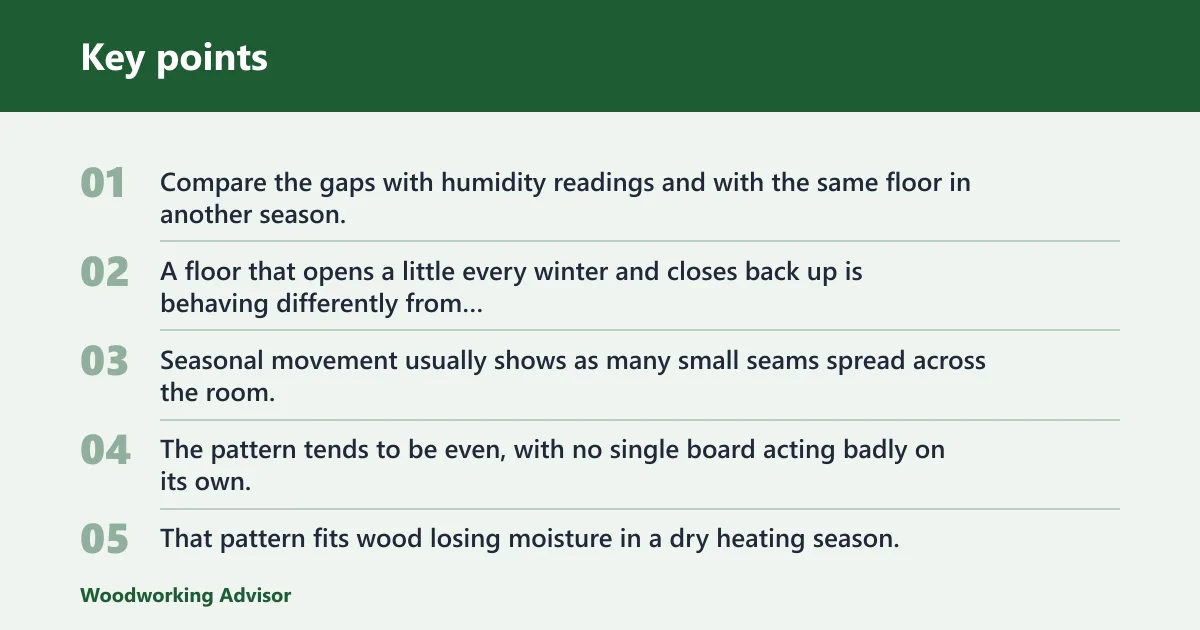
Normal does not mean automatic. Compare the gaps with humidity readings and with the same floor in another season. A floor that opens a little every winter and closes back up is behaving differently from a floor that stays open, cups, or starts squeaking.
What gap patterns fit seasonal movement?
Seasonal movement usually shows as many small seams spread across the room, often most visible in wider boards. The pattern tends to be even, with no single board acting badly on its own. That pattern fits wood losing moisture in a dry heating season.
Suppose a living room has 5-inch oak boards and the seams become easy to see in January, then nearly disappear by June. That repeatable change is far more consistent with winter shrinkage than with a one-time installation defect.
What gap patterns point to a problem?
Problems are more likely when gaps stay open all year, appear only in one strip of the floor, or come with cupping and movement underfoot. Uneven patterns can point to fast drying from a nearby vent, a crawlspace issue, subfloor moisture, or poor acclimation before installation.
A common first-timer mistake is to judge the floor by one cold week alone. A better check is to record the same seams in winter, spring, and late summer. If the gap width barely changes, the cause is probably not ordinary seasonal shrinkage.
How to judge severity by board width and pattern
Board width matters because the same percentage of shrinkage creates a more visible seam on wider planks. A tight group of narrow strip boards may move the same amount as a wider floor, but the seams are harder to notice. Wider boards make the issue look larger, even when the movement is within seasonal range.
Look at the floor in context. A few hairline seams on a wide-plank floor during a dry winter are less concerning than one open seam that keeps returning in the same place. Visibility and repeatability tell you more than the gap itself.
How to check room humidity
Indoor relative humidity is often the main number to watch. A digital hygrometer is recommended for monitoring room humidity, and some products cite 30–50% relative humidity as a common range. Heated homes can dry out quickly, so the reading matters more than the thermostat setting.
Heating systems dry indoor air and reduce moisture in the home. Furnaces, boilers, and space heaters can intensify shrinkage because they warm air without adding moisture. That is why a room can feel comfortable while still being too dry for wood flooring.
Where to place a digital hygrometer
Place the hygrometer in the room where the gaps are showing, not beside a supply vent, fireplace, sunny window, or direct heat source. Those spots can distort the reading and make the room seem drier or wetter than it really is. A mid-room reading is more useful for diagnosis.
Check readings at the same time of day for several days. If one room stays much drier than the rest of the house, the floor in that space may be reacting to local air movement rather than whole-home conditions.
What RH range to aim
Many flooring products point to 30–50% relative humidity, though the exact target depends on the flooring maker and the site conditions. Consistent humidity year-round is the only way to prevent gaps. During winter, the practical goal is to keep the room close to the manufacturer’s range rather than letting it swing widely.
Do not over-humidify. Too much indoor moisture can lead to condensation or cupping, especially if the house has cold surfaces or uneven heat. The target is stable, moderate humidity, not a damp room.
How heating systems affect readings
Forced-air heat can make RH drop fast, especially after long heating cycles. A furnace or space heater near a room can pull the reading down enough to open seams that were not visible in milder weather. That is why winter humidity should be checked when the heat has been running normally for several days.
Whole-house humidifiers are the best long-term moisture-control option because they connect to the HVAC system and add moisture to forced air. If a whole-house unit is not installed, a portable humidifier can help room by room, but it is a temporary fix rather than a house-wide remedy.
Can engineered hardwood shrink too?
Yes. Engineered hardwood can shrink in winter too, even though it usually moves less than solid hardwood. The top layer is real wood, so dry indoor air can still open seams or cause minor distortion if the room stays too dry for long enough.
The difference is degree, not immunity. Engineered flooring is generally more stable than a comparable solid floor, but it still depends on proper humidity, correct installation, and the right acclimation before the boards go down.
Why wide-plank engineered floors still show seams
Wide-plank engineered floors can still show seasonal seams because wider boards make movement more visible. Even if the actual shrinkage is small, the opening reads larger to the eye. That makes wide planks more sensitive to winter dryness from a homeowner’s point of view.
They also depend on the stability of the layers beneath the wear surface. If the humidity swings are sharp, or the installation was not matched to the site, a wide engineered plank can still gap or distort.
When engineered flooring needs inspection
Get an inspection if engineered boards gap all year, cup, or loosen along the seams. Also look closer if the floor behaves differently from room to room. That kind of inconsistency points away from normal seasonal change and toward a site or installation problem.
When gaps mean an installation or subfloor issue
Persistent gaps often point to installation or moisture trouble rather than winter dryness alone. Acclimation matters, and it must follow the flooring maker’s instructions for the specific flooring, subfloor, and environment. Manufacturers often specify humidity requirements before flooring installation for the same reason: the site conditions change how the wood behaves later.
Subfloor moisture content matters for both plywood and concrete. Unexpected moisture can create uneven movement, gaps, or distortion, while a very dry surface can contribute to shrinkage after the home starts heating. The floor and the structure underneath have to be checked together.
Signs of poor acclimation
Poor acclimation is more likely when the floor opens soon after installation and the gaps persist beyond a normal heating season. If the boards were installed before they matched the room conditions, they may have started at the wrong moisture level and moved too far once the house dried out.
That issue usually shows up across a broad area, not just beside one vent. If the floor keeps repeating the same pattern every winter, the installation may have been done without enough time for the boards to adjust to the site.
Signs of subfloor moisture trouble
Watch for seams that appear with cupping, loose edges, or movement that changes by room. Those signs can suggest the subfloor is carrying unexpected moisture or that the moisture balance between floor and structure is off. Concrete and plywood both need to be checked before and after installation when a problem is suspected.
If the gaps are paired with noisy boards or visible shape change, stop treating the issue as cosmetic. The floor may be reacting to a building condition rather than to ordinary winter dryness.
What to do before calling a pro
- Measure indoor RH with a digital hygrometer in the affected room.
- Compare readings over several days, not just once.
- Note whether the gaps appear in winter and close again later.
- Check whether the pattern is spread across the floor or limited to one zone.
- Look for cupping, loose boards, or squeaks.
- Review whether the floor was acclimated and installed to the maker’s instructions.
Should you use wood filler or wait?
Use wood filler only as a cosmetic patch for a gap you already understand. It does not stop seasonal movement, and it can crack or fall out if the floor keeps shrinking and swelling each year. If the seams are still changing with the seasons, filler is usually a temporary appearance fix, not a cure.
Waiting until spring makes sense when the gaps are small, seasonal, and tied to low RH. If the gaps stay open after humidity rises, or if they come with cupping or looseness, do not rely on filler alone. Fix the cause first.
Frequently asked questions
Does hardwood floor shrink in winter?
Yes. Hardwood flooring loses moisture in dry winter air and shrinks across the grain, which can open small seams between boards. That movement is most common in heated homes, especially when indoor RH drops below the flooring’s target range.
Do wood floors shrink in the winter?
They can. Wood flooring is hygroscopic, so winter heating often lowers indoor humidity and makes boards contract. Seasonal cracks may appear in winter and fade in summer, which is why a recurring pattern matters more than a single cold-weather snapshot.
Do hardwood floors expand in winter?
Usually no. Hardwood floors tend to shrink in dry winter air and expand when humidity rises, such as in spring or summer. If a floor seems to swell in winter, check for moisture from another source rather than assuming normal seasonal movement.
Do floorboards shrink in winter?
Yes, especially when heating systems dry the air. Solid boards change more in width than in length, so the shrinking often shows up as narrow seams. Wider boards make the movement easier to see, even if the actual change is small.
Why are there gaps between my hardwood floorboards in winter?
Winter gaps usually come from low indoor relative humidity. Heated air pulls moisture out of wood, and the boards contract. If the gaps close again later and appear in a repeating seasonal pattern, the movement is more likely normal than a sign of damage.
Are winter gaps in hardwood floors normal?
Often, yes. Many winter gaps are normal seasonal movement when they appear during dry months and ease up when humidity rises. Gaps that stay open all year, appear in one spot only, or come with cupping need a closer look.
What humidity level should I keep for hardwood floors in winter?
Many products cite 30–50% relative humidity as a common range, but the maker’s instructions should lead. A digital hygrometer is the best check, and a humidifier can help if winter heat dries the room below the target range.
When do winter hardwood floor gaps mean an installation problem?
Look harder when the gaps stay open after the season changes, show up only in one area, or return every year in the same pattern. Poor acclimation and subfloor moisture trouble are common suspects, especially when the seams come with squeaks, cupping, or loose boards.
Can engineered hardwood shrink in winter too?
Yes. Engineered flooring still contains real wood and can gap in dry air, though it generally moves less than comparable solid wood. Wide-plank engineered floors can still show visible seams, so the same humidity checks apply.
Should I use wood filler on winter floor gaps or wait until spring?
Wait if the gaps are seasonal and small. Wood filler is cosmetic and may fail if the floor keeps moving through the heating season. Use it only after you have confirmed the gaps are stable and not part of a larger humidity or installation problem.
Sponsored / affiliate links. As an Amazon Associate I earn from qualifying purchases. I may earn additional commission from eligible campaigns.