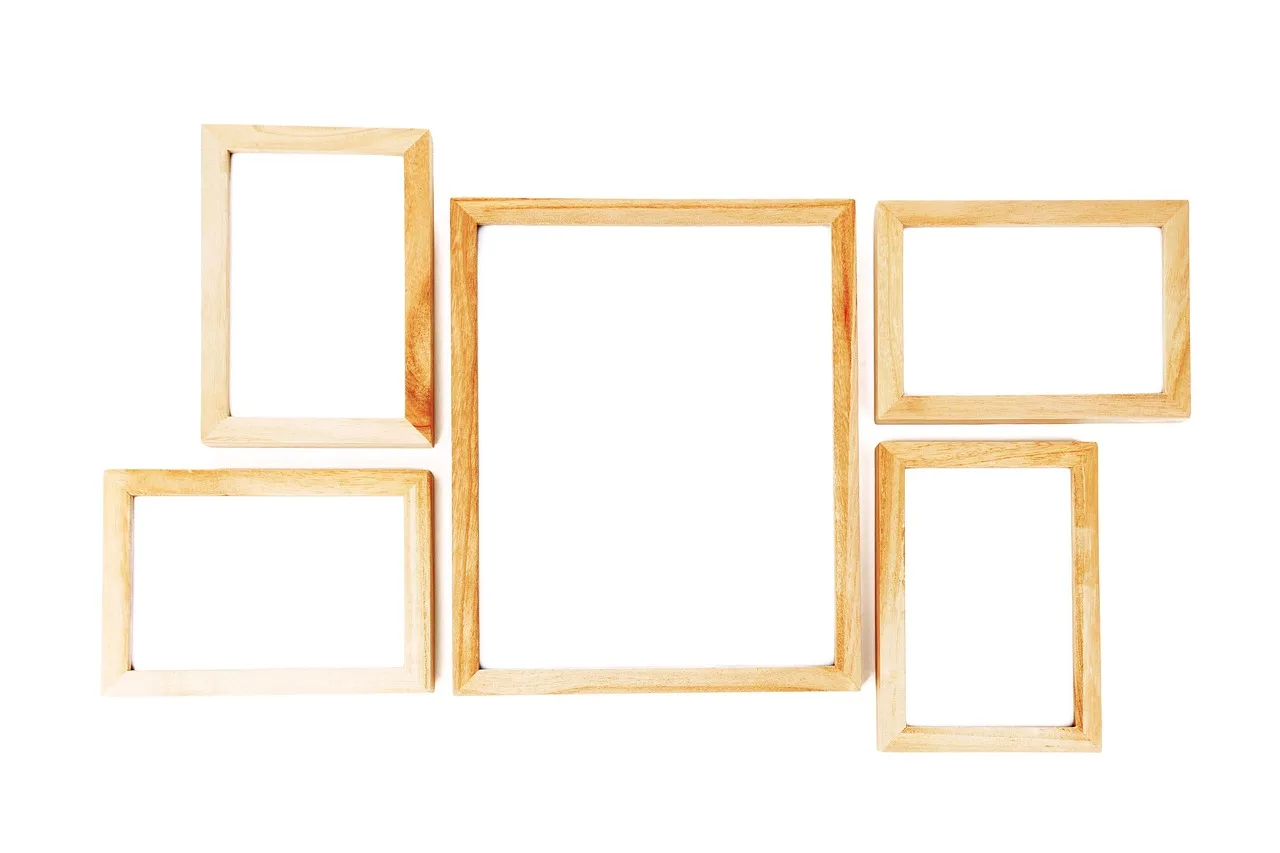
Wood Picture Frame Moulding Profiles
Wood picture frame moulding profiles are commonly chosen by rabbet depth, face width, and species: use about 1/4-inch to 3/8-inch rabbets for most prints and 1/2-inch or deeper for mats, glass, or thicker art. Wrong profile geometry can cause loose fits, bowed corners, or glazing that sits proud. This guide compares common profile shapes, wood species, lengths, and buying options so you can order the right stock before cutting.
Picture frame moulding is the shaped wood stock that becomes the visible frame and the hidden channel that holds the artwork stack. The profile geometry controls how much of the image edge is covered, how deep the package sits in the rabbet, and whether the frame reads as modern, traditional, or recessed.
Profile geometry, grain, and rabbet selection
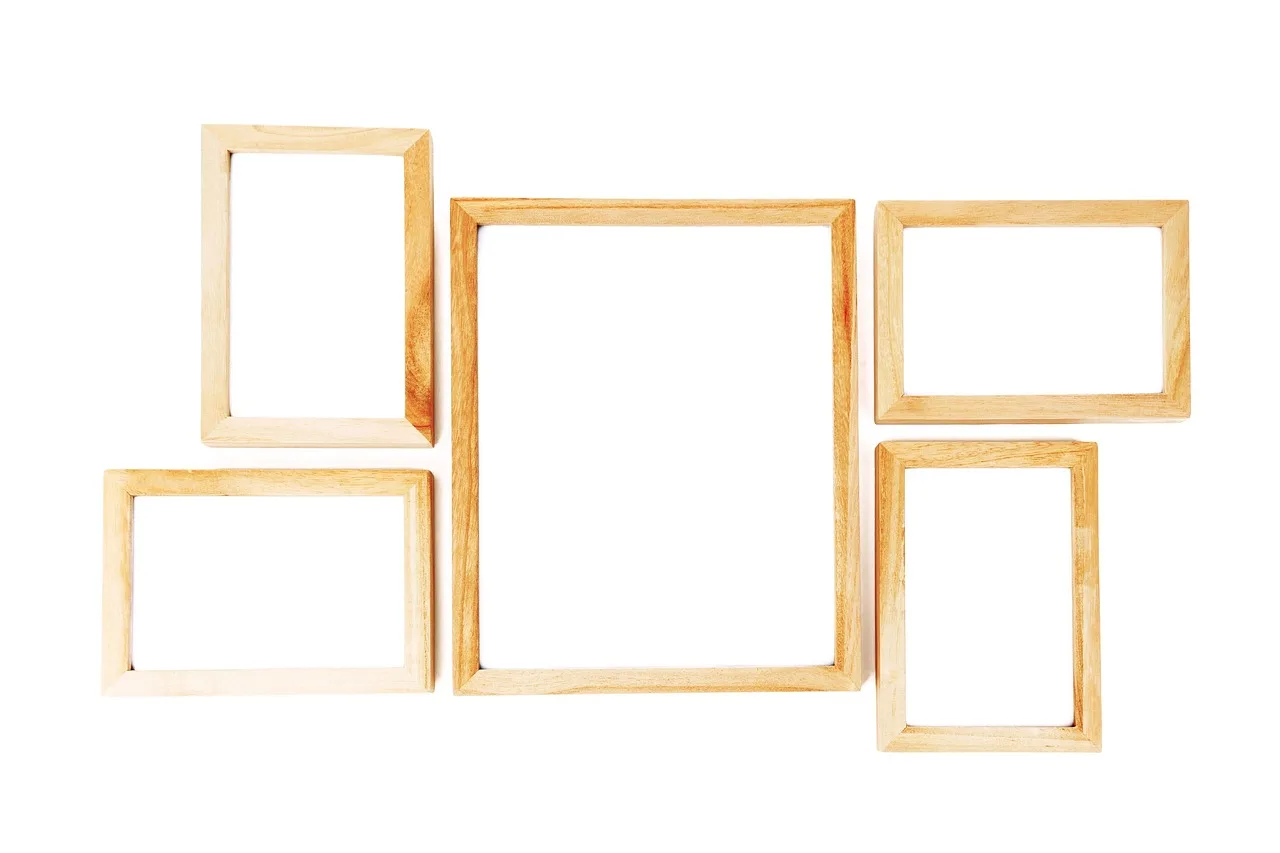

- 1/2-inch rabbet suits mats and glazing
- Solid wood with glued and v-nailed corners
- UV acrylic, backing board, and hardware included
How profile shape defines the frame
A profile is more than a decorative edge. A small cap gives a narrow visible band and a light visual break at the image edge, while a large cap adds more face width and a heavier border. A backbevel hides the inside edge, and a floater leaves a visible gap around the panel.
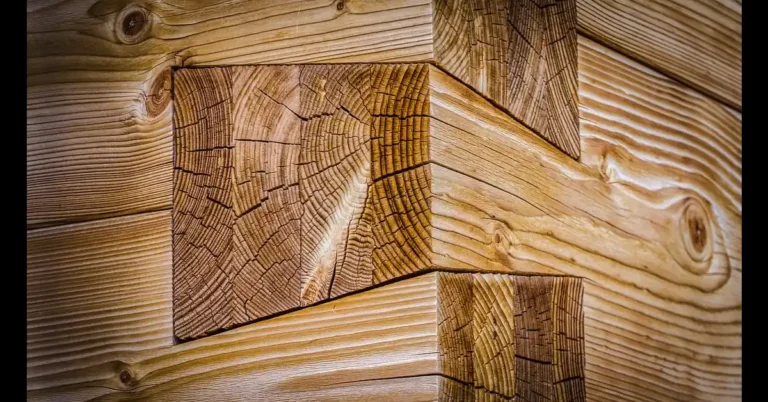
Edge grain and face grain matter too. Edge-grain profiles present a narrower exposed growth pattern and are often used where a cleaner, more consistent face is wanted. Face-grain profiles show wider grain across the face and can read more traditional.
Common profile families at a glance
Vermont Hardwoods groups profiles into categories like Edge Grain, Slant Caps, and Small Caps, and lists 71 picture frame moulding results in this category. Public Lumber tags picture frame moulding under custom moulding categories and lists traditional and contemporary varieties. Those labels help, but the real choice is still profile geometry and rabbet depth.
Why rabbet depth matters from the start
The rabbet must hold the glass or acrylic, the artwork or mat stack, and the backing without forcing the assembly proud of the frame back. That depth varies by profile, so a decorative face with a shallow rabbet may work for a bare print and fail on a matted piece.
Which profile family fits the job?
The right family depends on the job, not the catalog name. Small cap profiles suit compact artwork and narrow borders, large cap and backbevel profiles suit traditional framing, and floater or slant cap profiles fit contemporary work where the edge treatment is part of the look.
Small cap profiles for compact work
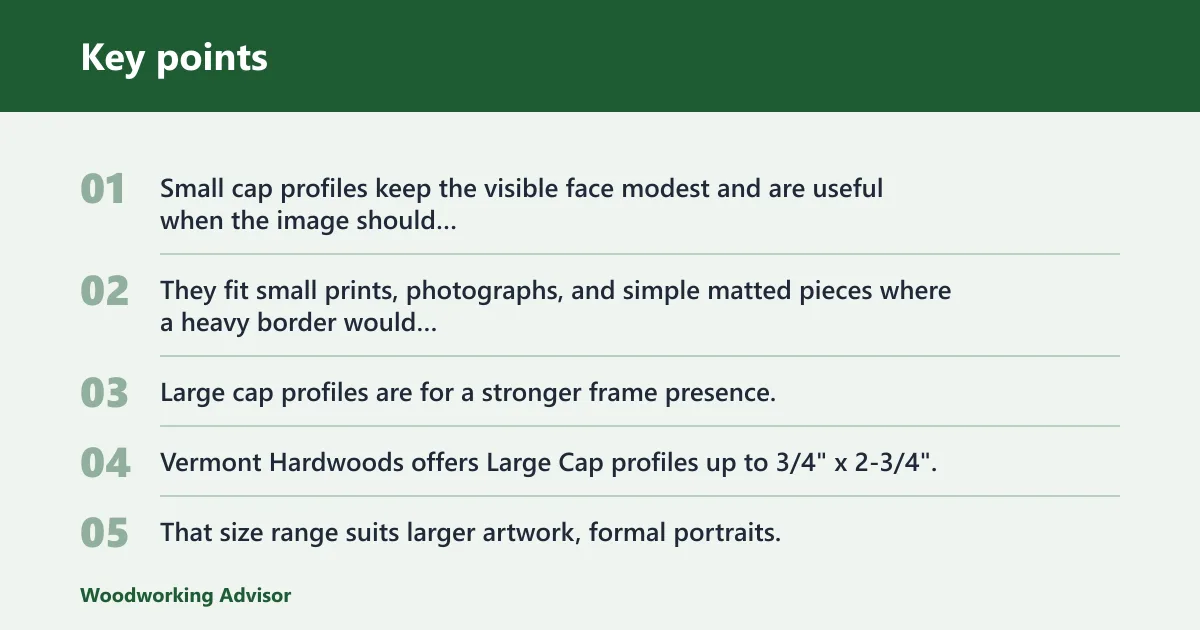
Small cap profiles keep the visible face modest and are useful when the image should stay dominant. They fit small prints, photographs, and simple matted pieces where a heavy border would overpower the subject.
Large cap and backbevel profiles for traditional work
Large cap profiles are for a stronger frame presence. Vermont Hardwoods offers Large Cap profiles up to 3/4″ x 2-3/4″. That size range suits larger artwork, formal portraits, and traditional compositions where the frame should hold visual weight.
A backbevel variant is useful when the inside edge needs to recess visually, which can make the opening feel cleaner. For restoration work, a backbevel or a closely matched traditional cap often gets closer to the period look than a modern square edge.
Floater, slant cap, and spacer profiles for modern framing
Floater profiles leave a visible gap around the panel, which works well for canvases and contemporary panels. Slant cap profiles angle the face inward and can reduce the apparent mass of the frame. Spacer profiles are chosen when the glazing stack needs more separation from the artwork surface.
Say your artwork is a 16 x 20 inch canvas panel with visible edges you want to keep exposed. A floater frame is usually the better fit than a standard cap, because the profile is chosen to preserve the edge, not hide it.
When a restoration needs a closer match
Restoration work usually starts with the existing profile, not a generic replacement. Match the cap shape, the sightline, and the face width first, then confirm the rabbet depth. A modern replacement that is wider or deeper may change the appearance even if the finish color is close.
Moulding profiles selection matrix
This matrix ties profile family to the fit questions that matter most: depth, width, length, use case, and cutting setup. Use it before you place an order, especially when the artwork stack includes glass, mats, spacers, or a thicker backing board.
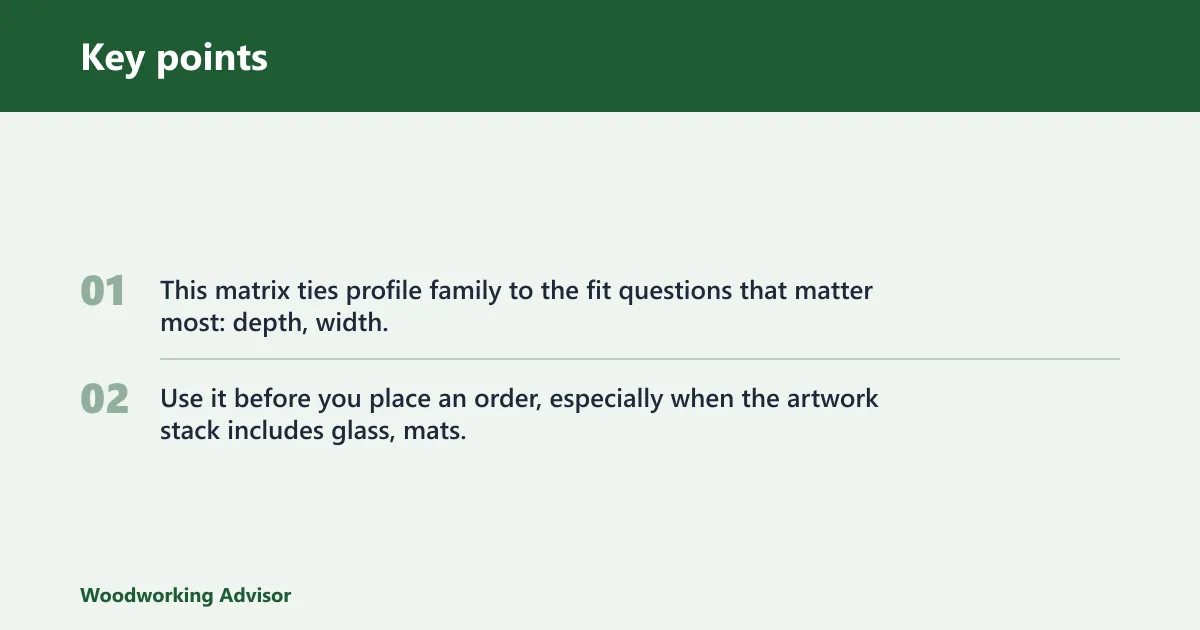
| Profile family | Rabbet depth range | Visible face width | Stock length | Typical use case | Likely cutting setup | Wrong-profile troubleshooting |
|---|---|---|---|---|---|---|
| Small cap | About 1/4 inch to 3/8 inch | About 1/2 inch to 3/4 inch | 9 to 10 feet, or 3 meter rods | Prints, photos, light matted work | Morso or fine-tooth miter saw | If the stack is thick, the glazing may sit proud or the backing may bow the frame open |
| Large cap | About 3/8 inch to 1/2 inch, sometimes deeper | About 1-1/4 inch to 2-3/4 inch and beyond | 9 to 10 feet, or 3 meter rods | Larger artwork, formal framing, stronger visual border | Morso guillotine or accurate miter saw with support | If the width is too light for the artwork, the frame can look thin and undersized |
| Backbevel | Often around 3/8 inch to 1/2 inch | Varies with the bevel and sightline | 9 to 10 feet, or 3 meter rods | Traditional frames, cleaner inside edge | Morso for repeatable corners | If chosen for a contemporary piece, the look may feel too formal |
| Floater | Depends on panel thickness and spacer needs | Moderate to wide face | 9 to 10 feet, or 3 meter rods | Canvas panels, modern displays | Miter saw with spacer control | If the rabbet is too shallow, the panel will not sit correctly or the reveal will be uneven |
| Slant cap | Usually moderate, profile dependent | Often narrow to medium | 9 to 10 feet, or 3 meter rods | Contemporary framing, lighter visual edge | Morso or miter box saw for careful control | If the artwork needs a deeper stack, the angle can hide a poor fit until assembly |
| Spacer profile | Chosen around glazing and artwork thickness | Varies widely | 9 to 10 feet, or 3 meter rods | Works with delicate originals and thick media | Miter saw plus dry-fit check | If the spacer height is wrong, the glazing can touch the art or the package can rattle |
How wide should the frame be?
Frame width should follow the scale of the artwork, not a catalog habit. Small sections around 1/2 inch to 3/4 inch work for compact pieces, while larger sections up to about 2-3/4 inches and beyond suit bigger images, heavier mats, and rooms that need more visual weight from the frame itself.
Matching width to artwork scale
A small print in a narrow frame often looks balanced because the eye stays on the image. A large canvas or a wide mat stack usually needs a wider profile so the border does not appear fragile. The subject matter matters too, since formal portraits and large decorative pieces often tolerate a broader border.
A common first-timer mistake is ordering a 2-3/4 inch profile for a small certificate. The border can overwhelm the document and make the frame feel larger than the content. The opposite mistake is using a thin cap on a large, matted print, which can make the whole assembly look underbuilt.
Small sections and larger sections
Small sections around 1/2 inch to 3/4 inch are common when the frame should stay quiet. Larger sections up to 2-3/4 inches and beyond belong to bigger pieces, especially where the moulding is meant to be part of the presentation rather than a narrow border around it.
What wood species and finishes should you choose?
Species choice affects appearance, machining behavior, availability, and finishing options. Ash, basswood, cherry, maple, red oak, walnut, and white oak are common choices, but the best pick depends on whether you want a painted frame, a stained frame, or a leafed finish with visible grain.
Common species and availability differences
Basswood is often chosen when a smooth painted surface matters, because the grain is relatively quiet. Cherry, maple, red oak, walnut, and white oak are more visible-grain options, with each species reading differently under clear finish or stain. Availability varies by supplier and by profile family, so the same species may not be offered in every shape.
Public Lumber says it can replicate thousands of moulding profiles, and Public Lumber lists picture frame moulding under custom moulding categories. That matters when you need a specific profile in a specific species rather than a close substitute.
NowFrames says fir is better than ayous for bending and storage stability. That kind of storage behavior matters on long stock, especially when the moulding has been kept flat or bundled for shipping.
Unfinished, lacquer, gold leaf, and silver leaf
Unfinished stock is the most flexible when you need to match a site finish or apply a custom coating. Lacquer is common when you want a sealed surface straight from the supplier. Gold leaf and silver leaf finishes fit traditional or decorative work where the frame is part of the display.
Paint and stain compatibility
Basswood and unfinished profiles are usually easier to paint cleanly. Maple and cherry can be stained, but the final look depends on grain and surface prep. Red oak and white oak accept stain well, while leafed finishes are usually chosen for appearance rather than stain compatibility.
What lengths and ordering options are common?
Stock length changes waste, shipping, and the number of corners you can cut from a bundle. The same source says picture frame mouldings in Europe are usually 3 meters and 9 or 10 feet in the USA. That length choice affects how much cut-off remains after a standard frame job.
Length, waste, and shipping
Longer rods can reduce splice needs, but they may increase shipping cost and handling difficulty. The same source says standard boxes can require 30 meters for bigger frame moldings, which shows why shipping format matters on larger orders. Shorter orders are simpler to handle, yet they can create more waste if your frame sizes do not divide evenly into the stock.
Catalog browsing, custom sizes, chop service, and minimum orders
Framing 4 Yourself offers more than 350 styles in wood, metal, and imitation wood, and Framing 4 Yourself sells unfinished wood picture frame moulding in lengths. That makes catalog filtering useful, but custom work still matters when the profile must match an existing frame or a specific artwork stack.
The same source says custom profile runs below $300 incur a $100 setup charge. That kind of minimum or setup fee can make a custom run reasonable for a larger order and poor value for a single short frame. Chop service can cut corners to size, but it limits how much adjustment you can make if the fit is off.
What affects cost per foot
Price usually changes with species, face width, finish, and whether you are buying rods, chopped lengths, or a custom run. A narrow unfinished basswood profile is usually easier to source than a wide walnut or leafed profile. Wider stock, specialty finishes, and smaller orders tend to raise the cost per usable foot.
How do you cut it accurately and safely?
Clean cuts start with stable stock, sharp cutting edges, and a machine that suits the profile. The main choice is between speed, dust control, and the level of repeatability you need. A guillotine-style cutter and a saw can both work, but they solve different problems.
Morso mitre guillotine for fast, repeatable cuts
A Morso mitre guillotine is a strong choice for repeatable corners on wood moulding. It gives a clean mitre with very little dust, which helps in a framing workflow. It is less forgiving of very hard, brittle, or oddly shaped stock, so the profile and species still matter.
Mitre saw setup for longer stock
A mitre saw handles longer rods well and works for wider or heavier profiles, but it creates dust and needs careful fence support. Use a fine-tooth blade, support the stock fully, and verify the angle before cutting the first corner. Long rods can bow, so check straightness before setting the stop.
Miter box saws for controlled hand cutting
A miter box saw is slower, but it can help when you need controlled hand cutting on a small run. It suits careful work on shorter lengths and can be useful for test cuts. Accuracy depends on the guide, the blade, and steady stock support.
Dust, tear-out, and bowed stock
Dust is a practical issue with powered saws, especially on long production runs. Tear-out is more likely on brittle finishes and some open-grain species, so cut the finished face carefully and keep the blade sharp. Bowed stock from long storage should be sorted before cutting, because a straight mitre on curved material still opens at assembly.
- Check rabbet depth against the full stack: art, glazing, spacers, and backing.
- Confirm face width against the artwork scale and the room setting.
- Choose species and finish based on paint, stain, or leaf requirements.
- Inspect stock length for waste, shipping limits, and bow.
- Make a test cut before committing to the full order or the final saw stop.
Frequently asked questions
How much does picture frame molding cost?
Cost changes with species, width, finish, and buying format. A simple unfinished stock is usually less expensive than a wide walnut or leafed profile, and custom work can add setup charges. The same source says custom profile runs below $300 incur a $100 setup charge, which can matter more than the raw price of the wood.
What profile categories are used for picture frame moulding?
Common categories include Edge Grain, Slant Caps, Small Caps, Large Cap, backbevel variants, floater profiles, and spacer profiles. Vermont Hardwoods groups profiles into categories like Edge Grain, Slant Caps, and Small Caps. Those labels are useful, but the fit still depends on the rabbet and the artwork stack.
What wood species are common for picture frame moulding?
Common species include ash, basswood, cherry, maple, red oak, walnut, and white oak. Basswood is often chosen for paint, while cherry, maple, oak, and walnut are often selected for visible grain and stain. Availability differs by supplier, so the species list can change by profile family.
What lengths are picture frame mouldings sold in?
The same source says picture frame mouldings in Europe are usually 3 meters and 9 or 10 feet in the USA. Some suppliers also sell chop service or custom lengths. The stock length matters because it affects waste, shipping cost, and whether you can cut multiple frames from one rod.
How wide should picture frame moulding be?
Use the artwork as the guide. Small sections around 1/2 inch to 3/4 inch fit compact pieces and lighter compositions, while larger sections up to 2-3/4 inches and beyond suit larger works or formal presentations. A frame that is too narrow can look weak, while one that is too wide can overpower the art.
How do you cut picture frame moulding safely and accurately?
Use a Morso mitre guillotine for repeatable cuts, a mitre saw for longer stock, or a miter box saw for controlled hand work. Support long rods, check for bow, and watch for tear-out on brittle finishes. Dust control matters with powered saws, and the first test cut should confirm the angle before full production.
Sponsored / affiliate links. As an Amazon Associate I earn from qualifying purchases. I may earn additional commission from eligible campaigns.