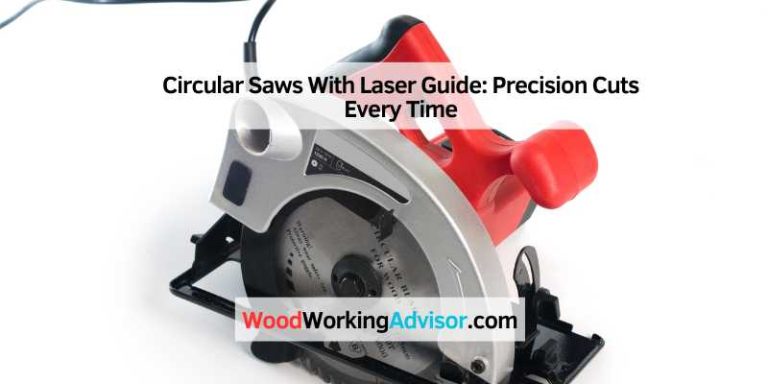
6 1/2 vs 7 1/4 Circular Saw: Bore, Bevel & Depth Compared
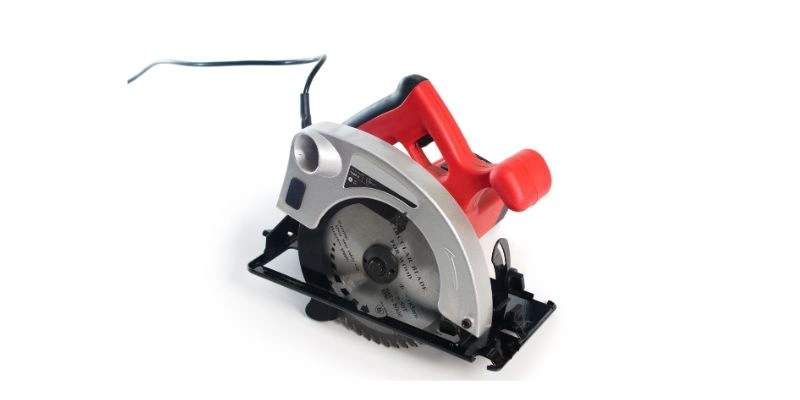
A 7 1/4-inch circular saw cuts roughly 3/8 inch deeper than a 6 1/2-inch saw — about 2-3/8 inches versus 2 inches at 90° — but a smaller blade doesn’t bolt onto a bigger saw just because the arbor bore matches. Picking the wrong size can leave you short a full pass through a 2×4. This guide covers blade compatibility between the two sizes, bevel range, and how Dewalt, Milwaukee, SKIL, and Makita models compare on paper.
Quick Answer
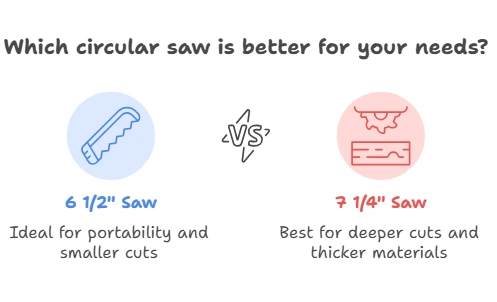
For framing and deck work, the 7 1/4-inch circular saw is the safer default — its deeper cut clears a single pass through 2x lumber and its blades are the most widely stocked size at any hardware store. Reach for the 6 1/2-inch saw instead when one-handed control on trim, plywood, or overhead cuts matters more than raw depth.
Subtle Differences Between a 6 1/2 and 7 1/4 Circular Saw
Best 7 1/4″ Circular Saw Pick
DEWALT 7 1/4″ Circular Saw (DWE575) – $127.45
A lightweight 7 1/4-inch corded saw that reaches the full ~2-3/8″ depth this guide covers, without the bulk of a worm-drive.
- Best for: Framing, deck joists, and other cuts through 2x lumber where the extra depth matters
- Why we picked it: A well-balanced 7 1/4-inch body that still hits full dimensional-lumber depth
- Main drawback: Corded only — no cordless version in this exact model line
Compare more circular saw options
 Option 1 SKIL 7 1/4″ Saw w/ Laser Guide (5280-01) – $59.00
|
 Option 2 DEWALT 20V MAX 6 1/2″ Cordless Saw (DCS565B) – $119.00
|
 Option 3 Milwaukee M18 6 1/2″ Cordless Saw (2630-20) – $121.52
|
As an Amazon Associate we earn from qualifying purchases.
The table below highlights the key distinctions between a 6 1/2-inch circular saw and a 7 1/4-inch circular saw — blade size, cutting depth, power, speed, portability, precision, control, and cost.
| Aspect | 6 1/2-inch Circular Saw | 7 1/4-inch Circular Saw |
| Blade Size | Smaller | Larger |
| Cutting Depth (90°) | ~2 in. | ~2-3/8 in. |
| Power and Torque | Lower power and torque | Higher power and torque |
| Speed and RPM | Higher RPM (blade tip speed) | Slightly lower RPM |
| Portability | Compact and lightweight | Slightly larger and heavier |
| Precision | Increased precision | Precision with proper technique |
| Control | Excellent control | Good control with proper handling |
| Cost | Generally more affordable | Wider price range, budget to premium |
Can You Put a 6 1/2-Inch Blade on a 7 1/4-Inch Circular Saw?
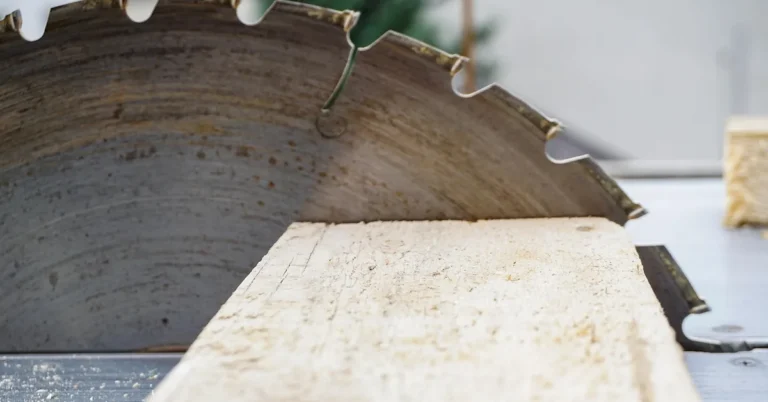
In most cases, no — even though many 6 1/2-inch and 7 1/4-inch blades share the same 5/8-inch arbor bore in the US, the bore matching doesn’t mean the swap is safe. The blade guard, base-plate cutout, and depth-adjustment mechanism on a 7 1/4-inch saw are sized for that saw’s own blade diameter.
Drop a smaller 6 1/2-inch blade into a 7 1/4-inch saw and it will usually spin fine on the arbor, but more of the blade retracts up under the guard than the saw was designed for, which throws off the depth scale and can leave the lower guard unable to close fully over the smaller disc. Going the other way — forcing a 7 1/4-inch blade into a 6 1/2-inch saw — is worse: the larger blade often won’t clear the guard or shoe at all, and if it does fit, it can spin faster than the smaller saw’s guard and housing were engineered to contain.
Always check your saw’s manual for its rated blade size before swapping, and only use a reduction ring when both the blade and saw manufacturer explicitly support that bore size. Our circular saw arbor adaptor guide covers how those reduction rings work in more detail.
Major Differences Between a 6 1/2 and 7 1/4 Circular Saw
Beyond the table above, several factors are worth walking through in detail: blade size, cutting depth, power, speed, portability, precision, blade availability, cost, and typical use case. For a broader shopping shortlist across sizes and brands, see our best circular saw picks.
- Blade Size:
The primary difference between a 6 1/2-inch circular saw and a 7 1/4-inch circular saw lies in their blade size. A 6 1/2-inch saw uses a blade with a diameter of 6 1/2 inches, while a 7 1/4-inch saw uses a larger blade with a diameter of 7 1/4 inches, and that difference in radius is what drives everything else on this list.
- Cutting Depth:
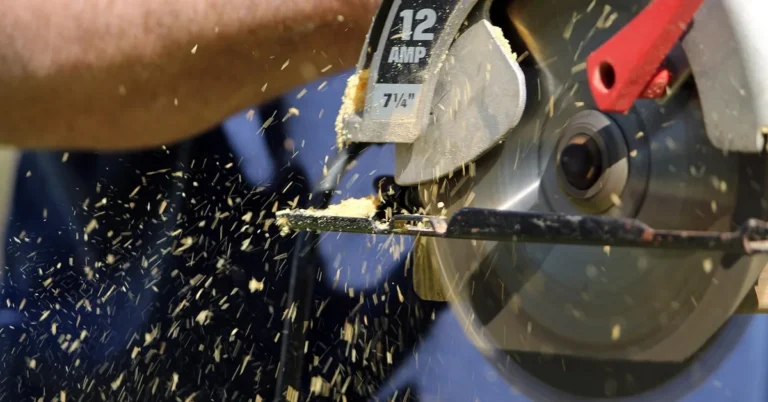
A 6 1/2-inch circular saw typically has a maximum cutting depth of around 2 inches at 90°. A 7 1/4-inch circular saw generally reaches up to about 2-3/8 inches, achieved the same way on both saws — by adjusting the blade’s position relative to the shoe.
- Power and Torque:
Blade size alone doesn’t set motor power, but it correlates with it: 7 1/4-inch saws tend to pair a larger blade with a more powerful motor, which helps the saw hold cutting speed and torque through denser materials and deeper cuts without bogging down.
- Speed and RPM:
A 6 1/2-inch circular saw typically spins at a higher no-load RPM than a larger-bladed saw — commonly in the 4,000 to 5,500 RPM range — because the smaller blade needs less torque to reach speed. A standard 7 1/4-inch saw usually runs a touch lower, around 4,000 to 5,000 RPM, while relying on the bigger blade’s tip speed and added torque to keep cutting smoothly.
- Portability:
6 1/2-inch saws are compact and lightweight, with a more streamlined housing that’s easy to carry between job sites. 7 1/4-inch saws are still portable but run slightly larger and heavier because the bigger blade needs a larger housing and motor. See our small circular saw roundup for a deeper look at 6-1/2″ and smaller options.
- Precision and Control:
The 6 1/2-inch saw’s smaller blade and lighter body make the cutting line easier to see and the tool easier to keep steady on finer work. The 7 1/4-inch saw’s extra weight can actually help here too — it adds stability and reduces vibration once you’re braced for a longer cut.
- Blade Availability:
Both sizes are widely stocked, but 7 1/4-inch blades have the broader selection by far — it’s the more popular size, so you’ll find more specialty options for ripping, crosscutting, fine finish work, and metal cutting in that diameter than in 6 1/2-inch.
- Cost:
6 1/2-inch saws tend to be the more affordable entry point, since a smaller motor and body cost less to build. 7 1/4-inch saws span a wider price range, from budget-friendly corded models to premium brushless cordless kits.
- Application and Material Compatibility:
6 1/2-inch saws suit plywood, MDF, and framing lumber like 2x4s, and are popular with DIYers doing occasional lighter cutting. 7 1/4-inch saws handle a wider range — thicker hardwoods, engineered lumber, and (with the right blade) some metal sheet — which is why contractors reach for this size on job sites that call for deeper, heavier-duty cuts.
- Safety Features:
Because 6 1/2-inch saws are lighter, they typically pair well with an automatic blade guard and an electric brake that stops the blade quickly once the trigger is released — useful for quick control on tight or overhead cuts. 7 1/4-inch saws often add anti-snag lower guards sized for their larger blade, and some models include laser guides to help keep longer, deeper cuts straight. Regardless of size, always wear eye protection, secure your workpiece, and keep your hands clear of the blade path.
Bevel Cutting Capacity: 6 1/2 vs 7 1/4 Circular Saw
Bevel range is one spec most comparison charts skip. On Dewalt’s own sidewinder lineup, the 6 1/2-inch cordless model bevels from 0° to 50°, while the 7 1/4-inch corded model bevels from 0° to 57° — a real difference if your project calls for steep angled cuts, like mitered fence rails or angled deck fascia.
📊 0°–50° bevel (6 1/2-inch) vs. 0°–57° bevel (7 1/4-inch) — Source: manufacturer product specifications, Dewalt DCS391B and DWE575SB (2026)
Not every model publishes an exact bevel range, so treat these two figures as a real example of the gap rather than a universal rule — always check the spec sheet for the specific saw you’re buying.
How Dewalt, Milwaukee, SKIL, and Makita Compare Across Both Sizes
Spec sheets vary by brand and model — here’s how a handful of well-known saws in each blade size stack up on the numbers manufacturers actually publish.
| Model | Blade Size | Motor | Bevel Range |
| Dewalt DCS391B (cordless) | 6 1/2″ | 5,150 RPM | 0–50° |
| Milwaukee 2730-20 M18 (cordless) | 6 1/2″ | Brushless | Not published |
| Makita SP6000J1 (plunge) | 6 1/2″ | 12-Amp | Not published |
| Dewalt DWE575SB (corded) | 7 1/4″ | 15-Amp | 0–57° |
| SKIL 5280-01 (corded) | 7 1/4″ | 15-Amp, 5,300 RPM | Not published |
| Makita 5007MG (corded) | 7 1/4″ | 5,800 RPM | Not published |
Not every manufacturer publishes RPM or bevel range for every model — where a cell says “Not published,” that’s the actual state of the spec sheet, not a guess. We break down one of these models in more depth in our Dewalt circular saw specs and review.
“I keep a 7 1/4-inch saw in the truck for framing and deck joists, but a 6 1/2-inch cordless lives in the toolbag for trim and drawer parts. Trying to make one saw do both jobs usually just means fighting the blade guard on whichever cut it’s the wrong size for.”
Frequently Asked Questions
Is a 6 1/2-inch circular saw too small for framing lumber?
Not necessarily. A 6 1/2-inch saw cuts about 2 inches deep at 90°, which is enough for a single pass through standard 2×4 framing lumber. It gets tighter on 2×6 or thicker stock, where you may need to flip the board and cut from both sides, or step up to a 7 1/4-inch saw for a cleaner single pass.
Which saw is better for cutting thicker materials and deeper cuts?
The 7 1/4-inch circular saw. Its larger blade gives roughly 2-3/8 inches of cutting depth at 90°, enough to clear most 2x dimensional lumber, thicker plywood, and engineered lumber in one pass — tasks a 6 1/2-inch saw would need multiple passes to finish.
Can a 7 1/4-inch circular saw cut through a 4×4 post in one pass?
Not straight through at 90° — a 4×4 measures about 3.5 inches thick, more than any handheld 7 1/4-inch saw’s roughly 2-3/8-inch max depth. You’ll need to cut from two or more sides and meet in the middle, or use a saw built specifically for post-cutting.
Do 6 1/2-inch circular saws come in cordless versions?
Yes — 6 1/2-inch is one of the most common blade sizes for cordless circular saws, with cordless models available from Dewalt, Milwaukee, Makita, and others. 7 1/4-inch saws are available cordless too, but tend to run heavier and pull more from the battery per cut.
Which size has a wider selection of replacement blades?
7 1/4-inch. It’s the more popular size overall, so hardware stores and online retailers stock a broader range of tooth counts and specialty blades — ripping, crosscutting, fine-finish, and metal-cutting — in 7 1/4-inch than in 6 1/2-inch.
Conclusion
Choose the 6 1/2-inch circular saw when maneuverability, precision, and cordless convenience matter more than raw depth — trim work, plywood, and general DIY tasks are its strong suit. Choose the 7 1/4-inch circular saw when you regularly cut thicker materials or need the deeper pass — it’s the more common size for framing and job-site work, and its blades are easier to find. Either way, don’t swap blades across sizes without checking your saw’s manual first.
Sponsored / affiliate links. As an Amazon Associate I earn from qualifying purchases. I may earn additional commission from eligible campaigns.