Alternatives to MDF Board: 6 Real Options and Honest Trade-Offs (2026)
MDF isn’t a bad material – it’s just the wrong one for a surprising number of projects. Swap it out and you usually fix one specific problem (moisture, weight, screw-holding, cost) while giving up something else in return.
A swollen edge under a bathroom sink, screws that strip out of a cabinet hinge after a year, a shelf that sags under a stack of books it was never rated to hold – these are MDF’s real failure points, and six materials fix them better than MDF does. None of them are a perfect drop-in replacement, though. Plywood, particleboard, solid wood, HDF, melamine-faced board, and PVC board each trade cost, weight, or workability to solve the problem MDF has in your specific project. This guide breaks down what actually changes with each swap, using real 2026 pricing, so you’re picking based on the trade-off instead of a marketing claim.
Quick Pick: Best All-Around MDF Alternative
For most cabinet, shelving, and furniture builds, cabinet-grade plywood is the safest swap. It keeps MDF’s flat surface but adds real screw-holding strength at the edges and far better tolerance for the occasional splash or humidity swing. A pack of pre-cut Baltic birch project panels is enough for drawer bottoms, cabinet backs, jigs, or several smaller builds without committing to a full 4×8 sheet from a lumberyard.
Best Plywood Alternative to MDF
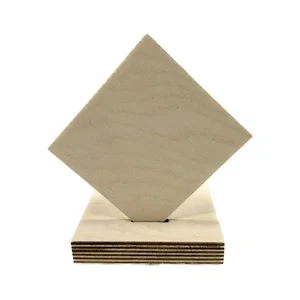 |
MakerStock 1/4" Baltic Birch Plywood Project Pack (6-Pack, 20×30 in.) – $110.95 Real cabinet-grade Baltic birch plywood in project-friendly panel sizes, so you get MDF’s flat, paintable surface with far better screw-holding and moisture resistance.
|
Plywood (Cabinet-Grade)
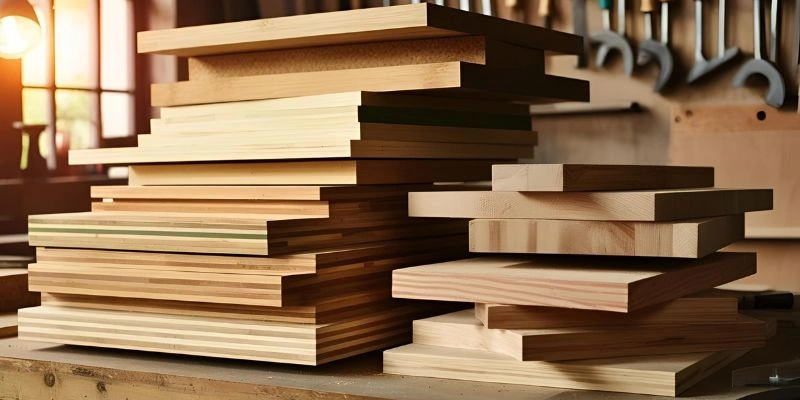
Plywood is layers of wood veneer glued together with the grain of each layer running perpendicular to the next. That cross-grain construction is the whole story: it’s what gives plywood real screw-holding strength at the edge (MDF’s weakest point) and makes it far less likely to swell or delaminate from a splash of water. Cabinet-grade birch plywood runs roughly $30 to $70 per 4×8 sheet, with premium Baltic birch or hardwood-faced sheets running $70 to $100+. That’s noticeably more than MDF’s $25 to $60 per sheet, but the strength difference matters most on load-bearing shelves, cabinet carcasses, and anything that gets screwed together and unscrewed more than once.
The trade-off: plywood’s edges show visible layers unless you cover them with edge banding or trim, and it doesn’t machine as cleanly as MDF for router profiles – MDF’s uniform fiber structure is still better for a smooth, void-free routed edge. For a deeper side-by-side on cabinet builds specifically, see our MDF vs. plywood for kitchen cabinets comparison.
Particleboard
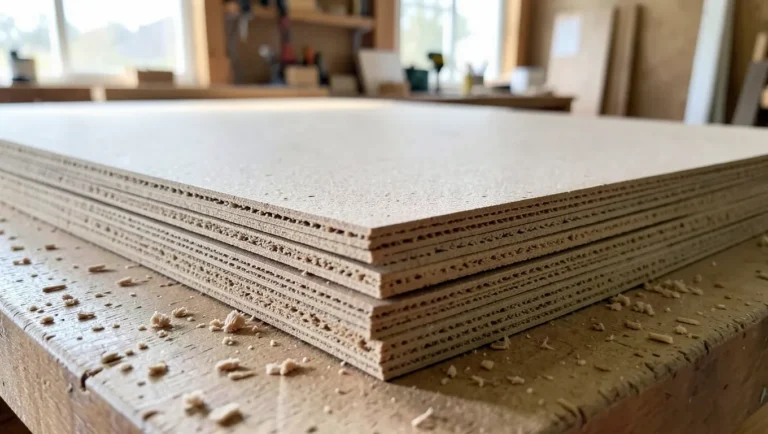
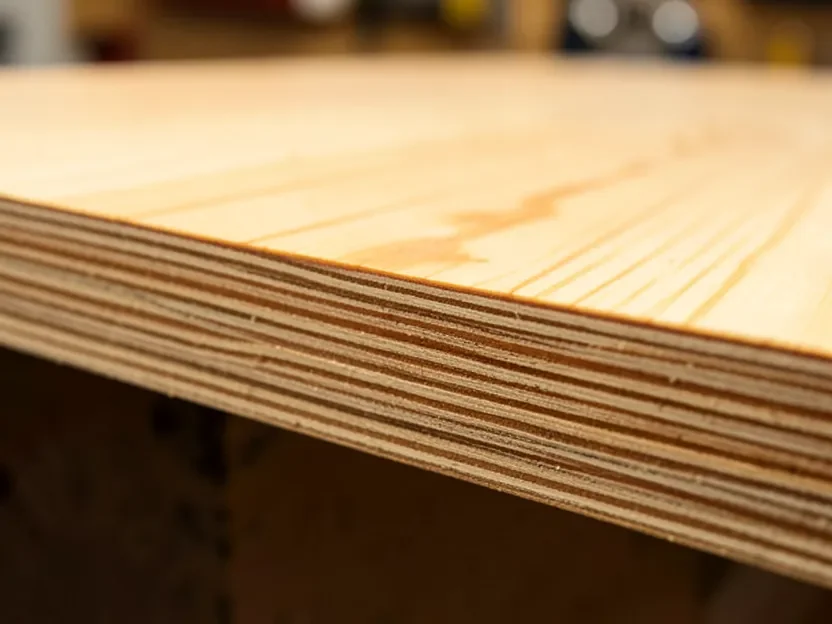
Particleboard is made from wood chips and shavings pressed with resin – a coarser process than MDF’s fine wood fibers. That’s the honest trade-off: particleboard is usually the cheapest alternative on this list, at roughly $20 to $35 per sheet, but it’s also weaker and lower-density than MDF. It doesn’t hold screws as well, especially on repeated assembly/disassembly (think flat-pack furniture), and its edges swell more readily when they get wet since the loose particle structure wicks moisture faster than MDF’s tighter fiber mat.
Where it makes sense: budget shelving, closet systems, and furniture that won’t get assembled and reassembled repeatedly. Where it doesn’t: anything near a sink, a laundry room, or an exterior wall with condensation risk – see our notes on whether particle board warps for what actually happens to it in humid conditions. If you’re also weighing OSB as a structural option, our MDF vs. OSB comparison covers that separately since OSB behaves differently again (better structural strength, rougher surface, not a like-for-like MDF swap).
Solid Wood / Hardwood
Solid wood is the most durable option here, and the most expensive – hardwood boards typically run $50 to $150+ per sheet-equivalent depending on species, and premium hardwoods can go well beyond that. You’re getting a real, single material with no resin binder, no formaldehyde off-gassing, and grain that actually means something structurally (it splits along the grain instead of crumbling like a damaged MDF edge).
The honest catch: solid wood moves. It expands and contracts across the grain with seasonal humidity changes in a way engineered panels don’t, so a wide solid-wood panel used as a cabinet side or tabletop needs to be built with that movement accounted for (breadboard ends, floating panel construction, proper acclimation before building). Skip that step and you’ll get cracked joints or a warped panel within a year or two. For small parts, trim, or anything under about 12 inches wide, this isn’t a real concern – it becomes one on wide panels.
HDF (High-Density Fiberboard) / Hardboard
HDF is made the same basic way as MDF – wood fibers pressed with resin – but compressed to a higher density, which is exactly what the name says. The result is a thinner, harder, more scratch-resistant panel. You’ll recognize it as pegboard, cabinet backing, and drawer bottoms. HDF sheets run roughly $20 to $30 for thin 1/4-inch stock, climbing to $40 to $60 for thicker 3/4-inch panels, which puts it in a similar price range to MDF itself rather than being a clear budget or premium pick.
Where HDF genuinely beats MDF: thin panels that need to resist dents and scratches (drawer bottoms, cabinet backs, pegboard). Where it doesn’t help: it’s rarely sold in the thicker stock (3/4-inch and up) that MDF is normally used for in structural panels or furniture carcasses, so it’s more of a specialty swap for specific thin-panel applications than a general-purpose replacement.
Melamine-Faced Board
Here’s the detail most “MDF alternatives” lists skip: melamine isn’t actually a substrate, it’s a surface finish. A melamine-faced board is almost always a particleboard or MDF core with a thin, hard, pre-finished melamine resin layer bonded to both faces. So when someone recommends “melamine board” as an MDF alternative, what you’re really choosing is the core material (usually particleboard) plus a factory-applied finish that saves you a painting or laminating step.
Melamine-faced particleboard runs roughly $45 to $70 per sheet – more than raw MDF or particleboard, but you’re paying for a durable, moisture-resistant, ready-to-use surface instead of paint and primer labor. It’s a strong pick for cabinet interiors, closet systems, and garage storage, where the pre-finished surface matters more than the core material’s own strength. It’s a poor pick anywhere you need to cut and expose a new edge often, since the raw particleboard or MDF core underneath is exposed at every cut and needs edge banding to match. For cabinet-specific guidance on when MDF itself is the right core material, see what MDF cabinets are good for.
Plastic / PVC Board
PVC and cellular-plastic board solve MDF’s biggest weakness completely: it doesn’t absorb water at all. No swelling, no delamination, no mold growth, even in constant wet conditions. That makes it the right call for bathroom vanities, outdoor kitchens, boat interiors, and anywhere else MDF (or even plywood) would eventually fail from moisture alone. It also machines cleanly – it cuts, routs, and drills like a dense hardwood without splintering.
The trade-off is cost and handling: PVC board is noticeably pricier than every wood-based option here, commonly landing in the $70 to $150+ per sheet range depending on thickness and density, and it’s heavier and more prone to expanding/contracting with temperature swings than wood-based panels are. It also dulls standard wood-cutting blades faster, so plan on carbide-tipped blades or bits. Reserve it for the specific wet-area or outdoor applications where its moisture-proof behavior actually earns the extra cost – it’s overkill (and expensive overkill) for a dry interior shelf.
Cost and Trade-Off Comparison
Here’s how the six alternatives actually stack up against MDF and each other, based on typical 2026 U.S. pricing for a standard 4×8 sheet:
| Material | Cost per 4×8 Sheet | Moisture Resistance | Screw-Holding Strength | Best Use Case |
|---|---|---|---|---|
| MDF (baseline) | $25 – $60 | Poor | Weak at edges | Painted furniture, molding, flat panels |
| Cabinet-Grade Plywood | $30 – $100+ | Good | Strong | Cabinet boxes, shelving, structural panels |
| Particleboard | $20 – $35 | Poor | Weak | Budget flat-pack furniture, dry-area shelving |
| Solid Wood / Hardwood | $50 – $150+ | Good (with sealing) | Very strong | Heirloom furniture, exposed-grain projects |
| HDF / Hardboard | $20 – $60 | Fair | Moderate | Cabinet backs, drawer bottoms, pegboard |
| Melamine-Faced Board | $45 – $70 | Good (face only) | Depends on core | Cabinet interiors, closet and garage storage |
| PVC / Plastic Board | $70 – $150+ | Excellent | Strong | Bathrooms, outdoor kitchens, wet areas |
Which Alternative Actually Fits Your Project?
Match the alternative to the specific problem you’re solving, not to a general “better than MDF” ranking:
- Wet area (bathroom, laundry, outdoor): PVC board first choice, cabinet-grade plywood as a cheaper second option
- Cabinet boxes and shelving that gets loaded down: Cabinet-grade plywood, for the edge screw-holding
- Budget flat-pack furniture, dry room only: Particleboard
- Heirloom-quality furniture or anything with exposed grain: Solid wood, built to allow for seasonal movement
- Drawer bottoms, cabinet backs, pegboard: HDF/hardboard
- Cabinet interiors or closet systems where you want a finished look without painting: Melamine-faced board
- Painted trim, molding, or a smooth routed profile edge: Honestly, MDF itself is still usually the right call here – none of the six alternatives above machine an edge as cleanly, which is the one thing MDF still does better than all of them
Frequently Asked Questions
What Is The Best Alternative To MDF Board?
Cabinet-grade plywood is the best all-around alternative for most builds, since it combines a flat, workable surface with much better screw-holding strength and moisture resistance than MDF. Particleboard is cheaper but weaker, and solid wood is stronger but pricier.
Is Plywood Better Than MDF For Cabinets?
For structural parts like cabinet boxes and shelves, yes – plywood holds screws better and handles moisture better. For cabinet doors that need a smooth, painted, routed edge, MDF is often still the better choice since plywood’s layered edge shows through paint.
What Is The Cheapest Alternative To MDF?
Particleboard is usually the cheapest engineered-wood alternative to MDF, at roughly $20 to $35 per 4×8 sheet. It’s also weaker and more prone to swelling at cut edges, so it works best in dry, low-stress applications.
Can You Use HDF Instead Of MDF?
Yes, for thin panels like cabinet backs, drawer bottoms, or pegboard, where HDF’s higher density and scratch resistance are an advantage. HDF isn’t commonly sold in the thicker 3/4-inch stock MDF is used for in structural panels, so it’s a specialty swap rather than a general replacement.
Conclusion
There’s no single “best” MDF alternative – there’s a best alternative for what’s actually going wrong with MDF in your specific project. Cabinet-grade plywood covers most general-purpose builds. Particleboard covers tight budgets in dry rooms. Solid wood covers anything meant to last generations. HDF, melamine-faced board, and PVC board each solve one narrow problem (thin durable panels, finished cabinet interiors, and total moisture immunity) better than any of the others. And for painted trim and routed profile edges, MDF often remains the right material even after reading all of this – which is the one honest answer most “alternatives” roundups skip.
Sponsored / affiliate links. As an Amazon Associate I earn from qualifying purchases. I may earn additional commission from eligible campaigns.