Properties of MDF: Density, Strength and Swell Numbers
MDF (medium-density fiberboard) is a dense, grain-free panel made of wood fibers, wax and resin, and its most useful properties come down to numbers: roughly 44 to 48 lb per cubic foot, a modulus of rupture (MOR) from about 2,800 to 4,500 psi depending on grade, and a 24-hour thickness swell cap of 5.5% only on moisture-resistant grades. Most articles stop at “smooth, cheap, hates water.” Below are the actual spec-sheet figures, what they mean at the bench, and where two boards that are both sold as “MDF” differ by 30% or more.
MDF Properties at a Glance
Best MDF Panel for Jigs
|
Woodhaven MDF 3/4 in (18 mm) Thick 12 x 24 in Panel
|
- Density: about 700 to 770 kg/m3 (44 to 48 lb/ft3) for standard Grade 130 and 155 panels from one major North American maker
- Strength: MOR of 2,800 to 4,500 psi and MOE of 280,000 to 450,000 psi, depending on grade and thickness
- Weakest direction: internal bond (how well the fibers hold together through the thickness) of 85 to 130 psi
- Water: standard MDF has no swell guarantee; MR10 grade caps 24-hour thickness swell at 5.5%
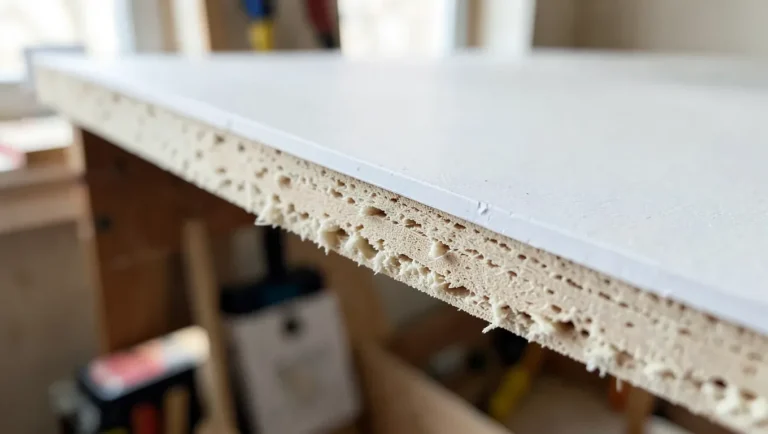
- Surface: no grain, no knots, takes paint and veneer evenly, but raw edges are fuzzy and absorbent unless sealed
Density: What “Medium” Actually Means
The “medium” in medium-density fiberboard is a manufacturing term, not a precise promise. One major North American producer lists its standard Grade 130 MDF at 700 to 745 kg/m3 and its Grade 155 at 740 to 770 kg/m3 under ANSI A208.2. In shop units that is roughly 44 to 48 lb per cubic foot, which is why MDF feels so much heavier than plywood of the same thickness.
You can turn that into a real number. A 3/4 in (18 mm) 4 x 8 ft sheet holds about 0.0567 cubic meters of board, so at 700 to 745 kg/m3 it weighs roughly 40 to 42 kg, or about 87 to 93 lb. That is a calculation from the density range above, not a weighed sheet, so treat it as a planning figure: a full sheet is a two-person carry, and the vehicle you load it into matters more than most buyers expect.
Density is also the first reason MDF cuts, routs and profiles so cleanly. The panel is almost the same all the way through, so there is no grain direction to tear out. For cutting technique and dust control, see how to cut MDF.
Strength Numbers by Grade (Real Spec-Sheet Values)
Here is the information most articles skip: “MDF” is not one material. The table below shows ANSI A208.2 minimum panel averages for four product lines from the same manufacturer (Georgia-Pacific UltraStock, 2018 data sheet), for panels from 1/2 in to 3/4 in thick.
| Property (min panel average) | Select | Premium | Lite | MR (MR50) |
|---|---|---|---|---|
| MOR, psi | 4,050 | 3,130 | 2,800 | 4,050 |
| MOE, psi | 405,000 | 313,000 | 280,000 | 405,000 |
| Internal bond, psi | 120 | 90 | 90 | 120 |
| Face screw holding, lb | 270 | 235 | 222 | 270 |
| Edge screw holding, lb | 250 | 215 | 215 | 250 |
| 24-hr thickness swell | 5.5% max | 5.5% max | 5.5% max | 5.5% max |
Source: Georgia-Pacific UltraStock MDF specification sheet. The Select column is the 1/2 in to 1 1/8 in range on that sheet. Values are manufacturer minimums, not what you will measure on every board.
Two readings matter. First, the Lite board has an MOR about 31% below the Select board (2,800 vs 4,050 psi), so a shelf that sags on Lite may be fine on Select. Second, internal bond falls as panels get thicker: the same sheet lists Premium at 110 psi in panels under 3/8 in but only 85 psi above 3/4 in. A thick, lower-bond core is where MDF splits when you drive a screw near an edge or lift a heavy part by its corner.
If you are choosing between MDF and a layered panel for load-bearing work, the strength-to-weight tradeoff is covered in MDF board vs plywood, and the fiber-versus-chip difference is in MDF vs particle board.

Moisture and Thickness Swell: Correcting a Common Myth
A common claim is that MDF is “treated to resist water” and is fine for bathrooms and kitchens. That is not true of standard MDF. Moisture resistance is a separate, tested designation in ANSI A208.2 section 3.6:
- MR10: passes a 24-hour thickness swell test of 5.5% or less
- MR50: passes the same 5.5% swell limit and also keeps 50% of its original MOR after accelerated aging
Even an MR50 board is moisture resistant, not waterproof, and the cut edges and screw holes are where water gets in. Standard MDF with no MR rating has no such guarantee, so a spill left for a day can raise the surface permanently. If a project will see damp air or splashes, buy an MR grade and seal every edge; the full sealing sequence is in our guide on how to make MDF water-resistant.
Screw Holding and Edges
The table above shows face screw holding of 222 to 270 lb and edge screw holding of 215 to 250 lb on the same boards. Edges hold a bit less, and the modest internal bond is why an edge screw can split a layer open. Practical rules: drill a pilot hole sized for the screw core, keep screws at least about 1 in from an edge when you can, and use coarse-thread or purpose-made screws. More detail is in which screws work in MDF.
Surface, Machining and Finishing
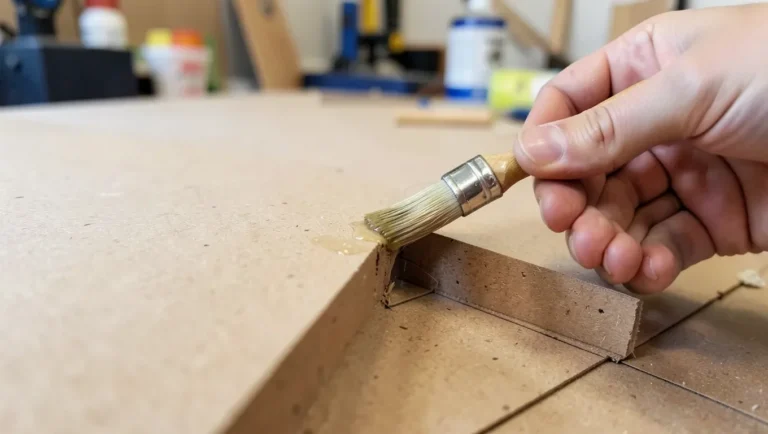
MDF has no grain, so it routes crisp profiles, takes veneer without telegraphing and paints more evenly than most solid wood. Its fine fibers also make very fine dust, so wear a dust mask or respirator and use dust collection when cutting or sanding. Raw edges soak up paint and glue, so seal them first; for adhesives see which glue works on MDF.
Formaldehyde is the other property buyers ask about. The same manufacturer lists CARB Phase 2 limits of 0.11 ppm for panels over 8 mm and 0.13 ppm for panels 8 mm or thinner, and some lines use no-added-formaldehyde resin. For how to buy lower-emission board, see whether MDF is sustainable.
Which MDF Property Should Drive Your Choice
| Project | Property to check | What to buy |
|---|---|---|
| Paint-grade cabinet doors | Surface smoothness, edge sealing | Standard grade, seal edges |
| Long shelves | MOR and MOE | Select-type grade, add a front edge strip |
| Router templates and jigs | Flatness, density | Any standard grade, 3/4 in |
| Laundry room or bathroom parts | Thickness swell | MR10 or MR50, sealed on all edges |
| Lightweight panels to carry | Density | Lite-type grade, accept lower strength |
Frequently Asked Questions
What are the main properties of MDF?
MDF is dense and uniform with no grain, with a typical density of about 700 to 770 kg/m3 (44 to 48 lb/ft3), an MOR of roughly 2,800 to 4,500 psi depending on grade, and very good machinability. Its main weakness is moisture: standard MDF has no swell guarantee, while MR10 limits 24-hour thickness swell to 5.5%.
Is MDF stronger than plywood?
Not for structural or load-bearing work. MDF has high density and good surface quality, but its internal bond is only about 85 to 130 psi, so it splits more easily through the thickness. Layered plywood is usually the better pick for shelves and boxes that carry weight.
Is MDF waterproof?
No. Even MR50 MDF is only moisture resistant: it meets a 5.5% limit on 24-hour thickness swell and holds 50% of its MOR after accelerated aging. Seal all edges and screw holes if it will see damp conditions.
How heavy is a sheet of MDF?
At 700 to 745 kg/m3, a 3/4 in 4 x 8 ft sheet works out to roughly 87 to 93 lb by calculation. Actual weight varies by grade and moisture content.
Does MDF hold screws well?
Reasonably well on the face (about 222 to 270 lb on the spec sheet values above) and a little less on the edge. Pilot holes and keeping screws away from edges prevent splitting.
Sponsored / affiliate links. As an Amazon Associate I earn from qualifying purchases. I may earn additional commission from eligible campaigns.