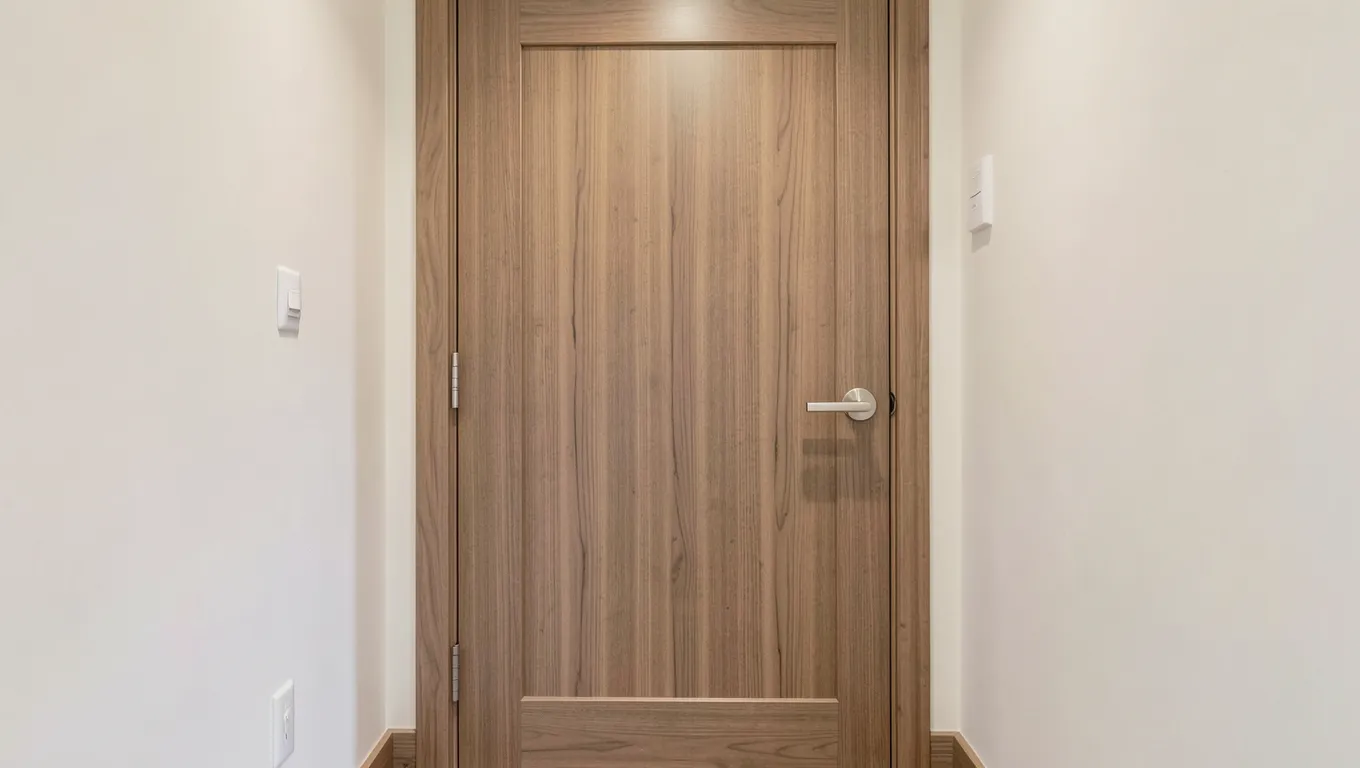
Ash Wood Door: Cost, Durability, and Buying Guide
Ash is a hardwood with a Janka hardness rating around 1,320 lbf – harder than red oak and close to hard maple – which is why it has been used for baseball bats and tool handles for over a century. That same toughness makes it a durable, good-looking option for interior doors, usually at a lower price than oak or walnut.
One thing most buying guides skip: ash lumber supply has gotten tighter since the early 2000s because of the emerald ash borer, an invasive beetle that has killed hundreds of millions of ash trees across North America. That doesn’t make ash doors hard to find, but it’s part of why solid ash sometimes costs more than it did a decade ago, and why veneer and engineered options exist for people who want the ash look without paying for scarce solid stock.
What Makes Ash a Good Door Wood
KEEP YOUR NEW DOOR LOOKING NEW
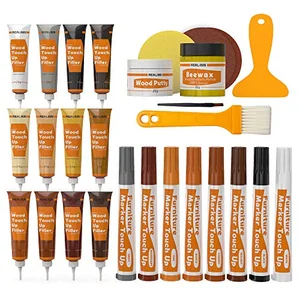 |
REALINN Wood Furniture Repair Kit – $20.99 A pre-hung ash door will pick up its first scuff near the strike plate or bottom rail within the first year – this kit fixes that without a full refinish.
|
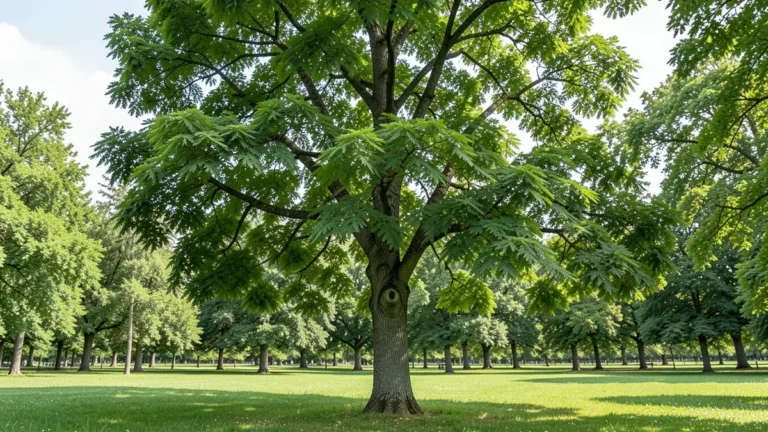
Ash trees are common across the eastern half of North America and much of Europe, and the wood has a long track record in products that take repeated impact – bats, hammer handles, hockey sticks, and oars. That’s the same fiber structure that resists dents and dings on a door in a busy hallway. Ash also has a pronounced, straight grain that’s easy to see through a clear or lightly tinted finish, which is why it’s a popular pick when someone wants a hardwood door without paying oak prices.
In real numbers: white ash sits at roughly 1,320 lbf on the Janka scale, red oak at about 1,290 lbf, white oak around 1,360 lbf, and hard maple near 1,450 lbf. Pine, by comparison, is usually somewhere between 380 and 870 lbf depending on species. Ash lands in the same durability range as oak for a noticeably lower board cost in most regions.
Ash vs. Other Common Door Woods
| Wood Type | Janka Hardness | Pros | Cons |
|---|---|---|---|
| Ash | ~1,320 lbf | Durable, strong straight grain, takes stain evenly, priced below oak | Solid stock supply has tightened due to emerald ash borer damage |
| Pine | ~380-870 lbf | Cheapest option, light, easy to cut and drill | Dents and scratches easily, knots can telegraph through paint |
| Red Oak | ~1,290 lbf | Classic look, widely available, very durable | Open grain can look busy, usually costs more than ash |
| Hard Maple | ~1,450 lbf | Very hard, smooth uniform surface, modern look | Tight grain takes stain unevenly (blotching), pricier than ash |
Ash sits in a genuine middle ground: it’s harder than pine by a wide margin, essentially tied with oak on the Janka scale, and softer to work with than oak without sacrificing much durability. For a door that will see kids, pets, or a daily-use hallway, that combination is hard to beat for the price.
Types of Ash Wood Doors
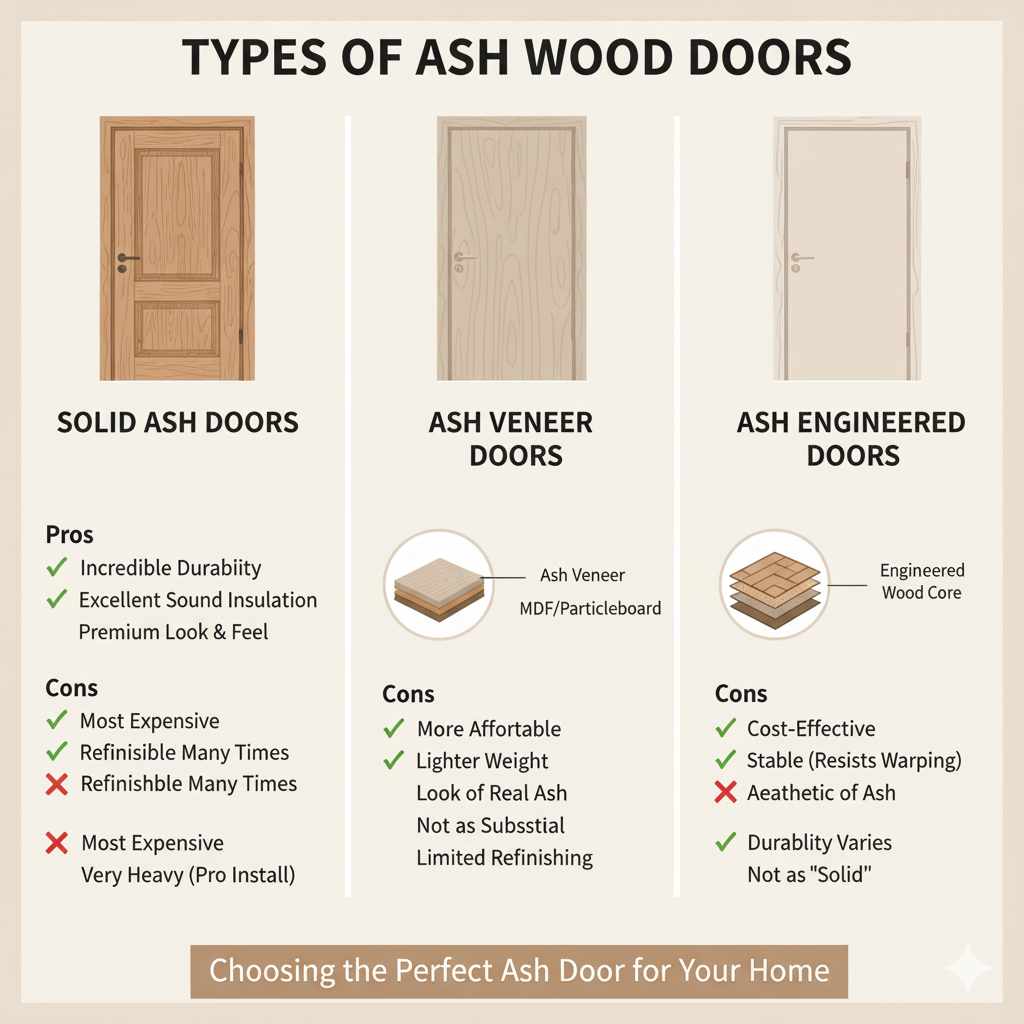
When you shop for an ash door, you’ll run into three constructions. They look similar once installed and finished, but they behave differently over time and cost very different amounts.
Solid Ash Doors
Built entirely from solid ash lumber, typically edge-glued from several boards rather than a single slab. Expect to pay roughly $400 to $1,200 for a solid ash interior door depending on size, panel detail, and glass inserts.
- Pros: Best sound dampening of the three, can be sanded and refinished multiple times over its life, feels solid when it closes.
- Cons: Heaviest option (a solid door can run 20-40 lbs heavier than veneer), highest price, most exposed to seasonal wood movement.
Ash Veneer Doors
A core of MDF, particleboard, or a hollow/solid-core frame is wrapped in a thin (usually 1/40 to 1/28 inch) layer of real ash. Typical price range is $150 to $400.
- Pros: Far more affordable than solid, lighter to hang, the MDF/particleboard core resists warping better than solid wood does.
- Cons: A deep gouge can cut through the veneer to the core underneath, and it can only be lightly sanded/refinished once or twice before you’re through the veneer layer.
Ash Engineered Doors
Similar concept to veneer, but built on an engineered wood core designed specifically for dimensional stability, often with an ash-faced skin over an LVL or finger-jointed stile-and-rail frame. Runs $100 to $300 in most cases – the least expensive of the three.
- Pros: Most dimensionally stable option in humid rooms, lowest cost, still shows real ash grain on the face.
- Cons: Longevity depends heavily on the manufacturer’s core quality and how well the face veneer was bonded – cheap versions can delaminate at the edges after years of humidity swings.
How to Choose the Right Ash Wood Door
Match Construction to Room and Budget
If budget is the deciding factor, engineered or veneer gets you the ash look for a fraction of solid-wood cost, and the more stable core is actually the better technical choice for a bathroom, laundry room, or kitchen where humidity swings daily. Save solid ash for a front-facing room – a study, dining room, or main hallway – where the extra sound dampening and heft are worth paying for.
Think About Traffic and Impact
Ash’s Janka hardness means it resists the kind of everyday dents a doorknob-into-drywall moment or a dragged toy box can cause, but no wood is immune. In a household with kids, large dogs, or a door that gets kicked open with an armload of laundry, solid ash or a thick-face veneer will outlast a thin engineered face over 10+ years.
Slab vs. Pre-Hung
- Slab doors: Just the door panel. Cheaper, but you’ll need to mortise and install hinges yourself and the panel has to match your existing frame’s rough opening exactly. Not a great first door project.
- Pre-hung doors: Arrive already mounted in a jamb with hinges attached and pre-drilled for the strike plate. For a first-time installer this is the far easier route – you’re squaring up a whole unit in a rough opening, not fitting a slab to an existing frame.
Caring for an Ash Wood Door
Routine cleaning is simple: a dry microfiber cloth for dust, or a barely damp cloth wiped with the grain for fingerprints and light grime. Skip ammonia-based glass cleaners and anything with vinegar or citrus oil on a finished door – both can dull or haze polyurethane and lacquer finishes over repeated use, even though they’re fine on unfinished wood.
For a heavier cleaning, a few drops of pH-neutral dish soap in warm water on a well-wrung cloth handles most grease and handprints around the knob area. Dry it immediately with a second cloth – standing moisture is what eventually causes the finish to cloud or the grain to raise slightly.
Scratches and Touch-Ups
A color-matched wax filler stick or touch-up marker (like the kit above) handles surface scratches on a stained door in a couple of minutes. For a gouge that’s gone through the finish into bare wood on a solid or thick-veneer door, clean the area, apply filler, let it cure, then feather in matching stain before resealing just that spot – trying to blend an entire panel usually creates a more visible patch than a small, well-matched touch-up.
Humidity and Seasonal Movement
Ash is more stable than pine but will still expand slightly in summer humidity and contract in dry winter heat. If a solid ash door starts sticking at the top corner in July and clears up by January, that’s normal seasonal movement, not a defect – a light sanding of the sticking edge (never the hinge side) usually solves it without needing to re-hang the door.
Installing a Pre-Hung Ash Door
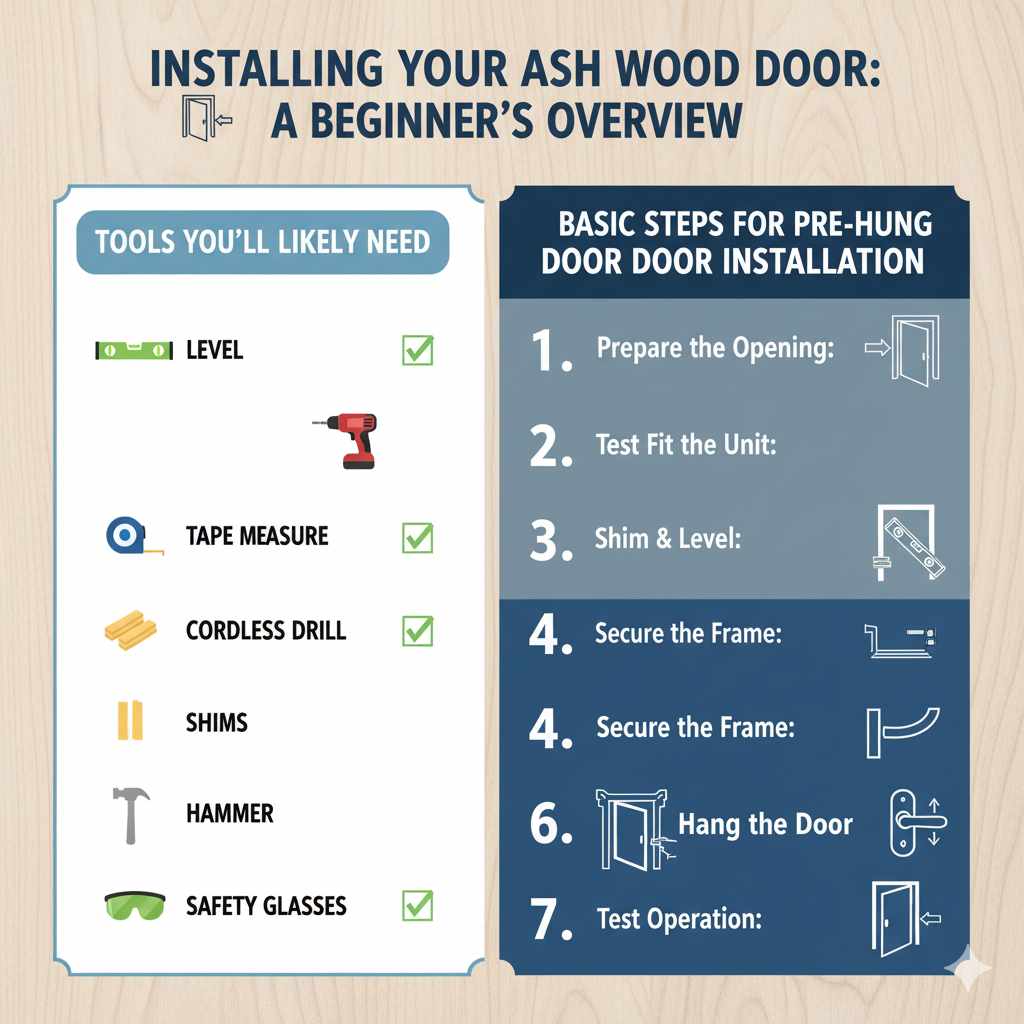
A pre-hung unit is sized with roughly 1/2 inch of clearance around the jamb so it can be shimmed plumb inside a rough opening – you’re not cutting the door to fit, you’re adjusting the frame with shims until it’s square. Wear safety glasses; you’ll be tapping shims with a hammer near eye level more than once.
Tools You’ll Need
- 4-foot level (a 2-foot level isn’t long enough to catch twist along the full jamb)
- Tape measure
- Cordless drill with driver bits and 3-inch construction screws for the hinge-side jamb
- Composite or cedar shims (a full pack – you’ll use more than you think)
- Hammer and a flush-cut or utility knife to trim shims
- Safety glasses and work gloves
Step-by-Step
- Check the rough opening: Confirm it’s roughly 2 inches wider and 2.5 inches taller than the door slab itself, and that the subfloor under the opening is level.
- Set and center the unit: Place the pre-hung frame in the opening, centered, with the door closed inside it.
- Shim the hinge side first: Place shim pairs behind each hinge location until the hinge jamb is dead plumb – this side controls how the door hangs, so get it right before touching the strike side.
- Screw the hinge jamb: Drive a 3-inch screw through the jamb and each shim pair into the wall framing behind it.
- Shim and secure the strike side: With the door closed, shim behind the strike jamb until the gap around the door is even top to bottom, then screw through those shims too.
- Trim shims flush with a utility knife or flush-cut saw, then install the door casing to cover the gap between jamb and wall.
- Test the swing: Open and close it fully several times and check the latch catches without slamming or dragging on the floor.
If the door binds at the top after everything’s screwed down, it’s almost always a shim that shifted on the hinge side, not a problem with the door itself – loosen, re-shim, and re-test before assuming anything is wrong with the unit.
Frequently Asked Questions About Ash Wood Doors
Q1: Is ash wood good for interior doors?
Yes. At roughly 1,320 lbf on the Janka hardness scale, ash is close to red oak and noticeably harder than pine, which makes it a good match for interior doors in high-traffic hallways and rooms with kids or pets.
Q2: Are ash wood doors expensive?
Solid ash typically runs $400 to $1,200, which is usually less than a comparable solid oak or walnut door. Veneer ($150-$400) and engineered ($100-$300) options bring the ash look in well under that if budget matters more than solid-wood weight and sound dampening.
Q3: How do I clean an ash wood door?
Dry microfiber cloth for dust, a barely-damp cloth with mild pH-neutral soap for grime, dried immediately with a second cloth. Avoid ammonia, vinegar, or citrus-oil cleaners on a finished door – they can dull the topcoat over time.
Q4: Can I paint or stain an ash wood door?
Yes to both. Ash’s open, straight grain takes stain evenly (it doesn’t blotch the way maple or cherry can), so it’s a reliable choice if you want a stained finish that shows real grain. For paint, prime first; if it’s already finished, scuff-sand lightly before the new coat.
Q5: Will an ash wood door warp?
Solid ash moves seasonally with humidity like any solid hardwood, though it’s more dimensionally stable than softwoods. If warping resistance in a humid room (bathroom, laundry) is the priority, an engineered-core or veneer door will outperform solid ash.
Q6: Are ash wood doors heavy?
Solid ash doors are noticeably heavier than veneer or engineered versions – often 20-40 lbs more – because of the wood’s density. That extra weight is part of why they feel and sound more solid, but it also means heavier-duty hinges and sometimes professional installation.
Q7: Where can I buy ash wood doors?
Home improvement stores and lumber yards carry pre-hung ash doors, and specialty door retailers can order solid ash to custom sizes. Because solid ash supply has tightened due to emerald ash borer damage to North American ash trees, always confirm with the retailer whether a listing is solid ash or an ash-faced veneer/engineered door before buying.
Bottom Line
Ash earns its place as a mid-tier hardwood door choice on hard numbers, not just looks: a Janka hardness close to oak, a straight grain that stains evenly, and a lower price than most other hardwoods that match its durability. Solid ash makes sense for a front hallway or study where sound dampening and heft matter; veneer or engineered ash makes more sense in a bathroom, kids’ room, or anywhere budget and stability matter more than solid-wood weight. Either way, a pre-hung unit and a shim-heavy, patient install will get you a door that swings true for years, and a small repair kit on hand means the first scuff isn’t a big deal.
Sponsored / affiliate links. As an Amazon Associate I earn from qualifying purchases. I may earn additional commission from eligible campaigns.