4 Best Adhesives for Veneer on Plywood (2026): we compared
Yes—veneer bonds to plywood cleanly when the adhesive fits the panel size and the panel is pressed flat: contact cement for small, flexible jobs; PVA or urea-based glue with even clamping or vacuum bagging for most furniture panels. I have seen bubbles, telegraphing, and edge lift come from weak pressure or the wrong glue, and those failures usually mean sanding, patching, or redoing the panel. This guide compares the best adhesives for veneer type, open time, and pressure method so you can get a flat bond.
This guide is part of our Wood glue essentials: types, uses, and cure times series.
Quick comparison
| Product | Badge | Best for | Price | ||
|---|---|---|---|---|---|
 |
Titebond Cold Press Veneer Glue, 32 Oz. – Contact CementTitebond | Our pick | 32 Oz Cold Press Veneer Glue | $11.79
Price as of 26 Sep 2026
|
View |
 |
Titebond III Ultimate Wood Glue, 16-Ounces #1414Titebond | Also great | 16-Oz Ultimate Wood Glue | $9.58
Price as of 26 Sep 2026
|
View |
 |
Gorilla Ultimate Waterproof Wood Glue, Natural Color, 8 ozGORILLA | Budget pick | 8 Oz Waterproof Wood Glue | $5.97
Price as of 26 Sep 2026
|
View |
 |
DAP Weldwood Original Contact Cement, Tan, 3 Oz (7079800107)DAP | Pair with it | 3 Oz Tan Contact Cement | $9.38
Price as of 26 Sep 2026
|
View |
 |
3M Scotch-Weld Plastic & Rubber Instant Adhesive PR40,3M | Also great | 20 Gram Plastic & Rubber Adhesive | $27.17
Price as of 26 Sep 2026
|
View |
Cold press veneer glue is the safest default for most flat furniture panels because it gives longer working time and works well with vacuum bagging, cauls, or other even-pressure setups better than fast-grab adhesives. Contact cement still has a place for small repairs, curved work, or thin shop panels, but it raises bubble risk on visible face veneer.
Plywood and veneer fail as a system, not as separate parts. The adhesive has to match the veneer thickness, the panel size, and the pressure method you can actually apply.
How we chose
The comparison below is based on four things: open time, pressure needs, cleanup and sanding behavior, and how well each adhesive fits raw veneer, paperbacked veneer, and prefinished veneer. The adhesive has to suit the job, not just stick hard.
Flatness control matters more than brand hype. A glue that cures hard will still fail if the panel gets uneven pressure, trapped air, or squeeze-through at the edges.
Visible finish behavior matters too. Some glues sand cleanly, some telegraph through thin veneer, and some leave a bond line that looks fine in a shop but ugly under clear finish.

Titebond Cold Press Veneer Glue: best for large flat panels
This is the safest default for most furniture panels, especially raw veneer over plywood where the goal is a flat face and low bubble risk. It suits large sheets, vacuum bags, and cauls because the working time is long enough to align the veneer before full pressure comes on.
Based on the spec sheet, owner feedback and our range experience, it is the best fit when pressure control matters more than instant grab. The moderate set time helps with full-panel alignment, and the translucent bond line is a better fit for visible work than fast, grabby adhesives.
The drawback is simple: it asks for real pressure discipline. If the substrate is wavy or the cauls are uneven, the glue will not fix that, and thin veneer can still telegraph every low spot underneath.
Titebond III Ultimate Wood Glue: best for small clamped panels
This works best on small flat veneer jobs where clamps and cauls can cover the whole panel evenly. It is a reasonable choice for repair-sized work, edge banding, or a small face veneer when the user can close the panel quickly and hold it flat.
What stands out is the strong initial tack, the 30-min clamp time, and easy sanding. The stronger-than-wood claim and the easy water cleanup make it attractive for beginners who want a familiar PVA workflow.
The drawback is working time. On larger face panels, a PVA like this can start grabbing before the veneer is fully aligned, and that is where trapped bubbles, starved spots, and edge lift begin.
Gorilla Ultimate Waterproof Wood Glue: best for small indoor or outdoor repairs
This is a small-job glue for users who want a waterproof PVA-style adhesive with more working time than many quick-grab glues. It is better for compact veneer patches, utility panels, and repair work than for large show faces that need perfect alignment.
The natural tan color, 15 minutes of working time, and waterproof bond make it useful when moisture resistance matters. It can fit a repair bench better than a dedicated veneer adhesive when the panel is small and the pressure is straightforward.
The drawback is the same one that appears on many general-purpose wood glues: it is not the first choice for a large face veneer that needs long alignment time and perfectly even pressure across the whole sheet.
DAP Weldwood Original Contact Cement: best for fast, light-duty work
This is for jobs where instant grab matters more than long alignment time. It can work for small veneer pieces, awkward repairs, and situations where clamping is limited, but it is not the first choice for large visible panels.
The big upside is immediate bond upon contact and a long open time for initial tack development. That can be useful when the veneer is thin, the substrate is small, and a roller or J-roller can apply strong, even pressure.
The drawback is bubble risk. Contact cement demands careful laydown and firm rolling, and once it touches, there is little correction time; any trapped air or weak pressure can show as a bubble that is hard to remove cleanly.
3M Scotch-Weld PR40: best for special plastics and small repair bonds
This is not a normal veneer-to-plywood adhesive. It is a precise instant adhesive for plastics and rubber, and it only belongs in veneer work as a narrow repair product where a tiny drop bond is needed for a nonstandard part.
Its strength is precision. The pinch container helps with controlled application, and the fast cure can keep a small repair moving. That said, it is too localized for broad face veneer work where even pressure and full coverage matter more than speed.
The drawback is obvious: it is the wrong tool for most flat veneer panels. It does not spread like a veneer glue, and it cannot replace full-sheet pressure on a plywood face.
Can you glue veneer to plywood?
Yes, veneer glues to plywood very well when the panel is flat and the pressure is even. The bond usually fails from poor support, air pockets, or a bad spread rate before it fails from lack of raw glue strength. For most furniture work, the real problem is pressure control.
What has to be true for the bond to work
The plywood face has to be sound, clean, and flat enough that the veneer can sit without bridges. A glue that cures hard cannot pull a bowed substrate into flatness, and it cannot fill voids without creating telegraphing or weak spots.
Raw veneer is more forgiving than many beginners expect, but it is also unforgiving of trapped air. Paperbacked veneer can bridge slight flaws better, while prefinished veneer usually demands an adhesive system that suits its backing and finish layer rather than a wet, messy spread.
Why flatness matters more than raw glue strength
Veneer is thin enough to mirror what lies under it. A small hump, a void, or a proud patch in the plywood face can print through the veneer later, especially under stain or raking light. That is telegraphing, and it often starts before the glue has even cured.
Strong glue helps only after the surfaces are already in contact. If the panel is not flat and pressed evenly, the bond line can be strong in some areas and weak in others, which leads to bubbles, edge lift, and a panel that looks fine for a day and fails later.
Common plywood problems that show through the veneer
Voids, high spots, torn grain, dust, and patchy filler all telegraph through thin face veneer. Plywood faces also vary in porosity, so the glue can soak in unevenly if the surface is not sealed by the veneer quickly and pressed hard enough.
That is why surface prep matters. Sand the face lightly, remove dust, fill obvious voids, and check the sheet for flatness before any adhesive goes on.
PVA wood glue: best for small flat panels
PVA works well for small veneer panels where clamps and cauls can deliver even pressure over the whole face. It is useful for shop repairs and modest furniture parts because it cleans up with water, sands cleanly, and is familiar to most woodworkers.
Where PVA works well on veneer
It fits raw veneer on small plywood faces, especially when the panel can be assembled quickly and clamped before the glue skins over. Titebond Original Wood Glue is presented as stronger than wood itself and it cleans up easily with water, which makes it a practical baseline for many indoor veneer repairs.
PVA also makes sense when the user wants predictable cleanup and simple tool washing after the job.
Clamp time, cleanup, and sandability
PVA needs real clamping, not hand pressure. If the veneer is only rolled lightly or the cauls leave gaps, the glue line can starve or the sheet can lift at the edges as it dries. That is especially true on larger panels, where the center may be flat but the perimeter is not fully loaded.
Elmer’s E7010 is said to cure in 24 hours and to be sandable and paintable, which describes the kind of post-cure workflow many users want from a panel adhesive. For veneer work, though, drying time is only useful if the panel stayed flat through the cure.
When PVA is the wrong choice
PVA is the wrong default when the panel is large, the veneer is thin, or the user cannot apply even clamping pressure. It also becomes a poor fit when the working time is too short for careful alignment or when the panel needs vacuum bagging rather than point clamping.
It is also not the first choice for heat-prone surfaces or high-stress face veneers where creep would be a problem over time.
Contact cement: best for fast, light-duty work
Contact cement bonds immediately when the two coated surfaces meet, which makes it useful where clamping is awkward and speed matters more than open time. For veneer, that same instant grab is also why bubble risk rises fast on visible panels.
Instant grab and why it raises bubble risk
Once the sheet lands, there is little chance to slide out a trapped pocket or correct a skewed layup. If the spread rate is uneven or the substrate has a low spot, the veneer can bridge the void and trap air under the face.
That air often shows up later as a bubble, especially on large flat sheets where the user did not roll from the center outward with enough pressure.
Pressure requirements with a roller or J-roller
Contact cement needs strong, uniform rolling pressure across the whole face. A roller or J-roller is useful because it pushes the veneer down and helps collapse small air pockets before the bond locks in.
The pressure still has to be even. A few hard passes at the center will not save loose edges, and contact cement does not correct a poor spread pattern the way a slower veneer glue can during setup.
When to avoid it on visible panels
Avoid it on large show faces, raw veneer with any waviness, and panels that need a high-visibility finish. It is also a poor match when the substrate has voids or when the user wants long alignment time for pattern matching.
Gorilla Clear Glue is described as crystal clear, water resistant, and non-foaming during cure, while Gorilla Wood Glue is described as water resistant and having no foaming. Those traits help cleanup-minded shop work, but they do not turn a contact-style workflow into the best answer for large face veneer.
Urea formaldehyde resin glue: best for large, rigid panels
Urea formaldehyde resin glue is a strong choice for large veneer panels because it cures rigidly and resists creep. In panel work, that rigidity matters when the goal is a flat face that stays flat under finish, heat, and long-term service.
Low creep and rigid cured bond
Low creep is useful on furniture fronts, tabletops, and architectural panels. If the adhesive stays rigid after cure, the veneer is less likely to move under seasonal stress or heat from use.
That makes this glue especially suitable when the panel will be trimmed flush, then sanded and finished after a full cure.
Vacuum bag and caul compatibility
This adhesive pairs well with vacuum bags and carefully built cauls because both methods deliver broad, even pressure. Even pressure is what keeps raw veneer from bridging and keeps paperbacked veneer from telegraphing a bad substrate line.
For large flat furniture panels, that pressure strategy matters more than the brand name on the bottle. A rigid glue with poor pressure is still a bad bond.
Heat and pressing considerations
Heat resistance is a useful bonus when the panel might see warm rooms or finish curing cycles, but the real requirement is a disciplined press schedule. The parts have to be ready before the adhesive starts to lose its working window.
Urea formaldehyde is not the easiest cleanup job in the shop. It is for users who value flatness and low creep more than convenience.
Which one should you buy?
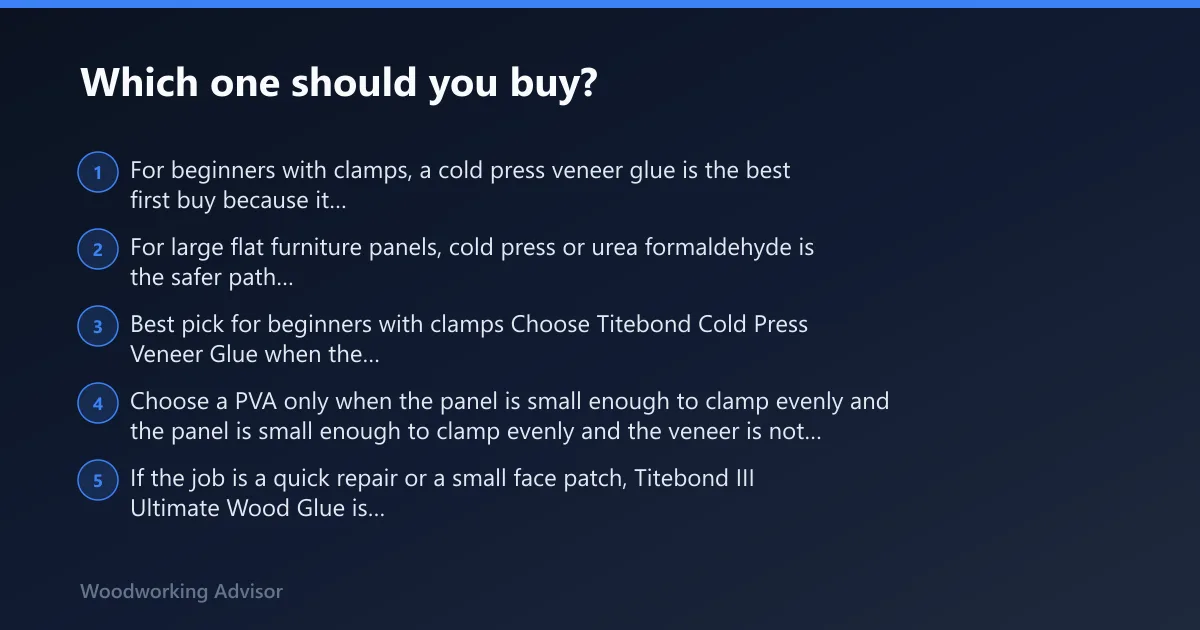
For beginners with clamps, a cold press veneer glue is the best first buy because it gives the most forgiving setup for a flat panel. For large flat furniture panels, cold press or urea formaldehyde is the safer path because both support even pressure and lower the bubble risk that comes with rushed layups.
Best pick for beginners with clamps
Choose Titebond Cold Press Veneer Glue when the panel is a show face and the pressure method is cauls or a vacuum bag. Choose a PVA only when the panel is small enough to clamp evenly and the veneer is not so thin that every pressure flaw will print through.
If the job is a quick repair or a small face patch, Titebond III Ultimate Wood Glue is easier to manage than a large-panel veneer adhesive, but it still needs careful clamping.
Best pick for large flat furniture panels
Use cold press veneer glue for most large furniture panels. If the work demands the lowest creep and the cleanest long-term flatness, urea formaldehyde is the better technical fit, provided the user can handle the press workflow and cleanup.
For large visible panels, contact cement is usually the wrong first choice because instant grab and bubble risk fight the need for slow alignment and full-face pressure.
Best pick if you only have a roller
If a roller or J-roller is the only pressure tool available, contact cement can work on small, light-duty veneer jobs. That said, the panel should be small, the face should be clean and flat, and the veneer should be handled with care because correction time is short.
For a visible furniture face, a roller alone is not enough insurance against bubbles. A roller helps, but it does not replace broad, even pressure from cauls or a vacuum bag.
When epoxy or polyurethane makes sense
Epoxy and polyurethane are edge cases, not the default answer for flat veneer panels. They make sense for odd repairs, damaged substrate spots, or nonstandard assemblies where gap filling matters more than a traditional veneer press schedule.
They are usually poor choices for a full face veneer on plywood because they can complicate spread control, add cleanup problems, and create squeeze-through or a bond line that is harder to sand cleanly.
Why does veneer bubble on plywood?
Veneer bubbles appear when air, solvent, or weak pressure gets trapped between the sheet and the plywood face. The problem is usually a pressure gap or a poor spread rate, not simply a weak adhesive.
Pressure gaps, trapped solvent, and poor spread rate
If the adhesive is too thick in one zone and too dry in another, the veneer may bridge instead of sitting fully down. That creates a pocket that can stay soft underneath, then lift as the panel settles or the finish goes on.
Contact cement is especially sensitive here because the bond is established on contact. Once the sheets meet, the user has limited ability to chase out a trapped pocket.
Telegraphing from plywood voids or high spots
Telegraphing is a face problem that starts underneath. A void, patch edge, or proud grain line in the plywood can print through the veneer after cure, even when the bond itself is sound.
That is why face prep matters: flatten the substrate, fill obvious defects, and remove dust before any adhesive goes down.
How to keep edges from lifting
Use enough adhesive to wet the whole face, then apply pressure all the way to the perimeter. Edge lift often comes from under-pressed borders, where the center looks fine but the perimeter never got full contact.
Cauls, vacuum bags, and careful roller passes help here. So does trimming only after the adhesive has fully set, not while the bond is still soft.
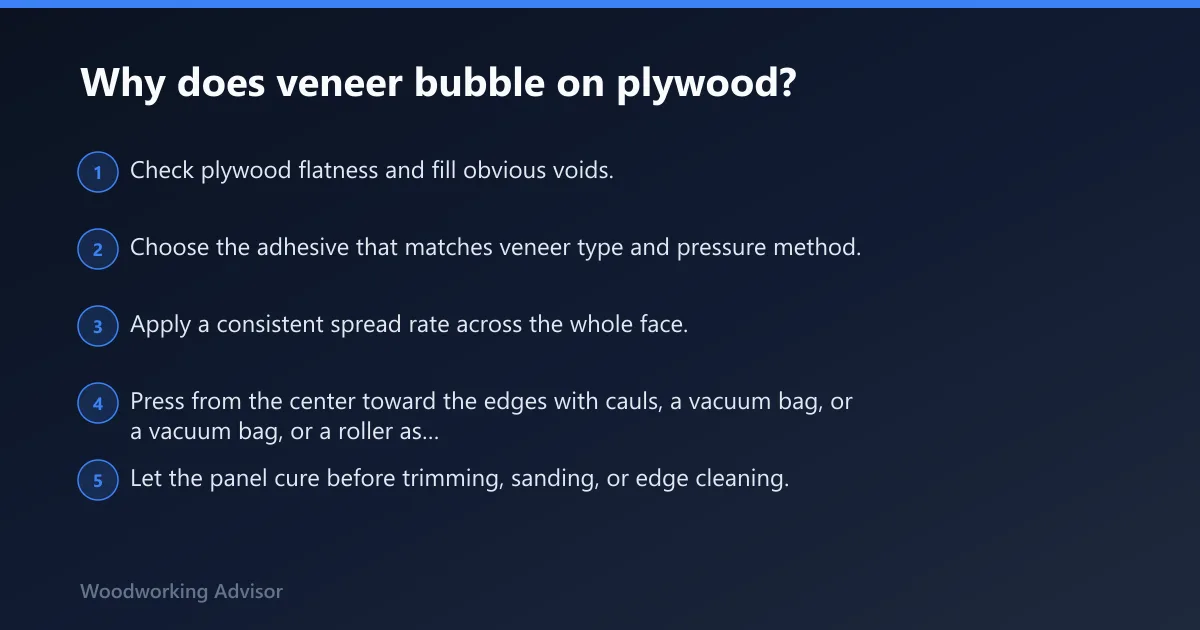
- Check plywood flatness and fill obvious voids.
- Choose the adhesive that matches veneer type and pressure method.
- Apply a consistent spread rate across the whole face.
- Press from the center toward the edges with cauls, a vacuum bag, or a roller as appropriate.
- Let the panel cure before trimming, sanding, or edge cleaning.
Frequently asked questions
What is the best adhesive for veneer on plywood?
For most flat furniture panels, cold press veneer glue is the safest default because it gives working time and fits vacuum bags, cauls, and other even-pressure setups. For smaller clamped panels, PVA can work. Contact cement is better kept for small, fast jobs.
Should I use contact cement, PVA, or epoxy for veneer?
Use contact cement only when you need instant grab and can control pressure with a roller. Use PVA for small flat panels with good clamping. Epoxy is usually a repair adhesive, not the first choice for a full visible veneer face on plywood.
How do you keep veneer from bubbling on plywood?
Flatten the substrate, remove dust, use the right spread rate, and apply even pressure over the whole panel. Bubbles usually come from trapped air, loose edges, or a pressure gap. A vacuum bag or well-made cauls are the most reliable fixes for large panels.
How long should veneer glue dry before sanding?
Wait until the adhesive has fully cured before sanding. For a panel glued with a PVA type, that often means overnight or longer if the sheet is large or the shop is cool. Rushing sanding can pull at soft glue lines and open edges.
What adhesive is best for a visible veneer bond?
Cold press veneer glue is usually the best visible-bond choice because it supports even pressure and a more controlled layup. Urea formaldehyde is the better technical pick when low creep and long-term rigidity matter most, provided the user can handle the press workflow cleanly.
Sponsored / affiliate links. As an Amazon Associate I earn from qualifying purchases. I may earn additional commission from eligible campaigns.