5 Best Nail Guns for Trim Work (2026): based on specs and reviews
For many trim jobs, a 16-gauge finish nailer is a solid all-around choice. For delicate molding, 18-gauge is often a good fit, while thicker hardwood casing and baseboards may call for 15-gauge or a sturdier 16-gauge setup. The wrong gauge or weak drive power means split stock, proud heads, and more hand-setting. This guide maps trim thickness, wood hardness, and install location to the right nailer, gauge, and power source.
This guide is part of our Drilling guide for bits, tools, and materials series.
Quick comparison
| Product | Badge | Best for | Price | ||
|---|---|---|---|---|---|
 |
Cordless 2" Brad Nailer Compatible with DeWalt 20VADOTOCAM | Budget pick | DeWalt 20V compatible · 18GA | $99.99
Price as of 14 Oct 2026
|
View |
 |
Milwaukee Electric – M18 Fuel 18 Gauge Brad NailerMilwaukee | Upgrade pick | M18 Fuel · Brushless · 18GA | $327.02
Price as of 14 Oct 2026
|
View |
 |
Metabo HPT Brad Nailer, Pneumatic 18 Gauge AdjustableMetabo HPT | Our pick | Pneumatic · 18GA · 2.2 lbs | $49.00
Price as of 14 Oct 2026
|
View |
 |
Senco 1X0201N FinishPro 32 16-Gauge Finish NailerSenco | Also great | 16GA Finish Nailer · Senco | $193.99
Price as of 14 Oct 2026
|
View |
 |
RYOBI ONE+ 18V 16-Gauge Cordless AirStrike Finish NailerRYOBI | Our pick | $179.70
Price as of 18 Oct 2026
|
View |
Use the matrix below to match trim thickness, wood hardness, and access constraints to gauge, magazine style, and power source. For painted work, hole size matters. For hardwoods and wider stock, holding power comes first.
📊 Bob Vila’s finish nailers drive nails up to 2.5 inches long. Source: The 8 Best Finish Nailers for DIYers and Pros, Tested & Reviewed.
How we chose
The decision points are straightforward. First is nail gauge, where a lower number means a thicker nail and more holding power. Second is trim thickness and wood hardness, because thin softwood is a different job from oak casing or crown.
Third is access. Inside corners, tight returns, and overhead crown often favor an angled magazine. Fourth is power source, because pneumatic tools are lighter and need a compressor, while cordless tools are portable but heavier and usually cost more.
Last is fastener fit: nail length, collation angle, and enough drive power to seat the head without crushing the surface or leaving it proud.

Best nail gun for trim work: 16-gauge finish nailer for most jobs
A 16-gauge finish nailer is the safest default for most trim work because it balances holding power and hole size. It fits baseboards, casing, and many crown jobs, especially when you want fewer visible fill spots without giving up grip.
For trim work, a brad nailer or a finish nailer is your best bet. Use 18-gauge for delicate trim and 16-gauge for heavier molding. For many DIYers, a 16-gauge finish nailer is the cleanest all-purpose pick.
Where 18-gauge gets too small is when the trim gets wider, the wood gets harder, or the joint needs more pull-in force. Where 15-gauge is more than you need is on thin stock or narrow painted molding, where the larger hole can mean extra filling and sanding.
Quick picks
- Best for delicate trim: 18-gauge brad nailer.
- Best all-around option: 16-gauge finish nailer.
- Best for heavier trim and tighter corners: 15-gauge angled finish nailer.
- Best for long sessions without a hose: cordless finish nailer.
- Best for lower tool weight and lower upfront cost: pneumatic nailer.
What does the trim selection matrix say?
The matrix below ties the tool to the job. Start with trim type, check wood hardness, then decide whether the access is open or cramped. That order keeps you from choosing by gauge alone and missing the real problem.
| Trim type | Wood hardness | Access constraint | Recommended gauge | Magazine style | Power source | Why this works |
|---|---|---|---|---|---|---|
| Shoe molding or quarter round | Softwood | Open run | 18-gauge brad | Straight or angled | Pneumatic or cordless | Small holes suit thin stock and paint-grade trim. |
| Window casing | Softwood or MDF | Open run | 16-gauge finish | Straight | Pneumatic for lighter body; cordless for no hose | Good balance of hold and repair-friendly hole size. |
| Baseboards | Softwood | Open run | 16-gauge finish | Straight or angled | Pneumatic or cordless | More holding power than brads without moving to a larger hole. |
| Baseboards | Hardwood | Inside corners | 15-gauge finish | Angled | Pneumatic if weight matters; cordless if mobility matters | Thicker nail improves grip in dense stock and angled noses help in corners. |
| Crown molding | Softwood or MDF | Overhead and tight returns | 16-gauge or 15-gauge finish | Angled | Pneumatic for lighter tool body; cordless for hose-free work | Angled magazines make inside corners easier and reduce awkward hand positions. |
| Heavy casing | Hardwood | Tight corners | 15-gauge finish | Angled | Pneumatic or cordless | More holding power helps resist pull-out on denser stock. |
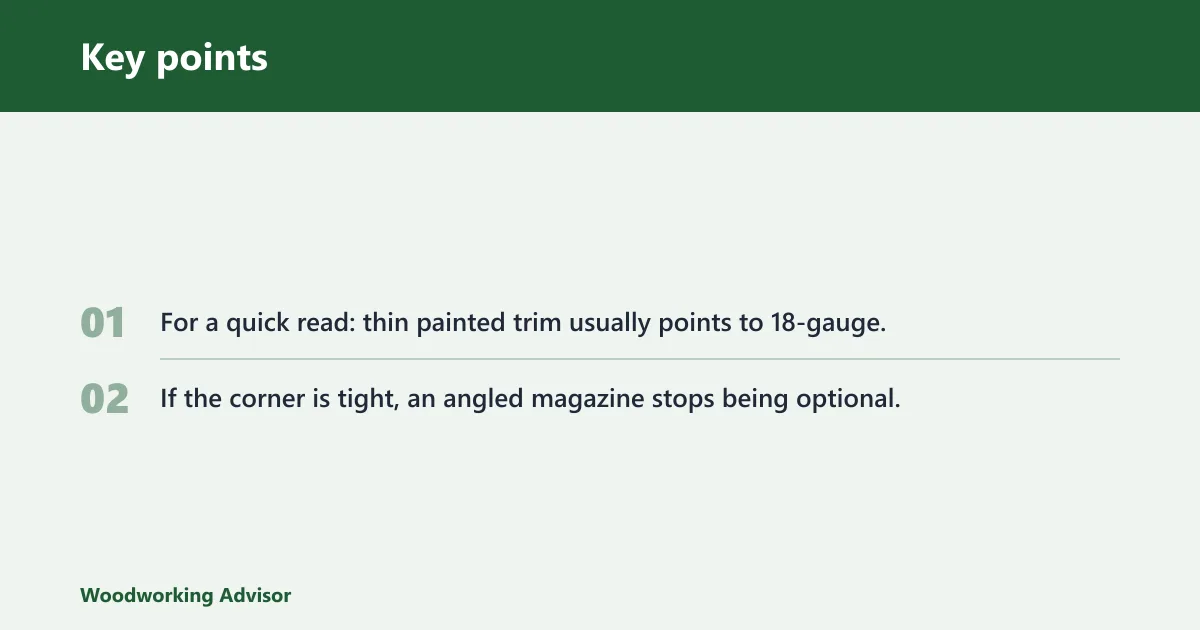
For a quick read: thin painted trim usually points to 18-gauge, but baseboards and crown often move to 16-gauge or 15-gauge once the profile gets heavier or the wood gets harder. If the corner is tight, an angled magazine stops being optional.
How to choose
Start with trim thickness. If the stock is thin, a smaller nail is easier to hide. If the stock is wide or dense, choose more holding power.
Then check the wood species. Softwood and MDF are friendlier to 16-gauge or 18-gauge tools, while hardwoods often justify 16-gauge or 15-gauge fasteners so the nails do not back out.
After that, look at access. Straight magazines fit open runs well. Angled magazines help inside corners, crown returns, and places where the tool nose fights the wall or ceiling line.
Last, choose power source based on how you work. Pneumatic tools need a compressor and hose but are lighter in the hand. Cordless tools remove the hose, but the battery adds weight and bulk.
18-gauge brad nailer: best for delicate trim
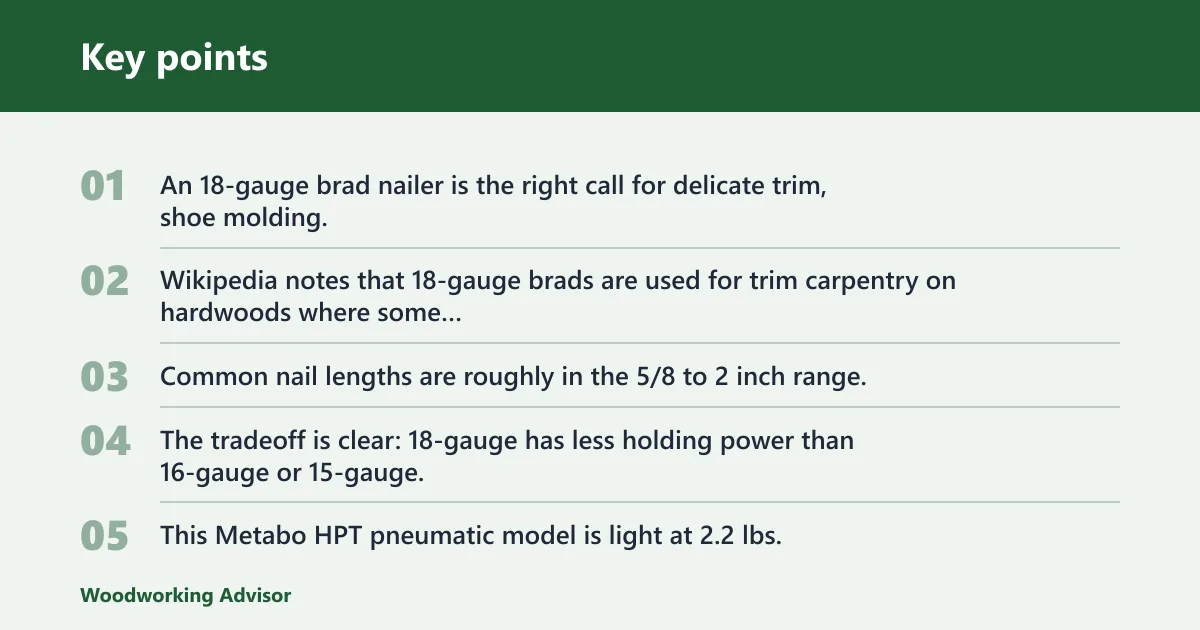
An 18-gauge brad nailer is the right call for delicate trim, shoe molding, and quarter round where small holes matter more than brute force. Wikipedia notes that 18-gauge brads are used for trim carpentry on hardwoods where some hole filling is acceptable, which makes them a fit for careful paint-grade work.
Common nail lengths are roughly in the 5/8 to 2 inch range, which can suit thinner stock and smaller profiles. The tradeoff is clear: 18-gauge has less holding power than 16-gauge or 15-gauge, so it can fall short on baseboards, wider casing, or hard maple trim.
This Metabo HPT pneumatic model is light at 2.2 lbs, and that helps on overhead or repetitive work. The drawback is the compressor and hose requirement, which limits mobility and adds setup time.
16-gauge finish nailer: best all-around trim choice
A 16-gauge finish nailer is the most versatile trim option for many DIY and pro jobs. It gives more holding power than a brad nailer, yet the holes are still easier to fill than the larger 15-gauge pattern, which is why it fits casing, baseboards, and many crown jobs.
Wikipedia states that 16 and 15 gauge finish nails are used in general fixing of softwood and MDF trim work. Bob Vila also lists a cordless 16-gauge finish nailer as best 16-gauge, and says finish nailers drive nails up to 2.5 inches long. (en.wikipedia.org)
This Senco pneumatic option is a strong value if you already have air. The drawback is the hose and compressor requirement, but that same setup usually keeps the tool lighter in hand.
15-gauge finish nailer: best for heavier trim and tight corners
A 15-gauge finish nailer is the better pick when the trim is heavier, the wood is harder, or the joint needs more bite. It makes a slightly larger hole than 16-gauge, but it also gives stronger hold, which matters on thick baseboards and crown in dense material.
15-gauge finish nailers are often angled for tight corners, and that matters more than many buyers expect. An angled magazine can keep the nose from hitting adjacent walls or the ceiling line when you are fastening crown or returning casing in a cramped corner.
This Milwaukee cordless brad nailer is not the same gauge, but it shows the cordless tradeoff clearly: no gas cartridge required and a fast fire rate, with the usual penalty of more tool weight and battery management. For 15-gauge work, the same cordless-versus-air decision still applies.
Pneumatic or cordless: which power source fits the job?
Pneumatic nail guns need an air compressor and hose, but they usually have a lighter tool body and lower upfront cost. Cordless nail guns run on batteries, remove the hose, and travel well, but they are heavier and usually cost more up front.
Bob Vila’s best bang for the buck is a pneumatic 16-gauge finish nailer, while its runner-up and best overall picks show that cordless and angled 15-gauge models have a place when mobility matters. Weight can be a real factor on overhead crown, where a 16-gauge cordless model is listed at 6 pounds 4.6 ounces, versus 4 pounds 1.5 ounces for a pneumatic 16-gauge model.
That gap matters over a long ceiling run. A heavier cordless tool is often worth it for ladder work without a hose, but if you are doing a lot of overhead trim, lighter pneumatic gear can reduce fatigue.
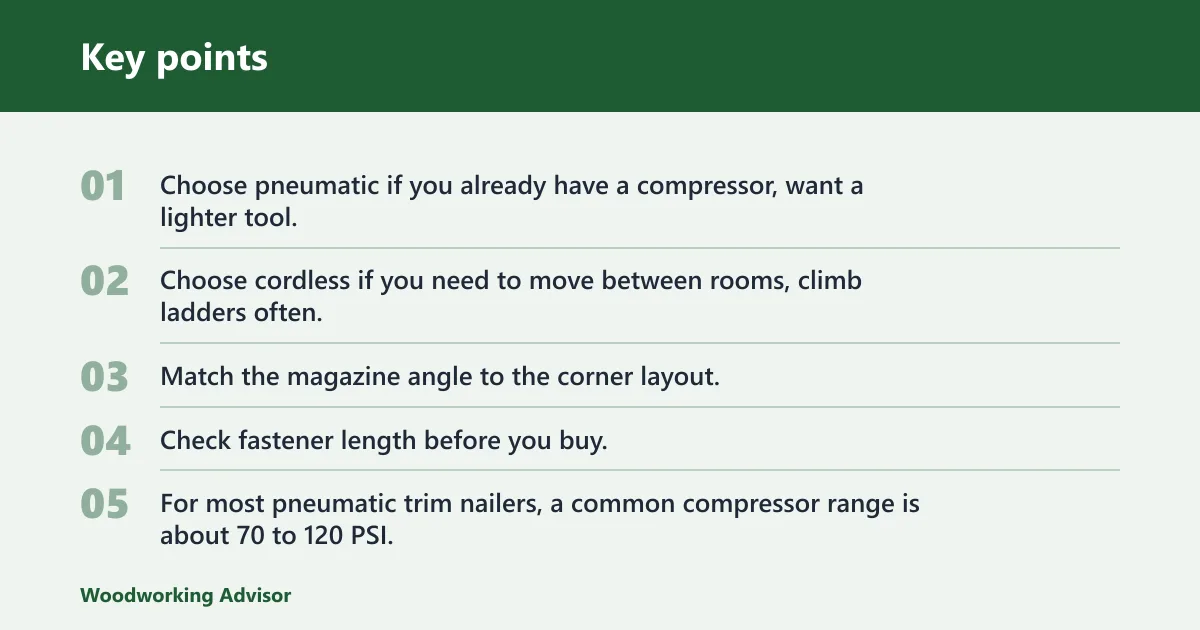
- Choose pneumatic if you already have a compressor, want a lighter tool, and will stay near the work area.
- Choose cordless if you need to move between rooms, climb ladders often, or want to avoid hose management.
- Match the magazine angle to the corner layout. Straight for open runs; angled for inside corners and crown returns.
- Check fastener length before you buy. Trim nails commonly run from 1 to 2 1/2 inches, and finish nails come in lengths between 5/8 and 2 1/2 in.
- For most pneumatic trim nailers, a common compressor range is about 70 to 120 PSI; check the tool manual before setting pressure.
Which one should you buy?
Buy the 16-gauge finish nailer if you want one tool for most baseboards, casing, and crown work. Buy 18-gauge only when the trim is thin and the holes must stay very small. Buy 15-gauge when the stock is heavier, the wood is harder, or the corners are tight.
If budget is tight and you already own an air compressor, a pneumatic tool is usually the cleaner purchase. If you move from room to room or work away from the compressor often, cordless is easier to live with despite the added weight.
For a very simple rule: delicate trim points to 18-gauge, general trim points to 16-gauge, and dense hardwood or demanding corner work points to 15-gauge with an angled magazine.
Frequently asked questions
what nail gun is best for trim
For most trim, a 16-gauge finish nailer is the best answer because it balances hole size and holding power. Use 18-gauge for delicate molding and smaller holes, then move to 15-gauge when the trim is heavier, the wood is harder, or the corner access is poor.
which nail gun for trim
Choose by trim thickness and wood hardness first, not by brand or power source. Thin shoe molding often fits 18-gauge, most baseboards and casing fit 16-gauge, and heavy hardwood trim or tight corners often call for 15-gauge, preferably with an angled magazine.
what is the best nail gun for trim work
The best single pick for trim work is usually a 16-gauge finish nailer. It is common for DIYers and pros because it gives a good mix of hold, smaller holes, and broad use across baseboards, casing, and many crown installs.
how to use a nail gun for trim
Set the depth so the head sits just below the surface without crushing the face. Match nail length to trim thickness, keep clear of knots and edges, and use enough pressure or battery power to avoid proud nails, blow-through, or sinking in soft stock.
what kind of nail gun for trim
For trim, you usually want either a brad nailer or a finish nailer. Pick brad for delicate trim and small holes. Pick finish nailers for baseboards, casing, crown, and any job where you need more holding power or longer nails.
best gauge nail gun for trim work
For most trim work, 16-gauge is the best gauge because it sits between small holes and strong hold. Use 18-gauge for thin, delicate pieces. Use 15-gauge when the trim is wider, the wood is harder, or you need extra grip at the joint.
Sponsored / affiliate links. As an Amazon Associate I earn from qualifying purchases. I may earn additional commission from eligible campaigns.